
Learning objectives / 学习目标
- 用 Einstein \(A,B\) 系数区分吸收、自发与受激辐射,并判断净吸收或净增益。
- 由速率方程解释为何两能级连续谐振泵浦不能维持反转,以及三、四能级方案如何绕开这一限制。
- 从一次往返的增益—损耗账本推出 laser threshold,并计算阈值增益。
- 区分 phase index 与 group index,计算 longitudinal modes、free spectral range、linewidth 与 coherence time。
- 用时间—频率互补解释 Q-switching 与 mode locking,并由平均功率求 pulse energy 与 peak power。
Prerequisites / 先修知识
- Coherence and Interferometry:相干时间、谱宽与干涉可见度。
- Multiple Slits and Gratings:离散共振条件与频谱选择。
- 原子能级、光子能量 \(E=h\nu=hc/\lambda_0\)、一阶常微分方程与指数增长/衰减。
Scope and conventions / 范围与约定
- 讨论半经典 laser model:介质能级量子化,腔场先按经典模处理;不量化场算符,不推导完整 master equation。
- 原子数密度为 \(N_i\),单位 \(\mathrm{m^{-3}}\);简并度为 \(g_i\)。简化例题若未说明,取 \(g_1=g_2\)。
- 光沿 \(+z\),小信号强度满足 \(dI/dz=(g-\alpha_i)I\);\(g,\alpha_i\) 的单位均为 \(\mathrm{m^{-1}}\)。
- 线形按 Lorentzian 时采用 \(\tau_c\simeq1/(\pi\Delta\nu)\);其他线形只保留数量级关系,不能机械套系数。
- 腔长为几何长度 \(L\);resonance 近似用 phase index \(n\),FSR 用 group index \(n_g\)。
- 所有示意图均为 schematic, not to scale;箭头表示过程或能流,不表示粒子真实轨迹。
Notation and modeling contract / 符号与建模契约
| Symbol | Meaning | SI unit |
|---|---|---|
| \(E_1,E_2\) | lower and upper level energies | J or eV |
| \(A_{21}\) | spontaneous-emission coefficient | \(\mathrm{s^{-1}}\) |
| \(B_{12},B_{21}\) | absorption and stimulated-emission coefficients for the stated \(\rho(\nu)\) | \(\mathrm{m^3\,J^{-1}\,s^{-2}}\) |
| \(\rho(\nu)\) | spectral energy density | \(\mathrm{J\,m^{-3}\,Hz^{-1}}\) |
| \(N_i\) | level population density | \(\mathrm{m^{-3}}\) |
| \(\Delta N\) | effective inversion density | \(\mathrm{m^{-3}}\) |
| \(\sigma(\nu)\) | stimulated transition cross section | \(\mathrm{m^2}\) |
| \(g,\alpha_i\) | gain and distributed internal loss | \(\mathrm{m^{-1}}\) |
| \(R_1,R_2\) | mirror power reflectivities | 1 |
| \(\nu_q,\Delta\nu_{FSR}\) | cavity-mode frequency and free spectral range | Hz |
| \(\Delta\nu,\tau_c\) | linewidth and coherence time | Hz, s |
| \(f_{rep},E_p,P_{peak}\) | repetition rate, pulse energy, peak power | Hz, J, W |
Knowledge 1 — Absorption, spontaneous emission, and stimulated emission / 吸收、自发与受激辐射
Knowledge ID: P05-U07-L01-K01
设两能级差满足 \(E_2-E_1=h\nu_0\)。光场在 \(\nu_0\) 附近可驱动三类过程:
- absorption:\(1\to2\),每次从场中移去一个光子;速率密度 \(R_{12}=N_1B_{12}\rho(\nu_0)\);
- spontaneous emission:\(2\to1\),无需外场触发;速率密度 \(R_{sp}=N_2A_{21}\),相位、方向和偏振通常随机;
- stimulated emission:\(2\to1\),由已有模触发;速率密度 \(R_{st}=N_2B_{21}\rho(\nu_0)\),新增辐射进入同一频率、传播模与相位关系。
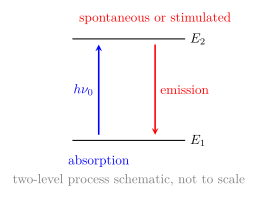
在热平衡中,下能级占据通常更大,吸收压过受激辐射。若计入简并度,Einstein relations 给
\[g_1B_{12}=g_2B_{21}.\]
在本文把 \(\rho(\nu)\) 定义为包含全部传播方向与两种偏振、每单位频率的 spectral energy density 时,另一条 detailed-balance relation 为
\[\boxed{\frac{A_{21}}{B_{21}}=\frac{8\pi h\nu_0^3}{c^3}}.\]
若改用每单位 angular frequency 的 energy density,或只统计单一方向/偏振模,\(B\) 的数值、单位表达与右端模态密度因子必须随 convention 一起转换,不能混用。
因此净受激贡献与
\[\Delta N=N_2-\frac{g_2}{g_1}N_1\]
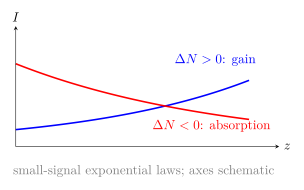
同号。\(\Delta N>0\) 才能在小信号极限提供净 stimulated gain。自发辐射不是“坏掉的受激辐射”;它既是激光起振的种子,也是 phase noise 与 fundamental linewidth 的来源。
Knowledge 2 — Population inversion and pumping / 粒子数反转与泵浦
Knowledge ID: P05-U07-L01-K02
Population inversion 指 laser transition 上能级的有效占据超过下能级,即 \(\Delta N>0\)。它不是“所有粒子都在激发态”,而是一个特定跃迁、特定简并权重下的非平衡分布。Pumping 是把外部能量送入介质的过程,可为光泵浦、电流注入、放电或化学反应。
纯两能级系统若用同一频率的连续光泵浦,吸收和受激辐射共享 Einstein coupling;强泵最终只会使两能级趋于饱和(等简并时 \(N_2\to N_1\)),不能得到稳态 \(N_2>N_1\)。三能级 laser 先泵到更高能级 \(3\),快速无辐射弛豫到 metastable level \(2\),再由 \(2\to1\) 激光跃迁。四能级 laser 的下激光能级也快速排空,因此阈值反转通常更易建立。
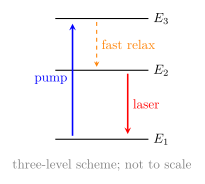
以四能级简化模型为例,反转可写成
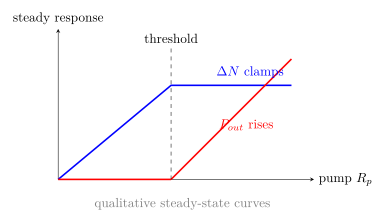
\[\frac{d\Delta N}{dt}=R_p-\frac{\Delta N}{\tau}-\sigma\Phi\Delta N,\]
其中 \(R_p\) 为有效泵浦率密度,\(\tau\) 为上能级寿命,\(\Phi\) 为腔内 photon flux。阈值以下 \(\Phi\) 小,\(\Delta N\approx R_p\tau\);阈值以上 stimulated depletion 增强,反转被 gain clamping 在阈值附近,而额外泵浦主要转成输出光。
Knowledge 3 — Optical gain and threshold / 光增益与阈值
Knowledge ID: P05-U07-L01-K03
小信号、均匀介质中,频率 \(\nu\) 的 gain coefficient 近似为
\[g(\nu)=\sigma(\nu)\Delta N, \qquad I(z)=I(0)e^{[g(\nu)-\alpha_i]z}.\]
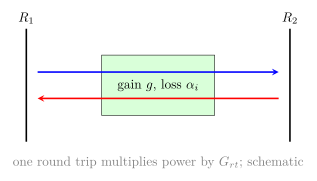
但有增益不等于已经起振。长度 \(L\) 的 linear cavity 经过一次往返,强度乘子为
\[G_{rt}=R_1R_2\exp\left[2(g-\alpha_i)L\right].\]
阈值为 \(G_{rt}=1\),因此
\[\boxed{g_{th}=\alpha_i+\frac{1}{2L}\ln\left(\frac{1}{R_1R_2}\right)}.\]
这个式子是能量账本:分布损耗和两个镜面损耗必须由一圈增益恰好补回。若介质只占腔长的一部分,应把 \(gL\) 改为对增益区的路径积分,不能把整段空腔误当 gain medium。
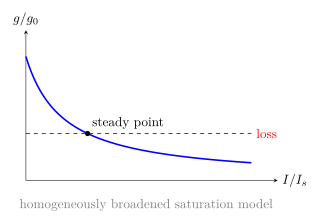
实际 gain 会随强度饱和。常用均匀展宽近似为
\[g(I)=\frac{g_0}{1+I/I_s},\]
其中 \(g_0\) 是 small-signal gain,\(I_s\) 是 saturation intensity。阈值以上,腔内强度增长使 \(g(I)\) 降到有效损耗附近,所以线性指数增长不会无限持续。
Knowledge 4 — Resonator modes, linewidth, and coherence / 谐振腔模、线宽与相干性
Knowledge ID: P05-U07-L01-K04
平面平行腔的近轴 longitudinal resonance 条件为往返相位 \(2\pi q\):
\[2n(\nu_q)L=q\lambda_0, \qquad \nu_q\simeq\frac{qc}{2nL}.\]
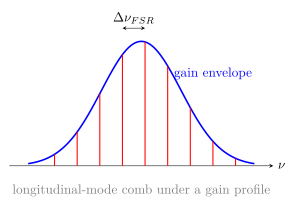
相邻模间隔需考虑色散,近似
\[\boxed{\Delta\nu_{FSR}=\frac{c}{2n_gL}}.\]
Gain bandwidth 内可能容纳许多纵模,但只有同时满足 cavity resonance、gain exceeds loss 与 transverse-mode stability 的模才能振荡。理想稳定 Gaussian resonator 还需要由镜面曲率决定的横模条件;本课不展开 ABCD stability 推导。
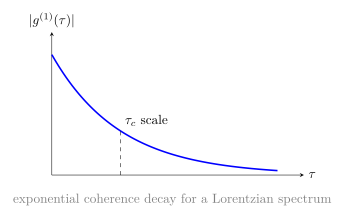
Laser 线宽来自有限 photon lifetime、spontaneous-emission phase diffusion、技术噪声与环境漂移。若功率谱近 Lorentzian,first-order coherence 的衰减给
\[\tau_c\simeq\frac{1}{\pi\Delta\nu}, \qquad L_c\simeq\frac{c\tau_c}{n_g}.\]
“laser 是单色光”只是近似;任何有限持续时间与噪声都会给非零 \(\Delta\nu\)。Cavity resonance linewidth 与 emitted laser linewidth 也不是同一概念;后者可远窄于 passive cavity resonance,但受 Schawlow–Townes 类噪声下限约束。
Knowledge 5 — Continuous-wave, pulsed, and mode-locked operation / 连续、脉冲与锁模运行
Knowledge ID: P05-U07-L01-K05
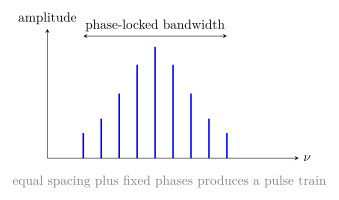
Continuous-wave (CW) laser 在稳态连续输出,速率方程达到近定常解。Q-switching 先把腔损耗维持在高值以储存反转,再迅速提高 cavity \(Q\),释放高能量、通常 ns 量级的脉冲。Mode locking 则让许多纵模的相位差固定;频域梳状线相干叠加,在时域形成周期性超短脉冲列。
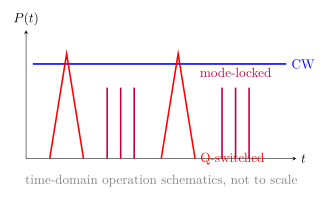
对 fundamental mode locking 且腔内每个 round trip 只有一个 pulse,若纵模间隔为 \(\Delta\nu_{FSR}\),pulse repetition rate 近似
\[f_{rep}=\Delta\nu_{FSR}, \qquad T_{rep}=\frac{1}{f_{rep}}.\]
Harmonic mode locking 或稳定的每圈多脉冲态可给 \(f_{rep}=m\Delta\nu_{FSR}\),其中 \(m\) 为正整数。
平均功率、单脉冲能量和峰值功率满足
\[E_p=\frac{P_{avg}}{f_{rep}}, \qquad P_{peak}\sim\frac{E_p}{\tau_p},\]
第二式的精确系数取决于 pulse shape。Transform-limited Gaussian pulse 的 intensity FWHM 精确满足
\[\Delta\nu\,\Delta t=0.441\ldots\simeq0.44.\]
一般 Gaussian pulse 则有 \(\Delta\nu\,\Delta t\ge0.441\)。Chirp 会让脉冲比 transform limit 更长;宽光谱是短脉冲的必要条件,但不是充分条件,频谱相位也必须合适。
Worked Examples / 完整例题
Worked Example 1 — Transition wavelength
某跃迁能量差为 \(\Delta E=1.96\,\mathrm{eV}\)。求共振真空波长。
研究对象: 单个理想原子跃迁。
系统/参考系: 原子静止系;忽略 recoil、Doppler 与 line broadening。
坐标与方向: 本题只求标量波长,无方向约定。
模型理由: 光子能量满足 \(\Delta E=hc/\lambda_0\)。
用 \(hc=1239.84\,\mathrm{eV\,nm}\):
\[\lambda_0=\frac{1239.84}{1.96}\,\mathrm{nm}=632.6\,\mathrm{nm}.\]
检查: eV 相消后得到 nm;可见红光量级合理;\(\Delta E\) 增大时 \(\lambda_0\) 变短。按三位有效数字为 \(633\,\mathrm{nm}\)。
Worked Example 2 — Laser threshold
均匀增益介质充满 \(L=0.300\,\mathrm m\) 腔,\(R_1=0.990\)、\(R_2=0.950\),内部分布损耗 \(\alpha_i=0.0100\,\mathrm{m^{-1}}\)。求阈值增益。
研究对象: 腔内沿轴传播的单一小信号模。
系统/参考系: 镜与介质静止;系统边界取一次完整往返。
坐标: \(+z\) 从 \(R_1\) 指向 \(R_2\);往返路程 \(2L\)。
模型理由: 均匀 gain/loss,镜面只以 power reflectivity 计损耗。
\[g_{th}=0.0100+\frac{1}{0.600}\ln\left(\frac{1}{0.990\times0.950}\right).\]
\[g_{th}=0.0100+0.1022=0.112\,\mathrm{m^{-1}}.\]
检查: 对数无量纲,除以长度得到 \(\mathrm{m^{-1}}\);若 \(R_1,R_2\to1\),阈值趋近 \(\alpha_i\);阈值为正且量级合理。三位有效数字。
Worked Example 3 — Cavity modes under a gain line
线性腔 \(L=0.250\,\mathrm m\)、\(n_g=1.50\),gain bandwidth 为 \(120\,\mathrm{GHz}\)。估算 FSR 与位于该带宽内的纵模数。
研究对象: 近轴 longitudinal cavity modes。
系统/参考系: 腔静止,忽略端面相位色散。
坐标: 腔轴为 \(z\)。
模型理由: 带宽远小于中心频率,取常量 \(n_g\)。
\[\Delta\nu_{FSR}=\frac{2.998\times10^8}{2(1.50)(0.250)} =3.997\times10^8\,\mathrm{Hz}.\]
即 \(\Delta\nu_{FSR}=400\,\mathrm{MHz}\)。带内间隔数约
\[N\simeq\frac{120\times10^9}{3.997\times10^8}=300.\]
检查: Hz 单位正确;腔越长 FSR 越小、容纳模越多。端点是否恰落在模上会造成约一个模的不确定性,所以报告“约 \(300\) 个”。
Worked Example 4 — Pulse energy and peak power
Mode-locked laser 的 \(P_{avg}=100\,\mathrm{mW}\)、\(f_{rep}=80.0\,\mathrm{MHz}\),Gaussian intensity pulse 的 FWHM 为 \(100\,\mathrm{fs}\)。求单脉冲能量与峰值功率。
研究对象: 稳定周期 Gaussian pulse train。
系统/参考系: 在固定输出截面测量;忽略脉冲间 pedestal。
坐标与方向: 时间零点取单脉冲峰值。
模型理由: \(P(t)=P_0\exp[-4\ln2\,t^2/\tau_{FWHM}^2]\),其积分为 \(1.0645P_0\tau_{FWHM}\)。
\[E_p=\frac{0.100}{80.0\times10^6}=1.25\times10^{-9}\,\mathrm J.\]
\[P_{peak}=\frac{E_p}{1.0645\tau_{FWHM}} =\frac{1.25\times10^{-9}}{1.0645\times100\times10^{-15}} =1.17\times10^4\,\mathrm W.\]
检查: \(\mathrm J/\mathrm s=\mathrm W\);\(12.5\,\mathrm{ns}\) 的脉冲间隔远大于 \(100\,\mathrm{fs}\),脉冲不重叠;平均仅 \(0.100\,\mathrm W\) 而峰值约 \(11.7\,\mathrm{kW}\),体现低 duty cycle。三位有效数字。
Lesson synthesis / 本课综合
建模顺序应为:先选跃迁并写微观 transition rates;再检查 pump 是否能建立 \(\Delta N>0\);把 \(g=\sigma\Delta N\) 放入一次往返增益—损耗账本求 threshold;用 cavity mode spacing 与 gain envelope 决定可振荡频率;最后由 gain saturation、损耗调制或模间相位关系判断 CW、Q-switched 或 mode-locked 输出。任何一步缺失,都不能仅凭“存在受激辐射”宣布激光起振。
Formula-and-decision table / 公式与决策表
| Need | Formula | Conditions | Main caution |
|---|---|---|---|
| photon resonance | \(E_2-E_1=h\nu_0\) | atom at rest, specified transition | broadening shifts/spreads resonance |
| effective inversion | \(\Delta N=N_2-(g_2/g_1)N_1\) | Einstein degeneracy convention | \(N_2>N_1\) alone may be insufficient |
| small-signal gain | \(g=\sigma\Delta N\) | unsaturated homogeneous slice | \(\sigma\) depends on frequency |
| threshold | \(g_{th}=\alpha_i+(2L)^{-1}\ln[1/(R_1R_2)]\) | gain fills length \(L\) | use power, not amplitude, reflectivity |
| FSR | \(\Delta\nu_{FSR}=c/(2n_gL)\) | weak variation across one FSR | resonance itself uses phase index |
| coherence time | \(\tau_c\simeq1/(\pi\Delta\nu)\) | Lorentzian spectrum | coefficient changes with line shape |
| pulse energy | \(E_p=P_{avg}/f_{rep}\) | one pulse per period | account for multiple pulses if present |
| peak power | \(P_{peak}\sim E_p/\tau_p\) | stated pulse-shape convention | exact shape factor matters |
Model boundaries / 模型边界
- Einstein rate model ignores coherent Rabi oscillations and density-matrix effects; strong ultrafast driving needs optical Bloch equations.
- Two-level no-inversion result assumes continuous resonant pumping through the same transition; transient coherent control or multilevel pathways lie outside that claim。
- \(g=\sigma\Delta N\) is small-signal and local; spatial hole burning、inhomogeneous broadening and gain competition alter multimode behavior。
- Plane-parallel threshold formula omits diffraction、output coupling phase、standing-wave pattern and transverse overlap; partial gain filling requires an overlap factor。
- \(\tau_c=1/(\pi\Delta\nu)\) assumes a Lorentzian spectrum and stationary statistics。
- Fourier time-bandwidth product only bounds transform-limited pulses; chirp and higher-order spectral phase lengthen them。
- “Mode locking” is not merely “many modes oscillate”; their relative phases must be stabilized。
Misconception clinic / 误区诊所
- “受激辐射一出现就会激光。” 只有 round-trip gain 至少补偿全部损耗才起振。
- “粒子数反转是所有原子都在上能级。” 它是特定跃迁上按简并修正后的相对占据条件。
- “强光可把理想两能级连续泵到 \(N_2>N_1\)。” 同一光场也同样增强受激向下跃迁,稳态趋于饱和而非反转。
- “Laser 完全单色、相干长度无限。” 自发辐射和技术噪声必给有限线宽。
- “宽光谱自动产生短脉冲。” 还需受控的谱相位;随机相位只给起伏的连续场。
Practice and retrieval / 练习与提取
- K01: \(\Delta E=2.48\,\mathrm{eV}\) 的跃迁对应何种真空波长?
Answer
\[\lambda_0=\frac{1239.84}{2.48}\,\mathrm{nm}=500\,\mathrm{nm}.\]
- K01: 为什么自发辐射既有帮助又造成噪声?
Answer
它向空腔模提供最初光子,帮助从零场起振;但随机发射时刻和相位造成 phase diffusion,贡献有限 linewidth 与强度噪声。
- K02: 等简并两能级在强连续共振泵浦下可达到的饱和占据关系是什么?
Answer
吸收和受激辐射趋于平衡,\(N_2\to N_1\);不能维持 \(N_2>N_1\)。
- K02: 为什么四能级 laser 通常比三能级 laser 更易起振?
Answer
四能级的下激光能级迅速排空,使 \(N_1\) 很小;只需较少上能级粒子即可形成 \(\Delta N>0\)。
- K03: \(L=0.50\,\mathrm m\)、\(R_1=R_2=0.98\)、\(\alpha_i=0\) 时求 \(g_{th}\)。
Answer
\[g_{th}=\frac{1}{1.00}\ln\left(\frac{1}{0.98^2}\right) =0.0404\,\mathrm{m^{-1}}.\]
- K03: 若 gain medium 只占腔长的四分之一,可否仍把整腔 \(L\) 代入 \(e^{2gL}\)?
Answer
不可。增益指数应取 \(2\int_{gain}g(z)\,dz\);均匀时使用实际 gain length,而分布损耗仍沿各自所在路径积分。
- K04: 空气腔 \(L=0.750\,\mathrm m\) 的 FSR 约多少?
Answer
取 \(n_g\simeq1\): \[\Delta\nu_{FSR}=\frac{2.998\times10^8}{1.50} =2.00\times10^8\,\mathrm{Hz}=200\,\mathrm{MHz}.\]
- K04: Lorentzian linewidth \(\Delta\nu=2.00\,\mathrm{MHz}\) 时,估算真空 coherence length。
Answer
\[\tau_c=\frac{1}{\pi\Delta\nu}=159\,\mathrm{ns}, \qquad L_c=c\tau_c=47.7\,\mathrm m.\]
- K05: \(P_{avg}=2.00\,\mathrm W\)、\(f_{rep}=100\,\mathrm{kHz}\),求 pulse energy。
Answer
\[E_p=\frac{2.00}{1.00\times10^5}=20.0\,\mu\mathrm J.\]
- K05: Transform-limited Gaussian pulse 的光谱 FWHM 为 \(5.00\,\mathrm{THz}\),最短 intensity FWHM 为多少?
Answer
\[\Delta t_{min}=\frac{0.44}{5.00\times10^{12}} =8.80\times10^{-14}\,\mathrm s=88.0\,\mathrm{fs}.\]
Exit ticket / 离堂检核
- 用一句话分别说明 inversion、threshold 与 saturation 的不同角色,并写出连接它们的两个核心方程。
- 某 laser 有宽增益谱但只输出单一窄线;列出至少两种可能的 cavity/selective mechanism,并指出“宽增益谱”为何不等同“宽输出谱”。
References and source notes / 参考资料与来源说明
Source-to-content map
| Source | Used for | Knowledge ID / section | Model boundary or convention |
|---|---|---|---|
| OpenStax University Physics Vol. 3, 8.6 Lasers | stimulated emission, inversion, gain medium and feedback | K01–K02 | introductory semi-classical picture |
| University of Illinois ECE 460, Lecture 1: Light Emission, Detection, and Statistics | Einstein processes, gain, threshold and laser kinetics | K01–K03 | rate-equation conventions made explicit in this note |
| MIT OCW 6.974, Fundamentals of Photonics full class notes | resonators, modes, lasers and integrated-optics context | K03–K05 | uses complex-field conventions that may differ by sign |
| NIST, Optical Frequency Combs | mode locking, comb spacing and time–frequency interpretation | K05 | overview source; pulse-shape coefficients checked independently |
资料实际打开核对日期:2026-08-29。四个核心直接来源均成功打开;正文重新组织,图示由本文方程原创,例题与练习独立复算。
复习与拓展
- Optical Fibers and Waveguides:把 laser 输出耦合到受限传播模并分析损耗和色散。
- Nonlinear and Integrated Photonics:短脉冲高峰值场驱动 \(\chi^{(2)}\)、\(\chi^{(3)}\) 过程。
- Quantum optics:spontaneous emission、coherent states 与 Schawlow–Townes linewidth 的量子推导。
- Laser engineering:ABCD stability、Gaussian eigenmodes、thermal lensing、Q-switch 与 mode-locker 实现。