
Learning objectives / 学习目标
- 用 Schwarzschild 一阶修正计算轨道每周的 perihelion advance,并把结果转换为每世纪角秒。
- 区分 light deflection、thin-lens equation、Einstein angle 与 magnification 的适用层级。
- 解释并估算 Shapiro delay 与 gravitational frequency shift,明确其观测者和几何路径。
- 分别计算 GPS 卫星钟的 gravitational 与 special-relativistic correction,并说明还需处理 Sagnac effect。
- 说明 pulsar timing 如何同时约束质量、轨道进动、时间延迟与 gravitational-wave damping。
Prerequisites / 先修知识
- Equivalence and Curved Spacetime:metric、geodesic、弱场钟速。
- Orbits and Kepler's Laws:椭圆轨道、半长轴 \(a\)、偏心率 \(e\)、周期。
- Lenses and Optical Systems:小角近似与成像几何。
- Time, Length, and Simultaneity:kinematic time dilation。
Scope and conventions / 范围与约定
- 主要采用 Schwarzschild 外部、弱场一阶近似:\(GM/(rc^2)\ll1\);中心天体自旋、四极矩、等离子体延迟等效应需另加模型。
- 轨道进动取 prograde 为正;\(\Delta\varpi\) 表示每个 radial period 的 periapsis advance。
- 光线偏折角 \(\hat\alpha\) 是 lens plane 附近的总偏折;\(\beta\) 是真实源角,\(\theta\) 是像角。
- Shapiro delay 是相对平直时空同端点传播时间的额外量,不是说局部光速小于 \(c\)。
- GPS 数值以 geoid reference clock 为基准,先展示 spherical-Earth leading terms;实际导航使用规定的 coordinate time、地球自转与钟差模型。
- binary pulsar formulas 在 point-mass、weak radiation-reaction 的 post-Newtonian 框架中使用。
Notation and modeling contract / 符号与建模契约
| Symbol | Meaning | SI unit |
|---|---|---|
| \(M\) | central or lens mass | kg |
| \(a,e\) | semimajor axis, eccentricity | m, 1 |
| \(\Delta\varpi\) | periapsis advance per orbit | rad |
| \(b\) | impact parameter | m |
| \(D_L,D_S,D_{LS}\) | observer–lens, observer–source, lens–source distances | m |
| \(\theta_E\) | Einstein angle | rad |
| \(\Delta t_S\) | Shapiro excess propagation time | s |
| \(R_\oplus,r_{GPS}\) | reference Earth radius, GPS orbital radius | m |
| \(P_b,\dot P_b\) | binary orbital period and its derivative | s, 1 |
| \(m_1,m_2\) | binary component masses | kg |
Knowledge 1 — Perihelion precession / 近日点进动
Knowledge ID: P06-U05-L02-K01
Newtonian inverse-square two-body orbit is a closed ellipse when perturbations are absent。Schwarzschild geodesic adds a small relativistic correction. 对 test particle 定义 \(u=1/r\),一阶轨道方程可写
\[\frac{d^2u}{d\phi^2}+u =\frac{GM}{h^2}+\frac{3GM}{c^2}u^2,\]
其中 \(h\) 是单位质量角动量。最后一项使 radial oscillation 与 azimuthal angle 不再严格同周期,近日点每周向前移动
\[\boxed{ \Delta\varpi =\frac{6\pi GM}{a(1-e^2)c^2} }.\]
公式适用于 \(GM/[a(1-e^2)c^2]\ll1\) 的 test-body orbit。实际行星的 observed residual 还需先减去其他行星摄动、太阳四极矩与参考系效应。
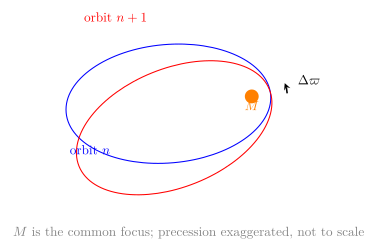
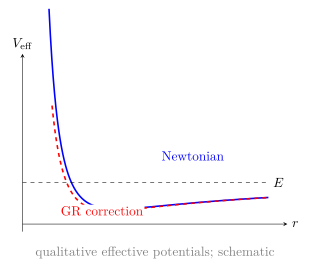
可把修正理解为 effective radial potential 对近心点附近运动的非线性改变;它不是椭圆整体像刚体被外力矩匀速旋转。
Knowledge 2 — Deflection of light and gravitational lensing / 光线偏折与引力透镜
Knowledge ID: P06-U05-L02-K02
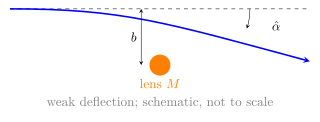
光沿 null geodesic。对于点质量或球对称质量外部、impact parameter \(b\gg r_s\),总偏折角为
\[\boxed{ \hat\alpha=\frac{4GM}{bc^2} }.\]
只用“光具有等效质量并服从 Newtonian attraction”会得到一半;GR 中时间与空间 metric components 都参与。局部始终测得光速 \(c\),偏折是 global path geometry 的结果。
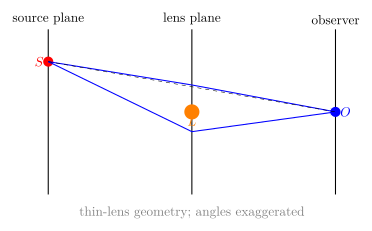
在 thin-lens、小角近似中,lens equation 为
\[\beta=\theta-\frac{D_{LS}}{D_S}\hat\alpha(D_L\theta).\]
点质量代入 \(b\approx D_L\theta\) 得
\[\beta=\theta-\frac{\theta_E^2}{\theta}, \qquad \theta_E= \sqrt{\frac{4GM}{c^2}\frac{D_{LS}}{D_LD_S}}.\]
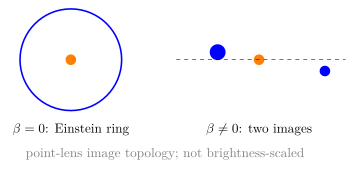
当 \(\beta=0\) 且轴对称时,像成为 Einstein ring;非完美对准产生两个点像。扩展源、扩展 lens mass distribution 需要 surface mass density 与 lensing potential。
Knowledge 3 — Shapiro delay and gravitational frequency shifts / 夏皮罗延迟与引力频移
Knowledge ID: P06-U05-L02-K03
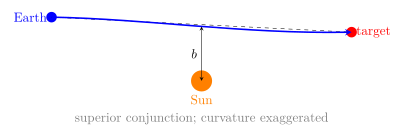
当 radar signal 掠过质量 \(M\) 时,curved spacetime 中的 coordinate travel time 比同端点平直模型更长。远端距离为 \(r_1,r_2\)、最近掠过距离为 \(b\),superior-conjunction 近似的一程 delay 为
\[\boxed{ \Delta t_S\approx\frac{2GM}{c^3} \ln\left(\frac{4r_1r_2}{b^2}\right) }.\]
对双程 radar echo 再乘约 \(2\);精确分析必须用 ephemeris、太阳系多体 metric、plasma delay 与仪器延迟共同拟合。
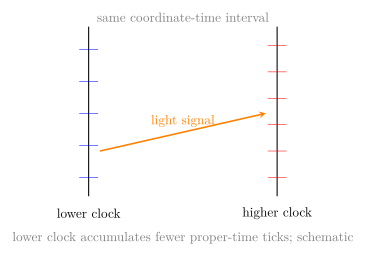
gravitational frequency shift 比较不同 gravitational potential 上的 clocks。定义 \(\Delta\Phi=\Phi_R-\Phi_E\)、\(\Delta\nu=\nu_R-\nu_E\),其中 \(E\) 是 emitter、\(R\) 是 receiver:
\[\frac{\Delta\nu}{\nu}\approx-\frac{\Delta\Phi}{c^2}.\]
它与 Shapiro delay 不同:前者主要是 clock-rate comparison,后者是 signal propagation time。实际 tracking observables 常把 clock、path、source motion 统一到一个 coordinate model 中。
Knowledge 4 — GPS relativistic corrections / GPS 相对论修正
Knowledge ID: P06-U05-L02-K04
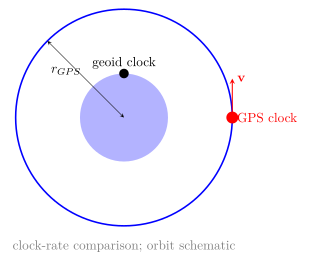
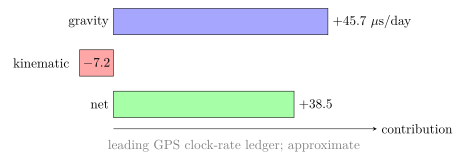
GPS 卫星钟处在更高的 Earth gravitational potential,同时相对地面钟运动。以 reference geoid 上的理想钟为基准,leading fractional rates 为
\[\left(\frac{\Delta\dot\tau}{\dot t}\right)_{grav} \approx\frac{GM_\oplus}{c^2} \left(\frac1{R_\oplus}-\frac1{r_{GPS}}\right)>0,\]
\[\left(\frac{\Delta\dot\tau}{\dot t}\right)_{kin} \approx-\frac{v_{GPS}^2}{2c^2}<0.\]
对 circular orbit,\(v_{GPS}=\sqrt{GM_\oplus/r_{GPS}}\)。典型 leading contributions 约为 gravitational \(+45.7\ \mathrm{\mu s/day}\) 与 kinematic \(-7.2\ \mathrm{\mu s/day}\),净值约 \(+38.5\ \mathrm{\mu s/day}\)。系统通过 onboard frequency offset 与 navigation-message model,避免这项 secular drift 作为未建模的 range error 累积。
Earth rotation 还产生 Sagnac correction:在 Earth-fixed rotating frame 中,coordinate propagation time 取决于 signal path orientation。因此,“每天加一次 \(38\ \mathrm{\mu s}\)”并不是完整 receiver algorithm;satellite ephemerides、eccentricity corrections、ionosphere/troposphere、hardware delays 与 clock estimation 都要纳入。
Knowledge 5 — Binary-pulsar tests / 双星脉冲星检验
Knowledge ID: P06-U05-L02-K05
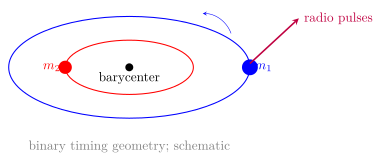
pulsar 可视作稳定的 rotating clock,其 pulse time of arrival 可在整个 binary orbit 上建模。除 Keplerian parameters 外,post-Keplerian observables 包括
- periastron advance \(\dot\omega\);
- combined gravitational redshift and second-order Doppler parameter \(\gamma_{PK}\);
- Shapiro range and shape parameters;
- orbital-period derivative \(\dot P_b\) from energy carried by gravitational radiation.
若在某理论中两个独立 post-Keplerian parameters 已确定 \(m_1,m_2\),额外参数就会 overconstrain 同一组质量,从而成为真正的理论检验。
For an approximately circular binary, quadrupole radiation gives
\[\dot P_b =-\frac{192\pi}{5} \left(\frac{2\pi G\mathcal M}{c^3P_b}\right)^{5/3},\]
where chirp mass
\[\mathcal M=\frac{(m_1m_2)^{3/5}}{(m_1+m_2)^{1/5}}.\]
Eccentric systems require a multiplicative enhancement factor depending on \(e\). The negative sign means the orbit loses energy and its period shrinks.
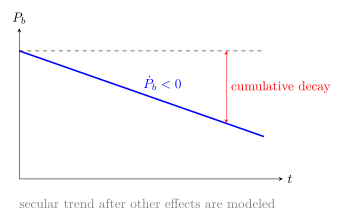
Observed \(\dot P_b\) must be corrected for relative acceleration in the Galaxy, proper-motion bias and other kinematic effects before comparison with intrinsic GR damping.
Worked Examples / 完整例题
Example 1 — Mercury 的 relativistic perihelion advance
已知: \(M_\odot=1.9885\times10^{30}\ \mathrm{kg}\),\(a=5.7909\times10^{10}\ \mathrm{m}\),\(e=0.2056\),Mercury period \(P=87.969\ \mathrm{day}\)。
系统与参考系: Sun–Mercury test-body approximation,heliocentric asymptotically inertial frame;prograde 为正。
模型理由: \(M_{Mercury}\ll M_\odot\),且 \(GM_\odot/[a(1-e^2)c^2]\ll1\)。
\[\Delta\varpi =\frac{6\pi GM_\odot}{a(1-e^2)c^2} =5.02\times10^{-7}\ \mathrm{rad/orbit}.\]
用 \(1\ \mathrm{rad}=206265\) arcsec:
\[\Delta\varpi=0.1035\ \mathrm{arcsec/orbit}.\]
一百年约有 \(36525/87.969=415.2\) 周,因此
\[\Delta\varpi_{century}\approx43.0\ \mathrm{arcsec/century}.\]
量纲无量纲;\(c\to\infty\) 时进动消失。该值是 Schwarzschild leading term,不等于未经建模的总观测进动。
Example 2 — 掠过太阳边缘的光线偏折
已知: impact parameter \(b=R_\odot=6.957\times10^8\ \mathrm{m}\)。
研究对象: 太阳外部的 null ray;Sun 近似球对称静态。
坐标与方向: 偏折向太阳为正。
\[\hat\alpha =\frac{4GM_\odot}{R_\odot c^2} =8.49\times10^{-6}\ \mathrm{rad}.\]
\[\hat\alpha=(8.49\times10^{-6})(206265) =1.75\ \mathrm{arcsec}.\]
偏折很小,支持 weak-deflection approximation。若 \(b\) 增大一倍,角度减半;方向指向 lens。这里忽略太阳等离子体造成的 frequency-dependent bending。
Example 3 — Earth–Mars superior conjunction 的一程 Shapiro delay
已知: 近似 \(r_1=1.00\ \mathrm{AU}\)、\(r_2=1.52\ \mathrm{AU}\)、\(b=R_\odot\);\(GM_\odot/c^3=4.9255\ \mathrm{\mu s}\),\(1\ \mathrm{AU}/R_\odot\approx215.0\)。
系统与参考系: heliocentric static Schwarzschild leading term;仅算一程 geometric excess。
模型理由: \(r_1,r_2\gg b\gg r_s\)。
\[\frac{4r_1r_2}{b^2} \approx4(1.00)(1.52)(215.0)^2 =2.81\times10^5,\]
\[\Delta t_S \approx2(4.9255\ \mathrm{\mu s})\ln(2.81\times10^5) =124\ \mathrm{\mu s}.\]
双程量约 \(248\ \mathrm{\mu s}\),但真实 conjunction 需用实际 geometry、planetary motion 和 solar-plasma correction。对数必须作用于无量纲比值。
Example 4 — GPS satellite clock 的 leading net rate
已知: \(GM_\oplus=3.9860\times10^{14}\ \mathrm{m^3\,s^{-2}}\),\(R_\oplus=6.378\times10^6\ \mathrm{m}\),\(r=2.656\times10^7\ \mathrm{m}\),一天 \(T=86400\ \mathrm{s}\)。
系统与参考系: circular-orbit satellite clock relative to ideal geoid clock;先忽略 Earth rotation。
模型理由: weak field and \(v/c\ll1\)。
\[\delta_g =\frac{GM_\oplus}{c^2}\left(\frac1{R_\oplus}-\frac1r\right) =5.28\times10^{-10},\]
\[\Delta\tau_g=T\delta_g=45.6\ \mathrm{\mu s/day}.\]
轨道速度
\[v=\sqrt{\frac{GM_\oplus}{r}}=3.87\times10^3\ \mathrm{m\,s^{-1}},\]
\[\delta_k=-\frac{v^2}{2c^2}=-8.35\times10^{-11}, \qquad \Delta\tau_k=-7.21\ \mathrm{\mu s/day}.\]
\[\Delta\tau_{net}=+38.4\ \mathrm{\mu s/day}.\]
正号说明卫星钟相对 geoid clock 较快。若忽略此项,按 \(c\Delta t\) 换算的日累积量级为 \(11.5\ \mathrm{km}\),说明 correction 不可选;这不是实际定位误差的简单逐日公式,因为系统会持续估计钟差。
Lesson synthesis / 全课综合
| Observable | Geometry acts on | Leading signature | Main nuisance model |
|---|---|---|---|
| perihelion advance | timelike orbit | \(\Delta\varpi>0\) | planetary perturbations, multipoles |
| light deflection/lensing | null path | angular shift, multiple images | lens mass distribution, plasma |
| Shapiro delay | null travel time | logarithmic excess delay | ephemeris, plasma, hardware |
| GPS clock rate | proper time | gravity plus kinematic correction | rotation, orbit, atmosphere |
| binary pulsar timing | orbit and pulse propagation | multiple post-Keplerian parameters | Galactic and proper-motion biases |
共同方法不是“看见某个数接近预测”而已,而是:明确 observable → 建立 GR prediction 与 nuisance model → 独立标定仪器和环境 → 用多参数或多系统交叉约束。
Formula-and-decision table / 公式—决策表
| Need | Formula | Conditions | Diagnostic check |
|---|---|---|---|
| 每周近日点进动 | \(\Delta\varpi=6\pi GM/[a(1-e^2)c^2]\) | weak Schwarzschild, test body | \(c\to\infty\) gives zero |
| 单次弱偏折 | \(\hat\alpha=4GM/(bc^2)\) | spherical lens, \(b\gg r_s\) | scales as \(1/b\) |
| 点质量 Einstein angle | \(\theta_E^2=(4GM/c^2)D_{LS}/(D_LD_S)\) | thin lens, small angles | angle is dimensionless |
| conjunction delay | \(\Delta t_S\approx(2GM/c^3)\ln(4r_1r_2/b^2)\) | far endpoints, weak field | log argument dimensionless |
| satellite gravitational rate | \(\delta_g=(GM/c^2)(1/R-1/r)\) | spherical static weak field | higher clock is faster |
| circular-orbit kinematic rate | \(\delta_k=-v^2/(2c^2)\) | \(v/c\ll1\) | moving clock is slower |
| circular binary damping | \(\dot P_b=-(192\pi/5)(2\pi G\mathcal M/c^3P_b)^{5/3}\) | circular, quadrupole leading order | negative sign |
Model boundaries / 模型边界
- 行星公式只给 Schwarzschild contribution;solar oblateness、frame dragging 与多体扰动可在更高精度显现。
- \(\hat\alpha=4GM/(bc^2)\) 是弱、点状或球对称 lens 的外部结果;strong lensing near photon orbit requires exact geodesics。
- thin-lens equation 把偏折压缩到一个平面,不能自动描述 wave optics、microlensing finite-source effects 或复杂 mass maps。
- Shapiro delay 是 coordinate-model observable difference;实验测的是 pulse/radar arrival time,必须连同 clock and ephemeris model。
- GPS 的 \(+38.4\ \mathrm{\mu s/day}\) 是 leading clock-rate summary,不替代完整 relativistic coordinate and signal-propagation model。
- binary quadrupole formula 的 circular form 不可直接用于高偏心系统;观测 \(\dot P_b\) 要减除 kinematic contamination。
Misconception clinic / 误区诊所
- “Mercury 的整个近日点进动都是 GR。” 大部分来自 Newtonian planetary perturbations;GR 解释的是正确建模后的 residual leading contribution。
- “光弯曲是因为 photon 有静质量。” photon 的 invariant mass 为零;它沿 curved spacetime 的 null geodesic。
- “gravitational lens 像玻璃透镜一样只形成一个倒像。” 点 lens 通常形成两个像;完美对准形成 ring,复杂 lens 可有更多像与 shear。
- “Shapiro delay 证明局部光速小于 \(c\)。” 局部惯性观察者仍测 \(c\);delay 比较的是全局路径与坐标时间。
- “卫星运动更快,所以 GPS clock 一定更慢。” kinematic term 为负,但 higher-potential gravitational term 更大且为正。
- “只要把 GPS clock 每天加 \(38\ \mu s\) 就完成相对论修正。” 实际系统还含预置频率、轨道偏心、Sagnac、信号路径与 clock estimation。
- “一个 pulsar 参数符合就验证了 GR。” 强测试来自多个 post-Keplerian parameters 在同一质量解上的交叉一致。
Practice and retrieval / 练习与提取
- 若轨道 \(a\) 不变而 \(e\) 从 \(0\) 增到 \(0.8\),GR periapsis advance 放大多少倍?
- 质量为太阳两倍、impact parameter 为太阳半径两倍的球对称 lens,偏折相对 solar-limb case 如何?
- 写出 point-lens equation 的两根 \(\theta_\pm\),并说明 \(\beta\to0\) 时为何不能把两像简单说成同一点。
- lens mass 增大四倍,固定 distances 时 \(\theta_E\) 如何变化?
- Shapiro 公式中若 \(b\) 增大两倍,delay 改变量是多少?
- 两只地面钟的势差 \(\Delta\Phi=1000\ \mathrm{m^2\,s^{-2}}\),一天相差多少?
- 只保留 GPS 的 \(-7.2\ \mathrm{\mu s/day}\) 会把净方向判断成什么?为什么错?
- 用 Example 4 的 \(38.4\ \mathrm{\mu s/day}\) 估算未经校正的一天 light-travel range scale。
- circular binary 若 chirp mass 不变而 \(P_b\) 减半,\(\lvert\dot P_b\rvert\) 放大多少?
- 为什么 observed binary \(\dot P_b\) 不能不经 Galactic acceleration correction 就直接与 quadrupole formula 比较?
Answers / 答案
1. 因子 \(1/(1-e^2)\);从 \(e=0\) 到 \(0.8\) 放大为 \(1/(1-0.64)=2.78\)。
2. \(\hat\alpha\propto M/b\),\(M\) 与 \(b\) 都乘 \(2\),所以相同。
3. \(\theta_\pm=[\beta\pm\sqrt{\beta^2+4\theta_E^2}]/2\)。\(\beta\to0\) 时方位角简并,轴对称的一整圈方向构成 Einstein ring。
4. \(\theta_E\propto\sqrt M\),所以增大为 \(2\) 倍。
5. \(\Delta t'_S-\Delta t_S=(2GM/c^3)\ln(1/4)=-(4GM/c^3)\ln2\);掠距变大,delay 减小。
6. \(\Delta\tau=T\Delta\Phi/c^2=9.61\times10^{-10}\ \mathrm{s}=0.961\ \mathrm{ns}\),高势钟较快。
7. 会误判 satellite clock 较慢;错误在于漏掉约 \(+45.7\ \mathrm{\mu s/day}\) 的 gravitational term。
8. \(c\Delta t=(2.998\times10^8)(38.4\times10^{-6})=1.15\times10^4\ \mathrm{m}\),约 \(11.5\ \mathrm{km}\)。
9. \(\lvert\dot P_b\rvert\propto P_b^{-5/3}\),故放大 \(2^{5/3}=3.17\)。
10. 系统相对太阳系的 Galactic acceleration 和 transverse proper motion also change apparent orbital period; only intrinsic \(\dot P_b\) tests radiation damping。
Exit ticket / 离堂检验
- 任选 Shapiro delay 与 GPS correction,说明各自“真正测到的 observable”、必须扣除的一项环境效应,以及 leading GR formula。
- 为什么 binary pulsar 的第三个 post-Keplerian parameter 比第一个更像“检验”而不是“参数测量”?
References and source notes / 参考资料与来源说明
- Einstein Online, Tests of general relativity: classical — perihelion advance、light deflection、gravitational redshift 的经典检验框架;核对于 2026-08-29。
- Einstein Online, A Test Bed for the General Theory of Relativity — solar-system tests and timing context;核对于 2026-08-29。
- MIT OpenCourseWare 8.033, Full Lecture Notes: Introduction to Relativity and Spacetime Physics — Schwarzschild geodesic predictions, redshift and tests;核对于 2026-08-29。
- NIST, Global Positioning System Receivers and Relativity — GPS clock and signal relativistic corrections;核对于 2026-08-29。
- Shapiro et al., Mercury's perihelion advance — Determination by radar, Physical Review Letters 28, 1594 (1972), DOI 10.1103/PhysRevLett.28.1594 — Mercury radar ranging and historical relativity-test context;核对于 2026-08-29。
- Max Planck Institute for Radio Astronomy, The Double Pulsar—Tests of General Relativity — multi-parameter binary-pulsar tests;核对于 2026-08-29。
- Max Planck Institute for Radio Astronomy, Fundamental Forces—Binary Pulsars — pulsar timing, relativistic gravity and orbital decay;核对于 2026-08-29。
所有示意图均按本课方程原创绘制,没有复制来源图。数值例题独立复算;来源用于核验公式、实验语境与模型边界。
Source-to-content map
| Source | Used for | Knowledge ID / Section | Model boundary or convention |
|---|---|---|---|
| Einstein Online classical tests | classical solar-system predictions | K01–K03 | leading weak-field effects |
| Einstein Online test bed | observational strategy | synthesis, K03 | compare observables with nuisance models |
| MIT 8.033 full notes | derivations and consistency | K01–K03 | Schwarzschild exterior, chosen sign convention |
| NIST GPS publication | GPS rates and receiver modeling | K04, Example 4 | geoid reference and rotating-Earth corrections |
| Shapiro et al. Mercury radar | ranging-test context | K01 | historical direct data source |
| MPIfR Double Pulsar | multiple post-Keplerian tests | K05 | observed system requires timing model |
| MPIfR Fundamental Forces | orbital decay and pulsar timing | K05 | kinematic corrections separated |
复习与拓展
- Lesson 6.5.3 将从 weak-field tests 过渡到 horizons、strong-field orbits 与 direct gravitational-wave detection。
- 与 Orbits and Kepler's Laws 对照:封闭 Kepler ellipse 是 Newtonian limit,precession 是 relativistic correction。
- 可扩展:PPN formalism、frame dragging、VLBI light deflection、space-clock redshift missions 与 pulsar timing arrays。