
Learning objectives / 学习目标
- 读写 Schwarzschild metric,解释 \(r_s\)、event horizon、coordinate singularity 与 curvature singularity 的区别。
- 计算 photon sphere、ISCO 与 static gravitational redshift,并指出这些公式对观察者和轨道类型的限制。
- 用 \(M,J,Q\) 描述 stationary black hole,计算 dimensionless spin 并判断 Kerr–Newman horizon condition。
- 在线性化近似中说明 Lorenz gauge、TT polarizations、quadrupole radiation 与传播速度。
- 把 strain 与 interferometer differential arm length 相联,并从 compact-binary chirp 解释为何频率与振幅同时上升。
Prerequisites / 先修知识
- Equivalence and Curved Spacetime:metric、curvature、geodesic 与 field equation。
- Tests and Applications of General Relativity:light propagation、timing 与 binary damping。
- Superposition and Interference:Michelson interference 与 phase difference。
- Energy, Momentum, and Reactions:relativistic energy and invariant mass。
Scope and conventions / 范围与约定
- 度规号差 \((-,+,+,+)\);Schwarzschild coordinates 为 \((t,r,\theta,\phi)\),\(d\Omega^2=d\theta^2+\sin^2\theta\,d\phi^2\)。
- \(r\) 是 areal radius:对称二球面积为 \(4\pi r^2\);它不是嵌入图上的普通径向距离。
- \(r_s=2GM/c^2\)。Event horizon 的严格定义是不能向 future null infinity 发送信号的区域边界,具有 global causal 性质。
- Kerr 参数 \(a_K=J/(Mc)\) 取长度单位;dimensionless spin \(\chi=cJ/(GM^2)=a_Kc^2/(GM)\)。
- 线性化写 \(g_{\mu\nu}=\eta_{\mu\nu}+h_{\mu\nu}\) 且 \(\lvert h_{\mu\nu}\rvert\ll1\);detector scalar strain 另记为 \(h_{\rm det}\),不与 perturbation trace \(h\) 混用。
- 干涉仪示意采用平面波沿 \(+z\)、plus polarization 主轴沿 \(x,y\);实际 detector response 含 sky position、polarization angle 与 antenna pattern。
- 本课不推导完整 Kerr metric、black-hole thermodynamics 或 quantum Hawking radiation。
Notation and modeling contract / 符号与建模契约
| Symbol | Meaning | SI unit |
|---|---|---|
| \(r_s\) | Schwarzschild radius \(2GM/c^2\) | m |
| \(r_+\) | outer Kerr–Newman horizon radius | m |
| \(r_{ph},r_{ISCO}\) | photon-sphere and innermost stable circular orbit radii | m |
| \(J,Q\) | black-hole angular momentum and charge | \(\mathrm{kg\,m^2\,s^{-1}}\), C |
| \(a_K\) | Kerr spin length \(J/(Mc)\) | m |
| \(\chi\) | dimensionless spin \(cJ/(GM^2)\) | 1 |
| \(q\) | dimensionless charge \(Q/(\sqrt{4\pi\epsilon_0G}\,M)\) | 1 |
| \(h_{\mu\nu}\) | metric perturbation | 1 |
| \(h_+,h_\times\) | TT polarization amplitudes | 1 |
| \(h_{\rm det}\) | detector strain scale \(\Delta L/L\) | 1 |
| \(\mathcal M\) | chirp mass | kg |
| \(f\) | gravitational-wave frequency | Hz |
Knowledge 1 — Schwarzschild geometry and event horizon / 史瓦西几何与事件视界
Knowledge ID: P06-U05-L03-K01
球对称、静态、无电荷天体外部真空的 Schwarzschild metric 为
\[ds^2 =-\left(1-\frac{r_s}{r}\right)c^2dt^2 +\left(1-\frac{r_s}{r}\right)^{-1}dr^2 +r^2d\Omega^2, \qquad r_s=\frac{2GM}{c^2}.\]
在 Schwarzschild coordinates 中,\(g_{tt}\to0\)、\(g_{rr}\to\infty\) at \(r=r_s\)。这只是 coordinate singularity:换用 ingoing Eddington–Finkelstein 或 Kruskal coordinates,metric components at horizon 可保持正则。自由落体者可在有限 proper time 穿过 horizon,局地并不会撞上一堵物质墙。
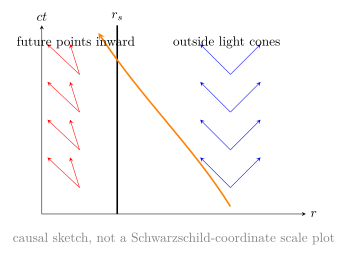
horizon 的物理特征是 causal one-way boundary,而不是 “escape speed formula 恰好等于 \(c\)” 本身。Newtonian escape-speed mnemonic 能给出相同半径尺度,却不能给出 horizon 的 global null geometry。
检查真实曲率可用 Kretschmann scalar:
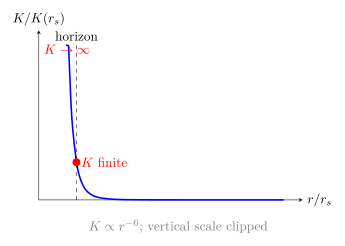
\[K=R_{\alpha\beta\gamma\delta}R^{\alpha\beta\gamma\delta} =\frac{48G^2M^2}{c^4r^6}.\]
\(K\) 在 \(r=r_s\) 有限,在 \(r\to0\) 发散。因此 \(r=r_s\) 的坏行为属于坐标,\(r=0\) 才是 classical curvature singularity。
Knowledge 2 — Orbits and redshift near compact objects / 致密天体附近轨道与红移
Knowledge ID: P06-U05-L03-K02
Schwarzschild equatorial geodesics 具有 conserved energy 与 angular momentum。三个半径尤其重要:
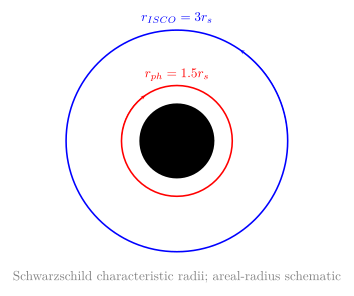
\[r_{horizon}=r_s=\frac{2GM}{c^2}, \qquad r_{ph}=\frac{3GM}{c^2}=\frac32r_s, \qquad r_{ISCO}=\frac{6GM}{c^2}=3r_s.\]
- \(r_{ph}\) 是 circular null orbit 的半径;它是不稳定的。
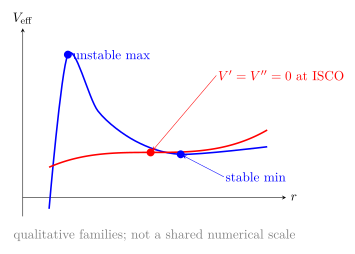
- \(r_{ISCO}\) 是 massive test particle 最内稳定圆轨道;\(3GM/c^2<r<6GM/c^2\) 可有不稳定 circular timelike orbit。
- Kerr black hole 的对应半径依赖 spin 与 prograde/retrograde orientation,不能套用 Schwarzschild 数字。
effective potential 说明为何稳定性改变。定性上,angular-momentum barrier 与 relativistic attractive term 竞争;minimum 对应稳定 circular orbit,maximum 对应不稳定 orbit,二者在 ISCO 合并。
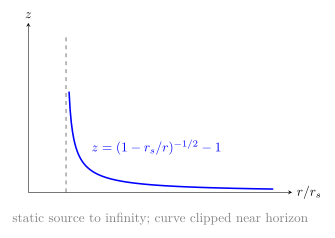
对 radius \(r\) 处的 static emitter 与 infinity static receiver,gravitational redshift 为
\[1+z=\frac{\nu_{emit}}{\nu_\infty} =\left(1-\frac{r_s}{r}\right)^{-1/2}.\]
当 \(r\to r_s^+\),该 static-observer redshift 发散;但维持 static worldline 所需 proper acceleration 也发散,所以这不是自由落体发射者的通用结论。真实 accretion-disk spectra 还叠加 orbital Doppler beaming、light bending、emission physics 与 viewing inclination。
Knowledge 3 — Black-hole mass, spin, and charge / 黑洞质量、自旋与电荷
Knowledge ID: P06-U05-L03-K03
在 classical four-dimensional GR 的 stationary, asymptotically flat electrovacuum 条件下,Kerr–Newman family 由
- mass \(M\);
- angular momentum \(J\),或 \(a_K=J/(Mc)\);
- electric charge \(Q\)
刻画。常把这概括为 no-hair result;它有明确 assumptions,并不表示任何动态、非真空、modified-gravity object 都只能有三个可测量量。
outer horizon radius(Boyer–Lindquist coordinate)为
\[r_+ =\frac{GM}{c^2} +\sqrt{ \left(\frac{GM}{c^2}\right)^2 -a_K^2 -\frac{GQ^2}{4\pi\epsilon_0c^4} }.\]
有 horizon 的条件是根号内非负。若 \(Q=0\),则
\[\lvert\chi\rvert =\left\lvert\frac{cJ}{GM^2}\right\rvert\le1.\]
astrophysical black holes 通常因周围 plasma 中和而近似 \(Q\approx0\),主要用 \(M\) 与 \(\chi\) 描述。Spin also creates frame dragging and an ergoregion outside part of the horizon。
为画出 Kerr–Newman horizon condition,定义 dimensionless charge
\[q\equiv\frac{Q}{\sqrt{4\pi\epsilon_0G}\,M}, \qquad \chi^2+q^2\le1.\]
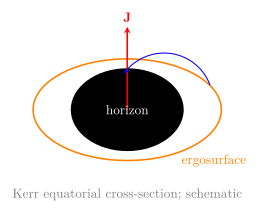
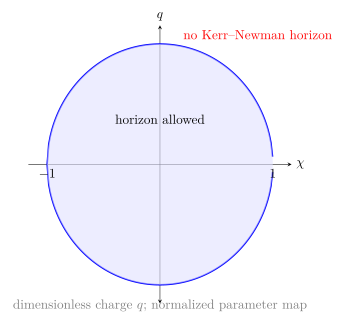
第二图用归一化 charge parameter \(q\) 表示 horizon inequality 的椭圆边界;它不是 astrophysical population distribution。
EHT 观测中的 dark central feature 是强 lensing 产生的 shadow/silhouette,周围亮环来自发光 plasma 和 lensed photon paths;它不是给 event horizon 表面拍照。shadow size/shape 与 \(M/D\)、spin、inclination 及 emission model 相联,可检验 strong-field geometry。
Knowledge 4 — Linearized gravity and gravitational waves / 线性化引力与引力波
Knowledge ID: P06-U05-L03-K04
在远离弱源的区域写
\[g_{\mu\nu}=\eta_{\mu\nu}+h_{\mu\nu}, \qquad \lvert h_{\mu\nu}\rvert\ll1.\]
定义 trace-reversed perturbation
\[\bar h_{\mu\nu} =h_{\mu\nu}-\frac12\eta_{\mu\nu}h, \qquad h=\eta^{\alpha\beta}h_{\alpha\beta}.\]
采用 Lorenz gauge \(\partial^\mu\bar h_{\mu\nu}=0\)。对本课 \((-,+,+,+)\) convention,定义
\[\Box\equiv\eta^{\alpha\beta}\partial_\alpha\partial_\beta =-\frac{1}{c^2}\frac{\partial^2}{\partial t^2}+\nabla^2.\]
linearized field equation 为
\[\Box\bar h_{\mu\nu} =-\frac{16\pi G}{c^4}T_{\mu\nu}.\]
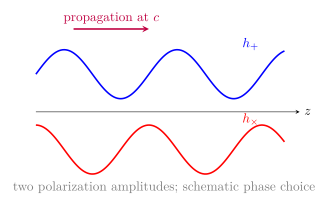
真空区 \(T_{\mu\nu}=0\),扰动以 \(c\) 传播。进一步取 transverse-traceless(TT)gauge 后,沿 \(z\) 传播的平面波只有 two independent polarizations:
\[h_{ij}^{TT} = \begin{pmatrix} h_+ & h_\times & 0\\ h_\times & -h_+ & 0\\ 0&0&0 \end{pmatrix}.\]
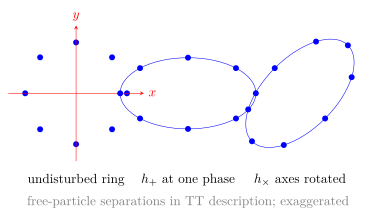
半个周期后 elongation and compression swap。图中点不是被介质拖动;wave 改变的是它们在 spacetime curvature 中的 proper separation。不同 gauge 可分配不同的 coordinate motion,但 detector observable 不随这种描述选择改变。
对孤立慢源,stress–energy conservation 排除了 monopole 与 dipole gravitational radiation;leading radiation 是 quadrupolar。远区量级
\[h_{ij}^{TT}(t,\mathbf x) \sim\frac{2G}{c^4D} \frac{d^2Q_{ij}^{TT}}{dt^2} \bigg|_{t-D/c}.\]
因此需要 time-varying, nonspherical mass quadrupole。严格的 gravitational-wave energy 在 GR 中具有 gauge subtleties;高频/远区可用 averaged effective flux,不应把它等同于普通 matter \(T_{\mu\nu}\) 的局域密度。
Knowledge 5 — Gravitational-wave sources and detection / 引力波源与探测
Knowledge ID: P06-U05-L03-K05
主要 source classes 包括:
- compact binary coalescences:black-hole、neutron-star binaries;
- burst sources:例如非对称 core collapse(waveform model dependent);
- continuous waves:rotating non-axisymmetric neutron stars;
- stochastic background:许多 unresolved sources 或早期宇宙机制的统计叠加。
地面 laser interferometer 以两个近正交 arms 比较 optical phase。对沿 \(z\) 入射并与 arms 对齐的 plus polarization,最低阶
\[\frac{\Delta L_x}{L}\approx\frac{h_+}{2}, \qquad \frac{\Delta L_y}{L}\approx-\frac{h_+}{2},\]
所以 differential strain
\[\frac{\Delta L_x-\Delta L_y}{L}\approx h_+.\]
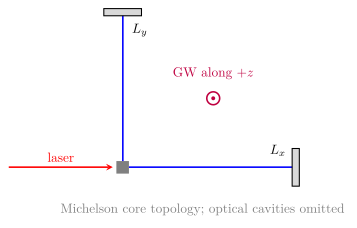
LIGO 类 detector 还加入 Fabry–Pérot arm cavities、power/signal recycling、多级隔振以及精密 control/calibration。仪器把 photodetector output 校准为 strain;“mirror displacement \(h_{\rm det}L\)”只是有用的响应尺度,并不是说 fixed Euclidean background 中的一把尺直接看见“空间被拉长”。
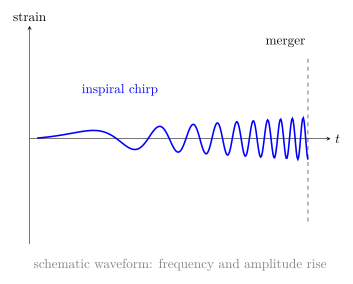
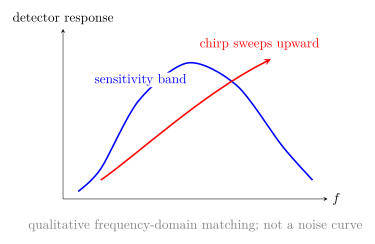
Compact binary inspiral generates a chirp。At leading circular order
\[\dot f =\frac{96}{5}\pi^{8/3} \left(\frac{G\mathcal M}{c^3}\right)^{5/3} f^{11/3},\]
\[\mathcal M=\frac{(m_1m_2)^{3/5}}{(m_1+m_2)^{1/5}}.\]
随着 separation 缩小,orbital frequency 与 wave amplitude 同时上升;merger 与 ringdown 则需要 strong-field numerical relativity 或 black-hole perturbation theory。
Detection 要求相隔 detector 之间的 waveform consistency、可靠 calibration/data quality、background estimation 与 statistical inference。单个仪器中的一次 transient 本身不能构成 astrophysical detection。
Worked Examples / 完整例题
Example 1 — \(10M_\odot\) Schwarzschild black hole 的 horizon scale
已知: \(M=10.0M_\odot\),\(M_\odot=1.9885\times10^{30}\ \mathrm{kg}\)。
系统与参考系: nonrotating, uncharged isolated black hole;使用 areal radius。
模型理由: Schwarzschild exterior。
\[r_s=\frac{2GM}{c^2} =2.953\ \mathrm{km}\left(\frac{M}{M_\odot}\right) =29.5\ \mathrm{km}.\]
horizon sphere area
\[A=4\pi r_s^2=1.10\times10^{10}\ \mathrm{m^2}.\]
三位有效数字。\(r_s\) 随 \(M\) 线性缩放;若错误地用 \(GM/c^2\) 会少一倍。面积是 horizon spatial cross-section 的 invariant area,Schwarzschild coordinate \(r_s\) 正是由此定义的 areal radius。
Example 2 — Schwarzschild ISCO 与 wave-frequency scale
已知: binary total mass \(M_{\rm tot}=10.0M_\odot\),且 \(m_1=m_2=5.00M_\odot\);假设等质量 compact binary 的终止频率量级由 Schwarzschild test-particle ISCO 估算。
系统与参考系: circular geodesic coordinate frequency measured at infinity;仅作量级 proxy。
模型理由: 以 \(M=M_{\rm tot}\) 代入 test-particle proxy:\(r_{ISCO}=6GM_{\rm tot}/c^2\),Newtonian-looking orbital relation 在 Schwarzschild circular coordinate frequency 中恰为 \(\Omega=\sqrt{GM_{\rm tot}/r^3}\)。
\[f_{orb} =\frac1{2\pi}\sqrt{\frac{GM_{\rm tot}}{r_{ISCO}^3}} =\frac{c^3}{2\pi6^{3/2}GM_{\rm tot}}.\]
dominant quadrupole wave frequency \(f_{GW}\approx2f_{orb}\):
\[f_{GW} \approx\frac{c^3}{\pi6^{3/2}GM_{\rm tot}} =439\ \mathrm{Hz}.\]
结果随 \(M^{-1}\) 缩放。对 comparable-mass binary,spin、mass ratio 与 strong nonlinear merger 会改变精确 termination frequency,所以不能把 \(439\ \mathrm{Hz}\) 当作 universal cutoff。
Example 3 — \(r=3r_s\) static source 的 redshift
已知: monochromatic source 在 Schwarzschild radius \(r=3r_s\) 处保持静止,远处静止 observer 接收。
系统边界: source、photon、asymptotic receiver;忽略 source orbital motion。
模型理由: exact static-clock Schwarzschild factor。
\[1+z=\left(1-\frac{r_s}{3r_s}\right)^{-1/2} =\sqrt{\frac32}=1.2247,\]
\[z=0.2247.\]
所以 \(\nu_\infty=\nu_{emit}/(1+z)=0.8165\nu_{emit}\)。无量纲且方向正确:远处测得 redshift。注意 \(r=3r_s\) outside ISCO boundary? 它恰等于 Schwarzschild ISCO;static source 不是 orbiting geodesic,必须靠非引力支撑。
Example 4 — \(4\ \mathrm{km}\) interferometer 对 \(h_+=1.0\times10^{-21}\) 的响应尺度
已知: equal arms \(L=4.00\times10^3\ \mathrm{m}\),optimal plus-polarized wave peak \(h_+=1.0\times10^{-21}\)。
系统与参考系: freely suspended end mirrors,wave normal to detector plane and axes aligned;计算 instantaneous long-wavelength scale。
模型理由: \(\lambda_{GW}\gg L\) 且 linear response。
\[\Delta L_x=\frac{h_+L}{2} =2.0\times10^{-18}\ \mathrm{m},\]
\[\Delta L_y=-\frac{h_+L}{2} =-2.0\times10^{-18}\ \mathrm{m},\]
\[\Delta L_x-\Delta L_y=h_+L =4.0\times10^{-18}\ \mathrm{m}.\]
两位有效数字。plus axes 旋转 \(45^\circ\) 或 source 改变 sky position 时,detector antenna factor 会降低甚至出现 null;实际光学 cavities amplify phase response,而不是把 spacetime strain 本身放大。
Lesson synthesis / 全课综合
从静态强场到动态辐射,可按四层组织:
- 背景几何: Schwarzschild/Kerr metric 给定 causal structure 与 geodesics。
- 不变量判据: horizon coordinate behavior 要用 regular coordinates 与 curvature invariants 区分;\(r=0\) 和 \(r=r_s\) 不是同类奇点。
- 强场可观测量: orbit frequencies、redshift、shadow、accretion signals 依赖 metric,同时依赖 source/observer model。
- 动态时空: weak perturbation 产生 two-polarization waves;compact binaries 形成 chirp,interferometers 读取 differential optical phase。
Formula-and-decision table / 公式—决策表
| Need | Formula | Conditions | Boundary check |
|---|---|---|---|
| nonrotating horizon scale | \(r_s=2GM/c^2\) | Schwarzschild | not a material surface |
| identify true curvature divergence | \(K=48G^2M^2/(c^4r^6)\) | Schwarzschild | finite at \(r_s\), divergent at \(0\) |
| characteristic orbits | \(r_{ph}=3GM/c^2\), \(r_{ISCO}=6GM/c^2\) | Schwarzschild test particles | Kerr values differ |
| static redshift to infinity | \(1+z=(1-r_s/r)^{-1/2}\) | supported static emitter | not valid at/inside horizon |
| dimensionless spin | \(\chi=cJ/(GM^2)\) | stationary black hole | \(\lvert\chi\rvert\le1\) for Kerr horizon |
| weak wave equation | \(\Box\bar h_{\mu\nu}=-16\pi GT_{\mu\nu}/c^4\) | \(\lvert h_{\mu\nu}\rvert\ll1\), Lorenz gauge | nonlinear near merger |
| detector response scale | \((\Delta L_x-\Delta L_y)/L\approx h_+\) | optimal long-wavelength geometry | include antenna pattern |
| chirp evolution | \(\dot f=(96/5)\pi^{8/3}(G\mathcal M/c^3)^{5/3}f^{11/3}\) | circular leading inspiral | merger needs stronger model |
Model boundaries / 模型边界
- Schwarzschild geometry requires spherical, nonrotating, uncharged external vacuum;real astrophysical black holes are closer to Kerr plus matter perturbations。
- event horizon is global;apparent horizon, photon ring, shadow edge and accretion disk inner edge are not synonymous。
- photon sphere and ISCO quoted here are Schwarzschild coordinate radii;spin changes them and prograde/retrograde values differ。
- no-hair statement assumes stationary classical GR electrovacuum;temporary merger distortions and surrounding fields are not “violations”。
- linearized wave theory requires \(\lvert h_{\mu\nu}\rvert\ll1\);near a binary merger one needs numerical relativity。
- measured strain depends on detector geometry and calibration;\(\Delta L/L\) is not a source-independent scalar at arbitrary frequency。
- classical singularities flag incompleteness of classical spacetime;they are not a finished quantum-gravity description。
Misconception clinic / 误区诊所
- “Event horizon 是黑色固体表面。” 它是 null causal boundary;局地自由落体者可平滑穿越。
- “\(g_{rr}\) 在 \(r_s\) 发散,所以物理曲率无限。” Kretschmann scalar at \(r_s\) finite;发散来自 Schwarzschild coordinates。
- “远处 observer 看见物体永远停在 horizon,所以物体从不穿过。” 这是特定坐标时间与无限 redshift 的表述;infalling proper time finite。
- “black-hole image 中的黑圈就是 event horizon。” EHT shadow 是 lensed photon capture region against emitting plasma,尺度通常大于 horizon。
- “所有黑洞都只由质量描述。” stationary GR black holes还可有 spin and charge;astrophysical charge 常可忽略而 spin 重要。
- “引力波像声波,需要介质。” 它是 spacetime geometry perturbation,在真空以 \(c\) 传播。
- “plus polarization 只是把 detector 整体放大缩小。” 它沿一轴伸长、正交轴压缩;half cycle later swap。
- “one detector 的 glitch 就是 gravitational wave。” 需要 calibrated multi-detector consistency、background statistics 与 waveform/coherence checks。
Practice and retrieval / 练习与提取
- 计算 Earth mass 若被压成 Schwarzschild black hole 时的 \(r_s\),取 \(M_\oplus=5.972\times10^{24}\ \mathrm{kg}\)。
- 用 \(K\propto r^{-6}\) 比较 \(r=r_s\) 与 \(r=2r_s\) 的 Kretschmann scalar。
- 在 \(r=2r_s\) 的 static emitter 对 infinity 的 redshift \(z\) 为多少?
- Schwarzschild \(r_{ph}\)、\(r_{ISCO}\) 分别是 horizon radius 的多少倍?哪个对应 massive stable orbit boundary?
- black hole 有 \(M=5.0M_\odot\)、\(J=1.5\times10^{43}\ \mathrm{kg\,m^2\,s^{-1}}\),求 \(\chi\) 并判断是否满足 Kerr bound。
- 解释为什么 astrophysical Kerr modeling 常取 \(Q\approx0\),但 no-hair statement 仍列 \(Q\)。
- 沿 \(z\) 传播的 pure plus wave 在半周期后如何改变 \(x,y\) 方向的相对长度?
- isolated slow source 为什么没有 leading mass-monopole gravitational radiation?
- \(L=3.0\ \mathrm{km}\) interferometer 遇到 optimal \(h_{\rm det}=2.0\times10^{-22}\),求 differential arm response scale。
- leading chirp formula 中,若 \(\mathcal M\) 加倍且 \(f\) 固定,\(\dot f\) 放大多少倍?
Answers / 答案
1. \(r_s=2GM_\oplus/c^2=8.87\times10^{-3}\ \mathrm{m}=8.87\ \mathrm{mm}\)。
2. \(K(r_s)/K(2r_s)=2^6=64\);两者都有限,只有 \(r\to0\) 发散。
3. \(1+z=(1-1/2)^{-1/2}=\sqrt2\),所以 \(z=0.414\)。
4. \(r_{ph}=1.5r_s\),\(r_{ISCO}=3r_s\);ISCO 是 massive circular orbit 的稳定性边界。
5. \(\chi=cJ/(GM^2)\approx0.683\),满足 \(\lvert\chi\rvert\le1\)。数值使用 \(M=9.94\times10^{30}\ \mathrm{kg}\)。
6. surrounding plasma 会快速 neutralize large net charge,因此 \(Q\) 通常不显著;但 Kerr–Newman electrovacuum classification 在理论上允许 conserved charge。
7. 若某时刻 \(x\) 伸长、\(y\) 压缩,半周期后 \(x\) 压缩、\(y\) 伸长;trace-free deformation 不作同向 isotropic breathing。
8. total mass-energy conservation keeps isolated monopole constant;center-of-mass momentum conservation removes independent dipole radiation,leading time-varying moment is quadrupole。
9. \(\Delta L_x-\Delta L_y=h_{\rm det}L=(2.0\times10^{-22})(3.0\times10^3)=6.0\times10^{-19}\ \mathrm{m}\)。
10. \(\dot f\propto\mathcal M^{5/3}\),放大 \(2^{5/3}=3.17\)。
Exit ticket / 离堂检验
- 用 curvature invariant 与 regular coordinates 两个判据说明为什么 Schwarzschild horizon 不是 curvature singularity。
- 从 source quadrupole → propagating TT wave → differential optical phase,写出一条不超过五步的 detector causal chain。
References and source notes / 参考资料与来源说明
- MIT OpenCourseWare 8.962, General Relativity Lecture Guide — Schwarzschild/Kerr geometry、horizons、orbits、linearized gravity;核对于 2026-08-29。
- MIT OpenCourseWare 8.033, Full Lecture Notes: Introduction to Relativity and Spacetime Physics — Schwarzschild metric、redshift、black holes and gravitational waves;核对于 2026-08-29。
- Event Horizon Telescope, Testing General Relativity — black-hole mass/spin/charge、shadow and no-hair test context;核对于 2026-08-29。
- Event Horizon Telescope Collaboration, First Sagittarius A* Results I: The Shadow — Sgr A* ring/shadow modeling and Kerr consistency;核对于 2026-08-29。
- LIGO Scientific Collaboration, Gravitational-Wave Science — sources、polarizations、strain and interferometric detection;核对于 2026-08-29。
- LIGO Scientific Collaboration, Detections — public event catalogs and observed compact-binary signals;核对于 2026-08-29。
- LIGO DCC, Interferometer Techniques for Gravitational-Wave Detection — Michelson/Fabry–Pérot topology、optical response and detector limitations;核对于 2026-08-29。
- LIGO/Virgo, Educator's Guide to Gravitational Waves — strain、chirp、black-hole binary and detection concepts;核对于 2026-08-29。
所有 TikZ 由本课方程与物理关系原创绘制,没有复制 EHT 或 LIGO 图像。图中的 horizon、shadow、waveform and detector scales 均明确标注 schematic 或 model boundary。
Source-to-content map
| Source | Used for | Knowledge ID / Section | Model boundary or convention |
|---|---|---|---|
| MIT 8.962 guide | horizons, Kerr, linearized gravity | K01–K04 | classical GR, advanced derivations selectively used |
| MIT 8.033 notes | Schwarzschild metric, redshift, waves | K01, K02, K04 | \((-,+,+,+)\) convention stated locally |
| EHT: Testing GR | \(M,J,Q\), no-hair and shadow | K03 | shadow is not horizon surface |
| EHT Sgr A* results | strong-field observational context | K02, K03 | model-dependent plasma imaging |
| LIGO GW science | polarizations, source classes, strain | K04, K05 | detector response depends on orientation |
| LIGO detections | direct-signal context | K05 | catalogs are empirical, not formula source |
| LIGO interferometer review | optical topology and calibration | K05, Example 4 | cavities/control beyond simple Michelson |
| LIGO educator guide | quadrupole chirp teaching model | K04, K05 | schematic quantities kept separate from full pipeline |
复习与拓展
- 下一课 Quantization of Radiation 将转向 quantum ideas;不要把 classical gravitational wave 量子化问题提前等同于 photon quantization。
- 与 Coherence and Interferometry 对照 detector optics;光学相位是读出工具,signal source 是 spacetime strain。
- 可扩展:Kruskal diagrams、Penrose causal diagrams、Kerr geodesics、quasinormal modes、black-hole thermodynamics、pulsar timing arrays and space interferometers。