
Learning objectives / 学习目标
- 从 preparation ensemble 构造 density operator,计算 observable expectation、purity 与 Bloch vector。
- 区分 pure/mixed states,说明同一 density operator 的 ensemble decomposition 不唯一。
- 从 system–environment entanglement 推导 reduced-state coherence factor \(\langle E_1\vert E_0\rangle\)。
- 区分 decoherence、dephasing、relaxation 与 measurement outcome;解释 pointer basis 和 classical emergence 的有限含义。
- 使用 Lindblad-form master equation 计算 pure dephasing 与 amplitude damping,并陈述 Markov approximation 边界。
Prerequisites / 先修知识
- Composite Systems and Entanglement:partial trace、Bell pair 与 local mixture。
- Quantum Time Evolution:von Neumann equation。
- Probability mixtures、matrix eigenvalues、commutator 与 anticommutator。
Scope and conventions / 范围与约定
- 系统 \(S\) 与环境 \(E\) 的 total state 可 pure,reduced \(\rho_S=\operatorname{Tr}_E\rho_{SE}\)。
- Density operator 必须 Hermitian、positive semidefinite、unit trace;本课 finite-dimensional examples 以 qubit 为主。
- Decoherence 指 selected-basis coherences 衰减;relaxation 指 populations/energy exchange。两者时间尺度常记 \(T_2,T_1\)。
- Lindblad equation 只作为 weak-coupling Markovian completely-positive dynamics 的 viewpoint;不从 microscopic bath 全面推导。
- 退相干解释 classical robustness,不单独选择 unique measurement outcome,也不修改 Born rule。
Notation and modeling contract / 符号与建模契约
| Symbol | Meaning | Unit |
|---|---|---|
| \(\rho\) | density operator | 1 |
| \(p_a\) | ensemble probability | 1 |
| \(\mathcal P=\operatorname{Tr}\rho^2\) | purity | 1 |
| \(\mathbf r\) | qubit Bloch vector | 1 |
| \(\gamma_\phi,\gamma_1\) | dephasing/relaxation rates | \(\mathrm{s^{-1}}\) |
| \(L_k\) | Lindblad jump operator | convention-dependent |
| \(T_1,T_2\) | longitudinal/transverse times | s |
1. Density operators and statistical mixtures / 密度算符与统计混合
Knowledge ID: P07-U08-L03-K01
若 preparation \(a\) 以概率 \(p_a\) 产生 \(\lvert\psi_a\rangle\),
\[\rho=\sum_ap_a\lvert\psi_a\rangle\langle\psi_a\rvert, \qquad p_a\ge0, \qquad \sum_ap_a=1.\]
任何 observable 的 expectation 是 \(\langle A\rangle=\operatorname{Tr}(\rho A)\)。不同 ensemble decompositions 可给同一 \(\rho\),因此 density operator—not a particular ignorance story—is operational state。unitary evolution 给 von Neumann equation:
\[\dot\rho=-\frac{i}{\hbar}[H,\rho].\]
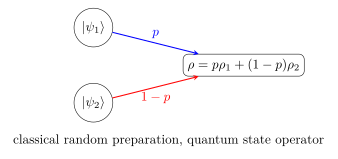
图 1 展示 proper statistical mixture 的制备图景;同一 \(\rho\) 可由别的 ensembles 得到。
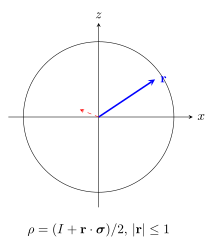
图 2 以 Bloch vector 表示 qubit density operator;surface 是 pure,interior 是 mixed。
2. Pure and mixed states / 纯态与混合态
Knowledge ID: P07-U08-L03-K02
pure state 满足 \(\rho^2=\rho\)、\(\operatorname{Tr}\rho^2=1\) 且 rank 1;mixed state 有 \(\operatorname{Tr}\rho^2<1\)。对 \(d\) 维系统,\(1/d\le\mathcal P\le1\)。off-diagonal elements 依赖 basis;“coherence 消失”必须说明在哪个 physically selected basis。
\[\rho=\begin{pmatrix}p&c\\c^*&1-p\end{pmatrix}, \qquad \lvert c\rvert^2\le p(1-p)\]
是 positive qubit state 的条件。diagonal probability 相同不意味着 states 相同;\(c\) 决定 complementary-basis interference。
判断一个候选 density matrix 是否物理,至少要逐项检查 Hermiticity、trace 1 与 eigenvalues 非负。只检查 diagonal entries 在 \(0\) 到 \(1\) 之间并不够,因为过大的 coherence 会让某个 eigenvalue 变负。例如上式的 positivity 正好要求 \(\lvert c\rvert^2\le p(1-p)\)。这一限制还说明 coherence 与 population imbalance 不能任意独立指定:当 \(p=0\) 或 \(1\) 时,state 已在 basis state 上,off-diagonal element 必须为零;当 \(p=1/2\) 时才允许最大 magnitude \(1/2\)。
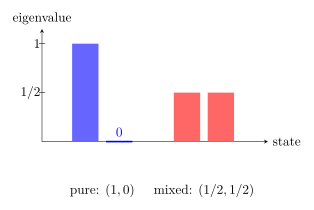
图 3 用 quantitative eigenvalue spectrum 而非某一 basis 的 diagonal appearance 判定 purity;pure case 的第二 eigenvalue 以 baseline marker 表示精确的零,不是一个很小的正数。
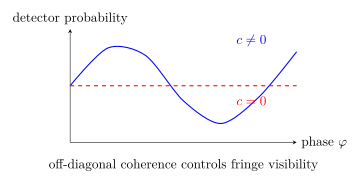
图 4 把 basis coherence 与 interference visibility 联系起来。
3. Open-system interaction and entanglement with environment / 开放系统与环境纠缠
Knowledge ID: P07-U08-L03-K03
设 system superposition 与环境初态发生 controlled correlation:
\[(\alpha\lvert0\rangle+\beta\lvert1\rangle)\lvert E\rangle \longrightarrow \alpha\lvert0\rangle\lvert E_0\rangle+ \beta\lvert1\rangle\lvert E_1\rangle.\]
partial trace 后
\[\rho_S= \begin{pmatrix} \lvert\alpha\rvert^2 & \alpha\beta^*\langle E_1\vert E_0\rangle\\ \alpha^*\beta\langle E_0\vert E_1\rangle & \lvert\beta\rvert^2 \end{pmatrix}.\]
coherence factor 是 environment-state overlap。环境记录越可区分,overlap 越小;global state 仍 pure/unitary,local state 却 mixed。忽略环境产生的 mixture 常称 improper mixture,其 local predictions 与相同 \(\rho_S\) 的 proper mixture 相同。
这个公式也给出一个直接的可逆性判据。若 \(\lvert E_0\rangle\) 与 \(\lvert E_1\rangle\) 仍可被实验者共同操控,就可能通过 unitary operation 让两条环境记录重新重合,从而恢复 system interference;若记录已扩散到大量不受控自由度,所需控制精度会随自由度数迅速变得不现实。由此可见,local decoherence 并非基本方程突然不再 unitary,而是相位信息从 single-system observable 转移到高阶 system–environment correlations。
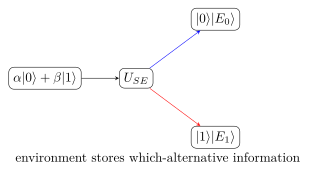
图 5 显示 system branches 与 environment records 的 entanglement。
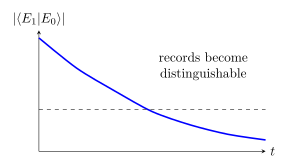
图 6 是 monotonic Markov-like overlap decay 的 schematic;structured environments 可有 revival,因此不是 universal curve。
4. Decoherence and emergence of classical behavior / 退相干与经典行为涌现
Knowledge ID: P07-U08-L03-K04
decoherence suppresses interference between alternatives robustly monitored by environment。interaction Hamiltonian selects a pointer basis—states that correlate with environment while remaining comparatively stable。macroscopic objects scatter enormous numbers of photons, gas molecules and internal modes, making environmental records nearly orthogonal on short timescales。
但 reduced density matrix diagonalization 只给 effective classical alternatives and probabilities;unitary decoherence alone does not choose one outcome in an individual run。Reversibility is hidden in system–environment correlations; quantum eraser or small engineered environments can restore interference if which-path information is coherently erased。
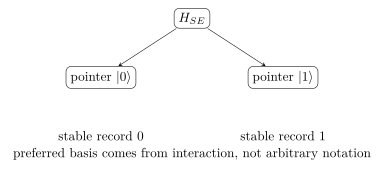
图 7 表示 environment-induced basis selection;并非所有 basis 同时 classical。
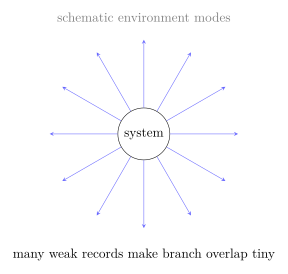
图 8 把 macroscopic amplification 画成许多环境 channels;箭头不是 radiation-pressure forces。
5. Master-equation viewpoint / 主方程观点
Knowledge ID: P07-U08-L03-K05
Markovian completely-positive trace-preserving semigroup 的 standard generator 可写成 Lindblad form:
\[\dot\rho=-\frac{i}{\hbar}[H,\rho] +\sum_k\gamma_k\left(L_k\rho L_k^\dagger- \frac12\{L_k^\dagger L_k,\rho\}\right).\]
pure dephasing 可取 \(L=\sigma_z\)(rate convention 要明确),使 populations fixed、off-diagonals decay。amplitude damping 可取 \(L=\sigma_-\),使 excited population relax 并向环境放出能量。对 qubit 常有
\[\frac{1}{T_2}=\frac{1}{2T_1}+\frac{1}{T_\phi}.\]
Lindblad form 保证 positivity,但并非每个 non-Markovian reduced dynamics 都能用 constant positive rates 表示。
使用主方程时应先写清 jump operator 的物理意义,再解矩阵元,而不是只背一个耗散符号。\(L=\sigma_-\) 对应一次可分辨的 downward quantum jump,其 ensemble average 同时改变 excited population 与 coherence;\(L=\sigma_z\) 对应环境随机读取相位标签,在所选 basis 中不交换能量。不同文献会把系数 2 吸收到 \(\gamma\) 或 \(L\) 中,因此比较 \(T_1,T_2\) 前必须从实际矩阵元的指数衰减率反推 convention。最后还要数值检查 trace 是否守恒、eigenvalues 是否始终非负,以及 long-time state 是否符合 bath temperature。
如果环境 correlation time 与系统衰减时间不可分离,constant-rate Lindblad model 可能把短时行为错误地外推为简单指数。此时应寻找 coherence revival、负的 time-local effective rate 或环境 spectral structure 等迹象,并改用 memory kernel、time-dependent generator 或扩大 system boundary。扩大边界把关键环境 mode 纳入“系统”后,剩余 bath 有时又能近似 Markovian;所以开放系统的划分本身也是建模选择,需要由时间尺度和可控程度检验。
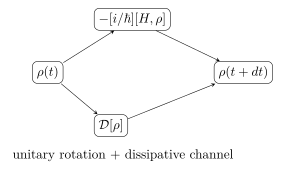
图 9 分解 Hamiltonian 与 dissipator roles;它们共同决定下一时刻 state。
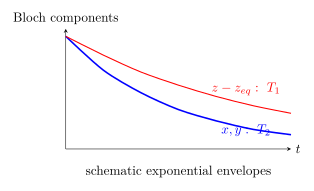
图 10 对比 transverse coherence 与 longitudinal relaxation times;实际 ordering 由 noise mechanisms 决定。
Worked Examples / 完整例题
Worked Example 1 — Classical preparation mixture
已知。 qubit 以 \(0.700\) 概率制备 \(\lvert0\rangle\),以 \(0.300\) 制备 \(\lvert1\rangle\)。
系统、basis 与模型。 单 qubit,computational basis;无后续 dynamics。
计算。 \(\rho=\operatorname{diag}(0.700,0.300)\),\(\langle\sigma_z\rangle=0.700-0.300=0.400\),purity \(\mathcal P=0.700^2+0.300^2=0.580\)。
检查与解释。 trace 1、eigenvalues nonnegative;\(1/2<0.580<1\),所以 mixed 但非 maximally mixed。
Worked Example 2 — 同一 \(I/2\) 的两种 ensembles
已知。 Ensemble A:equal \(\lvert0\rangle,\lvert1\rangle\);Ensemble B:equal \(\lvert+\rangle,\lvert-\rangle\)。
系统与模型。 单 qubit,\(\lvert\pm\rangle=(\lvert0\rangle\pm\lvert1\rangle)/\sqrt2\)。
计算。 A 给 \((\lvert0\rangle\langle0\rvert+\lvert1\rangle\langle1\rvert)/2=I/2\)。B 展开后 cross terms cancel,也给 \(I/2\)。
检查与解释。 所有 observables 对两 ensembles expectation 相同;不能从单个 density operator 反推出唯一 preparation history。
Worked Example 3 — Pure dephasing 的 purity
已知。 initial \(\lvert+\rangle\),dephasing 后 \(\rho(t)=\frac12\begin{pmatrix}1&e^{-\gamma t}\\e^{-\gamma t}&1\end{pmatrix}\);取 \(t=2/\gamma\)。
系统、basis 与模型。 qubit computational pointer basis;populations conserved,Markov exponential coherence。
计算。 \(\langle\sigma_x\rangle=e^{-2}=0.1353\)。purity \(\mathcal P=[1+e^{-4}]/2=0.5092\)。
检查与解释。 trace 保持 1,purity 从 1 向 \(1/2\) 接近但不低于 \(1/2\);能量 population 未变,故这是 dephasing 而非 relaxation。
Worked Example 4 — Amplitude damping
已知。 initial excited state,decay rate \(\gamma_1=2.00\times10^6\,\mathrm{s^{-1}}\),观察 \(t=0.500\,\mu\mathrm{s}\)。
系统与模型。 two-level system 与 zero-temperature Markov bath;jump \(L=\sigma_-\)。
计算。 \(P_e(t)=e^{-\gamma_1t}=e^{-1}=0.3679\),\(P_g=0.6321\);若初态有 coherence,其 amplitude envelope 是 \(e^{-\gamma_1t/2}=e^{-0.5}=0.6065\)(无额外 pure dephasing)。
检查与解释。 populations 和为 1、均非负;\(T_1=0.500\,\mu\mathrm{s}\),对应 relaxation,同时有限 \(T_2=2T_1\) 上限。
Lesson synthesis / 全课综合
Density operator 统一 classical preparation uncertainty 与 entanglement-induced local mixing;purity/eigenvalues 判定 state,不依赖某个 ensemble story;system–environment unitary interaction 把 phase information 转移到 correlations,partial trace 使 local coherences 按 environment overlap 衰减;pointer basis 和 redundancy 产生 classical robustness;在 weak-coupling Markov limit 中,Lindblad equation 将 unitary、dephasing 与 relaxation 放入一个 positivity-preserving framework。
解读开放系统时,应连续追问三个不同问题。第一,混合从哪里来?若实验者随机选择制备方案,它是经典 preparation uncertainty;若系统与环境纠缠后只观察系统,它来自 partial trace。两者可给完全相同的局部 \(\rho\),但只有检查联合系统的 correlations 才能区分来源。第二,什么量正在丢失?pure dephasing 使某一物理基底中的相对相位不可访问,却不必改变能量布居;amplitude damping 则把激发能和信息共同送入环境。第三,所谓不可逆有多强?在巨大、快速失忆的 bath 中,遗漏的环境自由度几乎无法重新操控,Markov master equation 很有效;在少量、结构化或强耦合环境中,coherence revival 与 information backflow 会暴露这种近似。
因此“退相干产生经典世界”要作有限解释:它说明某些 pointer states 为何稳定、宏观不同分支为何不再呈现可见干涉,也说明 classical probability calculus 为何在局部上有效;它并不把 global wave function 中其余 branches 数学删除,也不从 unitary equation 单独推出某次实验究竟出现哪一个 outcome。把这一区分写清楚,既避免把 decoherence 误作能量耗散,也避免把 phenomenological Lindblad equation 误作所有环境的精确基本定律。
在实验报告中,最好同时给出 state-preparation basis、tomography basis、拟合得到的 \(T_1\) 与 \(T_2\),以及模型假定的 bath temperature。仅说“coherence 降低了”无法区分读出误差、ensemble inhomogeneity、真正的 Markov dephasing 或能量弛豫。若能通过 spin echo 恢复一部分 fringe visibility,则说明其中存在可逆的低频 phase dispersion;未恢复部分才更接近不可控环境造成的 homogeneous decoherence。这样的控制实验也是检验 master-equation mechanism 的物理审计,而不是只比较一条指数曲线。
Formula-and-decision table / 公式与决策表
| Need | Formula | Use when | Limitation |
|---|---|---|---|
| Ensemble state | \(\rho=\sum_ap_a\lvert\psi_a\rangle\langle\psi_a\rvert\) | classical random preparation | decomposition not unique |
| Expectation | \(\langle A\rangle=\operatorname{Tr}(\rho A)\) | any density operator | observable must be in system space |
| Purity | \(\mathcal P=\operatorname{Tr}\rho^2\) | finite-dimensional state check | not an entanglement measure for arbitrary mixed states |
| Environment coherence | \(\rho_{01}\propto\langle E_1\vert E_0\rangle\) | controlled branch correlation | bath revivals possible |
| Unitary density evolution | \(\dot\rho=-(i/\hbar)[H,\rho]\) | closed system | purity conserved |
| Lindblad equation | Hamiltonian term plus \(\sum_k\gamma_k\mathcal D[L_k]\rho\) | Markov CPTP semigroup | non-Markovian memory excluded |
| Qubit times | \(T_2^{-1}=(2T_1)^{-1}+T_\phi^{-1}\) | standard independent channels | convention/platform dependent |
Model boundaries / 模型边界
- Density operator describes operational statistics but does not by itself reveal unique ensemble history。
- Reduced-state mixing from entanglement and classical mixture are locally indistinguishable, though global correlations differ。
- Decoherence does not by itself solve the single-outcome measurement problem。
- Pointer basis depends on dominant \(H_{SE}\) and timescale; competing couplings can prevent a simple basis。
- Markov approximation requires bath memory short relative to system evolution; structured reservoirs can show information backflow and revivals。
- Constant-rate Lindblad form is phenomenological unless rates/operators are microscopically justified。
- Classical emergence is approximate and scale-dependent; global superposition is not mathematically deleted。
Misconception clinic / 误区诊所
- “mixed state 是许多 particles simultaneously in different pure states。” 它是 preparation/local statistics 的 operator,不是每个 member 同时拥有所有 alternatives。
- “diagonal density matrix 永远 classical。” diagonal is basis-dependent;需要 environment-selected robust basis 与 negligible interference。
- “decoherence 必然伴随能量损失。” pure dephasing 可只衰减 off-diagonals,populations unchanged。
- “global unitarity 与 local irreversibility 矛盾。” phase information 可流入 inaccessible correlations;full reversal requires controlling environment。
- “purity 小就是 entanglement 大。” 对 global pure bipartite state 的 reduced purity 有此联系;一般 mixed global state 不成立。
- “Lindblad equation 是所有开放系统的 exact law。” 它是重要 Markovian class,不涵盖任意 memory effects。
Practice and retrieval / 练习与提取
- K01: 写出 ensemble density operator 与 expectation formula。
- K01: 为什么 ensemble decomposition 不唯一?
- K02: qubit maximally mixed state 的 purity 是多少?
- K02: \(\rho^2=\rho\) 表示什么?
- K03: environment states orthogonal 时 system coherence factor 是多少?
- K03: global pure 是否保证 subsystem pure?
- K04: dephasing 与 relaxation 分别改变 density matrix 哪些部分?
- K04: quantum eraser 需要对环境信息做什么?
- K05: Lindblad dissipator 的 anticommutator terms 有何作用?
- K05: 若 \(T_1=10\,\mu\mathrm{s}\) 且无 pure dephasing,\(T_2\) 最大多少?
Answers / 答案
- \(\rho=\sum_ap_a\lvert\psi_a\rangle\langle\psi_a\rvert\),\(\langle A\rangle=\operatorname{Tr}(\rho A)\)。
- 不同 pure-state projectors 的 convex sums 可产生同一 positive unit-trace operator,例如 equal \(z\) 与 equal \(x\) ensembles 都给 \(I/2\)。
- \(\operatorname{Tr}(I/2)^2=1/2\)。
- rank-one projector,即 pure state(在 normalized density-operator context)。
- \(\langle E_1\vert E_0\rangle=0\),对应 off-diagonal terms vanish。
- 不保证;entangled pure whole 的 reduced subsystem mixed。
- dephasing 主要衰减 selected-basis off-diagonals;relaxation 改变 populations 并通常也影响 coherences。
- 使 which-alternative records coherently indistinguishable/erase their distinguishability,再 postselect 或 recombine amplitudes。
- 与 jump term 一起保持 trace,并保证 generator 的 completely-positive structure;不能只保留 \(L\rho L^\dagger\)。
- \(T_2=2T_1=20\,\mu\mathrm{s}\)。
Exit ticket / 离堂检验
- 从 \(\alpha\lvert0E_0\rangle+\beta\lvert1E_1\rangle\) 写出 \(\rho_S\) 并指出 interference 的控制量。
- 用一句话说明“decoherence explains classical robustness”与“decoherence selects one outcome”为何不是同一主张。
References and source notes / 参考资料与来源说明
以下来源均于 2026-08-30 实际打开核验。
- MIT OCW 8.06 (2016), Chapter 3: Entanglement, Density Matrices, and Decoherence
- MIT OCW MAS.865J, Lecture 1: Density Matrices, System–Environment, and Quantum Operations
- MIT OCW 5.74, Lecture 12: The Density Matrix
- Duke Physics 590.06: Open Quantum Systems
- NIST: Dissipative Production of a Maximally Entangled Steady State of Two Quantum Bits
- Cornell ECE 5310 Quantum Optics Lecture Map
Source-to-content map
| Source | Used for | Knowledge ID / Section | Model boundary or convention |
|---|---|---|---|
| MIT 8.06 Chapter 3 | mixtures, partial trace, dephasing examples | K01–K04 | qubit examples and local/global distinction |
| MIT MAS.865J Lecture 1 | density matrices, environment and quantum operations | K01–K05 | operation-sum context not expanded fully |
| MIT 5.74 Lecture 12 | density-matrix dynamics and spectroscopy context | K01–K02, K05 | graduate notation simplified |
| Duke Open Systems | Lindblad/Markov scope and non-Hermitian Liouvillian context | K03–K05 | course synopsis used to delimit model |
| NIST experiment | engineered dissipation and entangled steady-state reality check | K03–K05 | not used as general theoretical proof |
| Cornell ECE 5310 | \(T_1/T_2\), open-system qubit and decoherence context | K04–K05 | platform-specific details omitted |
复习与拓展
- 下一 Part 回到 atomic structure;density matrices, linewidths and selection rules will reappear in spectroscopy。
- Quantum optics extends master equations to driven atoms, cavities and photon statistics。
- Statistical mechanics connects reduced states, thermalization and ensembles。
- Future numerical extension: integrate dephasing/amplitude-damping Lindblad equations and verify trace, positivity and Bloch contraction。