
Learning objectives / 学习目标
完成本课后,你应能:
- 用 reduced-mass Rydberg formula 计算 hydrogenic ion 的能量、波数与电离阈值。
- 从 \(n,\ell,s,j,m_j\) 写出 \(nL_j\) 记号并判断角动量允许值、宇称和简并度。
- 解释 relativistic kinetic correction、spin–orbit interaction 与 Darwin term 的来源、标度和适用条件。
- 说明 Lamb shift 为什么不能由 Schrödinger 或单纯 Dirac Coulomb theory 完整解释。
- 由 \(\mathbf F=\mathbf I+\mathbf J\) 计数 hyperfine levels,并用 \(A\mathbf I\cdot\mathbf J\) 求一级位移。
- 对每一层修正做量纲、符号、\(Z\alpha\) 小参数和能标层级检查。
Prerequisites / 先修知识
- Hydrogen Atom:约化质量、\(E_n\propto-1/n^2\)、轨道与节点。
- Spin 与 Addition of Angular Momentum:\(s=1/2\)、\(\mathbf J=\mathbf L+\mathbf S\)。
- Time-Independent Approximation Methods:一级微扰与简并子空间。
- Time-Dependent Processes:跃迁矩阵元与选择定则。
Scope and conventions / 范围与约定
- 研究单电子、点核、核电荷 \(+Ze\) 的 hydrogenic ion;无外场,质心静止,能量零点取电离阈值。
- SI 为默认单位制;谱学也使用波数 \(\tilde\nu=1/\lambda\),单位 \(\mathrm{m^{-1}}\) 或 \(\mathrm{cm^{-1}}\)。
- 先以 Schrödinger–Coulomb Hamiltonian 为基线,再按相对论、QED、核自旋逐层修正;不把这些修正重复计数。
- fine structure 的小参数为 \(Z\alpha\);轻原子满足 \(Z\alpha\ll1\)。高 \(Z\) 时必须直接使用 Dirac/QED 与有限核模型。
- \(E_{nj}\) 的简化公式只保留到 \(O[(Z\alpha)^4]\);Lamb shift 只讲物理结构与数量级,不在本课推导完整重整化。
Notation and modeling contract / 符号与建模契约
| Symbol | Meaning | SI unit |
|---|---|---|
| \(Z,n,\ell\) | 核电荷数、主量子数、轨道量子数 | 1 |
| \(s=1/2\) | 电子自旋量子数 | 1 |
| \(j\) | \(\mathbf J=\mathbf L+\mathbf S\) 的量子数 | 1 |
| \(I,F\) | 核自旋与 \(\mathbf F=\mathbf I+\mathbf J\) | 1 |
| \(\alpha\) | fine-structure constant | 1 |
| \(R_M\) | 含有限核质量的 Rydberg constant | \(\mathrm{m^{-1}}\) |
| \(\mu_B\) | Bohr magneton | \(\mathrm{J\,T^{-1}}\) |
| \(A\) | magnetic-dipole hyperfine constant | J 或 Hz 乘 \(h\) |
| \(\tilde\nu\) | spectroscopic wavenumber | \(\mathrm{m^{-1}}\) |
1. Hydrogenic energy scale and Rydberg spectrum / 类氢能标与里德伯谱
Knowledge ID: P08-U01-L01-K01
含约化质量 \(\mu=m_em_N/(m_e+m_N)\) 时,非相对论基线为
\[E_n=-hcR_M\frac{Z^2}{n^2}, \qquad R_M=R_\infty\frac{\mu}{m_e}.\]
由初态 \(i\) 到终态 \(f\) 的 photon wavenumber 是
\[\tilde\nu=R_MZ^2\left\lvert\frac{1}{n_f^2}-\frac{1}{n_i^2}\right\rvert.\]
这里 \(E_n<0\) 是 bound energy;\(-E_n\) 才是从该态到连续谱阈值的 ionization energy。\(Z^2\) 来自 Coulomb coupling 的平方,空间尺度则约为 \(a_0/Z\)。
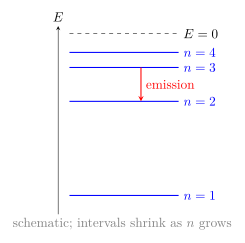
图 1 把电离阈值与离散 bound levels 放在同一能量轴上;跃迁方向决定吸收或发射,绝对能差决定光子频率。
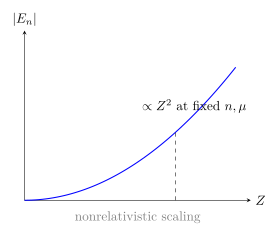
图 2 是定 \(n\) 的 binding magnitude 标度图;它不是高 \(Z\) 精确曲线,因为 \(Z\alpha\) 增大后相对论和核尺寸效应迅速增强。
2. Orbital angular momentum and spectroscopic notation / 轨道角动量与光谱项记号
Knowledge ID: P08-U01-L01-K02
单电子空间态用 \(n\ell m_\ell\),加入自旋后更适合用 \(nL_jm_j\)。字母映射为 \(\ell=0,1,2,3,\ldots\leftrightarrow S,P,D,F,\ldots\),并有
\[j=\ell\pm\frac12\quad(\ell>0), \qquad j=\frac12\quad(\ell=0),\]
\[m_j=-j,-j+1,\ldots,j, \qquad \pi=(-1)^\ell.\]
例如 \(2P_{3/2}\) 表示 \(n=2,\ell=1,j=3/2\),无外场时有 \(2j+1=4\) 个 \(m_j\) sublevels。大写 \(L\) 字母是 spectroscopic label,不等同于 \(L_z\) 分量。
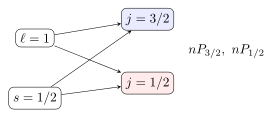
图 3 显示 \(\mathbf L\) 与 \(\mathbf S\) 的 angular-momentum addition,而不是经典矢量在平面内固定相加。
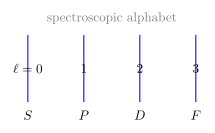
图 4 是 \(\ell\) 到光谱字母的“翻译尺”;term symbol 的字母承载角动量量子数,不是轨道形状的口语名称。
3. Fine structure and relativistic corrections / 精细结构与相对论修正
Knowledge ID: P08-U01-L01-K03
Pauli expansion 到 \(1/c^2\) 阶给出三类贡献:
\[H_{\rm mv}=-\frac{p^4}{8m_e^3c^2},\]
\[H_{\rm so}=\frac{1}{2m_e^2c^2}\frac{1}{r}\frac{dV}{dr}\,\mathbf L\cdot\mathbf S,\]
\[H_D=\frac{\hbar^2}{8m_e^2c^2}\nabla^2V.\]
\(H_{\rm mv}\) 是 relativistic kinetic-energy expansion;\(H_{\rm so}\) 包含电子静止系磁场与 Thomas factor;Darwin term 只对在原点概率密度不为零的 \(s\) states 产生直接贡献。三项相加后,hydrogenic fine-structure energy 到该阶只依赖 \(n,j\):
\[E_{nj}\approx -\frac{\mu c^2(Z\alpha)^2}{2n^2} \left[1+\frac{(Z\alpha)^2}{n^2} \left(\frac{n}{j+1/2}-\frac34\right)\right].\]
因此 characteristic splitting 相对 Coulomb energy 小约 \((Z\alpha)^2\);轻原子中是“精细”结构。
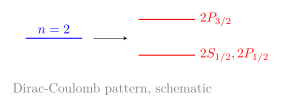
图 5 表示 fine structure 解除部分 \(\ell\) 简并,但单纯 Dirac point-Coulomb theory 仍让同 \(n,j\) 的 \(2S_{1/2}\) 与 \(2P_{1/2}\) 简并。

图 6 是修正层级账本;不同体系、不同 \(Z\) 和不同量子数会改变实际顺序,不能把箭头理解成严格大小不等式。
4. Lamb shift as a boundary to nonrelativistic theory / 兰姆位移作为非相对论理论边界
Knowledge ID: P08-U01-L01-K04
Lamb shift 是 radiative QED corrections 的可观测结果,主因包括 electron self-energy 与 vacuum polarization。它使 Dirac-Coulomb 中同 \(n,j\) 而不同 \(\ell\) 的能级不再严格相同;著名例子是 \(2S_{1/2}\) 相对 \(2P_{1/2}\) 上移约 \(1058\,\mathrm{MHz}\) 的数量级。
关键逻辑不是“再加一个经验常数”,而是:电子与量子化电磁场耦合,bare parameters 不能直接作为可观测量,需以 renormalized mass/charge 组织有限预言。\(s\) state 更靠近原点,对高动量涨落和核结构更敏感。
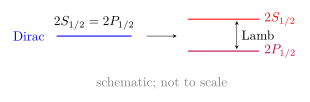
图 7 清楚标出 Lamb shift 的诊断意义:它打破的是 Dirac point-Coulomb 残余简并。
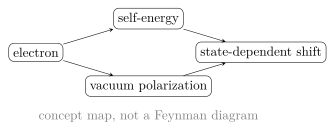
图 8 区分两类主要 radiative mechanisms;该图不是微扰图,也不暗示二者权重相同。
5. Hyperfine structure / 超精细结构
Knowledge ID: P08-U01-L01-K05
核磁矩与电子产生的磁场耦合,使电子总角动量 \(\mathbf J\) 再与核自旋 \(\mathbf I\) 合成为 \(\mathbf F\):
\[F=\lvert I-J\rvert,\lvert I-J\rvert+1,\ldots,I+J.\]
magnetic-dipole hyperfine Hamiltonian 常写为
\[H_{\rm hfs}=A\frac{\mathbf I\cdot\mathbf J}{\hbar^2},\]
所以一级能移
\[\Delta E_F=\frac{A}{2} \left[F(F+1)-I(I+1)-J(J+1)\right].\]
对 hydrogen \(1S_{1/2}\),\(I=J=1/2\),得到 \(F=0,1\);两者间隔对应约 \(1420.4058\,\mathrm{MHz}\)、约 \(21\,\mathrm{cm}\) 的重要射电谱线。若 \(I\ge1\),核 electric quadrupole moment 还可加入 \(B\) 常数项,本课不展开。
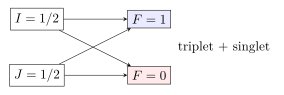
图 9 显示 hydrogen ground state 的 \(F\) coupling 与 \((2F+1)\) magnetic degeneracy。
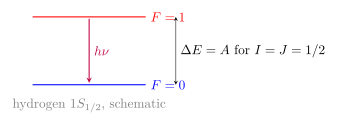
图 10 把 21-cm transition 作为 hyperfine energy difference 表示;真实跃迁是弱 magnetic-dipole process,不是强 E1 line。
Worked Examples / 完整例题
Worked Example 1 — He\(^+\) 的 Lyman-\(\alpha\) 基线波长
已知与研究对象。 \(Z=2\),跃迁 \(n_i=2\to n_f=1\);研究电子—\(^4\)He 核内部态,质心系,能量零点在电离阈值。取 \(R_M\approx R_\infty\),先忽略 fine/Lamb/hyperfine。
模型与方程。 非相对论 Rydberg model 合适,因为只求基线尺度:
\[\tilde\nu=R_\infty Z^2\left(1-\frac14\right)=3R_\infty.\]
用 \(R_\infty=1.0973731568\times10^7\,\mathrm{m^{-1}}\),
\[\lambda=\frac{1}{3R_\infty}=3.0378\times10^{-8}\,\mathrm m=30.38\,\mathrm{nm}.\]
检查与解释。 \(Z=2\) 使同系列波数为氢的 4 倍、波长约四分之一;m\(^{-1}\) 取倒数得到 m。结果在 extreme ultraviolet。精密值须加 reduced mass 与多层修正。
Worked Example 2 — 读出 \(3D_{5/2}\) 的量子数
系统与轴。 无外场 hydrogenic ion,任取 \(z\) 为量子化轴;研究单电子 internal state。\(D\) 给出 \(\ell=2\),电子 \(s=1/2\),标签给 \(j=5/2\)。
\[m_j=-\frac52,-\frac32,-\frac12,\frac12,\frac32,\frac52.\]
故 magnetic degeneracy 是 \(2j+1=6\),宇称 \((-1)^2=+1\)。\(j=5/2\) 也满足 \(\ell+s\)。
检查与解释。 所有量子数无量纲;无外场时轴不产生真实 preferred direction。若核自旋 \(I=1/2\),进一步可有 \(F=2,3\),但那已是 hyperfine labeling。
Worked Example 3 — fine-structure splitting 的数量级
已知与模型。 对轻 hydrogenic ion 的 \(n=2\),估算 fine/Coulomb 能标比;在质心系,使用 \(Z\alpha\ll1\) expansion。
\[\frac{E_{\rm fs}}{\lvert E_{\rm C}\rvert}\sim(Z\alpha)^2.\]
氢 \(Z=1\) 时 \((1/137.036)^2=5.33\times10^{-5}\);He\(^+\) 时乘 \(Z^2=4\),为 \(2.13\times10^{-4}\)。
检查与解释。 比值无量纲且远小于 1,支持 perturbative name “fine”。随 \(Z\) 增大二次上升;但接近 \(Z\alpha\sim1\) 时该展开失效,不能继续外推。
Worked Example 4 — \(I=3/2,J=1/2\) 的 hyperfine levels
已知与系统。 核自旋 \(I=3/2\),电子态 \(J=1/2\);无外场,系统包含电子与核自旋。允许
\[F=\lvert I-J\rvert,\ldots,I+J=1,2.\]
对 \(H=A\mathbf I\cdot\mathbf J/\hbar^2\):
\[\Delta E_{F=2}=\frac A2\left[6-\frac{15}{4}-\frac34\right]=\frac{3A}{4},\]
\[\Delta E_{F=1}=\frac A2\left[2-\frac{15}{4}-\frac34\right]=-\frac{5A}{4}.\]
故间隔 \(E_2-E_1=2A\);degeneracies 为 5 与 3,总数 8,等于 \((2I+1)(2J+1)=4\times2\)。
检查与解释。 若 \(A>0\),较大的 \(F\) 较高;若 \(A<0\) 次序反转。\(A\) 必须具有能量单位,计数守恒验证了 coupling 完整性。
Lesson synthesis / 全课综合
建模流程是:先用 \(E_n\propto-\mu Z^2/n^2\) 定基线;用 \(nL_j\) 说明 angular structure;检查 \(Z\alpha\) 后加入 mass–velocity、spin–orbit、Darwin;若实验分辨同 \(n,j\) 不同 \(\ell\),进入 QED Lamb layer;若核有 \(I\ne0\),再耦合到 \(F\)。每一层只解释其新增 splitting,避免把同一作用重复加进经验线位。
Formula-and-decision table / 公式与决策表
| Need | Formula | Use when | Boundary |
|---|---|---|---|
| Coulomb baseline | \(E_n=-hcR_MZ^2/n^2\) | isolated one-electron ion | no radiative/nuclear structure |
| Photon position | \(\tilde\nu=\lvert E_f-E_i\rvert/(hc)\) | line center | intensity requires matrix element |
| \(j\) values | \(j=\ell\pm1/2\) | one electron | for \(\ell=0\), only \(1/2\) |
| parity | \(\pi=(-1)^\ell\) | central field | multi-electron parity is product |
| fine scale | \(E_{\rm fs}/E_C\sim(Z\alpha)^2\) | \(Z\alpha\ll1\) | high \(Z\) needs Dirac/QED |
| spin–orbit | \(H_{\rm so}=(2m^2c^2r)^{-1}(dV/dr)\mathbf L\cdot\mathbf S\) | central \(V\) | Pauli expansion only |
| hyperfine | \(\Delta E_F=A[K]/2\) | magnetic-dipole hfs | quadrupole term omitted |
Model boundaries / 模型边界
- Point nucleus neglects finite charge radius; \(s\) levels are most sensitive.
- Fine formula is an asymptotic low-\(Z\alpha\) expansion; do not use near critical charge.
- Reduced mass is not the full recoil correction.
- Lamb shift needs renormalized QED; “vacuum fluctuation” alone is not a quantitative derivation.
- Hyperfine \(A\) model omits electric quadrupole interactions and external fields.
- Isolated stationary atoms omit Doppler, collisions, blackbody shifts and instrumental response.
Misconception clinic / 误区诊所
- “fine structure 就是测量误差。” 它是 Hamiltonian 中相对论与 spin-dependent terms 的可重复物理结果。
- “\(nL_j\) 的 \(L\) 是一个新量子数。” 它只是 \(\ell\) 的字母记号。
- “Dirac 方程已经包含 Lamb shift。” point-Coulomb Dirac spectrum 仍保留 \(2S_{1/2}\)–\(2P_{1/2}\) 简并;radiative QED 才解除。
- “所有 \(s\) 态都没有 spin–orbit,因此没有 fine correction。” \(H_{\rm so}\) 为零,但 mass–velocity 与 Darwin 仍贡献。
- “hyperfine 一定比 Lamb 小。” 量级依赖态、核矩与 \(Z\);层级图只是典型轻氢示意。
- “21 cm 是允许的 electric-dipole line。” 它是弱 magnetic-dipole hyperfine transition。
Practice and retrieval / 练习与提取
- K01: 写出 Li\(^{2+}\) 的 \(n=3\) binding energy 与 \(Z,n\) 标度。
- K01: 为什么同一 hydrogenic series 的波数随 \(Z^2\) 放大?
- K02: 展开 \(4F_{7/2}\) 的 \(n,\ell,j\)、宇称和 \(m_j\) 数。
- K02: 判断 \(2S_{3/2}\) 是否允许。
- K03: 列出 Pauli fine Hamiltonian 的三项,并指出哪项只直接影响 \(s\) state。
- K03: 比较 H 与 C\(^{5+}\) 的 \((Z\alpha)^2\),说明 expansion 风险。
- K04: Lamb shift 解除哪一种 Dirac-Coulomb 简并?
- K05: 对 \(I=1,J=1\) 列出所有 \(F\) 与总 magnetic-state 数。
- K05: 若 \(I=0\),是否有 magnetic-dipole hyperfine splitting?为什么?
- 综合: 为一条精密 hydrogenic line 建立从 Rydberg baseline 到实验线心的修正清单。
Answers / 答案
- \(E_3=-13.6057\times Z^2/9=-13.6057\,\mathrm{eV}\)(\(Z=3\));binding magnitude 同值。有限核质量略减小。
- Coulomb coupling 与 \(Z\) 成正比,bound energy 由该 coupling 的平方定标,故能差与波数按 \(Z^2\)。
- \(n=4,\ell=3,j=7/2\),even/odd 为 \((-1)^3=-1\),有 \(2j+1=8\) 个 \(m_j\)。
- 不允许;\(S\) 表示 \(\ell=0\),与 \(s=1/2\) 只能给 \(j=1/2\)。
- mass–velocity、spin–orbit、Darwin;Darwin 对点 Coulomb 直接采样原点,只影响 \(s\) states。
- H 为 \(5.33\times10^{-5}\);C\(^{5+}\) 为 \(36\) 倍,即 \(1.92\times10^{-3}\),仍小但高阶更重要。
- 解除同 \(n,j\) 而不同 \(\ell\)(如 \(2S_{1/2}\) 与 \(2P_{1/2}\))的残余简并。
- \(F=0,1,2\);总数 \(1+3+5=9=(2I+1)(2J+1)\)。
- 没有,因为无核磁偶极矩且只有 \(F=J\);可能仍有其他核结构效应,但不是 magnetic-dipole hfs。
- 依次考虑 reduced mass、relativistic fine terms、QED Lamb contributions、finite-size/recoil、hyperfine,再加外场、运动、碰撞与仪器线型;每项需与目标精度比较。
Exit ticket / 离堂检验
- 用一个能级图解释为什么 \(2S_{1/2}\)、\(2P_{1/2}\)、\(2P_{3/2}\) 能区分 Dirac fine 与 Lamb corrections。
- 给定 \(I,J,A\),写出判断 hyperfine level 数、能量次序和总态数的完整流程。
References and source notes / 参考资料与来源说明
以下直接来源均于 2026-08-30 实际打开核验;正文统一为 SI 并重新推导,TikZ 全为依据方程原创。
- NIST Atomic Spectroscopy — Atomic States, Shells, and Configurations
- NIST Atomic Spectra Database — Energy Levels Form
- NIST CODATA 2022 Recommended Values
- MIT OCW 8.06 Chapter 1 — Approximate Methods and Hydrogen Corrections
- NIST Atomic Spectroscopy — Zeeman Effect and Atomic-Structure Context
Source-to-content map
| Source | Used for | Knowledge ID / Section | Model boundary or convention |
|---|---|---|---|
| NIST Atomic States | \(nL_j\) notation, fine/Lamb/hyperfine hierarchy and 21-cm value | K02–K05 | authoritative structure summary; no derivation copied |
| NIST ASD levels | precision-data workflow | K01, model boundaries | database is benchmark, not simple-model output |
| CODATA 2022 | \(R_\infty,\alpha\) and constants | K01, examples | rounded display values declared |
| MIT 8.06 Ch. 1 | Pauli corrections, angular coupling, Stark/Zeeman context | K02–K04 | low-\(Z\alpha\) approximation stated |
| NIST Zeeman page | level labels and \(gM\mu_BB\) convention | review interface | external-field material deferred to Lesson 8.1.3 |
复习与拓展
- Lesson 8.1.2 replaces the one-electron Coulomb model by screening, exchange and coupling schemes.
- Lesson 8.1.3 turns external electric/magnetic fields and finite linewidth into observables.
- Precision AMO later revisits QED, clock shifts and hyperfine references.