
Learning objectives / 学习目标
- 构造 \(\mathcal H_A\otimes\mathcal H_B\),计算 basis、dimension 与 local operator。
- 用 coefficient-matrix rank 或 Schmidt decomposition 判定 pure bipartite state 是否 entangled。
- 执行 partial trace,解释纯整体产生 mixed subsystem 的 operational meaning。
- 推导 CHSH classical bound 2,计算 Bell state 的 \(2\sqrt2\) violation,并说明 no-signalling。
- 用 qubit gates 描述 Bell-pair preparation、teleportation corrections,并证明 universal no-cloning 不可能。
Prerequisites / 先修知识
- States, Bases, and Operators。
- Spin:Pauli operators 与 measurement basis。
- Identical Particles:composite state 与 exchange constraint 的区别。
- Linear algebra:Kronecker product、eigenvalues、singular-value decomposition 的概念。
Scope and conventions / 范围与约定
- 系统边界明确分成 \(A\)、\(B\);distinguishable subsystems 的 total space 是 tensor product。
- computational basis 顺序固定为 \(\lvert00\rangle,\lvert01\rangle,\lvert10\rangle,\lvert11\rangle\)。
- 本课的 entanglement 判据首先针对 pure bipartite states;mixed-state separability 更复杂。
- Bell/CHSH 讨论许多独立、同样制备的 pairs;single run 只有 \(\pm1\) outcomes。
- Teleportation 需要预共享 entanglement 加两 classical bits;不传输物质,也不绕开光速限制。
- EXT 部分给出 quantum-information language,但不展开 error correction、channel capacity 或 multipartite classification。
Notation and modeling contract / 符号与建模契约
| Symbol | Meaning | Unit |
|---|---|---|
| \(\mathcal H_A\otimes\mathcal H_B\) | composite Hilbert space | 1 |
| \(C_{ij}\) | bipartite pure-state coefficient matrix | 1 |
| \(s_r\) | Schmidt coefficients,\(s_r\ge0\) | 1 |
| \(\rho_A=\operatorname{Tr}_B\rho_{AB}\) | reduced density operator | 1 |
| \(S_{\rm CHSH}\) | CHSH correlation combination | 1 |
| \(H,X,Y,Z\) | Hadamard and Pauli gates | 1 |
1. Tensor-product state spaces / 张量积态空间
Knowledge ID: P07-U08-L02-K01
若 \(\dim\mathcal H_A=d_A\)、\(\dim\mathcal H_B=d_B\),则
\[\dim(\mathcal H_A\otimes\mathcal H_B)=d_Ad_B,\]
\[\lvert\Psi\rangle=\sum_{i=1}^{d_A}\sum_{j=1}^{d_B}C_{ij}\lvert i\rangle_A\otimes\lvert j\rangle_B.\]
只作用于 \(A\) 的 observable 写成 \(O_A\otimes I_B\);写成 \(O_A+O_B\) 既 dimension 不对,也丢失 subsystem identity。tensor product 是可能性空间的乘法,而 direct sum 描述 mutually exclusive sectors,二者不可混用。
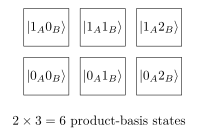
图 1 将 basis pair 的 Cartesian grid 显示为 tensor-product dimension。
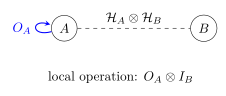
图 2 区分 local operation 与 subsystem partition;虚线不是 interaction Hamiltonian。
2. Separable and entangled states / 可分离态与纠缠态
Knowledge ID: P07-U08-L02-K02
pure state separable 当且仅当存在 \(\lvert a\rangle,\lvert b\rangle\) 使 \(\lvert\Psi\rangle=\lvert a\rangle\otimes\lvert b\rangle\)。等价地,coefficient matrix \(C\) rank 为 1。Schmidt decomposition 给
\[\lvert\Psi\rangle=\sum_{r=1}^{R}s_r\lvert u_r\rangle_A\lvert v_r\rangle_B, \qquad \sum_rs_r^2=1.\]
\(R=1\) separable,\(R>1\) entangled。entanglement 依赖 subsystem partition,但不依赖各子系统内的 local basis change。
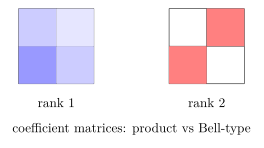
图 3 用 matrix rank 区分 factorable pattern 与不可 factor pattern。
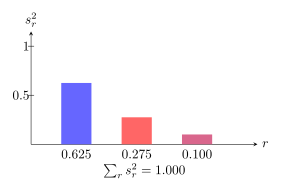
图 4 用 normalized heights \(0.625+0.275+0.100=1.000\) 画 Schmidt probabilities;只有一根 bar 的高度为 1 时才是 product state。
3. Reduced density matrices / 约化密度矩阵
Knowledge ID: P07-U08-L02-K03
对 \(\rho_{AB}=\lvert\Psi\rangle\langle\Psi\rvert\),只访问 \(A\) 时必须 partial trace:
\[\rho_A=\operatorname{Tr}_B\rho_{AB} =\sum_j{}_B\langle j\rvert\rho_{AB}\lvert j\rangle_B.\]
Schmidt basis 中 \(\rho_A=\sum_rs_r^2\lvert u_r\rangle\langle u_r\rvert\)。因此 pure entangled whole 可给 mixed local state;这不是“我们主观不知道 pure state”,而是所有 local observable statistics 的完整描述。\(\rho_A\) 与 \(\rho_B\) 具有相同非零 eigenvalues。
partial trace 的计算可以理解为把不可访问子系统的每个正交结果都做完备求和。它不会挑选某一个 \(B\) 结果,也不会把 entanglement 当作 classical ignorance;相反,\(A\) 的 off-diagonal terms 是否保留,取决于与之相连的 \(B\) states 是否仍有 overlap。若测量后把 \(B\) outcome 分类保存,conditional state of \(A\) 可以是 pure;若忽略该记录,unconditional \(\rho_A\) 才是这些条件态的加权和。两种说法对应不同的信息条件,不能混写。
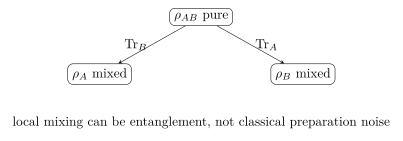
图 5 表示 partial trace 是 subsystem restriction,不是 physical destruction operation。
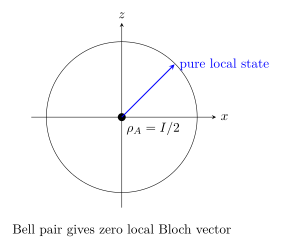
图 6 对比 pure qubit 的 Bloch-sphere surface vector 与 maximally entangled pair 的 maximally mixed local center。
4. Bell inequalities and nonclassical correlations / 贝尔不等式与非经典关联
Knowledge ID: P07-U08-L02-K04
local hidden-variable model 给 outcomes \(A(a,\lambda),B(b,\lambda)=\pm1\)。对每个 \(\lambda\),
\[\lvert A(a)[B(b)+B(b')]+A(a')[B(b)-B(b')]\rvert=2,\]
平均得 CHSH bound
\[\lvert S\rvert=\lvert E(a,b)+E(a,b')+E(a',b)-E(a',b')\rvert\le2.\]
量子 singlet 有 \(E(\mathbf a,\mathbf b)=-\mathbf a\cdot\mathbf b\),合适 axes 得 \(\lvert S\rvert=2\sqrt2\)。violating Bell inequality 排除满足实验假设的 local-hidden-variable model;它不允许 controllable faster-than-light messaging,因为任一方 local marginal 与远端 setting 无关。
CHSH 的逻辑不是比较四个同时可测的 quantum observables,而是比较四组独立重复实验的 correlations。local hidden-variable model 假定每一轮在给定 hidden variable 后,对任一可能 setting 都有局部结果函数;正是这一共同赋值使每轮的代数组合只能等于 \(\pm2\)。量子理论不为不相容 observables 提供同一轮的共同预存值,却能预测四组 ensemble correlations。实验分析还必须控制 setting independence、detection efficiency 与 spacelike separation,才能把 violation 准确解释为对 local realism 的约束。
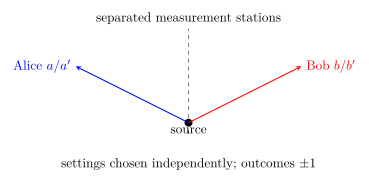
图 7 显示 CHSH protocol 的两方与 independently chosen settings。
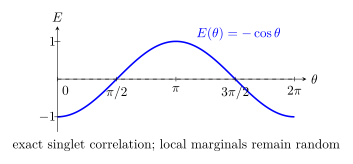
图 8 画出真实函数 \(E(\theta)=-\cos\theta\):\(E(0)=-1\)、\(E(\pi/2)=0\)、\(E(\pi)=+1\),并以 \(2\pi\) 周期返回;单边 outcomes 仍各自 random。
5. Qubits, gates, teleportation, and no-cloning / 量子比特、量子门、隐形传态与不可克隆
Knowledge ID: P07-U08-L02-K05
qubit 为 \(\lvert\psi\rangle=\alpha\lvert0\rangle+\beta\lvert1\rangle\),\(\lvert\alpha\rvert^2+\lvert\beta\rvert^2=1\)。Hadamard 与 CNOT 可由 \(\lvert00\rangle\) 制备 \(\lvert\Phi^+\rangle=(\lvert00\rangle+\lvert11\rangle)/\sqrt2\)。teleportation identity 可概括为:Alice 对 unknown qubit 与其 Bell half 作 Bell measurement,发送 2 classical bits,Bob 施加 \(I,X,Z\) 或 \(XZ\) correction;Alice 原 state 被 measurement 消耗。
universal cloning unitary 若满足 \(U\lvert\psi\rangle\lvert0\rangle=\lvert\psi\rangle\lvert\psi\rangle\),则 inner-product preservation 要求
\[\lvert\langle\phi\vert\psi\rangle\rvert =\lvert\langle\phi\vert\psi\rangle\rvert^2,\]
仅对 \(\lvert\text{overlap}\rvert=0\) 或 \(1\) 成立;后一种情况是同一 quantum ray(可差 global phase),故不能 clone arbitrary nonorthogonal states。
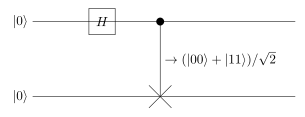
图 9 是 Bell-pair preparation circuit;CNOT 复制 basis correlation,不复制 arbitrary input state。

图 10 将 teleportation 的两种 resources 分开:entanglement alone 不足,classical message 仍必需。
Worked Examples / 完整例题
Worked Example 1 — CNOT 生成 Bell state 与 local mixture
已知。 input \(\lvert+\rangle_A\lvert0\rangle_B\),\(\lvert+\rangle=(\lvert0\rangle+\lvert1\rangle)/\sqrt2\)。
系统与模型。 两 distinguishable qubits;A 为 CNOT control,B 为 target。
计算。 CNOT 输出 \((\lvert00\rangle+\lvert11\rangle)/\sqrt2\)。\(\rho_{AB}\) 含四项;对 B trace 后 cross terms 因 \(\langle0\vert1\rangle=0\) 消失,\(\rho_A=(\lvert0\rangle\langle0\rvert+\lvert1\rangle\langle1\rvert)/2=I/2\)。
检查与解释。 \(\operatorname{Tr}\rho_A=1\)、\(\rho_A^2\) trace 为 \(1/2\);整体 pure、局部 mixed,故 entangled。
Worked Example 2 — Coefficient matrix 的 separability
已知。 \(\lvert\Psi\rangle=(\lvert00\rangle+2\lvert01\rangle+2\lvert10\rangle+4\lvert11\rangle)/5\)。
系统与 basis。 两 qubits,basis order 如 scope。
计算。 \(C=(1/5)\begin{pmatrix}1&2\\2&4\end{pmatrix}\),determinant 为 0、rank 1;故 \(\lvert\Psi\rangle=[(\lvert0\rangle+2\lvert1\rangle)/\sqrt5]_A\otimes[(\lvert0\rangle+2\lvert1\rangle)/\sqrt5]_B\)。
检查与解释。 amplitudes squares sum \((1+4+4+16)/25=1\);factorization 直接验证 separable。
Worked Example 3 — Singlet 的 CHSH violation
已知。 \(E(\mathbf a,\mathbf b)=-\cos(\theta_a-\theta_b)\);选 \(a=0^\circ,a'=90^\circ,b=45^\circ,b'=-45^\circ\),采用 \(S=E(a,b)+E(a,b')+E(a',b)-E(a',b')\)。
系统与模型。 许多同样制备的 singlet pairs;ideal projective spin measurements,settings independent。
计算。 前三项为 \(-1/\sqrt2\),最后 \(E(90^\circ,-45^\circ)=+1/\sqrt2\),故 \(S=-4/\sqrt2=-2\sqrt2\),\(\lvert S\rvert=2.828>2\)。
检查与解释。 未超过 quantum Tsirelson bound \(2\sqrt2\);local marginals 仍为 zero expectation,因此 violation 不是可控 signal。
Worked Example 4 — Teleportation correction table
已知。 Alice 输入 \(\lvert\psi\rangle=\alpha\lvert0\rangle+\beta\lvert1\rangle\) 并与 Bob 分享 \(\lvert\Phi^+\rangle\)。
系统边界与模型。 三 qubits;Alice 做 Bell-basis measurement 并发送 outcome,Bob 只做 local unitary。
推导。 联合态可重写为 \(\frac12[\lvert\Phi^+\rangle\lvert\psi\rangle+\lvert\Psi^+\rangle X\lvert\psi\rangle+\lvert\Phi^-\rangle Z\lvert\psi\rangle+\lvert\Psi^-\rangle XZ\lvert\psi\rangle]\)(global phases irrelevant)。Bob 依 outcomes 分别施加 \(I,X,Z,ZX\),恢复 \(\lvert\psi\rangle\)。
检查与解释。 四 outcomes 各概率 \(1/4\),sum 1;Bob 在收到 bits 前的 reduced state 是 \(I/2\),不能提前读取 \(\alpha,\beta\)。Alice 原 input 已被 Bell measurement 消耗,符合 no-cloning。
Lesson synthesis / 全课综合
先定义 subsystem partition 与 tensor-product basis,再判定 coefficient matrix 能否 factor;不能 factor 时用 Schmidt spectrum 与 reduced states 量化局部可见信息;Bell test 比较 correlation structure 与 local-hidden-variable polytope;quantum circuits 则把 entanglement 当资源,但始终受 no-signalling 与 no-cloning 限制。
这里有三层必须分开。第一层是数学结构:张量积把两个子系统的可能性组合起来,纠缠只是其中不能写成单一乘积的向量。第二层是局部可观测性:即使整体向量完全已知,一方仍只能用约化密度矩阵预测实验;把远端结果忽略后得到的混合不是计算粗糙造成的。第三层是相关性的因果解释:CHSH violation 说明这些联合统计不能由同时具备 locality 与预存 classical values 的模型复现,但每一方的边缘分布仍与远端 setting 无关。正因如此,teleportation 必须等待两 classical bits,而 entanglement 本身不能作为超光速电话。
还要注意,纠缠不是某个固定 basis 中“看见两项”就成立;局部 basis 旋转可以改变展开式的项数,却不会改变 Schmidt coefficients。可靠判据应基于 factorization、rank 或 reduced-state spectrum,而不是肉眼数 ket。
在电路语言中还要区分“复制已知正交符号”和“复制未知量子态”。CNOT 对 \(\lvert0\rangle,\lvert1\rangle\) 的表现像经典复制器,但对 superposition 会把 control 与 target 纠缠,产生的每个局部态都不是原纯态的第二份副本。no-cloning proof 的关键不是设备技术不足,而是 linearity 与 inner-product preservation;这也解释了量子密码为什么能检测窃听,以及 teleportation 为什么必须消耗原态。
Formula-and-decision table / 公式与决策表
| Need | Formula | Use when | Limitation |
|---|---|---|---|
| Composite dimension | \(d_{AB}=d_Ad_B\) | distinguishable subsystems | identical particles还要取 symmetry sector |
| Pure separability | \(\operatorname{rank}C=1\) | bipartite pure state | mixed states need convex test |
| Schmidt form | \(\sum_rs_r\lvert u_rv_r\rangle\) | any bipartite pure state | partition-dependent |
| Reduced state | \(\rho_A=\operatorname{Tr}_B\rho_{AB}\) | local statistics | does not specify full correlations |
| CHSH classical bound | \(\lvert S\rvert\le2\) | local hidden-variable assumptions | experimental loopholes matter |
| Singlet correlation | \(E=-\mathbf a\cdot\mathbf b\) | ideal spin singlet | noise reduces visibility |
| No-cloning test | \(\lvert z\rvert=\lvert z\rvert^2\) for arbitrary overlap \(z\) | hypothetical unitary cloner | \(\lvert z\rvert=1\) 是同一 ray;orthogonal known set may be copied |
Model boundaries / 模型边界
- Entanglement is relative to a subsystem decomposition; not every mathematical factorization is operationally accessible。
- Pure-state Schmidt rank does not classify mixed-state entanglement。
- Bell violation tests local realism under assumptions including setting independence and valid sampling; modern loophole-free designs address these experimentally。
- Bell correlation plus no-signalling does not define a communication channel。
- Teleportation fidelity in real devices is reduced by noisy entanglement, gates and measurements。
- No-cloning forbids universal perfect cloning of unknown nonorthogonal states; approximate/probabilistic protocols have separate bounds。
- Qubit model ignores leakage outside chosen two-level subspace。
Misconception clinic / 误区诊所
- “任何 superposition 都是 entangled。” 单系统 superposition 不等于 subsystem-nonfactorability。
- “measurement correlation 说明 Alice sends result to Bob instantly。” local marginal 不依赖 remote setting;只有 joint data comparison reveals correlation。
- “partial trace 是把 B physically erased。” 它计算 A-only observables,系统可仍存在且 entangled。
- “Bell violation proves faster-than-light causation。” 它排除 local-hidden-variable explanation,不提供 controllable signal。
- “CNOT 可以复制 qubit。” 它复制 computational-basis information;对 \(\lvert+\rangle\) 生成 entanglement而非两份 \(\lvert+\rangle\)。
- “teleportation sends an object instantly。” 它传 quantum state relation,需要 shared entanglement 和 ordinary classical communication。
Practice and retrieval / 练习与提取
- K01: \(d_A=3,d_B=4\) 时 composite dimension 是多少?
- K01: \(O_A\) 在 total space 怎样表示?
- K02: Bell state coefficient matrix 的 rank 是多少?
- K02: Schmidt coefficients 只有一个非零意味着什么?
- K03: \(\lvert\Phi^+\rangle\) 的 \(\rho_B\) 是什么?
- K03: pure state 的 \(\operatorname{Tr}\rho^2\) 等于多少?
- K04: CHSH local bound 与 quantum maximum 分别是多少?
- K04: 为什么单边 statistics 不能传递 remote setting?
- K05: \(H\) 后接 CNOT 对 \(\lvert00\rangle\) 的输出是什么?
- K05: no-cloning inner-product proof 中哪些 overlaps 不产生矛盾?
Answers / 答案
- \(3\times4=12\)。
- \(O_A\otimes I_B\)。
- 2,因此不可 factor、entangled。
- Schmidt rank 1,state separable。
- \(I/2\)。
- 1;对 mixed state 小于 1。
- classical local bound 2;quantum Tsirelson maximum \(2\sqrt2\)。
- reduced state \(\rho_A\) 与 Bob 的 choice 无关;Alice outcomes distribution unchanged。
- \((\lvert00\rangle+\lvert11\rangle)/\sqrt2\)。
- \(\lvert z\rvert=0\)(orthogonal)或 \(\lvert z\rvert=1\)(same quantum ray up to phase);arbitrary \(0<\lvert z\rvert<1\) impossible。
Exit ticket / 离堂检验
- 给出一个 global pure/local mixed 的 explicit state,并算出一边的 reduced matrix。
- 用两句分别解释 Bell violation 为何超越 classical locality、又为何不违反 no-signalling。
References and source notes / 参考资料与来源说明
以下来源均于 2026-08-30 实际打开核验。
- MIT OCW 8.06 (2016), Chapter 3: Entanglement, Density Matrices, and Decoherence
- Caltech Preskill Lecture Notes, Chapter 4: Quantum Entanglement
- MIT 18.435, Lecture 3: Bell, No-Cloning, and Teleportation
- University of Washington CSE 599Q: CHSH, No-Cloning, and Teleportation
- MIT OCW STS.042, Bell's Inequality and Quantum Entanglement
- MIT OCW MAS.865J, Lecture 1: Density Matrices and System–Environment
Source-to-content map
| Source | Used for | Knowledge ID / Section | Model boundary or convention |
|---|---|---|---|
| MIT 8.06 Chapter 3 | tensor products, reduced states, decoherence boundary | K01–K03 | bipartite pure focus |
| Preskill Chapter 4 | Bell, teleportation, no-cloning | K02–K05 | selected UG2/EXT material only |
| MIT 18.435 Lecture 3 | explicit CHSH settings and teleportation logic | K04–K05 | sign convention stated in example |
| UW CSE 599Q | circuit-level no-cloning and teleportation | K05 | computational basis fixed |
| MIT STS.042 notes | Bell historical/experimental interpretation | K04 | does not replace technical derivation |
| MIT MAS.865J | density matrices and environment operations | K03–K05 | prepares next lesson |
复习与拓展
- 下一课 distinguishes proper statistical mixtures from reduced states and develops decoherence/master equations。
- Quantum computing can extend gates to algorithms, error correction and channels。
- Many-body physics uses entanglement entropy and tensor networks。
- Experimental extension: simulate finite visibility \(E\to VE\) and find CHSH violation threshold \(V>1/\sqrt2\)。