
Learning objectives / 学习目标
完成本课后,你应能:
- 推导 linear rigid rotor 的 \(E_J=BJ(J+1)\)、degeneracy 与 pure rotational spacing。
- 由 harmonic/Morse expansion 得振动能级、zero-point energy 与 anharmonic overtone trend。
- 分解 diatomic rovibrational transition 为 P/R branches,并说明 Q branch 何时缺失或出现。
- 用 dipole derivative、polarizability derivative 和 molecular symmetry 区分 IR 与 Raman activity。
- 由 Stokes/anti-Stokes shifts 与 Boltzmann populations 解释 Raman spectrum。
- 完成单位、reduced mass、wavenumber/frequency 和 model-boundary checks。
Prerequisites / 先修知识
- Molecular Bonding:Born–Oppenheimer potential、\(R_e\)、\(k\)。
- Orbital Angular Momentum:rotor eigenvalues 与 \(2J+1\) degeneracy。
- Quantum Harmonic Oscillator:\(E_v=\hbar\omega(v+1/2)\)。
Scope and conventions / 范围与约定
- 先研究 closed-shell heteronuclear diatomic molecule,无电子/核自旋;center-of-mass frame,internuclear axis 是 body-fixed axis。
- rotational quantum number 用 \(J\),vibrational 用 \(v\);不与 electronic \(J\) 混用时由上下文区分。
- spectroscopy wavenumber \(\tilde\nu\) 以 \(\mathrm{cm^{-1}}\) 常用;\(E=hc\tilde\nu\)。rotational constant \(\tilde B\) 也用 \(\mathrm{cm^{-1}}\)。
- rigid rotor、harmonic oscillator 是最低阶模型;centrifugal distortion、rotation–vibration interaction 与 anharmonicity 作为修正。
- homonuclear molecules 无 permanent electric dipole,故无普通 pure rotational E1 / fundamental IR dipole absorption,但可能 Raman active。
Notation and modeling contract / 符号与建模契约
| Symbol | Meaning | SI unit |
|---|---|---|
| \(\mu=m_1m_2/(m_1+m_2)\) | nuclear reduced mass | kg |
| \(I=\mu R_e^2\) | diatomic moment of inertia | kg m\(^2\) |
| \(J,M\) | rotational quantum number/projection | 1 |
| \(\tilde B=h/(8\pi^2cI)\) | rotational constant in wavenumber | m\(^{-1}\) |
| \(v\) | vibrational quantum number | 1 |
| \(\omega_e\) | local angular vibrational frequency | s\(^{-1}\) |
| \(\tilde{\omega}_e=\omega_e/(2\pi c)\) | spectroscopic vibrational constant in wavenumber | m\(^{-1}\)(常用 cm\(^{-1}\)) |
| \(x_e\) | dimensionless anharmonicity constant | 1 |
| \(\boldsymbol\mu_d\) | molecular electric dipole | C m |
| \(\alpha_p\) | molecular polarizability tensor | C m\(^2\) V\(^{-1}\) |
1. Rigid-rotor energy levels / 刚性转子能级
Knowledge ID: P08-U02-L02-K01
固定 \(R=R_e\) 的 linear rotor Hamiltonian 是 \(L^2/(2I)\),故
\[E_J=\frac{\hbar^2}{2I}J(J+1)=hc\tilde BJ(J+1), \qquad J=0,1,2,\ldots\]
每个 \(J\) 有 \(2J+1\) 个 \(M\) states。permanent-dipole E1 pure rotational rule 为 \(\Delta J=\pm1\),absorption \(J\to J+1\) 的 wavenumber
\[\tilde\nu_J=2\tilde B(J+1).\]
因此相邻 lines 间隔 \(2\tilde B\)。高 \(J\) 时 bond stretches,加入 \(-hc\tilde D J^2(J+1)^2\) centrifugal distortion,间隔不再严格相等。
这组结论可以直接从角动量本征值理解:刚性约束把径向自由度冻结,只留下分子轴在球面上的取向,因此 kinetic energy 由 \(\hat J^2/(2I)\) 给出。能级简并来自空间各向同性,而不是“分子可以沿 \(2J+1\) 条轨道旋转”。若施加外场、考虑核自旋统计或分子处于非线性转子构型,这个简并与简单容量都会改变。
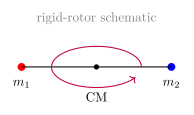
图 1 表示 center-of-mass 关于垂直轴的 rotation;原子间距固定只是 model assumption。
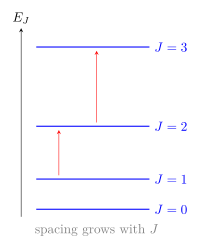
图 2 显示 \(J(J+1)\) level spacing 增长;spectral absorption lines 却因相邻差值线性于 \(J+1\) 而等距。
2. Vibrational harmonic and anharmonic models / 振动谐性与非谐性模型
Knowledge ID: P08-U02-L02-K02
在 \(R_e\) 附近令 \(q=R-R_e\):
\[U(R)=U(R_e)+\frac12kq^2+\frac16U'''(R_e)q^3+\cdots.\]
harmonic frequency 与 levels:
\[\omega_e=\sqrt{\frac{k}{\mu}}, \qquad E_v=\hbar\omega_e\left(v+\frac12\right).\]
Morse-like anharmonic spectrum 常写为
\[\frac{E_v}{hc}=\tilde{\omega}_e\left(v+\frac12\right) -\tilde{\omega}_e x_e\left(v+\frac12\right)^2.\]
相邻 spacings 随 \(v\) 下降,有限 number of bound levels 终止于 dissociation。弱 overtones \(\Delta v=2,3,\ldots\) 可来自两种不同来源:mechanical anharmonicity 改变态与能级;electrical anharmonicity 则来自 transition operator 的高阶展开。即使势能保持 harmonic,若
\[\mu_d(Q)=\mu_0+\mu'_0Q+\frac12\mu''_0Q^2+\cdots,\]
\(Q^2,Q^3,\ldots\) 项也可产生 overtone matrix elements。Raman 中相同逻辑作用于 \(\alpha_p(Q)\) 的高阶导数。因此“仅有 \(\Delta v=\pm1\)”必须同时假设 harmonic eigenstates 与 linear dipole approximation。
谐振子之所以只在低 \(v\) 可靠,是因为它只读取势能曲线在 \(R_e\) 处的二阶导数;三阶项带来左右不对称,四阶及更高项继续修正能级。实验上,基本频率给出局部曲率,连续几个 overtone 的非等距则约束 \(x_e\) 与解离趋势。把一条高阶跃迁仍强行解释成等距弹簧,会同时误判 force constant 与 dissociation energy。
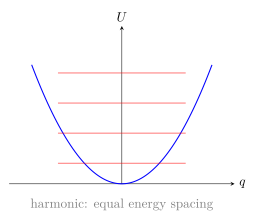
图 3 把 quadratic well 与等距 levels 对齐;水平线长度不代表波函数 support。
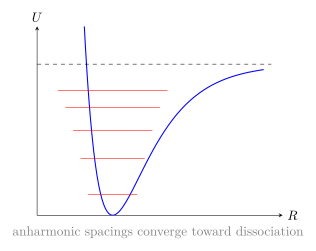
图 4 是 Morse-like well;level spacing 与 binding interval 均随 \(v\) 增大而缩小。
3. Rotational–vibrational spectra / 转动—振动光谱
Knowledge ID: P08-U02-L02-K03
最低阶 rovibrational term value 是
\[\frac{E(v,J)}{hc}\approx\tilde{\omega}_e\left(v+\frac12\right)+\tilde B_vJ(J+1).\]
对 linear diatomic fundamental \(v=0\to1\),同时 \(\Delta J=\pm1\):\(\Delta J=-1\) 是 P branch、\(+1\) 是 R branch;普通 \(\Sigma\leftrightarrow\Sigma\) diatomic E1 中 \(\Delta J=0\) 的 Q branch 缺失。若近似 \(B_0\approx B_1=\tilde B\),lines 位于 band origin 两侧约 \(2\tilde B\) 等距;真实 \(B_1<B_0\) 使 branches slightly converge/diverge 并形成 band head possibilities。
这里的 band origin 是在忽略转动贡献时的振动跃迁位置,并不一定对应一条实际可见谱线。每条线的强度还乘 lower-state Boltzmann population、Hönl–London angular factor 与仪器响应。因而“谱峰最高的位置”不能未经拟合就当作 \(\tilde{\omega}_e\);可靠反演应同时拟合 P/R 两支的位置和强度包络。
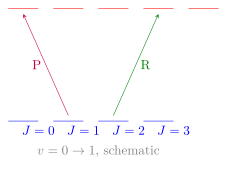
图 5 用 lower/upper vibrational manifolds 展示 P/R angular changes;未画 Q 是该简化 symmetry case 的 selection rule。
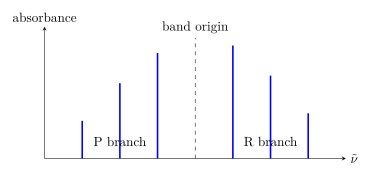
图 6 是 idealized rovibrational band;peak envelope 来自 rotational populations 和 line strengths,不是 additional energy levels。
4. Selection rules and molecular symmetry / 选择定则与分子对称性
Knowledge ID: P08-U02-L02-K04
IR vibrational intensity 要求 normal coordinate \(Q\) 改变 dipole moment:
\[\left(\frac{\partial\boldsymbol\mu_d}{\partial Q}\right)_0\ne0.\]
Raman activity 则要求 polarizability tensor 改变:
\[\left(\frac{\partial\alpha_p}{\partial Q}\right)_0\ne0.\]
selection rule 是 integral symmetry:integrand 必须含 totally symmetric representation。对有 inversion center 的 molecule,mutual exclusion 常成立:gerade Raman-active modes 与 ungerade IR-active modes 分开。对无 inversion center 的分子,同一 mode 可同时活跃。
判断一个 normal mode 是否可见时,应先明确平衡构型的 point group,再确定该 mode、dipole-vector components 与 polarizability-tensor components 的 irreducible representations。只有直积中含 totally symmetric representation,相关积分才可能非零。这个步骤解释了“谱线缺失”为什么是对称性证据;但实验缺峰也可能来自低灵敏度、峰重叠或 population,不可只凭肉眼作唯一归因。
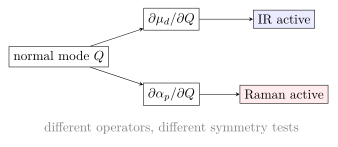
图 7 将 IR 与 Raman activity 的 operator derivatives 分开,避免以“有/无 dipole”一条规则覆盖所有 spectroscopy。
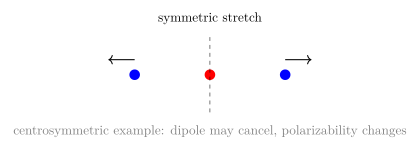
图 8 是 centrosymmetric triatomic 的 symmetric stretch schematic;实际 activity 需 point-group representation,不可只凭视觉猜测。
5. Raman scattering / 拉曼散射
Knowledge ID: P08-U02-L02-K05
Raman 是 inelastic light scattering。incident frequency \(\nu_L\) 通过 virtual intermediate amplitude;若 molecule 最终 gain energy \(\Delta E\),Stokes photon
\[\nu_S=\nu_L-\frac{\Delta E}{h};\]
若 molecule 初态已激发并 lose energy,anti-Stokes photon
\[\nu_{AS}=\nu_L+\frac{\Delta E}{h}.\]
shift \(\Delta\tilde\nu\) 与 laser frequency 近似无关,便于材料 fingerprint。rotational Raman 对 linear rotor 常有 \(\Delta J=\pm2\);vibrational Raman harmonic limit 主导 \(\Delta v=\pm1\)。anti-Stokes 通常更弱,因为 excited initial population 按 Boltzmann factor 减少。
Raman 强度还依赖入射与散射偏振、张量取向和探测几何。若 laser frequency 靠近真实 electronic transition,resonance Raman 会选择性增强与该 electronic excitation 耦合的 modes;此时简单的远失谐 polarizability picture 仍给出对称性语言,却不足以定量预测强度。
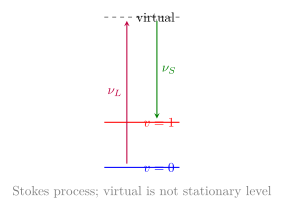
图 9 显示 Stokes scattering 后 molecule 留在更高 vibrational state;dashed virtual state 不应当作真实寿命能级。
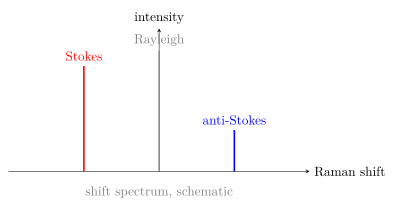
图 10 对比 Rayleigh、Stokes 与 anti-Stokes;横轴符号取决于仪器 convention,物理判断应回到 photon energy balance。
Worked Examples / 完整例题
Worked Example 1 — 从 rotational spacing 求 bond length
已知与系统。 heteronuclear diatomic pure rotational lines 间隔 \(2\tilde B=20.0\,\mathrm{cm^{-1}}\),\(\mu=1.627\times10^{-27}\,\mathrm{kg}\)。质心系、rigid rotor。
\(\tilde B=10.0\,\mathrm{cm^{-1}}=1000\,\mathrm{m^{-1}}\),
\[I=\frac{h}{8\pi^2c\tilde B}=2.799\times10^{-47}\,\mathrm{kg\,m^2},\]
\[R_e=\sqrt{\frac I\mu}=1.31\times10^{-10}\,\mathrm m=0.131\,\mathrm{nm}.\]
检查与解释。 \(c\tilde B\) 有 s\(^{-1}\),\(h/(c\tilde B)\) 有 kg m\(^2\);angstrom-scale 结果合理。centrifugal distortion 会让不同 line pairs 给略不同 apparent \(B\)。
Worked Example 2 — isotope shift of vibration
已知与模型。 force constant 不变,isotopologue reduced mass 从 \(\mu\) 变 \(2\mu\)。harmonic frequency
\[\omega'=\sqrt{\frac{k}{2\mu}}=\frac{\omega}{\sqrt2}.\]
若原 fundamental 为 \(3000\,\mathrm{cm^{-1}}\),新值约 \(2121\,\mathrm{cm^{-1}}\)。
检查与解释。 ratio 无量纲;heavier isotope red-shifts vibration。BO electronic curve nearly same 是假设,small adiabatic corrections 未计。
Worked Example 3 — P/R branch positions
已知。 band origin \(\tilde\nu_0=2000\,\mathrm{cm^{-1}}\),取 \(B_0=B_1=1.50\,\mathrm{cm^{-1}}\)。对 lower \(J=2\):
R branch \(J'=3\):
\[\tilde\nu_R(2)=\tilde\nu_0+2B(J+1)=2009.0\,\mathrm{cm^{-1}}.\]
P branch \(J'=1\):
\[\tilde\nu_P(2)=\tilde\nu_0-2BJ=1994.0\,\mathrm{cm^{-1}}.\]
检查与解释。 R 在高 wavenumber、P 在低 wavenumber;同一 \(J\) 的 offsets 不对称是 \(J+1\) 与 \(J\) 的差。真实 \(B_1\ne B_0\) 会修正。
Worked Example 4 — anti-Stokes/Stokes population ratio
已知与模型。 vibrational shift \(1000\,\mathrm{cm^{-1}}\),\(T=300\,\mathrm K\);假设 scattering factors 相同,仅比较 initial populations。
用 \(hc/k_B=1.4387769\,\mathrm{cm\,K}\):
\[\frac{N_1}{N_0}=\exp\left[-\frac{hc(1000\,\mathrm{cm^{-1}})}{k_BT}\right] =e^{-4.796}=8.26\times10^{-3}.\]
检查与解释。 exponent 无量纲;anti-Stokes 约为 Stokes 的 \(0.8\%\) population scale。严格 intensity ratio 还含 photon-frequency fourth-power 与 instrument response。
Lesson synthesis / 全课综合
从 spectrum 回到 structure 的流程:纯转动 spacing → \(B\) → \(I\) → \(R_e\);振动 origin → \(\omega_e\) → \(k\);branch curvature → \(B_v,D_v\) 与 rotation–vibration coupling;missing/present lines → dipole/polarizability derivatives 与 symmetry;Stokes/anti-Stokes ratio → temperature/population。每一步都先声明单位和模型。
Formula-and-decision table / 公式与决策表
| Need | Formula | Use when | Boundary |
|---|---|---|---|
| rigid rotor | \(E_J=\hbar^2J(J+1)/(2I)\) | fixed \(R_e\) | centrifugal distortion at high \(J\) |
| rotational line | \(\tilde\nu=2\tilde B(J+1)\) | permanent dipole, absorption | homonuclear E1 absent |
| harmonic vibration | \(\omega_e=\sqrt{k/\mu}\),\(\tilde{\omega}_e=\omega_e/(2\pi c)\) | near \(R_e\); harmonic eigenstates | no dissociation; \(\Delta v=\pm1\) only together with linear dipole \(\mu(Q)\approx\mu_0+\mu'_0Q\) |
| anharmonic terms | \(G(v)=\tilde{\omega}_e(v+1/2)-\tilde{\omega}_e x_e(v+1/2)^2\) | Morse-like low levels | constants may vary |
| IR activity | \(\partial\mu_d/\partial Q\ne0\) | dipole absorption | symmetry-specific tensor components |
| Raman activity | \(\partial\alpha_p/\partial Q\ne0\) | inelastic scattering | resonance Raman needs extension |
Model boundaries / 模型边界
- Rigid rotor ignores centrifugal stretching and electronic angular momentum.
- Harmonic potential gives no dissociation;harmonic eigenstates combined with a linear transition dipole give only \(\Delta v=\pm1\),而 mechanical anharmonicity 或 \(\mu_d(Q)\) / \(\alpha_p(Q)\) 的高阶项都可产生 overtones。
- Simple P/R pattern assumes linear molecule, specific electronic symmetry and \(B_0\approx B_1\).
- Point-group selection rules require correct normal-mode irreducible representations.
- Raman virtual-state picture is perturbative; near electronic resonance, intensities change strongly.
- Thermal intensity formulas assume equilibrium and optically thin sample.
Misconception clinic / 误区诊所
- “rigid rotor levels equally spaced。” \(E_J\) spacings grow;pure rotational transition frequencies 才等距。
- “homonuclear molecule 没有光谱。” 它可有 Raman、electronic、quadrupole 等 spectra,只是 ordinary permanent-dipole rotational/IR rules differ。
- “zero-point energy 表示分子经典振动。” 它是 ground-state quantum energy,不是一条确定轨迹。
- “Q branch 永远不存在。” 它在简单 diatomic \(\Sigma\leftrightarrow\Sigma\) 中缺失,但其他 angular symmetries/polyatomics 可出现。
- “IR inactive 就 Raman inactive。” 两者测试不同 operator derivatives;centrosymmetric molecules 常 mutual exclusion。
- “virtual state 是短寿命真实能级。” 它是 scattering amplitude 中的 off-shell intermediate description。
Practice and retrieval / 练习与提取
- K01: \(J=4\) rotor level 有多少 \(M\) states?
- K01: 若 \(R_e\) 增大 10% 且 \(\mu\) 不变,\(B\) 变为多少倍?
- K02: \(k\) 增大四倍,harmonic frequency 如何变?
- K02: 为什么 anharmonic level spacing 随 \(v\) 减小?
- K03: 定义 P、Q、R branches 的 \(\Delta J\)。
- K03: ideal \(B=2.0\,\mathrm{cm^{-1}}\) 时 pure rotational line spacing 是多少?
- K04: 给出 IR active 与 Raman active 的 derivative tests。
- K04: centrosymmetric molecule 的 mutual exclusion 表示什么?
- K05: Stokes photon 比 laser photon 能量高还是低?差值去哪了?
- 综合: 如何用 IR 与 Raman 联合判断一个 vibrational mode 的 symmetry?
Answers / 答案
- \(2J+1=9\)。
- \(I\propto R_e^2\)、\(B\propto1/I\),故变为 \(1/1.1^2=0.826\) 倍。
- \(\omega\propto\sqrt k\),变 2 倍。
- real bond potential 向 dissociation 方向变平;Morse correction 使 \(G(v+1)-G(v)\) 随 \(v\) 线性下降。
- P: \(-1\),Q: \(0\),R: \(+1\)。
- \(2B=4.0\,\mathrm{cm^{-1}}\)。
- IR: \((\partial\mu_d/\partial Q)_0\ne0\);Raman: \((\partial\alpha_p/\partial Q)_0\ne0\)。
- inversion-symmetric 情况下同一 normal mode 通常不能同时 IR 与 Raman active;ungerade/gerade 分属不同 operator symmetry。
- 更低;差值作为 molecule 的 rotational/vibrational excitation energy。
- 测同一 frequency mode 是否出现在 IR/Raman,结合 polarization/depolarization 与 point-group character table;不能只凭峰缺失,需考虑 sensitivity 和 overlap。
Exit ticket / 离堂检验
- 给出从三条相邻 microwave lines 反演 \(B,D\) 并检查 rigid-rotor validity 的方法。
- 解释为什么 isotopic substitution 同时改变 rotational 与 vibrational spectra,却一阶不大改 BO electronic potential。
References and source notes / 参考资料与来源说明
以下来源于 2026-08-30 实际打开核验;所有计算按 SI 与波数 convention 独立复算,TikZ 原创。
- OpenStax University Physics 3 — Molecular Spectra
- MIT OCW 5.80 Lecture 3 Supplement — Anharmonic Oscillator and Vibration–Rotation Interaction
- NIST Molecular Spectroscopy — Molecular Parameters and Energy Levels
- MIT Junior Lab — Raman Spectroscopy on Diatomic Molecules
- NIST Chemistry WebBook — Vibrational and Electronic Energy Levels
- NIST SRD — Molecular Parameter and Selection-Rule Conventions
Source-to-content map
| Source | Used for | Knowledge ID / Section | Model boundary or convention |
|---|---|---|---|
| OpenStax 9.2 | rotor, oscillator and P/R band intuition | K01–K03 | simple diatomic level |
| MIT 5.80 Suppl. 3 | anharmonicity and rotation–vibration coupling | K02–K03 | perturbative expansion in \(q/R_e\) |
| NIST MolSpec Hydro | rotational constants, distortion, selection conventions | K01, K03–K04 | real molecules nonrigid |
| MIT Raman proposal | Raman shifts and extraction of bond properties | K05 | experimental context |
| NIST WebBook | authoritative vibrational/electronic data interface | K02–K05 | data depend on phase/matrix conditions |
| NIST Triatomic | polyatomic selection rules and constants | K04 | diatomic model not blindly generalized |
复习与拓展
- Lesson 8.2.3 embeds these rotational/vibrational ladders inside electronic states.
- Radiative Processes derives transition rates and lifetimes.
- Precision spectroscopy later treats Doppler-free and coherent methods.