
Learning objectives / 学习目标
完成本课后,你应能:
- 用 Born–Oppenheimer product states 将 electronic、vibrational、rotational energies 组织成 vibronic bands。
- 由 Franck–Condon overlap 与 vertical-transition picture 预测 progression 与 intensity envelope,而不把 vertical line 当核轨迹。
- 区分 fluorescence、phosphorescence、internal conversion、intersystem crossing 与 nonradiative loss,并解释 Stokes shift。
- 按 energy scale、sample requirement、operator derivative 与 selection rule 选择 microwave、IR、Raman、UV–visible method。
- 从谱图中区分 line position、band envelope、lifetime、quantum yield 与 instrument response。
- 对简单实例计算 Franck–Condon Poisson factors、Stokes shift、lifetime yield 与 photon wavelength。
Prerequisites / 先修知识
- Molecular Rotation and Vibration:rotor/vibrator levels、IR/Raman rules。
- Molecular Bonding:BO surfaces 与 dissociation asymptotes。
- Time-Dependent Processes:transition matrix elements 与 Fermi golden rule。
Scope and conventions / 范围与约定
- 分子在实验室系受光,内部核坐标以一条 effective normal coordinate \(Q\) 示意;polyatomic 实际有 \(3N-6\) 或线性分子的 \(3N-5\) vibrational modes。
- Born–Oppenheimer product \(\Psi\approx\psi_{el}(\mathbf r;Q)\chi_v(Q)\) 为起点;intensity 还可含 Herzberg–Teller/nonadiabatic corrections。
- potential curves 的纵轴是 energy、横轴是 nuclear coordinate;Franck–Condon “vertical” 指 nuclei 在 electronic transition time 内近似不变。
- fluorescence 通常指同 multiplicity 的 fast radiative decay;phosphorescence 通常涉及 spin-forbidden triplet-to-singlet decay,实际材料命名需结合态性质。
- 方法比较以 isolated/gas or simple condensed sample 为基线;solvent、matrix、reabsorption 与 concentration quenching 另行说明。
Notation and modeling contract / 符号与建模契约
| Symbol | Meaning | SI unit |
|---|---|---|
| \(Q\) | normal coordinate | m 或 mass-weighted unit |
| \(\Delta Q\) | 两 electronic surfaces 的 equilibrium-coordinate displacement | m(本课 displaced-oscillator convention) |
| \(\mu_Q\) | 该 ordinary-length normal coordinate 的 effective modal mass | kg |
| \(S_H\) | dimensionless Huang–Rhys factor | 1 |
| \(v',v''\) | upper/lower vibrational quantum numbers | 1 |
| \(q_{v'v''}\) | Franck–Condon factor | 1 |
| \(\mu_{eg}\) | electronic transition dipole | C m |
| \(k_r,k_{nr}\) | radiative/nonradiative rate | s\(^{-1}\) |
| \(\tau\) | excited-state lifetime | s |
| \(\Phi\) | luminescence quantum yield | 1 |
1. Electronic transitions and vibronic structure / 电子跃迁与振电结构
Knowledge ID: P08-U02-L03-K01
在 BO factorization 下,一个 electronic surface 上还有 vibrational/rotational ladders:
\[E\approx T_e+G(v)+F_v(J).\]
electronic transition 的 photon energy 因而为 electronic origin 加 vibrational 与 rotational differences。单个 electronic band 可含 vibrational progression,每个 vibronic line 又带 rotational fine structure;condensed phase 中碰撞和 inhomogeneity 常把细线融合成 broad band。
transition amplitude 在 Condon approximation 下近似 factorize:
\[M_{fi}\approx\mu_{eg}(Q_0)\langle\chi_{v'}\vert\chi_{v''}\rangle.\]
因此 electronic selection 与 nuclear overlap 都能让 line 强或弱。
实际读谱时要把三种层级分开:electronic origin 决定整个 band 的能量尺度,vibrational progression 记录两个 surfaces 的位移与曲率差,rotational contour 则包含 moment of inertia 和温度信息。若碰撞或溶剂使转动结构无法分辨,细线消失不等于转动量子化消失;它只是被 homogeneous 或 inhomogeneous broadening 合并。
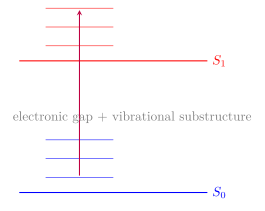
图 1 显示 electronic manifolds 内嵌 vibrational ladders;水平线不是 equally spaced 的普遍保证。
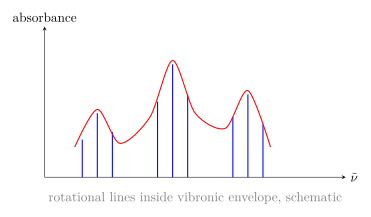
图 2 区分 discrete rotational lines 与 broader vibrational envelope;red curve 是 envelope,不是另一套能级。
2. Franck–Condon principle / 弗兰克—康登原理
Knowledge ID: P08-U02-L03-K02
electronic motion 比 nuclear motion 快,跃迁期间 \(Q\) 近似不变;quantum statement 是 vibrational overlap 控制 intensity:
\[q_{v'v''}=\left\lvert\int\chi_{v'}^*(Q)\chi_{v''}(Q)dQ\right\rvert^2.\]
在 configuration-coordinate diagram 中 vertical arrow 连接同一 \(Q\),但 strongest final \(v'\) 取决于 overlap,不一定是 \(v'=0\)。equilibrium displacement \(\Delta Q\) 有长度单位,它的效应由 dimensionless Huang–Rhys factor 编码,二者不能等同。本课在两个 harmonic surfaces 曲率相同、\(Q\) 为 ordinary length coordinate、effective modal mass 为 \(\mu_Q\) 的 convention 下定义
\[S_H=\frac{\mu_Q\omega(\Delta Q)^2}{2\hbar}.\]
若使用 mass-weighted coordinate,质量因子会吸收到坐标定义中,必须相应改写而不能混用 convention。从 \(v''=0\) 的 progression 可近似
\[q_{v'0}=e^{-S_H}\frac{S_H^{v'}}{v'!}.\]
Condon approximation 令 \(\mu_{eg}\) 对 \(Q\) 近似常数;若其导数显著,Herzberg–Teller coupling 可激活 Franck–Condon-dark modes。
Franck–Condon principle 只回答核波函数 overlap 对相对强度的贡献,并不单独判断 electronic transition 是否在 electric-dipole symmetry 下允许。完整强度是 electronic matrix element、vibrational overlap、rotational factor 与 population 的乘积。多原子分子中 normal coordinates 在两个 electronic states 之间还可能发生旋转混合;此时一维 displaced-oscillator 图仍可建立直觉,却不能替代多维 overlap calculation。
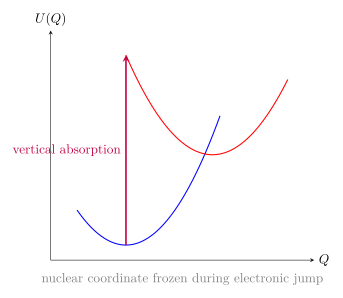
图 3 是 displaced potentials 的 vertical transition;箭头不表示 nuclei 沿竖直方向移动。
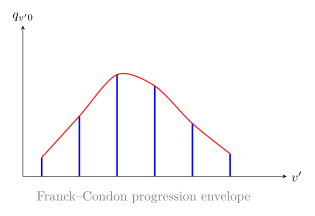
图 4 表示 overlap distribution 可以在 \(v'>0\) 达峰;具体 heights 由 displacement、frequency change 与 Duschinsky mixing 决定。
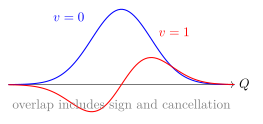
图 5 提醒 overlap 是 wavefunction amplitude integral;只比较 density overlap 会丢失 phase cancellation。
3. Fluorescence and phosphorescence / 荧光与磷光
Knowledge ID: P08-U02-L03-K03
吸收后通常先发生 ultrafast vibrational relaxation/internal conversion,population 到达较低 excited vibronic levels。fluorescence 多为 \(S_1\to S_0\) spin-allowed radiative decay;phosphorescence 多为经 intersystem crossing 到 \(T_1\) 后的 \(T_1\to S_0\) spin-forbidden decay,寿命通常更长。
若只有 radiative 与 nonradiative rates:
\[\tau=\frac{1}{k_r+k_{nr}}, \qquad \Phi=\frac{k_r}{k_r+k_{nr}}=k_r\tau.\]
absorption 后的 vibrational relaxation 使 emission photon 平均能量较低,形成 Stokes shift。phosphorescence 并非必然肉眼“持续发光”;oxygen quenching、temperature、matrix rigidity 与 spin–orbit coupling 都会改变动力学。
时间分辨信息与稳态谱图承担不同任务。稳态 integrated intensity 主要约束 quantum yield 与 population supply,decay curve 才直接检验 lifetime 和是否存在多个 emitting states。若 decay 不是单指数,不能把一个平均寿命代入两通道公式并声称得到唯一的 \(k_r,k_{nr}\);应建立包含 energy transfer、trapping 或 conformer exchange 的 rate matrix。
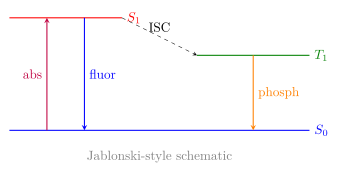
图 6 区分 singlet fluorescence、intersystem crossing 与 triplet phosphorescence;vertical positions 不按真实能量比例。
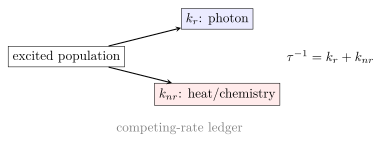
图 7 是最小 kinetic model;多 exponential states、energy transfer 与 reabsorption 需要扩展 rate network。
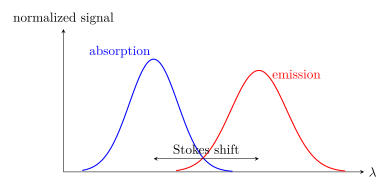
图 8 在 wavelength axis 上表示 fluorescence red shift;若改用 frequency/wavenumber,左右方向相反,必须先读轴。
4. Microwave, infrared, Raman, and UV–visible methods / 微波、红外、拉曼与紫外可见方法
Knowledge ID: P08-U02-L03-K04
四类方法按 coupled degree of freedom 与 operator 区分:
- microwave:主要 pure rotation,需要 permanent dipole(ordinary E1),给 \(I,R_e\) 和 dipole-related structure;
- infrared:振动/rovibration,需要 \(\partial\mu_d/\partial Q\ne0\),给 functional groups、force constants;
- Raman:inelastic scattering,需要 \(\partial\alpha_p/\partial Q\ne0\),对 symmetric/nonpolar modes 尤其互补;
- UV–visible:electronic/vibronic transitions,需要 electronic transition dipole/other coupling,给 electronic gaps、chromophores 与 excited-state dynamics。
方法的频域有重叠;名称指 mechanism 和 experimental architecture,不只是一段波长。sample phase、selection rules、resolution 与 desired observable 共同决定选择。
多方法联合的价值在于它们观测不同算符。microwave 对永久偶极矩和转动结构敏感,IR 读取 dipole derivative,Raman 读取 polarizability derivative,UV–visible 则探测 electronic transition moment 与 vibronic envelope。一个 mode 在某方法中缺失、在另一方法中出现,并非数据矛盾,而是对称性选择规则提供的互补约束。
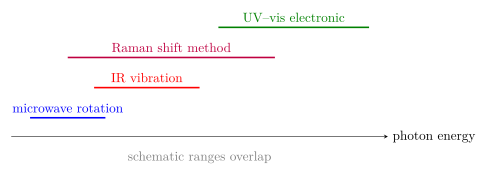
图 9 是 energy-scale map;Raman 的 measured shift 可对应 rotation/vibration,而 pump photon 本身可在 visible。
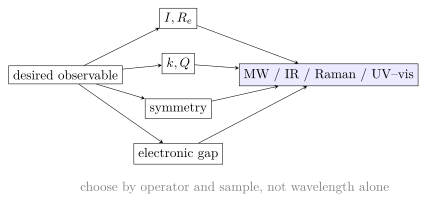
图 10 给出 method-selection workflow;同一 observable 常需多方法交叉约束。
Worked Examples / 完整例题
Worked Example 1 — vibronic photon energy
系统与模型。 ground/excited electronic origins 相差 \(2.50\,\mathrm{eV}\);absorption 同时激发 upper vibration \(v'=2\),每 quantum \(0.080\,\mathrm{eV}\);从 \(v''=0\) 且忽略 zero-point difference/rotation。
\[E_\gamma=2.50+2(0.080)=2.66\,\mathrm{eV},\]
\[\lambda=\frac{1239.842}{2.66}\,\mathrm{nm}=466\,\mathrm{nm}.\]
检查与解释。 energy additions use same zero convention;eV cancels to nm。\(2.50\,\mathrm{eV}\) 是 origin 而非所有 band peaks。
Worked Example 2 — Franck–Condon progression
已知与模型。 equal-frequency displaced harmonic surfaces,\(S_H=2.0\),initial \(v''=0\)。Poisson factors:
\[q_{00}=e^{-2}=0.1353,\]
\[q_{10}=2e^{-2}=0.2707, \qquad q_{20}=\frac{2^2}{2}e^{-2}=0.2707,\]
\[q_{30}=\frac{2^3}{6}e^{-2}=0.1804.\]
检查与解释。 factors 无量纲且全体 \(v'\) 求和为 1;峰在 \(v'=1,2\),说明 strongest line 不必是 0–0。electronic dipole variation 未计。
Worked Example 3 — quantum yield 与 rates
已知。 measured lifetime \(\tau=4.0\,\mathrm{ns}\),fluorescence yield \(\Phi=0.60\)。single-state two-channel model。
\[k_r=\frac{\Phi}{\tau}=1.5\times10^8\,\mathrm{s^{-1}},\]
\[k_{nr}=\frac{1-\Phi}{\tau}=1.0\times10^8\,\mathrm{s^{-1}}.\]
检查与解释。 \(k_r+k_{nr}=2.5\times10^8\,\mathrm{s^{-1}}=1/\tau\);yield 在 \([0,1]\)。若 decay multiexponential,该 inversion 不唯一。
Worked Example 4 — 选择 spectroscopy method
问题。 分别测:(a) gas-phase polar diatomic bond length;(b) centrosymmetric molecule 的 symmetric stretch;(c) chromophore electronic gap。
选择与理由。 (a) microwave rotational lines 给 \(B\to I\to R_e\),需 permanent dipole;(b) symmetric stretch 常 IR weak/inactive 但 \(\partial\alpha_p/\partial Q\ne0\),用 Raman;(c) UV–visible absorption/fluorescence 探测 electronic/vibronic gap。
边界检查。 若 (a) molecule nonpolar,可用 rotational Raman;(b) 必须用 point group 验证 activity;(c) observed peak 还受 Franck–Condon envelope/solvent shift,不能等同 vertical electronic energy without model。
Lesson synthesis / 全课综合
解析 molecular electronic spectrum 的流程:确定 electronic surfaces 与 multiplicity → 在每 surface 上放 vibrational/rotational structure → 用 electronic transition symmetry 与 Franck–Condon overlaps 预测 band → 加 vibrational relaxation、ISC/IC 与 competing rates 解释 emission → 根据 desired coordinate/operator 选择 MW/IR/Raman/UV–vis → 以 cross-method consistency 检查结构和动力学。
在真正的数据处理中,还应先完成能量轴和强度轴的校准,再把背景、仪器响应与样品本征信号分开。吸收峰位置主要约束初末态能差,积分面积与跃迁偶极矩和粒子数有关,荧光衰减约束动力学速率,而偏振和温度依赖进一步检验态对称性与布居。若只凭一张归一化谱图同时断言键长、电子能隙和寿命,就把互不相同的可观测量混在了一起。稳健结论应说明哪一个参数由哪一种数据直接约束,哪些参数来自模型拟合,以及拟合在溶剂重组、非绝热耦合或多发光中心存在时是否仍唯一。
对未知样品,推荐从低复杂度假设开始:先识别可重复的 band origin 和振动间隔,再用同位素替换、偏振、温度与时间分辨测量逐层排除偶然重叠。一个解释若同时满足能量守恒、selection rules、Franck–Condon envelope、rate equation 与另一种光谱方法的交叉检查,才具有较强物理可信度。
Formula-and-decision table / 公式与决策表
| Need | Formula/criterion | Use when | Boundary |
|---|---|---|---|
| vibronic energy | \(T_e+G(v)+F_v(J)\) | BO separated manifolds | nonadiabatic mixing omitted |
| FC factor | \(q=\lvert\langle\chi'\vert\chi''\rangle\rvert^2\) | Condon approximation | transition dipole may depend on \(Q\) |
| displaced oscillator | \(S_H=\mu_Q\omega(\Delta Q)^2/(2\hbar)\);\(q_{v0}=e^{-S_H}S_H^v/v!\) | equal curvature, one ordinary-length mode | mass-weighted convention / Duschinsky mixing require revision |
| lifetime | \(\tau^{-1}=k_r+k_{nr}\) | single exponential state | multiple pathways need network |
| yield | \(\Phi=k_r\tau\) | same two-channel model | reabsorption/quenching can bias measured value |
| method choice | operator derivative + energy scale | spectroscopy design | ranges overlap |
Model boundaries / 模型边界
- BO/Condon factorization fails with strong vibronic coupling, conical intersections or \(Q\)-dependent dipole.
- One-coordinate diagrams suppress multidimensional normal-mode rotation (Duschinsky effect).
- Kasha-like rapid relaxation has exceptions; excitation-wavelength dependence can occur.
- Singlet/triplet labels require spin remains meaningful; heavy atoms enhance spin–orbit mixing.
- Quantum yield/lifetime formulas assume homogeneous single-state kinetics.
- Condensed-phase spectra include solvent reorganization, inhomogeneous broadening and reabsorption.
Misconception clinic / 误区诊所
- “vertical transition 说明 nuclei 垂直移动。” 纵向是 energy axis;\(Q\) 在跃迁瞬间近似固定。
- “Franck–Condon factor 是 density overlap。” 它是 signed amplitude overlap 的模平方,先有 cancellation 再平方。
- “0–0 line 必最强。” displaced surfaces 可让 \(v'>0\) overlap 最大。
- “fluorescence 总在吸收同一波长。” relaxation 与 solvent reorganization 通常产生 Stokes shift。
- “phosphorescence 就是很慢的 fluorescence。” 它通常改变 spin multiplicity、selection rule 与 kinetic pathway。
- “Raman 属于红外吸收。” Raman 是 inelastic scattering,pump 可见而 shift 对应 vibration。
Practice and retrieval / 练习与提取
- K01: 写出 molecular term energy 的 electronic/vibrational/rotational 分解。
- K01: 为什么 gas-phase electronic band 可含大量窄 lines?
- K02: 给出 Franck–Condon factor 的 integral definition。
- K02: \(S_H=1\) 时 \(q_{00}\) 与 \(q_{10}\) 各多少?
- K03: 区分 internal conversion 与 intersystem crossing。
- K03: \(k_r=2\times10^8\,\mathrm{s^{-1}}\)、\(k_{nr}=3\times10^8\,\mathrm{s^{-1}}\),求 \(\tau,\Phi\)。
- K03: 为什么 oxygen 常 quench triplet phosphorescence?
- K04: nonpolar homonuclear diatomic 的 pure rotation 用哪种方法可见?
- K04: UV–visible peak 为什么不一定等于 adiabatic 0–0 gap?
- 综合: 一分子 IR 中无某 mode、Raman 中很强、UV–vis fluorescence 有大 Stokes shift,分别给出最小解释。
Answers / 答案
- \(E\approx T_e+G(v)+F_v(J)\),必要时再加 spin、hyperfine 与 field terms。
- 每 electronic surface 内有 many vibrational levels,每 vibronic level 又有 rotational sublevels;低碰撞时可分辨。
- \(q_{v'v''}=\lvert\int\chi_{v'}^*(Q)\chi_{v''}(Q)dQ\rvert^2\)。
- \(q_{00}=e^{-1}=0.3679\),\(q_{10}=e^{-1}=0.3679\)。
- IC 在同 multiplicity electronic states 间 nonradiative conversion;ISC 改变 spin multiplicity(如 \(S_1\to T_1\))。
- \(\tau=1/(5\times10^8)=2.0\,\mathrm{ns}\);\(\Phi=2/5=0.40\)。
- ground-state O\(_2\) 是 triplet,能通过 spin-allowed energy transfer/deactivation 与 triplet excited molecules 相互作用,增加 \(k_{nr}\)。
- rotational Raman(普通 permanent-dipole microwave E1 不可用)。
- peak 位置由 vertical transition 与 FC envelope 决定,且有 solvent/inhomogeneous shifts;adiabatic 0–0 是 minima 加 ZPE difference。
- mode 可能 centrosymmetric Raman-active/IR-inactive;大 Stokes shift 表示 excited-state relaxation/reorganization 或 strongly displaced surfaces,需排除 reabsorption/instrument effects。
Exit ticket / 离堂检验
- 画两个 displaced surfaces,标 absorption、relaxation、fluorescence 与 0–0 transition,并逐一说明 photon/nuclear energy flow。
- 为未知 molecule 设计 MW+IR+Raman+UV–vis 的最小互补测量集,列出每种方法唯一增加的约束。
References and source notes / 参考资料与来源说明
以下来源于 2026-08-30 实际打开核验;正文使用统一 BO、rate 与 SI convention,图全部原创。
- MIT OCW 5.61 Lectures 30–31 — Electronic Spectroscopy and Franck–Condon
- MIT OCW 12.815 — Molecular Spectroscopy
- NIST Chemistry WebBook — Vibrational and Electronic Energy Levels
- NIST Chemistry WebBook — Benzene IR, UV–visible, Raman and Energy-Level Data
- NIST Chemistry WebBook — Method Codes Used in Electronic Spectra
- MIT OCW 3.014 — Franck–Condon Principle and Fluorescence Appendix
Source-to-content map
| Source | Used for | Knowledge ID / Section | Model boundary or convention |
|---|---|---|---|
| MIT 5.61 Lectures 30–31 | vibronic structure, FC principle, radiative/nonradiative dynamics | K01–K03 | Condon/BO limits identified |
| MIT 12.815 | rotational, vibrational, electronic methods and line structure | K01, K04 | atmospheric context generalized carefully |
| NIST WebBook polyatom | authoritative vibrational/electronic data and technique labels | K01–K04 | matrix/gas conditions noted |
| NIST benzene entry | concrete IR/Raman/UV–vis cross-method example | K04 | data compilation, not theory source |
| NIST method codes | precise experimental method vocabulary | K04 | codes do not imply identical selection rules |
| MIT 3.014 appendix | vertical transition, fluorescence and Stokes shift | K02–K03 | reproduced source figure not used |
复习与拓展
- Unit 8.3 derives spontaneous/stimulated transition rates and two-level coherent dynamics.
- Laser operation uses gain media whose vibronic structure controls bandwidth.
- Precision methods use fluorescence detection and Raman transitions while suppressing Doppler/systematic shifts.