
Learning objectives / 学习目标
完成本课后,你应能:
- 以电荷转移、电子共享、离域与瞬时极化区分四类 bonding limits,同时识别真实材料的混合性。
- 写出 molecular Hamiltonian 并说明 Born–Oppenheimer separation 的小参数与 nonadiabatic boundary。
- 比较 valence-bond (VB) localized-pair 与 molecular-orbital (MO) delocalized descriptions。
- 由 LCAO 正交组合判定 bonding/antibonding、节点、能量与 bond order。
- 从 potential-energy curve 读取 equilibrium distance、force、force constant、dissociation energy 与 turning points。
- 对 bonding prediction 做电子数、宇称/对称性、能量零点和极限 \(R\to\infty\) 检查。
Prerequisites / 先修知识
- Many-Electron Atoms:antisymmetry、orbitals、configuration。
- Time-Independent Approximation Methods:variational principle 与 basis expansion。
- Quantum Harmonic Oscillator:势阱最低点附近的 quadratic expansion。
Scope and conventions / 范围与约定
- 以 isolated molecule 的 center-of-mass frame 为主;核间坐标 \(R\),电子坐标集合 \(\mathbf r\)。
- total energy 零点按问题声明:常取 separated neutral atoms at rest;\(D_e\) 从势阱最低点到 asymptote,\(D_0\) 从 vibrational ground level 到 asymptote。
- 所有轨道图是 wavefunction phase/density schematic,不是电子经典轨迹或硬边界。
- ionic/covalent/metallic/van der Waals 是 limiting pictures;同一体系可同时含多种贡献。
- 先用 diatomic molecule 建立一维 potential curve;polyatomic case 推广为多维 potential-energy surface。
Notation and modeling contract / 符号与建模契约
| Symbol | Meaning | SI unit |
|---|---|---|
| \(R\) | internuclear separation | m |
| \(R_e\) | equilibrium separation | m |
| \(E_{\rm el}(R)\) | clamped-nuclei electronic energy | J |
| \(U(R)\) | 含核间排斥的 adiabatic potential | J |
| \(S=\langle\phi_A\lvert\phi_B\rangle\) | orbital overlap | 1 |
| \(D_e,D_0\) | well-bottom/ground-level dissociation energy | J |
| \(k=U''(R_e)\) | local force constant | N m\(^{-1}\) |
1. Ionic, covalent, metallic, and van der Waals bonding / 离子、共价、金属与范德瓦耳斯键
Knowledge ID: P08-U02-L01-K01
ionic limit 由电子转移后的 unlike charges Coulomb attraction 主导;covalent limit 由电子在两个核之间共享并降低 kinetic+potential total energy;metallic bonding 是大量原子间 valence states 的离域占据;van der Waals interaction 包含 permanent/induced dipoles 与 London dispersion,远距常见 \(-C_6/R^6\)。
任何键都不是“只有吸引”:短程核—核排斥、电子—电子排斥与 Pauli/exchange repulsion 使能量在有限 \(R_e\) 处达到最低。
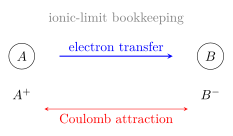
图 1 是 ionic limit 的 charge bookkeeping;真正态仍由量子波函数描述,箭头不表示永久完整转移必然发生。
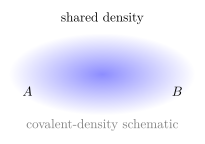
图 2 用 internuclear density enhancement 表示 covalent stabilization;颜色不是电荷符号。
2. Born–Oppenheimer approximation / 玻恩—奥本海默近似
Knowledge ID: P08-U02-L01-K02
去除质心后,molecular Hamiltonian 可概写为
\[H=T_N+H_{\rm el}(\mathbf r;\mathbf R)+V_{NN}(\mathbf R).\]
因核质量远大于电子质量,电子对给定核构型快速调整。先解 clamped-nuclei equation
\[H_{\rm el}(\mathbf r;\mathbf R)\psi_k(\mathbf r;\mathbf R) =E_{{\rm el},k}(\mathbf R)\psi_k(\mathbf r;\mathbf R),\]
这里 \(H_{\rm el}\) 含电子动能、电子—核吸引与电子—电子排斥,但不含核间排斥;因此供核运动使用的 adiabatic potential 必须定义为
\[U_k(\mathbf R)=E_{{\rm el},k}(\mathbf R)+V_{NN}(\mathbf R),\]
并在单一 surface 近似下求
\[[T_N+U_k(\mathbf R)]\chi_k(\mathbf R)=E\chi_k(\mathbf R).\]
特征小参数常与 \((m_e/M_N)^{1/4}\) 或核/电子速度比相关。near-degenerate electronic surfaces、avoided crossing、conical intersection 与强非绝热跃迁处,单一 surface approximation 会失败。
最小 two-state model 令未耦合的 diabatic energies 为 \(E_1(R),E_2(R)\)、实耦合为 \(V\);对 \(2\times2\) Hamiltonian diagonalize 得
\[E_\pm(R)=\frac{E_1(R)+E_2(R)}{2} \pm\sqrt{\left[\frac{E_1(R)-E_2(R)}{2}\right]^2+V^2}.\]
若 \(E_1(R_c)=E_2(R_c)\),adiabatic branches 在 \(R_c\) 的最小能隙就是 \(2\lvert V\rvert\)。因此“avoided crossing”不是在两条任意曲线之间加一条连接线,而是同一个耦合 Hamiltonian 的两条 eigenvalue branches。

图 3 显示 parameter separation 的计算流程;它不是电子先“真的完成运动”后核才动的时间序列。
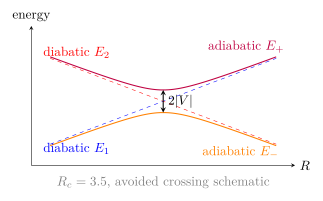
图 4 先以虚线画出在 \(R_c\) 相交的 diabatic energies,再画耦合 \(V\) 产生的 adiabatic branches;最小能隙为 \(2\lvert V\rvert\),其邻域的 derivative coupling 与 nonadiabatic risk 增强。曲线是教学示意而非特定分子的拟合。
3. Valence-bond and molecular-orbital pictures / 价键与分子轨道图景
Knowledge ID: P08-U02-L01-K03
VB picture 以 localized atomic/hybrid orbitals 的 pair overlap 与 resonance structures 组织成键,适合连接 Lewis structure、方向性与局域键断裂。MO picture 把 one-electron orbitals 展开为全分子 basis,电子填入 delocalized MOs,适合解释 excited states、magnetism 与 spectroscopy。
两者不是互相排斥的“真/假理论”;充分大的 VB 或 MO expansion 可描述同一 Hilbert space。区别在截断、basis 与解释语言。
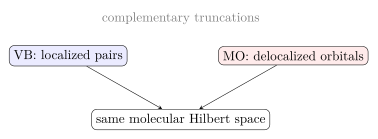
图 5 强调两种表象共享同一物理态空间;箭头不是一方“转化”为另一方的反应。
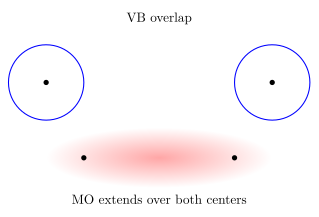
图 6 对比 localized basis emphasis 与 delocalized eigenorbital emphasis;上方圆并非互不相交的真实电子容器。
4. Bonding and antibonding orbitals / 成键与反键轨道
Knowledge ID: P08-U02-L01-K04
两个归一化 atomic orbitals 的 LCAO combinations 是
\[\psi_+=\frac{\phi_A+\phi_B}{\sqrt{2(1+S)}}, \qquad \psi_-=\frac{\phi_A-\phi_B}{\sqrt{2(1-S)}}.\]
同相组合通常增强 internuclear density、降低能量,称 bonding;反相组合在两核间产生 node、通常升高能量,称 antibonding。对 occupied MOs,
\[\text{bond order}=\frac{N_b-N_a}{2}.\]
这是有用指标而非所有体系的精确可观测量;heteronuclear orbitals、correlation 与 multicenter bonding 会使解释更细致。
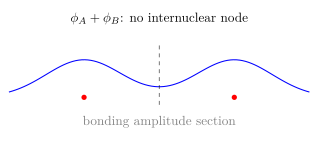
图 7 是 bonding amplitude 的一维截面;纵轴可正可负,不能直接当 probability density。
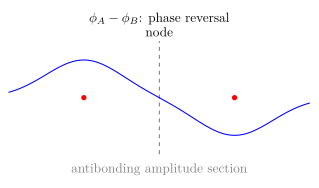
图 8 显示 antibonding combination 的 internuclear node;概率密度虽非负,但 node 仍保留。
5. Potential-energy curves and dissociation / 势能曲线与解离
Knowledge ID: P08-U02-L01-K05
adiabatic potential \(U(R)\) 给出 nuclear force
\[F_R=-\frac{dU}{dR}.\]
equilibrium 满足 \(U'(R_e)=0\)、稳定要求 \(U''(R_e)>0\)。最低点附近
\[U(R)\approx U(R_e)+\frac12k(R-R_e)^2, \qquad k=U''(R_e).\]
\(R\to\infty\) 的 asymptote 指定 dissociation products。\(D_e=U(\infty)-U(R_e)\),而可从 vibrational ground state 解离的 \(D_0=D_e-E_{\rm ZPE}\)。若有 barrier 或 avoided crossing,光解通道可不同于 ground asymptote。
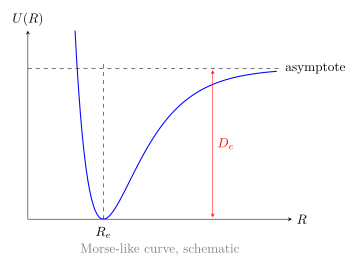
图 9 同时标出 repulsive wall、minimum 与 dissociation asymptote;\(D_e\) 箭头应从 well bottom 到 asymptote。
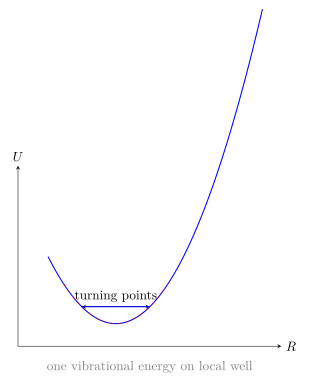
图 10 将 nuclear vibrational energy 放进 potential well;水平线与曲线交点是 classical turning points,波函数仍可延伸到 forbidden tails。
Worked Examples / 完整例题
Worked Example 1 — 从 ionic energy balance 判断可成键性
已知与系统。 separated \(A+B\) 为零点;把电子从 \(A\) 转到 \(B\) 需 ionization \(5.1\,\mathrm{eV}\)、释放 electron affinity \(3.6\,\mathrm{eV}\);形成离子后在 \(R=0.30\,\mathrm{nm}\) 的 Coulomb energy 为 \(-e^2/(4\pi\epsilon_0R)\)。忽略 short-range repulsion。
\[\Delta E_{\rm transfer}=5.1-3.6=1.5\,\mathrm{eV},\]
\[V_C=-\frac{1.43996\,\mathrm{eV\,nm}}{0.30\,\mathrm{nm}}=-4.80\,\mathrm{eV}.\]
总和 \(-3.30\,\mathrm{eV}\),在该粗模型中 ionic configuration energetically favorable。
检查与解释。 单位消去正确;未含 Pauli repulsion、polarization 与 crystal/molecular geometry,不能把 \(0.30\,\mathrm{nm}\) 当预测平衡距离。
Worked Example 2 — Born–Oppenheimer time-scale check
已知。 electronic gap \(2.0\,\mathrm{eV}\),vibrational quantum \(0.050\,\mathrm{eV}\)。以 \(\tau\sim h/E\) 比较特征时间。
\[\frac{\tau_{el}}{\tau_{vib}}=\frac{E_{vib}}{E_{el}}=0.025.\]
电子调整时间约为核振动的 \(2.5\%\),支持 adiabatic starting point。
检查与解释。 比值无量纲;即使总体尺度分离,若两 electronic surfaces gap 接近零,nonadiabatic coupling 仍可强。
Worked Example 3 — MO bond order 与 magnetism
系统。 假想 two-center molecule 的 relevant configuration 为 \((\sigma)^2(\sigma^*)^1\)。电子数 \(N_b=2,N_a=1\):
\[\mathrm{BO}=\frac{2-1}{2}=\frac12.\]
一电子未成对,因此在 spin-only picture 中 paramagnetic。
检查与解释。 bond order 无量纲,正值提示 net bonding;移去 antibonding electron 会使 BO 增至 1,通常增强键。实际 bond length/energy 仍需 potential calculation。
Worked Example 4 — 从势能曲率求振动频率与 \(D_0\)
已知与模型。 \(k=480\,\mathrm{N\,m^{-1}}\),reduced mass \(\mu=1.60\times10^{-27}\,\mathrm{kg}\),\(D_e=4.50\,\mathrm{eV}\);local harmonic approximation。
\[\omega=\sqrt{\frac{k}{\mu}}=5.48\times10^{14}\,\mathrm{s^{-1}},\]
\[E_{\rm ZPE}=\frac12\hbar\omega=2.89\times10^{-20}\,\mathrm J=0.180\,\mathrm{eV}.\]
所以 \(D_0\approx4.32\,\mathrm{eV}\)。
检查与解释。 \(k/\mu\) 的单位 s\(^{-2}\);\(D_0<D_e\) 符合 ground vibration 已位于 well bottom 之上。anharmonicity 会修正数值。
Lesson synthesis / 全课综合
成键分析流程:先声明 separated-fragment zero 与电子数;用 BO 固定核并求 electronic surface;选择 VB/MO basis 解释密度与 spin;检查 bonding/antibonding occupancy;在 \(U(R)\) 上找 \(R_e\)、\(k\)、\(D_e\) 和 asymptote;最后检验 nonadiabatic、correlation、relativistic 与 environment boundaries。
Formula-and-decision table / 公式与决策表
| Need | Formula/model | Use when | Boundary |
|---|---|---|---|
| electronic surface | \(H_{el}(R)\psi=E_{el}(R)\psi\);\(U=E_{el}+V_{NN}\) | BO clamped nuclei | fails near strong nonadiabatic coupling |
| LCAO pair | \((\phi_A\pm\phi_B)/\sqrt{2(1\pm S)}\) | two-orbital picture | basis truncation |
| bond order | \((N_b-N_a)/2\) | simple MO occupancy | not universal observable |
| force | \(F_R=-dU/dR\) | adiabatic curve | coordinate-specific |
| local vibration | \(k=U''(R_e)\) | near minimum | anharmonic at large amplitude |
| dissociation | \(D_0=D_e-E_{ZPE}\) | ground vibrational state | product asymptote must be specified |
Model boundaries / 模型边界
- Bond categories are limits, not mutually exclusive labels.
- Born–Oppenheimer ignores derivative couplings and geometric phases on a single surface.
- Two-orbital LCAO omits polarization, correlation and larger basis functions.
- Bond order is model dependent in multicenter/metallic systems.
- Harmonic expansion only holds near \(R_e\).
- Isolated-molecule curves omit solvent, lattice and external-field shifts.
Misconception clinic / 误区诊所
- “成键只要势能降低,不需管动能。” wavefunction localization/delocalization 同时改变 kinetic energy;稳定由 total energy 决定。
- “BO 表示核完全静止。” 它先 parameterize electronic states,再量子化核运动。
- “VB 与 MO 必有一个是错误的。” 它们是不同 basis/truncation 与解释语言。
- “antibonding orbital 没有电子就会排斥。” orbital 本身是可占据态;只有 occupancy 才贡献能量与 bond order。
- “\(D_e=D_0\)。” \(D_0\) 从 vibrational ground level 起,通常小一个 zero-point energy。
- “势能曲线最低点表示两原子静止不动。” nuclear ground state 仍有 zero-point motion。
Practice and retrieval / 练习与提取
- K01: 分别给 ionic、covalent、metallic、dispersion 一个 microscopic signature。
- K01: 为什么任何稳定 bond 都需要 short-range repulsion?
- K02: 写出 BO 两步 eigenproblem 并指出核坐标扮演的角色。
- K02: 举出 BO 容易失效的能级结构。
- K03: VB 与 MO 各更自然解释什么 observable?
- K04: \((\sigma)^2(\pi)^4(\pi^*)^2\) 的 bond order 是多少?假设前两类为 bonding。
- K04: 为什么 out-of-phase combination 通常更高能?
- K05: 若 \(U'(R)<0\),radial force 指向增大还是减小 \(R\)?
- K05: \(D_e=5.0\,\mathrm{eV}\)、ZPE \(0.20\,\mathrm{eV}\),求 \(D_0\)。
- 综合: 给出从 ab initio surface 到可测 bond length、vibrational frequency 与 dissociation threshold 的链条。
Answers / 答案
- ionic:显著 charge transfer;covalent:internuclear shared density;metallic:跨多中心 delocalized partially filled states;dispersion:correlated instantaneous dipoles 与 \(-C_6/R^6\) tail。
- 若无短程排斥,总能会随靠近持续下降而塌缩;核—核、电子—电子与 Pauli/kinetic effects 产生 repulsive wall。
- 固定 \(\mathbf R\) 解 electronic equation 得 \(E_{{\rm el},k}(\mathbf R)\),再构造 \(U_k=E_{{\rm el},k}+V_{NN}\) 并解 nuclear Schrödinger equation;\(\mathbf R\) 在第一步是 parameter、第二步是 coordinate。
- 两个不同电子态接近、avoided crossing 或 conical intersection。
- VB 自然解释局域键/共振与方向性;MO 自然解释离域、excited configurations、magnetism 与 spectroscopy。
- \(N_b=6,N_a=2\),BO \(=(6-2)/2=2\)。
- internuclear node 增加 curvature/kinetic cost,且减少两核间稳定电子密度。
- \(F_R=-U'(R)>0\),指向增大 \(R\)。
- \(D_0=4.80\,\mathrm{eV}\)。
- 求 \(U(R)\) → minimum 给 \(R_e\) → curvature \(U''(R_e)=k\) 与 \(\omega=\sqrt{k/\mu}\) → nuclear levels → ground level 到 correct asymptote 给 \(D_0\),并核对 nonadiabatic corrections。
Exit ticket / 离堂检验
- 用 total-energy language 解释为什么 bonding combination 较稳定而极短 \(R\) 又不稳定。
- 画一条标有 \(R_e,D_e,D_0\) 和两个 turning points 的势能曲线,并解释每个标签的实验意义。
References and source notes / 参考资料与来源说明
以下来源于 2026-08-30 实际打开核验;所有表述与 TikZ 均重新组织/原创。
- OpenStax University Physics 3 — Types of Molecular Bonds
- MIT OCW 5.61 Lectures 28–29 — Modern Electronic Structure and Born–Oppenheimer
- OpenStax Chemistry 2e — Molecular Orbital Theory
- OpenStax Chemistry — Valence Bond Theory
- MIT OCW 5.61 Lecture 28–29 Resource — MO, BO, Variational Principle
- OpenStax Organic Chemistry — Noncovalent Interactions
Source-to-content map
| Source | Used for | Knowledge ID / Section | Model boundary or convention |
|---|---|---|---|
| OpenStax UP 9.1 | bonding categories and total-energy intuition | K01 | categories presented as limits |
| MIT 5.61 28–29 | BO surfaces and electronic-structure workflow | K02, K05 | clamped nuclei and approximation stated |
| OpenStax MO | LCAO, bonding/antibonding, bond order | K03–K04 | simple diatomic model |
| OpenStax VB | localized overlap and potential minimum | K03, K05 | complementary to MO |
| MIT 2007 resource | variational and overlap-repulsion connection | K02–K05 | qualitative use only |
| OpenStax noncovalent | dipole/dispersion categories | K01 | condensed environment deferred |
复习与拓展
- Lesson 8.2.2 quantizes nuclear rotation/vibration on the BO potential.
- Lesson 8.2.3 uses two electronic surfaces and Franck–Condon overlaps.
- Condensed matter later extends MO splitting to energy bands and metallic bonding.