
Learning objectives / 学习目标
学完本课后,你应能:
- 用电场与气体倍增区分 ionization chamber、proportional counter 与 Geiger–Müller counter;
- 建立 scintillator 的光子—光电子—电荷链,并识别 light yield、quenching 与统计分辨率;
- 解释 semiconductor depletion region、electron–hole pair creation 与高能量分辨率的来源;
- 定义并计算 intrinsic/absolute efficiency、FWHM resolution、dead-time correction 与 background subtraction uncertainty;
- 读出 gamma pulse-height spectrum 中 photopeak、Compton continuum、backscatter/escape features,并执行线性能量标定。
Prerequisites / 先修知识
- Radiation Interaction with Matter 的 ionization、attenuation 与 secondary particles。
- Decay Law and Statistics 的 Poisson counting statistics。
- 电势差、电场、漂移与基本放大电路。
- Gaussian distribution、均值、标准差与线性回归。
Scope and conventions / 范围与约定
- 一次 event 指探测器在给定 acquisition window 内形成的一次可判别脉冲;它不必等同于一个入射粒子。
- 计数率用 \(n\) 表示真实 incident-event rate、\(m\) 表示 recorded rate;dead-time 模型必须声明 paralyzable 或 nonparalyzable。
- 能量分辨率默认写 \(R=\mathrm{FWHM}/E_0\);若资料用 \(\sigma/E_0\),必须显式转换。
- efficiency 必须说明分母:进入 active volume 的粒子还是源发射的全部粒子。
- 本课只讨论原理与基础数据分析;高压、低温、密封源和辐射场的实际操作需由合格实验室按规程完成。
Notation and modeling contract / 符号与建模契约
| Symbol | Meaning | SI unit |
|---|---|---|
| \(E_{\mathrm{dep}}\) | energy deposited in active medium | J or eV |
| \(W\) | mean energy per gas ion pair | J or eV |
| \(w\) | mean energy per semiconductor electron–hole pair | J or eV |
| \(M\) | gas or electronic gain | 1 |
| \(N_{\mathrm{pe}}\) | detected photoelectrons | 1 |
| \(\varepsilon_{\mathrm{int}}\) | intrinsic efficiency | 1 |
| \(\varepsilon_{\mathrm{abs}}\) | absolute efficiency | 1 |
| \(\tau\) | dead-time parameter; triggering convention depends on the stated model | s |
| \(\sigma_E\) | standard deviation of a peak | J or eV |
| \(\mathrm{FWHM}\) | full width at half maximum | J or eV |
1. Gas-ionization detectors / 气体电离探测器
Knowledge ID: P10-U05-L02-K01
辐射在气体中产生 primary ion pairs。外电场使电子和正离子向相反电极漂移,避免 recombination 并形成电流或电荷脉冲。若沉积能为 \(E_{\mathrm{dep}}\),初级平均离子对数仍是 \(N_0\approx E_{\mathrm{dep}}/W\)。
随 applied voltage 增大,探测器经历不同工作区:
- ionization chamber region: 收集几乎全部 primary charge,无 avalanche,信号与沉积能成正比但较小;
- proportional region: 电子在强场区发生 Townsend avalanche,增益 \(M\) 近似保留初级电离比例,可做能谱;
- limited proportionality: space charge、光子反馈等破坏严格比例;
- Geiger–Müller region: 单次初始事件触发沿阳极传播的放电,pulse size 基本与初始能量无关,适合计数而非能谱;
- 再升高电压会进入 continuous discharge,不能工作。
Quenching gas 与 dead time/recovery time 用于终止放电并恢复场。GM plateau 的斜率、阈值和环境修正影响稳定性;“有脉冲”不等于“能准确测能量”。
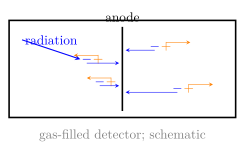
图 1 画出 primary pairs 的反向漂移。真实圆柱 proportional counter 的场在细阳极附近最强,avalanche 因而局限于阳极周围。
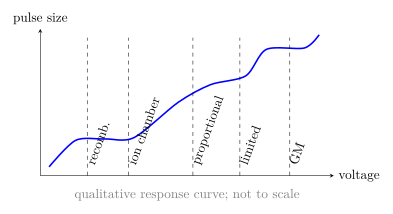
图 2 表示连续变化的工作区;纵轴和边界取决于气体、几何和电子学,不能把示意图当作 operating-voltage table。
2. Scintillation detectors / 闪烁探测器
Knowledge ID: P10-U05-L02-K02
Scintillator 把沉积能量转为可见或紫外光。光经反射、吸收与光学耦合到 photomultiplier tube(PMT)或 silicon photomultiplier(SiPM),再转为 photoelectrons 并放大。平均链可写
\[N_{\mathrm{pe}} =E_{\mathrm{dep}}Y_\gamma\varepsilon_{\mathrm{opt}}\mathrm{PDE},\]
其中 \(Y_\gamma\) 是每单位能量的 light yield,\(\varepsilon_{\mathrm{opt}}\) 是光收集效率,PDE 是 photon-detection efficiency。若只有 photoelectron counting fluctuation,统计极限近似
\[R_{\mathrm{stat}} \equiv\frac{\mathrm{FWHM}}{E_0} \approx\frac{2.355}{\sqrt{N_{\mathrm{pe}}}}.\]
真实分辨率还包括 nonproportional light yield、photon transport variation、gain variation、dark noise 与 electronics noise。Organic scintillator 的轻、重带电粒子响应常受 quenching 影响,光输出不再简单正比于 \(E_{\mathrm{dep}}\);无机高 \(Z\) 晶体常有较高 gamma stopping efficiency,但 decay time、hygroscopicity 与 afterglow 等也需权衡。

图 3 是测量链;任一环节的非均匀性都会把相同 \(E_{\mathrm{dep}}\) 展宽为 pulse-height distribution。
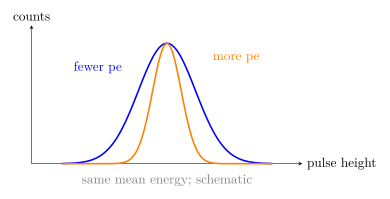
图 4 显示增加 \(N_{\mathrm{pe}}\) 可减小统计相对宽度,但材料非线性和电子噪声会给额外下限。
3. Semiconductor detectors / 半导体探测器
Knowledge ID: P10-U05-L02-K03
在 reverse-biased p–n junction 中,depletion region 几乎没有自由载流子,辐射沉积能量产生 electron–hole pairs。电场把电子与空穴分别收集到电极,平均信号电荷为
\[N_{eh}\approx\frac{E_{\mathrm{dep}}}{w}, \qquad Q=eN_{eh}.\]
半导体 \(w\) 通常只有数 eV,比气体 \(W\) 小得多,因此相同能量产生更多载流子,统计分辨率更好。Fano factor 使 pair-number variance 小于独立 Poisson 模型的简单预期;最终分辨率还受 leakage current、capacitance、trapping、charge-collection time 与 preamplifier noise 影响。
Silicon 适合 charged particles 与 x rays;高纯 germanium 具有优秀 gamma energy resolution,但其小 band gap 导致室温热载流子多,通常需冷却。高原子序数、较大体积和充分 depletion 可提高高能 photon full-energy efficiency,但也增加 capacitance、成本和 crystal-growth difficulty。
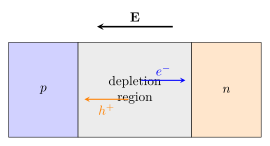
图 5 表示 reverse bias 下的载流子分离;箭头方向对应 conventional field 与负电子运动相反。
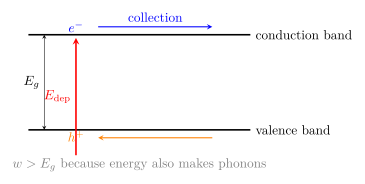
图 6 提醒:pair-creation energy \(w\) 不是 band gap \(E_g\),两者的区别与气体中的 \(W\) 和 ionization potential 类似。
4. Efficiency, resolution, dead time, and background / 效率、分辨率、死时间与本底
Knowledge ID: P10-U05-L02-K04
Intrinsic efficiency 与 absolute efficiency 的分母不同:
\[\varepsilon_{\mathrm{int}} =\frac{N_{\mathrm{det}}}{N_{\mathrm{enter}}}, \qquad \varepsilon_{\mathrm{abs}} =\frac{N_{\mathrm{det}}}{N_{\mathrm{emit}}} =\varepsilon_{\mathrm{geom}}\varepsilon_{\mathrm{int}}\]
(简单独立因子近似)。效率还必须说明 threshold、energy window、particle type 与 source geometry。Full-energy peak efficiency 与 total efficiency 也不等价。
若 monoenergetic peak 近似 Gaussian,
\[\mathrm{FWHM}=2\sqrt{2\ln2}\,\sigma_E\approx2.355\sigma_E, \qquad R=\frac{\mathrm{FWHM}}{E_0}.\]
Nonparalyzable dead-time 模型中,每个 recorded event 造成固定 \(\tau\) 的盲区:
\[m=\frac{n}{1+n\tau}, \qquad n=\frac{m}{1-m\tau},\]
要求 \(m\tau<1\)。Paralyzable 模型则有 \(m=ne^{-n\tau}\),未记录事件仍会延长盲区;两种修正式不能混用。
若 gross counts \(G\) 与独立 background counts \(B\) 的测量时间分别为 \(t_g,t_b\),净计数
\[S=G-\alpha B,\qquad \alpha=\frac{t_g}{t_b},\]
其 Poisson standard uncertainty 为
\[\sigma_S=\sqrt{G+\alpha^2B}.\]
若有 drift、correlated background 或 efficiency uncertainty,还要额外传播系统不确定度。
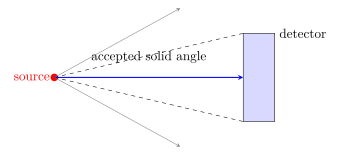
图 7 将 geometry 与 intrinsic response 分开;把探测器移近会提高 absolute efficiency,却不必改变 intrinsic efficiency。
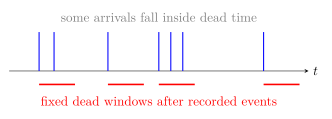
图 8 表示 nonparalyzable 模型:盲区内 arrival 不会启动新盲区。若硬件行为不同,必须改用相应模型或直接测量 live time。
5. Spectroscopy and pulse-height analysis / 能谱与脉冲高度分析
Knowledge ID: P10-U05-L02-K05
Pulse height 通常先映射为 ADC channel \(C\),再用已知线谱做标定:
\[E(C)=aC+b\]
(线性近似)。残差若呈系统弯曲,应加入合理的非线性模型或修正 electronics,而不能只增加高阶项掩盖漂移。标定、样品和本底测量应保持 gain、threshold 与 shaping time 一致。
对单能 gamma,photopeak 表示全部能量最终留在 active volume;Compton continuum 来自散射光子逃逸。一次 Compton backscatter 给电子的最大能量是
\[E_{\mathrm{CE}} =E_\gamma\left( 1-\frac{1}{1+2E_\gamma/(m_ec^2)} \right),\]
对应 Compton edge。Pair production 后,一个或两个 \(511\,\mathrm{keV}\) annihilation photons 逃逸可形成 single-escape 或 double-escape peak。真实 spectrum 是 source spectrum 与 detector response matrix 的卷积,还叠加 electronic noise、pile-up、background 与 geometry。
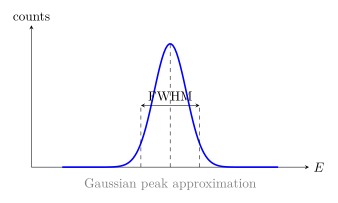
图 9 定义 FWHM;同一探测器的 absolute FWHM 与 relative resolution 随能量的变化通常不同。
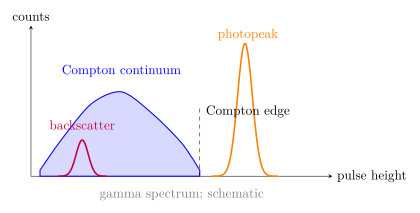
图 10 把典型结构标出;edge 和 peak 的精确位置必须由能量—动量守恒与 detector geometry 计算。
Worked Examples / 完整例题
Worked Example 1 — Proportional counter 的输出电荷
已知: \(5.90\,\mathrm{keV}\) x ray 全部沉积在 \(W=26.0\,\mathrm{eV}\) 的气体中,gas gain \(M=2.00\times10^4\)。
系统与模型: active gas 内单次全能量事件;忽略 attachment、recombination 与 saturation。
\[N_0=\frac{5.90\times10^3}{26.0}=227,\]
\[Q=MeN_0 =(2.00\times10^4)(1.602\times10^{-19})(227) =7.27\times10^{-13}\,\mathrm C.\]
检查与解释: \(M\) 无量纲,输出约 \(0.727\,\mathrm{pC}\)。若进入 GM region,pulse size 不再保持 \(N_0\) 比例,不能用此式测能量。
Worked Example 2 — Scintillator 光电子数与统计分辨率
已知: \(662\,\mathrm{keV}\) gamma 全能量沉积;\(Y_\gamma=4.00\times10^4\,\mathrm{photons\,MeV^{-1}}\),\(\varepsilon_{\mathrm{opt}}=0.150\),PDE \(=0.250\)。
系统: scintillator 加 photodetector 的完整光学链;先只计 photoelectron Poisson limit。
\[N_{\mathrm{pe}} =(0.662)(4.00\times10^4)(0.150)(0.250) =993.\]
\[R_{\mathrm{stat}}\approx\frac{2.355}{\sqrt{993}} =0.0747=7.47\%.\]
检查与解释: 光学和 PDE 因子都小于 1;真实 FWHM 不会优于该简化链给出的数量级,并常因 nonproportionality 更宽。
Worked Example 3 — Silicon 中的 electron–hole charge
已知: silicon detector 中沉积 \(E_{\mathrm{dep}}=1.00\,\mathrm{MeV}\),\(w=3.60\,\mathrm{eV}\),charge-collection efficiency 为 \(0.980\)。
研究对象: depletion region 内产生并到达电极的载流子。
\[N_{eh}=\frac{1.00\times10^6}{3.60} =2.78\times10^5,\]
\[Q_{\mathrm{col}} =0.980eN_{eh} =4.36\times10^{-14}\,\mathrm C.\]
即 \(43.6\,\mathrm{fC}\)。合理性检查: 相同沉积能量在半导体中产生的 pairs 远多于气体,解释了较好的统计分辨率;但 leakage current 与 electronics noise 仍可能占主导。
Worked Example 4 — Dead time、本底与线性标定
已知: nonparalyzable system 记录率 \(m=8.00\times10^3\,\mathrm{s^{-1}}\),\(\tau=20.0\,\mu\mathrm s\)。在 \(100\,\mathrm s\) gross run 中记录 \(G=9200\),在 \(200\,\mathrm s\) background run 中记录 \(B=8000\)。两条 calibration peaks 为 \((C,E)=(200,0.511\,\mathrm{MeV})\) 与 \((500,1.274\,\mathrm{MeV})\)。
模型: dead time 固定且不延长;两次 counts 独立 Poisson;标定线性。
首先 \(m\tau=0.160<1\),
\[n=\frac{8000}{1-0.160} =9.52\times10^3\,\mathrm{s^{-1}}.\]
本底缩放 \(\alpha=100/200=0.500\),
\[S=9200-0.500(8000)=5200,\]
\[\sigma_S=\sqrt{9200+0.500^2(8000)} =106.\]
净计数为 \(5200\pm106\)(standard uncertainty)。标定斜率与截距:
\[a=\frac{1.274-0.511}{500-200} =2.543\times10^{-3}\,\mathrm{MeV/channel},\]
\[b=0.511-200a=0.00233\,\mathrm{MeV}.\]
检查: 代回 \(C=500\) 得 \(1.274\,\mathrm{MeV}\);dead-time correction 增大 recorded rate。若背景和样品测量 live-time definition 不同,应先统一归一化。
Lesson synthesis / 全课综合
探测器不是“看见粒子”的黑箱,而是五层映射:
- radiation 在 active medium 中是否相互作用;
- 沉积能量产生多少 ion pairs、photons 或 electron–hole pairs;
- 多少载流子或光被收集;
- electronics 怎样放大、整形、触发和数字化;
- calibration 与 response model 怎样把 channels 反演为 counts、energies 和 uncertainties。
气体探测器展示电场增益的可调区间;scintillator 以材料体积和高效率见长;semiconductor 以小 pair-creation energy 和高分辨率见长。选择探测器必须同时比较 radiation type、efficiency、resolution、rate capability、timing、geometry 与环境要求。
Formula-and-decision table / 公式与决策表
| Task | Relation | Required declaration | Main limitation |
|---|---|---|---|
| gas primary pairs | \(N_0=E_{\mathrm{dep}}/W\) | gas and \(W\) | recombination, attachment |
| scintillation signal | \(N_{\mathrm{pe}}=EY_\gamma\varepsilon_{\mathrm{opt}}\mathrm{PDE}\) | light yield and optics | quenching, nonproportionality |
| semiconductor charge | \(N_{eh}=E_{\mathrm{dep}}/w\) | material and temperature | trapping, leakage, noise |
| peak resolution | \(R=\mathrm{FWHM}/E_0\) | FWHM or \(\sigma\) convention | non-Gaussian tails |
| nonparalyzable correction | \(n=m/(1-m\tau)\) | dead-time model | invalid near saturation |
| background subtraction | \(S=G-\alpha B\) | live times and windows | systematic drift |
| linear calibration | \(E=aC+b\) | stable electronics | residual nonlinearity |
Model boundaries / 模型边界
- \(N=E/W\) 与 \(E/w\) 给平均值;能量分辨率要加入 Fano、gain 和 electronics fluctuations。
- GM counter 适合计数,不保留初级能量信息;proportionality 也只在相应电压区成立。
- \(2.355/\sqrt{N_{\mathrm{pe}}}\) 是纯 photon-statistics 极限,不是所有 scintillator 的实测分辨率公式。
- Full-energy peak efficiency、total efficiency、intrinsic efficiency 与 absolute efficiency 分母不同。
- Dead-time correction 必须与硬件模型匹配;强 pile-up 时简单一参数模型可能失效。
- Spectrum features 同时受 source、interaction 与 detector geometry 决定,不能只靠峰形直接等同于核跃迁。
Misconception clinic / 误区诊所
- “电压越高,气体探测器越灵敏,所以一直加高最好。” 错;不同电压区对应不同物理,过高进入 continuous discharge。
- “Scintillator 产生的光子数就是 photodetector 收到的 photoelectrons。” 中间还有光收集、PDE、反射吸收和 coupling losses。
- “Semiconductor band gap 就是产生一对载流子的平均能量。” \(w>E_g\),因为能量也进入 phonons。
- “Efficiency 是探测器的一个固定常数。” 它依赖能量、粒子、阈值、窗口和几何,且定义分母必须声明。
- “谱峰宽度全是核态寿命造成的。” 多数教学谱中 detector statistics 与 electronics resolution 更显著。
Practice and retrieval / 练习与提取
- [K01·概念] 比较 ionization chamber、proportional counter 与 GM counter 是否能保留 deposited-energy information。
- [K01·定量] \(3.00\,\mathrm{keV}\) 全沉积于 \(W=30.0\,\mathrm{eV}\) 气体,\(M=500\),求平均输出电子数。
- [K02·定量] \(1.00\,\mathrm{MeV}\) 沉积,\(Y_\gamma=2.00\times10^4\,\mathrm{MeV^{-1}}\),总 photon-to-pe efficiency \(0.0800\),求 \(N_{\mathrm{pe}}\) 和统计 FWHM fraction。
- [K02·边界] 列出两个使 light output 不再严格正比于 deposited energy 的原因。
- [K03·定量] \(360\,\mathrm{keV}\) 在 \(w=3.60\,\mathrm{eV}\) 的 silicon 中全沉积,求理想 pairs。
- [K03·概念] 为什么 high-purity germanium gamma detector 常需要冷却?
- [K04·定量] nonparalyzable detector 有 \(m=2.00\times10^4\,\mathrm{s^{-1}}\)、\(\tau=10.0\,\mu\mathrm s\),求 \(n\)。
- [K04·统计] \(G=2500\)、\(B=900\),测量时间相同,求 net counts 及 Poisson standard uncertainty。
- [K05·定量] \(E_\gamma=0.662\,\mathrm{MeV}\),用 \(m_ec^2=0.511\,\mathrm{MeV}\) 求 Compton edge。
- [K01–K05·综合] 若要同时区分两条相距很近的 gamma lines 并在高计数率下工作,应比较哪些 detector 和 electronics 指标?
第 1 题答案
Chamber 收集 primary charge、可测平均沉积或剂量;proportional region 保留能量比例;GM pulse 大小几乎与初级能量无关,只适合计数。
第 2 题答案
\(N_0=3000/30=100\),输出电子数 \(MN_0=5.00\times10^4\)。
第 3 题答案
\(N_{\mathrm{pe}}=(1.00)(2.00\times10^4)(0.0800)=1600\);\(R=2.355/\sqrt{1600}=0.0589=5.89\%\)。
第 4 题答案
例如 particle-dependent quenching、nonproportional light yield、position-dependent light collection 或 saturation。
第 5 题答案
\(N_{eh}=360000/3.60=1.00\times10^5\) pairs。
第 6 题答案
Germanium band gap 小,室温 thermal carriers 和 leakage current 增加 noise;冷却改善信噪与分辨率。
第 7 题答案
\(m\tau=0.200\),\(n=20000/(1-0.200)=2.50\times10^4\,\mathrm{s^{-1}}\)。
第 8 题答案
\(S=1600\);\(\sigma_S=\sqrt{2500+900}=58.3\),即 \(1600\pm58\)。
第 9 题答案
\(E_{\mathrm{CE}}=0.662[1-1/(1+2(0.662/0.511))]=0.478\,\mathrm{MeV}\)。
第 10 题答案
比较 FWHM resolution、full-energy peak efficiency、maximum rate、dead time、pile-up rejection、timing、gain stability、background 与 calibration residuals;不能只看 detector material。
Exit ticket / 离堂检验
- 某探测器 absolute efficiency 提高但 intrinsic efficiency 不变,给出一个纯几何解释,并写出需要控制的量。
- 观测到谱峰变宽且 centroid 漂移。分别提出一个 detector-statistics 原因、一个 electronics 原因和一个校准诊断。
References and source notes / 参考资料与来源说明
以下链接均于 2026-08-30 实际核对;正文和图示为重新组织的原创教学表达。
- IAEA: Radiation Detectors — gas、scintillation、semiconductor detector families and selection criteria。
- IAEA: Scintillation Detectors — scintillation production、photodetection and detector performance。
- Particle Data Group 2024: Particle Detectors at Accelerators — gaseous、scintillation、semiconductor detectors, resolution and rate effects。
- MIT OpenCourseWare 22.101 Lecture 21: Detection of Nuclear Radiation — detector response and pulse-height spectra。
- IAEA Nuclear Instrumentation Experiments Catalogue 2023 — spectroscopy, calibration, dead time, efficiency and resolution experiments。
- CERN Detector Lecture Collection — official lectures on gaseous, scintillator and semiconductor technologies。
Source-to-content map
| Source | Used for | Knowledge ID / Section | Model boundary or convention |
|---|---|---|---|
| IAEA detector overview | detector families and choice | K01–K03 | choice depends on radiation and measurement objective |
| IAEA scintillation module | light-production chain | K02 | photon statistics is only one resolution term |
| PDG 2024 | detector physics and performance | K01–K04 | technologies span many geometries and rate regimes |
| MIT 22.101 | pulse-height response | K04, K05 | response is detector plus source plus geometry |
| IAEA experiments catalogue | calibration/dead time/efficiency | K04, K05 | experimental definitions and uncertainties required |
| CERN lectures | cross-technology comparison | K01–K03 | no single detector optimizes every metric |
复习与拓展
- 下一课把 counts 与 deposited energy 转成 absorbed、equivalent 与 effective dose,并讨论应用边界。
- 与 Poisson counting statistics 联结:source randomness 与 detector inefficiency 共同决定 observed variance。
- 未来扩展:coincidence timing、response matrices、Bayesian unfolding、time projection chambers 与 calorimeters。