
Learning objectives / 学习目标
学完本课后,你应能:
- 从 imparted energy 定义 absorbed dose,并区分 gray、equivalent dose 与 effective dose;
- 区分 tissue reactions 与 stochastic effects,说明剂量、剂量率、空间分布和不确定性在风险表述中的作用;
- 推导封闭体系的 parent–daughter dating equation,并为 tracer 建立质量—衰变账本;
- 比较 SPECT 的 collimation 与 PET 的 coincidence localization,解释图像重建为什么是 inverse problem;
- 用 target coverage、organs at risk、fractionation 与 verification 描述 treatment planning 的物理优化,而不把教学模型当作临床处方。
Prerequisites / 先修知识
- Decay Law and Statistics 的 exponential decay、activity 与 half-life。
- Radiation Interaction with Matter 的能量沉积与 shielding。
- Radiation Detection 的 efficiency、spectroscopy 与 counting uncertainty。
- 质量守恒、指数函数、加权和与基本图像几何。
Scope and conventions / 范围与约定
- Absorbed dose 是物理能量—质量量;equivalent/effective dose 是辐射防护量,加入 ICRP/IAEA 的 radiation 与 tissue weighting conventions。
- Effective dose 用于计划与比较辐射防护,不是个体确定性损伤、患者特异风险或 radiotherapy prescription 的精确估计。
- Biological response 依赖 organ、endpoint、dose rate、fractionation、age 与个体差异;本课不给医疗建议或个人风险判断。
- Dating 默认 parent–daughter system 在 closure 后封闭,decay constant 已知且 initial daughter 可约束;违反这些条件会产生 apparent age。
- PET、SPECT 和 treatment planning 只讲物理原理;实际临床决策必须由合格医疗团队使用设备校准、患者数据和监管规范。
Notation and modeling contract / 符号与建模契约
| Symbol | Meaning | SI unit |
|---|---|---|
| \(D\) | absorbed dose | Gy = \(\mathrm{J\,kg^{-1}}\) |
| \(D_{T,R}\) | absorbed dose in tissue \(T\) from radiation \(R\) | Gy |
| \(w_R\) | radiation weighting factor | 1 |
| \(H_T\) | equivalent dose to tissue \(T\) | Sv |
| \(w_T\) | tissue weighting factor | 1 |
| \(E_{\mathrm{eff}}\) | effective dose | Sv |
| \(\lambda\) | radioactive decay constant | \(\mathrm{s^{-1}}\) |
| \(P,D^\ast\) | remaining parent and radiogenic daughter amounts | same amount unit |
| \(A\) | activity | Bq |
| \(\Delta t\) | PET arrival-time difference | s |
为避免与粒子能量 \(E\) 混淆,本课在叙述中把 effective dose 写作 \(E_{\mathrm{eff}}\),但正式标准常直接记为 \(E\)。
1. Absorbed, equivalent, and effective dose / 吸收、当量与有效剂量
Knowledge ID: P10-U05-L03-K01
Absorbed dose 是单位质量中平均 imparted energy:
\[D=\frac{\mathrm d\bar{\varepsilon}}{\mathrm dm}, \qquad 1\,\mathrm{Gy}=1\,\mathrm{J\,kg^{-1}}.\]
它可用于物质、器官或 detector volume,但必须说明质量元素、空间平均与时间区间。同样的 macroscopic \(D\) 可由稀疏低-LET 轨迹或密集高-LET 轨迹产生,微观结构和生物效应不必相同。
Radiation protection 用 radiation weighting factor 建立 tissue equivalent dose:
\[H_T=\sum_R w_R D_{T,R}.\]
再用 tissue weighting factor 建立 effective dose:
\[E_{\mathrm{eff}}=\sum_T w_T H_T.\]
\(H_T\) 与 \(E_{\mathrm{eff}}\) 的单位均是 sievert(Sv),但意义不同:前者针对一个 tissue 的 radiation-weighted dose,后者把多个 tissues 按参考人群的相对 detriment 再加权。不能把 Gy 与 Sv 只当“不同换算单位”,也不能对 radiotherapy 的不均匀高剂量直接用 effective dose 取代 organ-specific absorbed dose。
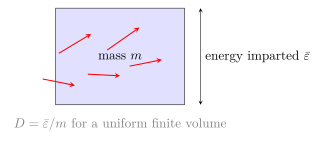
图 1 表示有限体积平均。若把质量缩小到微米甚至细胞尺度,能量沉积变得离散,需进入 microdosimetry 而非把宏观 \(D\) 当作连续场。
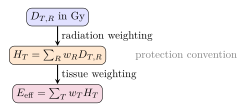
图 2 清楚分离 measured/calculated absorbed dose 与 protection-weighted quantities;权重不是材料常数。
2. Biological effects and risk / 生物效应与风险
Knowledge ID: P10-U05-L03-K02
Ionization 可直接或经 water radiolysis 间接损伤 DNA、membranes 和其他 molecules。细胞可能 repair、misrepair、die 或保持可繁殖;组织层面响应由 cell type、oxygenation、spatial distribution 与 time pattern 共同决定。
Radiation protection 常区分:
- tissue reactions(旧称 deterministic effects): 通常存在与 endpoint 相关的阈值区间,超过后 severity 随 dose 增长;阈值不是所有人共享的单一硬数值。
- stochastic effects: 主要关注 cancer 与 heritable risk;保护模型把 probability 与 dose 联系,severity 本身不随引发该事件的 dose 简单增加。
低剂量风险受到统计功效、confounders、dose reconstruction 与模型选择限制。监管或防护采用的 nominal coefficients 是人群层面的规划工具,不应输出为某个个体的确定概率。Dose rate 和 fractionation 可给 biological repair 时间;但效应依 endpoint 与 radiation quality 而异,不能用一句“分次永远更安全”覆盖所有情形。
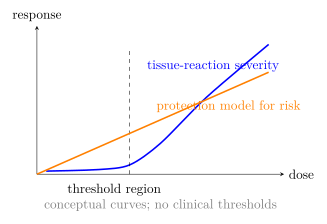
图 3 比较的是两类建模逻辑,不是给出个人风险曲线;橙线代表常用 protection-model idea,不声称低剂量个体效应可由图精确预测。
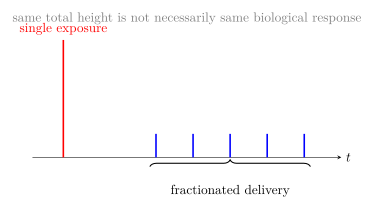
图 4 表示时间结构是独立变量;即使 total absorbed dose 相同,repair、repopulation 和 dose-rate effects 也会改变 response。
3. Radioisotope dating and tracers / 放射性测年与示踪
Knowledge ID: P10-U05-L03-K03
设 closure 时有 parent 数量 \(P_0\),之后无 parent/daughter 进出且 radiogenic daughter 初始量可扣除。则
\[P(t)=P_0e^{-\lambda t}, \qquad D^\ast(t)=P_0-P(t).\]
消去 \(P_0\):
\[\frac{D^\ast}{P}=e^{\lambda t}-1, \qquad t=\frac{1}{\lambda}\ln\left(1+\frac{D^\ast}{P}\right).\]
半衰期应与待测 timescale 同量级,且 daughter origin、closure time、contamination 与 later loss 必须可约束。Isochron methods 通过多个共生样品的比值关系同时处理 initial daughter;若体系开放或样品经历重置,所得是 model age 而非“石头唯一的年龄”。
Tracer 是可区分但在所研究过程上尽量跟随目标物质的标记。设 tracer inventory \(N\) 同时受 flow 和 decay 控制,则简单 compartment model 可写
\[\frac{\mathrm dN}{\mathrm dt} =q_{\mathrm{in}}C_{\mathrm{in}} -q_{\mathrm{out}}\frac{N}{V} -\lambda N.\]
稳定同位素也可做 tracer;放射性 tracer 的额外优势是高灵敏 detection 与 time clock,但必须进行 decay correction、mass-balance check,并控制引入量不扰动系统。
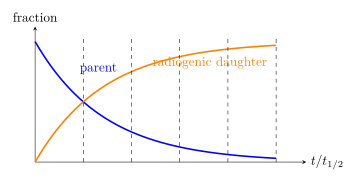
图 5 是 initial radiogenic daughter 已扣除、体系封闭的一对一 decay ledger;branching 或 decay chain 需扩展方程。
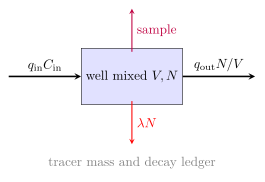
图 6 把 flow、decay 和 sampling 分开;忽略任一项都可能把 residence time 误估为 radioactive age。
4. PET, SPECT, and nuclear medicine / PET、SPECT 与核医学
Knowledge ID: P10-U05-L03-K04
Nuclear medicine 把 radionuclide 接到参与特定 biological pathway 的 tracer 上,测量其空间—时间分布。图像信号反映 tracer kinetics、delivery、binding/metabolism、decay、attenuation 与 detector response 的组合,不是单纯的解剖密度。
SPECT 使用 gamma-emitting tracer。机械 collimator 只接受某些方向的光子,gamma camera 从多个角度取得 projections,再重建三维 activity distribution。Collimation 给方向信息,却牺牲大量 efficiency。
PET 的 positron 在组织中减速后与 electron annihilate,理想静止情形产生两束近 \(511\,\mathrm{keV}\)、近反向光子。两个 detectors 在 coincidence window 内触发定义 line of response;time-of-flight difference 给出沿线位置约束
\[x=\frac{c\Delta t}{2}.\]
实际图像需修正 attenuation、scatter、random coincidences、dead time、normalization 与 positron range。Reconstruction 是带噪的 inverse problem;resolution、sensitivity 与 dose/scan time 之间存在权衡。
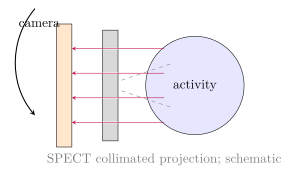
图 7 显示 collimator 以效率换方向选择。Camera rotation 或多头 geometry 提供不同角度的 projection data。
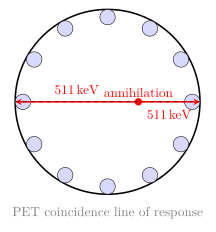
图 8 中 annihilation point 在 center 右侧;右侧光子先到。有限 timing resolution 只把点限制在一段概率分布,而不是精确定位。
5. Radiotherapy and treatment planning / 放射治疗与治疗计划
Knowledge ID: P10-U05-L03-K05
External-beam radiotherapy 用 photons、electrons 或 particles 从体外沉积能量;brachytherapy 把 sealed sources 置于或靠近 target。Treatment planning 先通过 CT/MRI/PET 等确定 target 与 organs at risk(OARs),再用 calibrated beam model 计算三维 absorbed-dose distribution。
Conformal beams 或 intensity modulation 从多个方向叠加,使 target 达到 prescribed coverage,同时尽量降低 OAR dose。优化可抽象为
\[\min_{\mathbf w\ge0} \left[ \sum_{i\in T}a_i(D_i(\mathbf w)-D_i^{\mathrm{goal}})^2 + \sum_{j\in O}b_j\,\Phi(D_j(\mathbf w)) \right],\]
其中 \(\mathbf w\) 是 beamlet weights,\(\Phi\) 对 OAR overdose 加罚。这个目标函数不是临床真理:contouring uncertainty、motion、beam-model error、setup error 与 biological response 都要求 margins、image guidance、independent QA 和 plan verification。
Fractionation 把 total treatment 分成多次 delivery,使 tumor control 与 normal-tissue recovery 的时间响应可被权衡。Dose-volume histogram(DVH)压缩了三维分布,便于比较 coverage 与 OAR exposure,但丢失空间位置;两个 DVH 相同的 plan 仍可能有不同 hot-spot geometry。
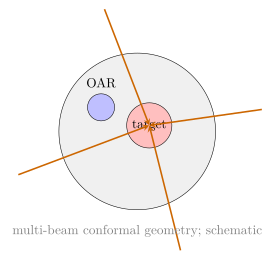
图 9 仅表示多方向叠加;真实 beams 有有限宽度、energy spectrum、penumbra 与 patient-dependent attenuation。
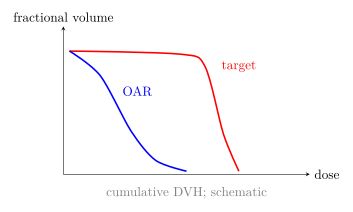
图 10 展示理想目标是 target curve 靠高剂量、OAR curve 靠低剂量;DVH 不能告诉你高剂量落在器官的哪个位置。
Worked Examples / 完整例题
Worked Example 1 — 吸收剂量
已知: 平均 \(2.00\,\mathrm{mJ}\) 能量沉积在质量 \(0.500\,\mathrm{kg}\) 的均匀体积中。
系统边界: 只计该体积内的 imparted energy;忽略能量随时间和空间的不均匀。
\[D=\frac{2.00\times10^{-3}}{0.500} =4.00\times10^{-3}\,\mathrm{J\,kg^{-1}} =4.00\,\mathrm{mGy}.\]
检查与解释: Gy 与 J/kg 量纲一致。这个数不指定 radiation type 或 tissue sensitivity,因此不能直接称为 equivalent/effective dose。
Worked Example 2 — 当量与有效剂量的两级加权
已知: Tissue 1 受 \(2.00\,\mathrm{mGy}\) photon dose 与 \(0.100\,\mathrm{mGy}\) alpha dose;取 \(w_R=1\) 与 20,\(w_{T1}=0.12\)。Tissue 2 的 equivalent dose 为 \(1.00\,\mathrm{mSv}\),\(w_{T2}=0.04\);其他 tissues 在此简化例中为 0。
模型: 仅演示防护权重计算,不代表患者剂量评价。
\[H_{T1} =(1)(2.00)+(20)(0.100) =4.00\,\mathrm{mSv}.\]
\[E_{\mathrm{eff}} =(0.12)(4.00)+(0.04)(1.00) =0.520\,\mathrm{mSv}.\]
检查: weighting factors 无量纲,Sv 保留。\(H_{T1}\) 与 \(E_{\mathrm{eff}}\) 不能互换;若 exposure 非均匀,必须逐 tissue 计算。
Worked Example 3 — Parent–daughter 测年
已知: 封闭样品中已扣除 initial daughter,测得 \(D^\ast/P=3.00\);parent half-life 为 \(1.25\,\mathrm{Ga}\)。
系统与模型: closure 后无 parent/daughter 迁移,一对一 decay,decay constant 恒定。
\[t=\frac{1}{\lambda}\ln(1+3.00) =\frac{t_{1/2}}{\ln2}\ln4 =2t_{1/2}=2.50\,\mathrm{Ga}.\]
检查与解释: 两个半衰期后 parent 剩 \(1/4\),daughter/parent \(=(3/4)/(1/4)=3\)。若 daughter 曾流失,测得比值偏小并给出偏年轻 apparent age。
Worked Example 4 — PET time-of-flight 定位
已知: 沿一条 detector diameter,右侧 photon 比左侧早到 \(\Delta t=400\,\mathrm{ps}\)。规定 \(+x\) 向右,取 \(c=3.00\times10^8\,\mathrm{m\,s^{-1}}\)。
模型: 两 photon 近反向、速度为 \(c\),忽略 detector timing bias 和 non-collinearity。
\[x=\frac{c\Delta t}{2} =\frac{(3.00\times10^8)(400\times10^{-12})}{2} =6.00\times10^{-2}\,\mathrm m.\]
annihilation point 在中心右侧 \(6.00\,\mathrm{cm}\)。方向检查: 右侧先到意味着右侧路程短,点确实位于右侧。实际 timing uncertainty 会把该位置展宽。
Worked Example 5 — 简化 treatment-plan objective
已知: 以 normalized dose 评价两个 plan:目标剂量 goal 为 1。Plan A 有 \((D_T,D_O)=(0.98,0.40)\),Plan B 有 \((1.01,0.25)\)。简化 objective
\[J=(D_T-1)^2+2D_O^2.\]
系统: 一个 target metric 与一个 OAR metric;这是数学示例,不是临床处方。
\[J_A=(-0.02)^2+2(0.40)^2=0.3204,\]
\[J_B=(0.01)^2+2(0.25)^2=0.1251.\]
在此权重下 Plan B 较优。边界检查: 改变 OAR 权重、加入 hot spots、robustness 或 delivery constraints 可改变排序;objective value 不能替代 clinician review 与 QA。
Lesson synthesis / 全课综合
本课的共同结构是“物理量 → 模型权重或反演 → 应用决策”:
- Energy deposition 给 absorbed dose;
- protection conventions 给 equivalent/effective dose;
- biological evidence 与 uncertainty 给 population-level risk models;
- radioactive clock 或 tracer balance 反演 age、flow 与 residence time;
- detector projections 反演 activity image;
- beam transport 与 optimization 反演 treatment delivery。
越靠近应用端,模型依赖、数据校准和伦理/监管边界越重要。高质量物理笔记必须同时写清可计算量、不可直接推断量与验证步骤。
Formula-and-decision table / 公式与决策表
| Task | Relation | Use only when | Do not infer directly |
|---|---|---|---|
| absorbed dose | \(D=\mathrm d\bar\varepsilon/\mathrm dm\) | mass and imparted energy defined | individual biological outcome |
| equivalent dose | \(H_T=\sum_Rw_RD_{T,R}\) | protection weighting convention | treatment prescription |
| effective dose | \(E_{\mathrm{eff}}=\sum_Tw_TH_T\) | reference-person protection use | patient-specific exact risk |
| closed-system age | \(t=\lambda^{-1}\ln(1+D^\ast/P)\) | initial daughter and closure controlled | age if system reopened |
| PET TOF location | \(x=c\Delta t/2\) | calibrated line of response | exact point below timing resolution |
| plan objective | \(J(\mathbf w)\) | stated weights and constraints | unique clinically best plan |
Model boundaries / 模型边界
- Gray measures absorbed energy per mass; sievert quantities add biological/protection weighting. They are not universally convertible by one factor.
- Effective dose is intended for radiological protection comparisons and optimization, not retrospective individual risk or therapeutic dose prescription.
- Tissue-reaction thresholds and stochastic-risk coefficients depend on endpoint, population and evidence; low-dose estimates carry substantial uncertainty.
- Dating equations require closed systems, correct decay constants and initial daughter treatment; weathering or metamorphism may reset or mix clocks.
- Tracer must follow the process being inferred and not perturb it; decay, exchange and sampling all enter the balance.
- PET/SPECT reconstruction requires attenuation/scatter/random correction and a validated system response.
- Treatment planning is patient- and machine-specific; teaching objectives and schematic DVHs are not executable clinical plans.
Misconception clinic / 误区诊所
- “1 Gy 就等于 1 Sv。” 只有在特定 weighting conditions 下数值可能相同,物理意义仍不同。
- “Effective dose 能给某个患者精确的患癌概率。” 错;它是 reference-person protection quantity,不能承担个体化预测。
- “放射性测年只要代半衰期,不需要地质模型。” closure、initial daughter、contamination 与重置历史决定年龄是否有意义。
- “PET 直接拍到 positron 的轨迹。” PET 探测 annihilation photons 的 coincidence lines,并通过统计重建 activity。
- “DVH 相同就说明两个治疗计划等价。” DVH 丢失空间位置、运动与 delivery robustness。
Practice and retrieval / 练习与提取
- [K01·定量] \(6.00\,\mu\mathrm J\) 均匀沉积于 \(2.00\,\mathrm g\),求 absorbed dose。
- [K01·概念] 分别说明 Gy、equivalent Sv 与 effective Sv 的计算层级。
- [K02·判断] 为什么“相同 total dose 就有相同 biological effect”通常不成立?列出三项遗漏变量。
- [K02·表达] 用一句准确表述区分 tissue-reaction severity 与 stochastic-effect probability。
- [K03·定量] 封闭体系中 \(D^\ast/P=1\),年龄是多少个 half-lives?
- [K03·边界] Parent 流失会使简单 parent–daughter age 偏大还是偏小?说明理由。
- [K04·比较] SPECT 与 PET 分别怎样获得方向/位置约束?各自牺牲或依赖什么?
- [K04·定量] PET arrival-time difference 为 \(200\,\mathrm{ps}\),求沿 line of response 的中心偏移大小。
- [K05·概念] 为什么 treatment plan 需要 image guidance 与 independent QA,即使计算机 objective 已很低?
- [K01–K05·综合] 选 dating、imaging 或 therapy 中任一应用,写出“输入数据—物理模型—输出—关键不可直接推断量”的四列表。
第 1 题答案
\(D=6.00\times10^{-6}/2.00\times10^{-3}=3.00\times10^{-3}\,\mathrm{Gy}=3.00\,\mathrm{mGy}\)。
第 2 题答案
Gy 是 imparted energy/mass;equivalent dose 对一个 tissue 按 radiation type 加权;effective dose 再按 tissues 的 reference detriment 加权。
第 3 题答案
至少包括 radiation quality/LET、dose rate 或 fractionation、spatial distribution、organ/cell type、oxygenation 和 individual variation。
第 4 题答案
Tissue reactions 通常在 endpoint-dependent threshold region 上方 severity 随 dose 增加;stochastic protection models 主要令发生概率随 dose 增加,而 severity 不由 dose 决定。
第 5 题答案
\(D^\ast/P=1\) 意味 parent=daughter,parent 剩一半,所以 \(t=t_{1/2}\)。
第 6 题答案
若 daughter 保留而 parent 流失,\(D^\ast/P\) 偏大,代入封闭模型会给偏老 apparent age;若两者同时迁移,方向需具体建模。
第 7 题答案
SPECT 以 mechanical collimator 选择方向,牺牲 efficiency;PET 以两个 \(511\,\mathrm{keV}\) photons 的 coincidence 给 line of response,依赖 timing、attenuation/scatter corrections。
第 8 题答案
\(x=c\Delta t/2=(3.00\times10^8)(200\times10^{-12})/2=0.0300\,\mathrm m=3.00\,\mathrm{cm}\)。
第 9 题答案
Patient setup、motion、contouring 与 beam-model errors 会使 planned 与 delivered dose 不同;QA 验证机器、数据传输和独立计算。
第 10 题答案
示例 PET:输入为 tracer activity、coincidence events、calibration/attenuation map;模型为 decay、transport、response 与 reconstruction;输出为 estimated activity image;不能直接推断个体疾病结论或精确细胞代谢而无临床与生物模型。
Exit ticket / 离堂检验
- 写一段不超过三句的报告语言,准确说明某组织吸收了 \(2\,\mathrm{mGy}\),并避免把它误报为 effective dose 或个人风险。
- 对“PET 图像亮区就是肿瘤”和“测得 parent/daughter 比就得到岩石真年龄”各指出一个共同的 inverse-problem 错误。
References and source notes / 参考资料与来源说明
以下链接均于 2026-08-30 实际核对。医疗部分只用于物理教学,不构成医学建议。
- ICRP Publication 147: Use of Dose Quantities in Radiological Protection — absorbed、equivalent、effective dose uses and limitations。
- IAEA Basic Safety Standards: Dose Quantities — definitions, weighting and units。
- NIST SP 330, Section 2 — SI absorbed-dose and dose-equivalent units。
- US EPA: Radiation Health Effects — tissue damage, cancer risk and public-facing risk context。
- US NRC: Radiation and Its Health Effects — dose, rate and health-effect overview。
- USGS: Radiogenic Isotopes and the Eastern Mineral Resources Program of the U.S. Geological Survey — parent–daughter systems, half-lives and closed-system assumption。
- IAEA: Isotope Hydrology Training Courses — stable/radioactive isotopes, groundwater dating and tracer interpretation。
- NIBIB: Nuclear Medicine — PET、SPECT、tracers and clinical imaging principles。
- NCI: External Beam Radiation Therapy — imaging, planning, conformal delivery and normal-tissue sparing。
Source-to-content map
| Source | Used for | Knowledge ID / Section | Model boundary or convention |
|---|---|---|---|
| ICRP 147 | dose quantities and purposes | K01, K02 | effective dose is a protection quantity, not individualized risk |
| IAEA BSS | formal dose definitions | K01 | weighting factors are protection conventions |
| NIST SP 330 | SI units Gy and Sv | K01 | unit equality does not imply quantity equality |
| EPA and NRC | effects and risk communication | K02 | population evidence and dose-rate context |
| USGS | parent–daughter dating | K03 | closed system and initial daughter required |
| IAEA isotope hydrology | tracers and age indicators | K03 | flow, mixing and decay must be distinguished |
| NIBIB | PET/SPECT physics | K04 | reconstructed tracer distribution is an inverse result |
| NCI | radiotherapy planning | K05 | clinical planning requires imaging, conformation and professional QA |
复习与拓展
- 与 Radiation Detection 联结:dose 与 image 都由 counts、efficiency、calibration 和 uncertainty 建立。
- 下一 Part 的 particle decays 将把核衰变推广到 relativistic particles、lifetimes、branching fractions 与 detector signatures。
- 未来扩展:microdosimetry、linear–quadratic model、kinetic compartment imaging、tomographic reconstruction、robust treatment optimization。