
Learning objectives / 学习目标
学完本课后,你应能:
- 将时空平移与旋转分别连接到能量、动量与角动量守恒,并在事件层面建立矢量账本;
- 为反应逐项核算 electric charge、baryon number、total/flavor lepton numbers,并说明各自的理论地位;
- 正确定义 \(P\)、\(C\)、\(T\) 对坐标、动量、自旋和粒子标签的作用,避免把它们当作普通几何镜像;
- 陈述 CPT theorem 的条件与可检验后果,而不把 CPT 等同于 C、P、T 分别守恒;
- 依据相互作用类型把 selection rule 标记为 exact、approximate 或 violated,并用 amplitude/rate 的层级估计抑制。
Prerequisites / 先修知识
- Reactions and Decays 的 four-momentum、decay 与 threshold。
- 经典角动量与量子自旋的基本加法;复振幅的模平方给概率或率。
- 知道反应式中的 antiparticle 用 bar 或相反电荷标记。
- Noether theorem 的场论推导留到 Classical Fields and Symmetry;本课使用其物理结论。
Scope and conventions / 范围与约定
- “对称性”指作用量或动力学定律在指定变换下不变,不是图形看起来对称。
- isolated system 的 energy–momentum 与 total angular momentum 由时空均匀性/各向同性支撑;开放系统必须把外界通量计入。
- 电荷在标准模型中是精确规范荷;\(B\) 和 \(L\) 的地位更细:常见微扰过程高度守恒,但 flavor lepton numbers 因 neutrino mixing 不严格,total \(L\) 是否被 Majorana physics 破坏仍是实验问题。
- \(C\)、\(P\)、\(T\) 是离散变换;weak interaction 可破坏它们中的若干,而 CPT 在局域、Lorentz invariant、unitary quantum field theory 等标准假设下成立。
- 本课不推导 antiunitary time reversal、anomaly 或 neutral-meson mixing 的完整形式,只给可操作层级与边界。
Notation and modeling contract / 符号与建模契约
| Symbol | Meaning | Type / unit |
|---|---|---|
| \(Q\) | electric charge in units of \(e\) | dimensionless |
| \(B\) | baryon number | dimensionless |
| \(L_e,L_\mu,L_\tau\) | flavor lepton numbers | dimensionless |
| \(L\) | total lepton number | dimensionless |
| \(\mathbf J=\mathbf L+\mathbf S\) | total angular momentum | \(\mathrm{J\,s}\) or \(\hbar\) |
| \(P,C,T\) | parity, charge conjugation, time reversal | discrete operators |
| \(\eta_P\) | intrinsic parity eigenvalue | \(+1\) or \(-1\) |
| \(\mathcal M\) | transition amplitude | convention-dependent |
| \(A_{CP}\) | CP asymmetry | dimensionless |
1. Energy, momentum, and angular momentum / 能量、动量与角动量
Knowledge ID: P11-U01-L02-K01
若基本动力学不显含时间原点,则时间平移不改变实验结果,对应能量守恒;空间平移对应动量守恒;旋转不变性对应总角动量守恒。场论中这些是 Noether currents 的积分量。本课在事件层面写为
\[\sum_{\mathrm{in}}p_i^\mu=\sum_{\mathrm{out}}p_f^\mu, \qquad \mathbf J_{\mathrm{in}}=\mathbf J_{\mathrm{out}}.\]
角动量必须包括 orbital 与 spin:
\[\mathbf J=\mathbf L+\mathbf S.\]
选择参考点会改变开放子系统的 \(\mathbf L\),但对封闭系统、同时计入所有部分后,物理选择规则一致。衰变中 \(J\) 守恒会限制 daughter spins 与 relative orbital angular momentum \(L\) 的耦合。
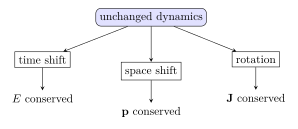
图 1 是 Noether 对应的概念图;它说明守恒量来自动力学对称性,而不是额外贴在反应式上的经验规则。
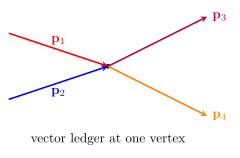
图 2 提醒动量是矢量账本;“动量大小相加相等”只在共线特殊情形成立。
2. Electric charge, baryon number, and lepton numbers / 电荷、重子数与轻子数
Knowledge ID: P11-U01-L02-K02
反应可用 additive quantum-number ledger 检查:
\[\sum_{\mathrm{in}}Q=\sum_{\mathrm{out}}Q, \qquad \sum_{\mathrm{in}}B=\sum_{\mathrm{out}}B, \qquad \sum_{\mathrm{in}}L=\sum_{\mathrm{out}}L.\]
常用赋值为:quark \(B=1/3\)、antiquark \(B=-1/3\);baryon \(B=1\)、antibaryon \(B=-1\);charged lepton 与 neutrino 有相应 flavor \(L_\alpha=1\),antilepton 为 \(-1\)。例如
\[n\rightarrow p+e^-+\bar\nu_e\]
满足 \(Q:0=1-1+0\),\(B:1=1\),\(L_e:0=1-1\)。
但“守恒”必须附带层级:electric charge 是精确的;proton decay 尚未观测使 \(B\) 在低能实验中极好守恒,但标准模型的非微扰效应并不把 \(B+L\) 当作绝对精确量;neutrino oscillation 直接说明 \(L_e,L_\mu,L_\tau\) 不是传播全过程的严格守恒标签。若 neutrino 是 Majorana particle,total \(L\) 也可破坏;这一点尚待实验确定。
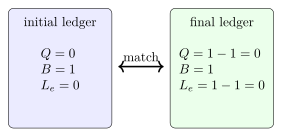
图 3 把不同 quantum numbers 分成独立行;一个过程不能用“总数看起来差不多”代替逐项匹配。
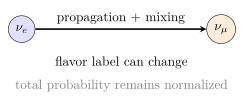
图 4 表示 neutrino flavor conversion;它不等于 electric charge nonconservation,也不能单凭 oscillation 判定 total lepton number 是否破坏。
3. Parity, charge conjugation, and time reversal / 宇称、电荷共轭与时间反演
Knowledge ID: P11-U01-L02-K03
三种离散变换的操作对象不同:
\[P:(t,\mathbf x)\mapsto(t,-\mathbf x),\]
\[C:\text{particle}\mapsto\text{antiparticle},\]
\[T:(t,\mathbf x)\mapsto(-t,\mathbf x).\]
在 \(P\) 下 polar vectors 如 \(\mathbf p\) 反向,而 axial vector \(\mathbf J=\mathbf r\times\mathbf p\) 不反向,所以 helicity \(h\propto\mathbf S\cdot\mathbf p\) 改号。在 \(T\) 下 \(\mathbf p\) 与 \(\mathbf J\) 都反向,电荷不变;量子理论的 \(T\) 是 antiunitary,不能只把影片倒放当完整定义。\(C\) 改变内部 charge labels,不反转空间坐标。
强、电磁过程在可测精度内通常尊重 C/P(在适用本征态中)和 T;charged-current weak interaction 强烈破坏 C 与 P。CP 也被 weak interaction 破坏,但程度和 flavor sector 有关。
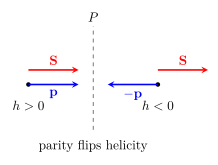
图 5 从左侧 \(\mathbf S\parallel\mathbf p\)(\(h>0\))开始;parity 反转 polar momentum 而保持 axial spin 的方向,所以右侧 \(\mathbf S\) 与 \(\mathbf p\) 反平行(\(h<0\))。
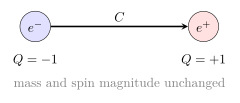
图 6 表示 charge conjugation 改变 additive charges;它不是把电子沿空间反方向运动。
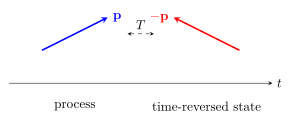
图 7 强调 time-reversed state 要反转 momenta 与 angular momenta;比较实验率还需正确交换 initial/final states。
4. CPT symmetry / CPT 对称性
Knowledge ID: P11-U01-L02-K04
CPT theorem 的标准表述是:在满足 locality、Lorentz invariance、unitarity/Hermitian Hamiltonian 与通常 spin–statistics/microcausality 条件的量子场论中,组合 \(CPT\) 是精确对称。它不是“因为 C、P、T 各自都成立”——事实上 weak processes 可分别破坏它们。
CPT 的可检验后果包括 particle/antiparticle 质量与 total lifetime 相同、additive charges 相反,并对共轭过程的 amplitudes 建立关系。若报告 CPT violation,必须同时审查实验系统误差以及理论假设是否被放弃。
若 CPT 成立而 CP 被观察到破坏,则相应意义下 T 也必须破坏,使组合保持不变。这是逻辑关系,不意味着任一 CP asymmetry 都能不经 neutral-state mixing 与 final-state effects 分析直接读成 T asymmetry。
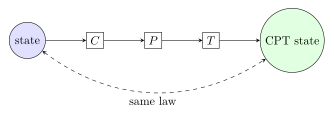
图 8 把组合变换与 individual symmetry 分开;中间任一步可不保持相同率,最终组合仍可对称。
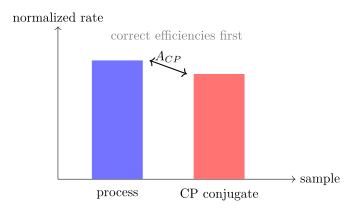
图 9 表示 rate asymmetry 的测量逻辑;raw bar-height difference 还可能包含 production、acceptance 与 detector charge asymmetry。
5. Conservation, approximate conservation, and violation / 严格、近似守恒与破坏
Knowledge ID: P11-U01-L02-K05
守恒规则必须写成“在哪个 Hamiltonian/interaction 和精度下”:
- strict/exact: 生成该量的 symmetry 是完整理论的精确对称,如 electric charge conservation。
- approximate: dominant interaction 尊重 symmetry,但小参数、质量差或较弱相互作用破坏它;如 isospin 对 \(m_u\approx m_d\) 的近似、strangeness 在强相互作用中守恒但可由弱衰变改变。
- violated: 变换前后可测 amplitudes/rates 不相等,如 parity violation in weak charged currents 与 CP violation in kaon/B systems。
若受禁过程仅由小 symmetry-breaking amplitude \(\epsilon\mathcal M_0\) 发生,则率通常按
\[\Gamma_{\mathrm{suppressed}}\propto\lvert\epsilon\mathcal M_0\rvert^2 =\lvert\epsilon\rvert^2\Gamma_0\]
缩小。需要区分 amplitude-level 一阶小量与 rate-level 二阶小量;有干涉时,observable 也可能出现线性 \(\epsilon\) 项。
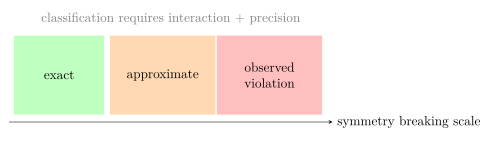
图 10 不是统一数值刻度,而是审题顺序:先确定 dynamical sector 和 measurement precision,再贴守恒标签。
Worked Examples / 完整例题
Worked Example 1 — 用量子数发现 beta decay 的漏失粒子
题目: 只写 \(n\to p+e^-\) 时,检查 \(Q,B,L_e\);再加入 \(\bar\nu_e\)。
系统边界: neutron decay 的全部末态;初态 neutron 静止系不是量子数账本所必需,但用于能量—动量检查。
只写两体末态时:\(Q:0=1-1\)、\(B:1=1\) 均通过,但
\[L_e:0\ne1.\]
加入 \(\bar\nu_e\),其 \(Q=0,B=0,L_e=-1\),则
\[0=1+(-1).\]
物理解释与检查: antineutrino 同时带走连续 electron spectrum 所需的能量、动量和角动量。量子数守恒本身不确定其质量或能谱,但能排除不完整反应式。
Worked Example 2 — parity selection rule
题目: 假设一个 \(J^P=0^-\) 的粒子衰变为两个 spin-0、intrinsic parity 均为 \(-1\) 的粒子。若相互作用守恒 parity,最低 partial wave 是否允许?
参考系与轴: parent rest frame;relative orbital angular momentum 为 \(L\)。两个 daughter spins 为零,为保持 \(J=0\) 必须 \(L=0\)。
末态 parity 为
\[P_f=\eta_1\eta_2(-1)^L=(-1)(-1)(+1)=+1.\]
初态 \(P_i=-1\),故 \(P_i\ne P_f\)。结论: 在 parity-conserving interaction 中,spin-0 daughters 的该两体 channel 被禁;若由 parity-violating weak interaction 发生,则不能用此规则禁戒。检查:改为 parent \(0^+\) 时 \(L=0\) 可允许。
Worked Example 3 — 从计数计算 raw CP asymmetry
已知: efficiency-corrected samples 中,过程与 CP-conjugate 过程分别有 \(N=10600\) 和 \(\bar N=9400\) 个事件;暂忽略本底与系统误差。
\[A_{CP}=\frac{N-\bar N}{N+\bar N} =\frac{1200}{20000}=0.0600.\]
对 binomial-like counting,近似统计误差
\[\sigma_A\approx\sqrt{\frac{1-A^2}{N+\bar N}} =0.00706.\]
统计上约为 \(8.50\sigma\)。边界检查: 这不是最终 CP discovery;必须控制 unequal production、charge-dependent efficiency、background asymmetry 与 look-elsewhere choices。无量纲结果与输入总计数相符。
Worked Example 4 — approximate symmetry 的 amplitude 与 rate
已知: dominant allowed amplitude 为 \(\mathcal M_0\);一个 approximate symmetry 禁戒的 channel 仅由 breaking term \(\epsilon\mathcal M_0\) 产生,\(\epsilon=0.020\),且 phase space 相同。
\[\frac{\Gamma_{\mathrm{sup}}}{\Gamma_0} =\frac{\lvert\epsilon\mathcal M_0\rvert^2}{\lvert\mathcal M_0\rvert^2} =\epsilon^2=4.0\times10^{-4}.\]
即 rate 抑制约 \(1/2500\)。检查: \(\epsilon\to0\) 回到 exact selection rule;若 suppressed amplitude 与其他 amplitude 干涉,某些 asymmetry 可对 \(\epsilon\) 一阶敏感,不能机械套平方。
Lesson synthesis / 本课综合
处理粒子反应的第二层筛选流程:
- 先用上一课的 four-momentum 判断 kinematically allowed;
- 列出 \(Q,B,L_\alpha\) 与其他 quantum numbers 的 initial/final ledger;
- 指明由哪一种 interaction 主导,确定哪些 symmetries exact、approximate 或 violated;
- 对离散变换,逐一写清 \(P,C,T\) 对 state 的作用,不凭“镜像直觉”;
- 把 selection rule 作用在 amplitude,再决定 observable 是平方抑制还是干涉的一阶效应;
- 把 raw asymmetry 与 detector/production/systematic effects 分开。
Formula-and-decision table / 公式与决策表
| Decision | Relation | Use when | Caveat |
|---|---|---|---|
| 四动量是否守恒? | \(\sum p_{\rm in}^\mu=\sum p_{\rm out}^\mu\) | isolated event | missing particles must be included |
| additive charge 是否匹配? | \(\sum q_{\rm in}=\sum q_{\rm out}\) | \(Q,B,L\) ledger | status differs among quantum numbers |
| two-body parity? | \(P_f=\eta_1\eta_2(-1)^L\) | parity-conserving interaction | weak interaction may violate P |
| CP rate asymmetry? | \(A_{CP}=(\Gamma-\bar\Gamma)/(\Gamma+\bar\Gamma)\) | conjugate samples corrected | raw counts include detector effects |
| small breaking rate? | \(\Gamma_{\rm sup}/\Gamma_0\sim\lvert\epsilon\rvert^2\) | isolated breaking amplitude | interference can be linear |
Model boundaries / 模型边界
- Energy conservation in a time-dependent external field applies only after including field/source energy; subsystem energy need not be constant。
- Individual flavor lepton numbers are not exact propagation invariants because neutrinos mix; total lepton number remains an open experimental issue, not a settled exact law。
- \(C\) parity is defined only for appropriate neutral states that map to themselves under charge conjugation; a charged particle is not generally a \(C\) eigenstate。
- T violation is not established by ordinary dissipative irreversibility; fundamental T tests compare properly transformed quantum transitions。
- CPT theorem conclusions depend on its assumptions. A Lorentz-violating or nonlocal proposal changes the logical package and must specify which assumption is relaxed。
Misconception clinic / 常见误区诊所
- “守恒律只是实验总结,与对称性无关。” 守恒量的深层结构由动力学不变性给出;实验决定哪些对称性自然实现或破坏。
- “中微子振荡说明电荷不守恒。” 振荡改变 flavor composition,不改变 electric charge;不同 quantum-number ledgers 不能混用。
- “镜面反射会把自旋箭头也翻转。” spin 是 axial vector;在 parity 下与 polar momentum 的变换不同。
- “CP 破坏就等于 CPT 破坏。” 在 CPT 成立的理论中,CP violation 与相应 T violation 协调,CPT 可仍精确。
- “没观测到就是严格守恒。” non-observation 给实验上限;exactness 还需理论 symmetry statement,approximate rules 可极强抑制而非完全为零。
Practice and retrieval / 练习与提取
- [K01 · 概念] 把 time translation、space translation、rotation 分别与 conserved quantity 配对,并说明 angular momentum 为什么要含 spin。
- [K02 · 账本] 检查 \(e^-+e^+\to\gamma+\gamma\) 的 \(Q,B,L_e\)。
- [K02 · 边界] 检查 hypothetical proton decay \(p\to\pi^0+e^+\) 的 \(Q\) 与 \(B\),说明它若观察到意味着什么。
- [K03 · 变换] 对 \(P\) 变换,分别写出 \(\mathbf r,\mathbf p,\mathbf L=\mathbf r\times\mathbf p\) 的变换。
- [K03 · 变换] 对 \(T\) 变换,分别写出 \(\mathbf p\) 与 \(\mathbf J\) 的变换,并说明 electric charge 是否改变。
- [K03 · 定量] 两个 spinless daughters 的 intrinsic parities 为 \(+1\) 和 \(-1\),relative \(L=1\)。求 final parity。
- [K03 · 边界] 用一句话解释为什么 charged pion 不是 \(C\) eigenstate。
- [K04 · 证据] 若 \(A_{CP}=0.030\) 且总计数 \(N_{\rm tot}=40000\),忽略系统误差,估计 \(\sigma_A\) 与统计显著性,并说明 CPT 与 CP 的逻辑边界。
- [K05 · 定量] 一个 symmetry-breaking amplitude ratio 是 \(5.0\times10^{-3}\),无干涉且 phase space 相同。估计 rate ratio。
- [K05 · 分类] 将 electric charge、strangeness in strong interaction、parity in charged-current weak interaction 分别标记 exact、approximate/sector-dependent 或 violated,并说明理由。
Answer 1
时间平移对应 \(E\),空间平移对应 \(\mathbf p\),旋转对应 \(\mathbf J\)。量子粒子具有 intrinsic spin,因此只有 \(\mathbf J=\mathbf L+\mathbf S\) 是完整的旋转生成量。
Answer 2
初态 \(Q=-1+1=0\)、\(B=0\)、\(L_e=1-1=0\);双光子三项皆为零,全部匹配。还需能量—动量与角动量守恒才能完整判断。
Answer 3
\(Q:1=0+1\) 通过;\(B:1\ne0\),破坏 baryon number。若排除误判并确认该衰变,将是超越常见低能标准模型过程的重要证据,不是“能量缺失”即可解释。
Answer 4
\(P:\mathbf r\to-\mathbf r\),\(\mathbf p\to-\mathbf p\);故 \(\mathbf L\to(-\mathbf r)\times(-\mathbf p)=\mathbf L\)。\(\mathbf L\) 是 axial vector。
Answer 5
\(T:\mathbf p\to-\mathbf p\)、\(\mathbf J\to-\mathbf J\);electric charge 不变。量子态还需复共轭/antiunitary 处理。
Answer 6
\[P_f=(+1)(-1)(-1)^1=+1.\] 两个负号分别来自 intrinsic parity product 与 odd orbital wave。
Answer 7
\(C\) 把 \(\pi^+\) 映为不同状态 \(\pi^-\),而非同一状态乘一个 eigenvalue;所以单个 charged pion 不是 \(C\) eigenstate。
Answer 8
\[\sigma_A\approx\sqrt{\frac{1-A^2}{N_{\rm tot}}}=0.00500,\] 显著性约 \(0.030/0.00500=6.0\sigma\),但这不含任何 systematic uncertainty。
Answer 9
\[\Gamma_{\rm sup}/\Gamma_0\approx(5.0\times10^{-3})^2=2.5\times10^{-5}.\]
Answer 10
Electric charge:exact;strangeness:在 QCD/QED sector 中 exact,weak interaction 可改变,因此在完整 Standard Model 或未指定 interaction 时只能称 sector-dependent,并常表现为低能近似选择定则;parity in charged-current weak interaction:violated。标签必须包含相互作用范围。
Exit ticket / 离堂任务
- 为一个你自选的粒子衰变画三行 quantum-number ledger,并在每行写明“exact、sector-dependent 或 open”。
- 解释“CPT 成立、CP 破坏、T 破坏”三者可以同时为真的逻辑,不超过 80 字。
References and source notes / 参考资料与来源说明
以下来源均于 2026-08-30 实际打开核对;叙述重新组织,图示未复制来源:
- Particle Data Group, Tests of Conservation Laws 2025 — C/P/T tests、CPT assumptions、CP/T violation status。
- Particle Data Group, 2024 Conservation-Law Summary Tables — experimental limits and classification conventions。
- MIT OpenCourseWare 8.701, Lecture 2.1: Symmetries—Introduction — symmetry, conservation, Noether viewpoint。
- MIT OpenCourseWare 8.701, Lecture 2.3: Parity — parity transformation and selection rules。
- MIT OpenCourseWare 8.701, Lecture 2.4: Charge Conjugation — C operation and eigenstate conditions。
- MIT OpenCourseWare 8.701, Lecture 2.5: CP Violation — CP observables and weak-interaction violations。
Source-to-content map / 来源—内容映射
| Source | Used for | Knowledge ID / Section | Model boundary or convention |
|---|---|---|---|
| PDG Tests of Conservation Laws | C/P/T/CPT status and assumptions | K03, K04, K05 | exact statements conditioned on QFT assumptions |
| PDG summary tables | experimental-limit viewpoint | K02, K04, Model boundaries | non-observation distinguished from exact proof |
| MIT 8.701 Symmetries | Noether and quantum-number framework | K01, K02 | full field derivation deferred to Unit 11.5 |
| MIT 8.701 Parity | polar/axial vectors and parity selection | K03, Example 2 | only parity-conserving interactions use rule |
| MIT 8.701 Charge Conjugation | particle–antiparticle mapping | K03 | charged states are generally not C eigenstates |
| MIT 8.701 CP Violation | asymmetries and weak violation | K03, K05, Example 3 | detector and production asymmetries separated |
复习与拓展
- Unit 11.2 将为 \(Q,B,L\) 的载体建立 quark/lepton/hadron 分类,并把 rules 连接到四种 interactions。
- Unit 11.3 将以 gauge symmetries、CKM/PMNS mixing 解释哪些量严格、近似或被破坏。
- Unit 11.4 将把 CP asymmetry 的 raw counts 扩展到 likelihood、control regions 与 systematic uncertainty。