
Learning objectives / 学习目标
学完本课后,你应能:
- 用 spin 与 exchange statistics 区分 fermion/boson,并解释“boson”不等于“force carrier”;
- 列出三代 charged leptons 与 neutrinos,比较其电荷、稳定性和相互作用通道;
- 由 quark flavor、fractional electric charge、baryon number 与 color 计算复合态量子数;
- 区分 meson、baryon 与更一般 hadron,说明 color singlet 和 confinement 的作用;
- 为 particle–antiparticle pair 建立守恒账本,计算最简单 annihilation/pair-production 的能量与动量。
Prerequisites / 先修知识
- Symmetries and Conservation Laws 的 \(Q,B,L\) ledger。
- 量子 spin、Pauli exclusion principle、波函数交换的基本概念。
- Reactions and Decays 的四动量与不变质量。
- 本课以分类和可计算量子数为主;规范群表示与 QCD dynamics 延后到 Unit 11.3。
Scope and conventions / 范围与约定
- elementary 指在当前实验分辨率与标准模型中无已知内部结构,不等于哲学上的最终不可分。
- 用 \(q\) 表示任意 quark,用 \(\bar q\) 表示 antiquark;color labels \(r,g,b\) 是内部量子数,不是真实可见颜色。
- Quark charges 以 elementary charge \(e>0\) 为单位:up-type 为 \(+2/3\),down-type 为 \(-1/3\)。
- Hadrons 是 color-singlet strongly interacting states;简单 quark model 的 \(q\bar q\) meson 与 \(qqq\) baryon 是最低 Fock-content 分类,不排除 tetraquark、pentaquark、hybrid 与 glueball candidates。
- 粒子质量采用 current PDG-scale facts 时只作层级说明;不把易随拟合更新的数值表当永久定义。
Notation and modeling contract / 符号与建模契约
| Symbol | Meaning | Value / type |
|---|---|---|
| \(s\) | spin quantum number | integer or half-integer |
| \(Q/e\) | electric charge in units of \(e\) | dimensionless |
| \(B\) | baryon number | \(1/3\) per quark |
| \(L_\alpha\) | lepton flavor number | \(\alpha=e,\mu,\tau\) |
| \(u,d,c,s,t,b\) | six quark flavors | fermions |
| \(r,g,b\) | three color basis labels | internal charge |
| \(q\bar q\) | minimal meson content | color singlet |
| \(qqq\) | minimal baryon content | color singlet |
1. Fermions and bosons / 费米子与玻色子
Knowledge ID: P11-U02-L01-K01
在三维相对论量子理论中,spin-statistics theorem 将 half-integer spin 与 Fermi–Dirac statistics 连接,将 integer spin 与 Bose–Einstein statistics 连接:
\[\text{fermion}:s=\frac12,\frac32,\ldots, \qquad \text{boson}:s=0,1,2,\ldots.\]
交换两个 identical fermions,many-particle wavefunction 改号;交换 identical bosons,波函数不变:
\[\Psi_F(1,2)=-\Psi_F(2,1), \qquad \Psi_B(1,2)=+\Psi_B(2,1).\]
因此同一 single-particle quantum state 最多容纳一个给定 fermionic internal state,而 bosons 可共同占据。Quarks 与 leptons 是 elementary spin-\(1/2\) fermions;photon、gluons、\(W/Z\) 是 spin-1 gauge bosons,Higgs 是 spin-0 boson。复合粒子也按 total spin 分类:proton 是 fermion,pion 是 boson。
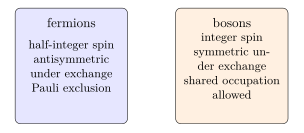
图 1 把分类依据放在 spin 与 exchange symmetry,而不是“物质粒子/力粒子”这种有例外的速记。
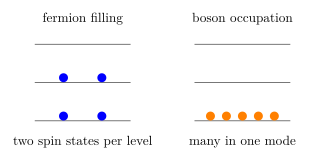
图 2 是 occupation schematic;真实 degeneracy 由 spin、color、orbital 等全部 quantum numbers 决定。
2. Lepton families and neutrinos / 轻子族与中微子
Knowledge ID: P11-U02-L01-K02
三代 leptons 是
\[\begin{pmatrix}\nu_e\\e^-\end{pmatrix}, \qquad \begin{pmatrix}\nu_\mu\\\mu^-\end{pmatrix}, \qquad \begin{pmatrix}\nu_\tau\\\tau^-\end{pmatrix}.\]
每个 charged lepton 有 \(Q=-e\),相应 neutrino 为电中性;所有 leptons 都是 color singlets,不参与 strong interaction。Charged leptons 参与 electromagnetic 与 weak interactions,neutrinos 只通过 weak interaction(以及极弱的 gravity)被常规探测。电子在已知范围内稳定;muon 与 tau 可 weak-decay 为更轻 leptons。
“Generation”表示相同 gauge quantum-number pattern 的重复,不表示 heavier generation 是由 first generation 组成。Neutrino flavor state 与 mass state 不是同一基底:
\[\lvert\nu_\alpha\rangle=\sum_i U_{\alpha i}^*\lvert\nu_i\rangle.\]
因此 production/detection 的 flavor label 在传播中可振荡;本课只建立结构,详细 mixing 见 Unit 11.3。
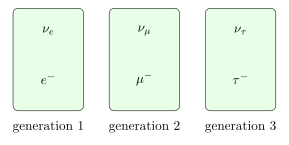
图 3 显示每代的 weak doublet pattern;垂直位置不是质量坐标,盒子尺寸也不按质量比例。
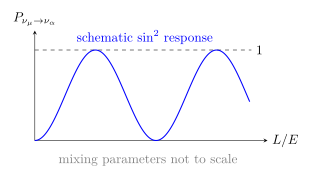
图 4 以非负的 \(\sin^2\) 型概念曲线表示 flavor-transition probability 随 \(L/E\) 变化,并明确限制在 \(0\le P\le1\);它不代表特定 mixing parameters。
3. Quark flavors, color, and fractional charge / 夸克味、色与分数电荷
Knowledge ID: P11-U02-L01-K03
六种 quark flavors 按三代排列:
\[\begin{pmatrix}u\\d\end{pmatrix}, \qquad \begin{pmatrix}c\\s\end{pmatrix}, \qquad \begin{pmatrix}t\\b\end{pmatrix}.\]
Up-type \(u,c,t\) 有 \(Q=+2e/3\);down-type \(d,s,b\) 有 \(Q=-e/3\)。每个 quark 有 \(B=1/3\),每个 antiquark 的 \(Q\)、\(B\) 号反转。每种 flavor 又有三种 color basis states。Color 是 strong-interaction charge;物理 isolated hadrons 必须是 color singlets。
Quark fractional charge 从未作为自由静态粒子直接取出,不是因为电荷量子化失败,而是 QCD confinement 使分离 quark 的能量增长并产生新的 hadrons。Top quark 寿命太短,来不及 hadronize;这也是“所有 quarks 都形成 ordinary hadrons”的重要例外。
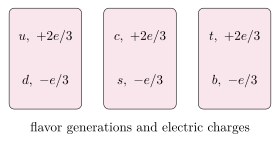
图 5 同时编码 flavor 与 fractional charge;mass hierarchy 未按比例绘制。
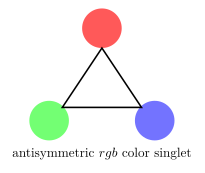
图 6 用三种 basis labels 表示 baryon color singlet;“红绿蓝混成白”只是助记,真正对象是 SU(3) 内部态。
4. Mesons and baryons / 介子与重子
Knowledge ID: P11-U02-L01-K04
Hadrons 是参与 strong interaction 的 color-singlet composite states。最简 quark-model 分类:
\[\text{meson}:q\bar q,\quad B=0; \qquad \text{baryon}:qqq,\quad B=1.\]
典型例子为
\[p=uud, \quad n=udd, \quad \pi^+=u\bar d, \quad K^+=u\bar s.\]
电荷由 constituents 相加。例如 \(Q_p/e=2/3+2/3-1/3=1\)。但 hadron mass 不能把 “quark masses” 简单相加:尤其 light hadrons 的质量大部分来自 QCD field energy、quark kinetic energy 与 binding dynamics。
Meson 不必总是 boson-like \(q\bar q\) 的简单空间图,baryon 也有 gluon/sea-quark components。现代 spectroscopy 还允许 tetraquark、pentaquark、molecule、hybrid 与 glueball interpretations;minimal valence content 是量子数记账工具,不是静态小球模型。
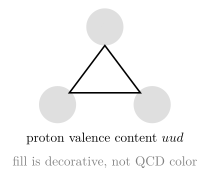
图 7 仅表示 proton valence quantum numbers;中性填色不编码 QCD color,位置也不是 proton 内可观测的经典 quark 轨道。
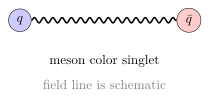
图 8 表示 meson 的 minimal \(q\bar q\) content;波浪线只提示 gluonic binding,不是单个经典弹簧。
5. Antiparticles and annihilation / 反粒子与湮灭
Knowledge ID: P11-U02-L01-K05
每种粒子都有 antiparticle:质量和 spin 相同,electric charge 与其他 additive quantum numbers 反号。某些 neutral particles 可与自身 antiparticle 相同(photon),另一些 neutral particles 仍有不同 antiparticle(neutron)。所以“电中性”不等于“self-conjugate”。
Particle 与 antiparticle 相遇时可 annihilate,但必须保持 four-momentum 与所有 exact charges。\(e^-e^+\) 在 COM 静止极限不能只产生一个 real photon,因为单光子无法同时满足总能量非零与总动量零;最简单 electromagnetic final state 是 two photons:
\[e^-+e^+\rightarrow\gamma+\gamma.\]
“湮灭”不是能量消失,而是初态 fields 的 excitations 转成其他 field excitations。只要 quantum numbers、energy 与 couplings 允许,也可产生 muon pairs、hadrons 或其他多体末态。
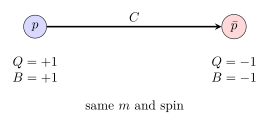
图 9 表示 antiparticle mapping;bar 反转 additive quantum numbers,不反转正能量。
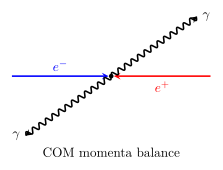
图 10 展示 rest-COM annihilation 的 back-to-back photons;实验室 boost 后不必等能或反向。
Worked Examples / 完整例题
Worked Example 1 — Fermion level filling
题目: 四个相同 spin-\(1/2\) fermions 被限制在非简并的一维 orbital levels,每个 orbital 只因 spin 有 twofold degeneracy。求最低能配置中 occupation。
系统与模型: 封闭的 noninteracting fermion system;single-particle state 由 orbital \(n\) 与 spin projection 完整标记。Pauli principle 要求同一 \((n,m_s)\) 至多一个粒子。
最低 orbital \(n=0\) 可放 \(m_s=\pm1/2\) 两粒,下一 orbital \(n=1\) 再放两粒:
\[(n=0):2, \qquad (n=1):2.\]
检查: 若误把四粒全放 \(n=0\),会重复相同 spin states;若粒子是 spin-0 bosons,四粒可共同占 \(n=0\)。此例说明 statistics 依完整 state label,不是“fermions 永不在同一位置”。
Worked Example 2 — 从 quark content 求 \(\Omega^-\) 量子数
已知: \(\Omega^-=sss\),每个 \(s\) quark 有 \(Q/e=-1/3\)、\(B=1/3\)、strangeness \(S=-1\)。
\[\frac{Q_{\Omega}}e=3\left(-\frac13\right)=-1, \qquad B_\Omega=3\left(\frac13\right)=1,\]
\[S_\Omega=3(-1)=-3.\]
系统边界: 量子数取 minimal valence content;gluons/sea pairs 对 net additive numbers 为零。结果与 baryon classification 匹配。颜色须取 antisymmetric singlet,不能把三个 \(s\) 的 color state也设成完全相同。
Worked Example 3 — \(K^+\) 的 quark ledger
已知: \(K^+=u\bar s\)。\(Q_u/e=+2/3\),\(Q_{\bar s}/e=+1/3\);\(B_u=+1/3\),\(B_{\bar s}=-1/3\),\(S_{\bar s}=+1\)。
\[Q_{K^+}/e=\frac23+\frac13=+1,\]
\[B_{K^+}=\frac13-\frac13=0, \qquad S_{K^+}=+1.\]
检查: \(B=0\) 识别其为 meson;integer charge 来自 fractional constituent charges。不能从 \(u\bar s\) masses 简单求 kaon mass,因为 QCD field energy 显著。
Worked Example 4 — 静止 \(e^-e^+\) 湮灭
已知: electron 与 positron 在 COM 中均近似静止,\(m_ec^2=0.511\,\mathrm{MeV}\),末态为两光子。
坐标: 令 photon 1 沿 \(+x\)。初态总动量为零,所以 photon 2 沿 \(-x\) 且等能。能量守恒:
\[2m_ec^2=E_{\gamma1}+E_{\gamma2}=2E_\gamma.\]
\[E_\gamma=0.511\,\mathrm{MeV}, \qquad p_\gamma=0.511\,\mathrm{MeV}/c.\]
换算 SI,单光子能量约 \(8.19\times10^{-14}\,\mathrm J\)。检查: 两光子能量合计 \(1.022\,\mathrm{MeV}\)、动量矢量和为零;单光子末态无法满足两项条件。
Lesson synthesis / 本课综合
分类流程:
- 由 total spin 判断 fermion/boson statistics;
- 问 elementary state 是否携带 color:leptons 无,quarks 有;
- 对 quark state 加 \(Q,B\) 与 flavor quantum numbers;
- 只接受 overall color-singlet hadrons,并用 \(q\bar q\)、\(qqq\) 作 minimal valence ledger;
- 生成 antiparticle 时保持 mass/spin,反转 additive charges;
- 对 annihilation 或 pair production 再施加 four-momentum、angular momentum 与 interaction selection rules。
Formula-and-decision table / 公式与决策表
| Question | Rule | Use when | Limitation |
|---|---|---|---|
| Fermion or boson? | half-integer vs integer \(s\) | relativistic particle/state total spin | composite total spin matters |
| Quark charge? | up-type \(+2/3\), down-type \(-1/3\) | valence ledger | antiquark signs reverse |
| Meson or baryon? | \(q\bar q\) vs \(qqq\) minimal content | conventional hadrons | exotics and sea/gluons exist |
| Net baryon number? | \(B=(N_q-N_{\bar q})/3\) | additive bookkeeping | top decays before hadronization |
| Rest annihilation photons? | \(E_\gamma=m_ec^2\) for two photons | \(e^-e^+\) at rest | motion/extra photons change energies |
Model boundaries / 模型边界
- Spin-statistics theorem assumes relativistic local quantum field theory; classroom occupation diagrams are consequences, not its proof。
- Neutrino “flavor” is production/detection basis, not a particle with one fixed mass; quoted upper masses and mixing fits evolve with data。
- Color is a quantum basis label subject to gauge symmetry; classical colored balls are only mnemonic。
- Quark-model valence content predicts additive quantum numbers well but not precise hadron masses or decay amplitudes without QCD dynamics。
- Annihilation final state is not always photons; allowed channels depend on \(\sqrt{s}\), charges, angular momentum and couplings。
Misconception clinic / 常见误区诊所
- “所有 fermions 是物质,所有 bosons 是力。” Composite bosonic matter 与 scalar Higgs 立即构成反例;正确标准是 spin-statistics。
- “三代表示第三代由前两代组成。” Generations 是相同 quantum-number pattern 的重复,不是层层复合。
- “Fractional charge 应在实验中看见自由 \(e/3\) 小球。” Confinement 阻止孤立 quark;fractional charges 从 hadron structure 与 scattering 中推断。
- “Proton mass 等于两个 \(u\) 加一个 \(d\) 的质量。” Light-hadron mass 主要来自 QCD dynamics。
- “Neutral particle 一定等于自己的 antiparticle。” Neutron 有 distinct antineutron;self-conjugacy 取决于全部 quantum numbers。
Practice and retrieval / 练习与提取
- [K01 · 分类] 将 electron、photon、proton、\(\pi^0\)、Higgs 分为 fermion/boson,并说明依据。
- [K01 · 原理] 为什么 two identical spin-\(1/2\) fermions 可占同一 orbital 但不可占同一完整 single-particle state?
- [K02 · 提取] 列出第二代 lepton doublet 的名称、电荷与是否参与 strong interaction。
- [K03 · 定量] 计算 neutron \(udd\) 的 \(Q/e\) 与 \(B\)。
- [K04 · 定量] 计算 \(\pi^-=d\bar u\) 的 \(Q/e\)、\(B\)。
- [K04 · 定量] 一个 \(u\bar c\) state 的 electric charge 与 baryon number 是多少?
- [K03 · 边界] 为什么 \(rgb\) 的图示不能理解为三种光学颜色?
- [K04 · 模型] 判断 \(uud\bar d\) 是否能作为普通 meson 或 baryon 的 minimal valence content;计算其 \(B\)。
- [K05 · 定量] \(e^-e^+\) 在 COM 中每个粒子总能量为 \(1.00\,\mathrm{GeV}\),若湮灭为两个光子,求每个光子能量。
- [K05 · 解释] 解释为什么“annihilation”不违反能量守恒,也不意味着 particle 与 antiparticle 的全部历史被抹去。
Answer 1
Electron、proton 为 half-integer-spin fermions;photon、\(\pi^0\)、Higgs 为 integer-spin bosons。Proton/\(\pi^0\) 是 composite,但分类使用 total spin。
Answer 2
同一 orbital 仍可有两个不同 spin projections,故完整 state labels 不同;Pauli 禁止的是所有 quantum numbers 相同的 occupancy。
Answer 3
\((\nu_\mu,\mu^-)\);电荷分别 \(0,-e\)。二者都无 color、都不参与 strong interaction;\(\mu^-\) 参与 electromagnetic 与 weak,\(\nu_\mu\) 参与 weak。
Answer 4
\[Q/e=\frac23-\frac13-\frac13=0, \qquad B=3\left(\frac13\right)=1.\]
Answer 5
\(Q/e=-1/3-2/3=-1\);\(B=1/3-1/3=0\),符合 charged meson。
Answer 6
\(Q/e=2/3-2/3=0\);\(B=1/3-1/3=0\)。它可作为 neutral meson 的 valence content,具体 spectroscopy 还需 spin/parity/QCD。
Answer 7
Color 是 SU(3) strong charge basis,在内部 Hilbert space 中变换;名称仅为标签,与可见光频率或颜料混合无关。
Answer 8
\(B=(3-1)/3=2/3\),不是 color-singlet ordinary hadron 的允许净 baryon number。该裸 valence list 不能直接作为 isolated meson/baryon;还需满足 color singlet 与 integer \(B\)。
Answer 9
初态总能量 \(2.00\,\mathrm{GeV}\)、总动量零;two photons 等能反向,故每个 \(E_\gamma=1.00\,\mathrm{GeV}\)。
Answer 10
初态总 four-momentum 与 exact quantum numbers 被末态携带;只是 field excitation 类型改变。末态 correlations 仍保存由 conservation laws 与 amplitude 编码的信息。
Exit ticket / 离堂任务
- 不查表,为 \(p,n,\pi^+,K^+\) 写出 valence content,并逐项验证 electric charge 与 baryon number。
- 用一个“neutral but not self-conjugate”和一个“boson but not force carrier”的例子拆解两个常见误区。
References and source notes / 参考资料与来源说明
以下权威直接来源均于 2026-08-30 实际打开核对;正文与图示重新组织创作:
- CERN, The Standard Model — three generations、quarks/leptons、colors 与 carrier-particle overview。
- Particle Data Group, Review of Particle Physics 2024: Quark Model — quark quantum numbers、meson/baryon color singlets 与 exotic-hadron boundary。
- OpenStax, University Physics Volume 3, 11.1 Introduction to Particle Physics — fermion/boson、lepton/quark families 与 interaction classification。
- OpenStax, University Physics Volume 3, 11.3 Quarks — quark charges and hadron valence examples。
- MIT OpenCourseWare 8.701, Lecture 0.6: Particles — particle inventory and classification conventions。
- MIT OpenCourseWare 8.701, Lecture 4.3: Antiparticles — antiparticle mapping and annihilation viewpoint。
Source-to-content map / 来源—内容映射
| Source | Used for | Knowledge ID / Section | Model boundary or convention |
|---|---|---|---|
| CERN Standard Model | generation and force-carrier overview | K02, K03 | public overview cross-checked with PDG |
| PDG Quark Model | color singlets, mesons, baryons, exotics | K03, K04 | valence model distinguished from full QCD state |
| OpenStax 11.1 | HS→UG bridge for spin and families | K01, K02 | updated numerical masses not used as definitions |
| OpenStax 11.3 | additive quark-number examples | K03, K04 | QCD mass-generation caveat added |
| MIT 8.701 Particles | graduate classification structure | K01–K04 | course terminology normalized to Catalog |
| MIT 8.701 Antiparticles | particle/antiparticle state mapping | K05 | exact four-momentum checks retained |
复习与拓展
- 下一课把“谁携带哪些 charges”转成 electromagnetic、weak、strong、gravity 的 coupling/range/mediator 比较。
- Unit 11.3 将用 gauge fields 解释 color、weak isospin 与 carrier bosons,而不再依赖小球模型。
- 后续可扩展 spin-flavor multiplets、hadron spectroscopy、parton distribution functions 与 exotic-state identification。