
Learning objectives / 学习目标
- 从球壳受力推导 \(dP/dr=-Gm\rho/r^2\),解释其时间尺度与适用条件;
- 联合 mass continuity 与 EOS 构造结构方程,区分 gas/radiation/degeneracy pressure;
- 写出 \(dL/dr=4\pi r^2\rho\epsilon\),比较 pp chain、CNO 与 triple-alpha 的温度敏感性;
- 使用 radiative diffusion gradient 与 Schwarzschild criterion 判断 transport mode;
- 由 virial theorem 推出 \(T\sim GM\mu m_u/(kR)\) 的温标并解释负热容。
Prerequisites / 先修知识
- Fluid Statics、Thermodynamics;
- Photon energy 与基础核反应;
- Stellar Observables and Classification 的 \(M,R,L,T_{\rm eff}\)。
Scope and conventions / 范围与约定
- 采用 nonrotating、nonmagnetic、spherical、quasi-static 1D star;\(r\) 向外。
- \(m(r),L(r)\) 是 enclosed mass 与穿过半径 \(r\) 的 luminosity。
- Composition \(X_i\) 可随半径与时间变;本课先看某一时刻的 structure snapshot。
- Local thermodynamic equilibrium 与 diffusion approximation 只在 optical depth 足够大时适用。
- 对流只给 stability criterion;精确 flux 需 mixing-length 或 3D radiation hydrodynamics。
Notation and modeling contract
| Symbol | Meaning | SI |
|---|---|---|
| \(r,m(r),R,M\) | radius, enclosed, total radius/mass | m, kg |
| \(P,\rho,T\) | pressure, density, temperature | Pa, kg m\(^{-3}\), K |
| \(L(r),\epsilon\) | luminosity and energy generation per mass | W, W kg\(^{-1}\) |
| \(\kappa\) | Rosseland mean opacity | m\(^2\) kg\(^{-1}\) |
| \(a_{\rm rad}\) | radiation constant | J m\(^{-3}\) K\(^{-4}\) |
| \(\mu\) | mean molecular weight in \(m_u\) units | 1 |
| \(\Omega,U\) | gravitational and internal energy | J |
1. Hydrostatic equilibrium / 流体静力平衡
Knowledge ID: P12-U03-L02-K01
厚度 \(dr\) 的球壳所受向外 pressure-force difference 平衡向内 gravity:
\[\frac{dP}{dr}=-\rho(r)\frac{Gm(r)}{r^2}.\]
\(dP/dr<0\) 表示压力向外下降。Hydrostatic equilibrium 是加速度可忽略的瞬时近似;恒星仍可缓慢 nuclear evolution、oscillate 或 lose mass。若扰动时间接近 dynamical time \(t_{\rm dyn}\sim\sqrt{R^3/(GM)}\),必须求 time-dependent hydrodynamics。
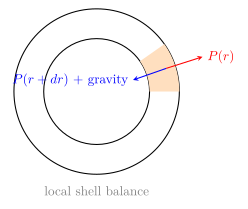
图 1 强调压力是壳面应力而非一个“从中心射出的力”。
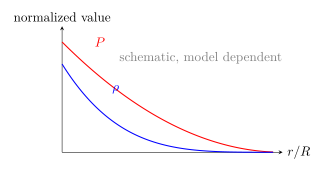
图 2 示意 \(P,\rho\) 中心大、表面小;曲线不是太阳实测剖面。
2. Mass conservation and equation of state / 质量守恒与状态方程
Knowledge ID: P12-U03-L02-K02
球壳 mass continuity 为
\[\frac{dm}{dr}=4\pi r^2\rho, \qquad m(0)=0,\qquad m(R)=M.\]
EOS 把 pressure 与 density、temperature、composition 相连。完全电离 ideal gas 近似
\[P_{\rm gas}=\frac{\rho k_BT}{\mu m_u},\]
radiation pressure 为 \(P_{\rm rad}=a_{\rm rad}T^4/3\)。高密度 compact objects 还需 electron/neutron degeneracy;不能用“热气压”解释所有恒星。Opacity \(\kappa(\rho,T,X_i)\) 也由 microphysics 决定,影响 transport 和 structure。
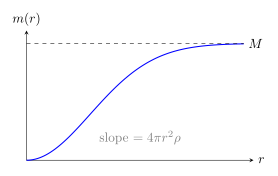
图 3 显示 \(m(r)\) 单调增加;中心斜率为零不表示中心密度为零。
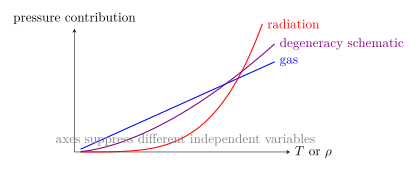
图 4 比较 pressure support 的不同 microphysics;它们不能由一条共同横轴精确量化,故标作 schematic。
3. Nuclear energy generation / 核能产生
Knowledge ID: P12-U03-L02-K03
局部核能率 \(\epsilon(\rho,T,X_i)\) 进入 luminosity equation:
\[\frac{dL}{dr}=4\pi r^2\rho\epsilon.\]
Main-sequence 净反应把四个 proton 变为一个 He-4 nucleus,约 \(0.7\%\) rest mass 成为能量与 neutrinos。太阳质量附近 pp chain 主导;更热核心 CNO cycle 的温度敏感性更强。He burning 的 triple-alpha 要更高温。反应率的陡峭 \(T\) dependence 与 hydrostatic/thermal feedback 共同产生 thermostat;degenerate core 中 pressure 对 \(T\) 不敏感时可能发生 runaway。
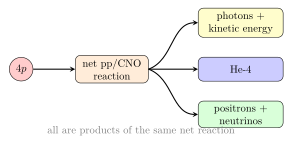
图 5 只画净结果;He-4、能量、positrons 与 neutrinos 是同一净反应的共同产物,pp chain 的中间反应未画出。
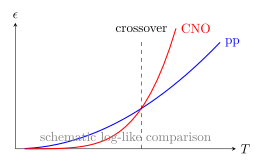
图 6 展示 CNO 对温度更敏感;实际指数随温度区间变化。
4. Radiative and convective energy transport / 辐射与对流能量输运
Knowledge ID: P12-U03-L02-K04
Optically thick diffusion limit 中 radiative gradient 为
\[\frac{dT}{dr}=-\frac{3\kappa\rho L(r)}{16\pi a_{\rm rad}cT^3r^2}.\]
Opacity 大或 luminosity 大要求更陡的温度梯度。定义 \(\nabla=d\ln T/d\ln P\);若 radiative equilibrium 所需 \(\nabla_{\rm rad}>\nabla_{\rm ad}\),上移 fluid parcel 比环境暖而有 buoyancy,发生 convection(Schwarzschild criterion)。Convection 同时输运热和混合 composition;其效率和 overshoot 需模型化。
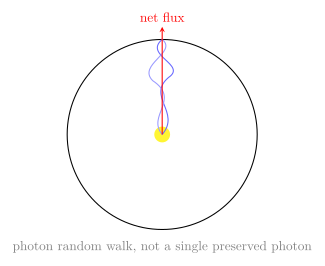
图 7 的随机路径表示能量扩散,不应解读为核心同一 photon 原封不动抵达表面。
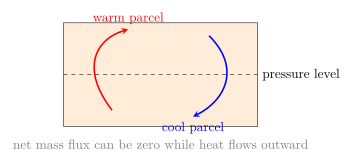
图 8 显示 convection 的双向质量循环和向外净能流。
5. Virial theorem and stellar temperature scale / 位力定理与恒星温标
Knowledge ID: P12-U03-L02-K05
对静态、表面压力可忽略的 self-gravitating ideal monatomic gas,scalar virial theorem 给
\[2U+\Omega=0, \qquad \Omega\sim-\alpha\frac{GM^2}{R},\]
\(\alpha\) 取决于 density profile。因此收缩使 \(\Omega\) 更负,其中约一半释放能量辐射,另一半增加 \(U\),使 star 收缩而升温:self-gravitating system 具有负热容行为。粒子热能与引力能比较得
\[k_BT\sim\frac{GM\mu m_u}{R}\]
乘上 order-unity structure coefficient。这解释为什么更紧致/更大质量的核心更热,但不能代替完整中心边界积分。
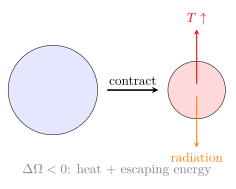
图 9 是 virial energy split;图中箭头不代表物质喷出。
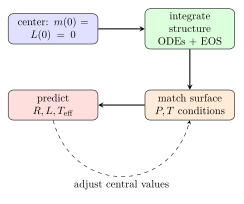
图 10 把 stellar model 显示为边值 shooting/relaxation 问题,而不是单公式代入。
Worked examples / 完整例题
Worked Example 1 — Solar mean density
已知: \(M_\odot=1.989\times10^{30}\,\mathrm{kg}\),\(R_\odot=6.957\times10^8\,\mathrm m\)。系统: 整颗太阳球体;只求平均密度。
\[\bar\rho=\frac{3M}{4\pi R^3}=1.41\times10^3\,\mathrm{kg\,m^{-3}}.\]
三位有效数字,量纲 kg m\(^{-3}\)。该值接近水密度却不表示太阳内部均匀;中心密度远大,photosphere 远小。它只约束 integrated mass continuity。
Worked Example 2 — Hydrostatic pressure scale
已知: 同上太阳 \(M,R\)。模型/边界: 只以 \(P\sim GM^2/R^4\) 估数量级,忽略 dimensionless structure coefficient。
\[P_*\sim\frac{GM_\odot^2}{R_\odot^4}=1.13\times10^{15}\,\mathrm{Pa}.\]
量纲 \(\mathrm{Pa}\)。自引力强时中心需要极高压力,符号和数量级合理;真实 solar central pressure 取决于 density profile,不能把该尺度当精确值。
Worked Example 3 — 维持太阳光度所需的净氢燃料消耗率
已知: \(L_\odot=3.828\times10^{26}\,\mathrm W\),氢到氦可用效率 \(\eta=0.0070\),\(c=2.998\times10^8\,\mathrm{m\,s^{-1}}\)。系统边界: 核反应区域,先忽略 neutrino energy correction。
\[\dot m_{\rm fuel}=\frac{L}{\eta c^2}=6.08\times10^{11}\,\mathrm{kg\,s^{-1}}.\]
这里的 \(\dot m_{\rm fuel}=L/(\eta c^2)\) 是氢燃料处理/消耗率,不是恒星净质量亏损率。约 \(6.1\times10^8\) tonnes/s 的氢参与净转换;相应直接变为辐射等能量的核反应质量亏损(mass-equivalent)率是 \(L/c^2=4.26\times10^9\,\mathrm{kg\,s^{-1}}\)。单位均为 kg/s,且 \(\eta<1\) 使 fuel rate 更大,合理;更精确模型还需扣除 neutrino carried energy。
Worked Example 4 — Virial temperature scale
已知: \(M=M_\odot,R=R_\odot,\mu=0.61\)。模型: 完全电离 ideal gas,取结构系数 \(1/3\):
\[T\sim\frac{GM\mu m_u}{3k_BR}=4.7\times10^6\,\mathrm K.\]
一位到两位有效数字足够。\(T\propto M/R\),更紧致更热,极限正确。太阳实际中心约 \(1.5\times10^7\,\mathrm K\),差异说明 order-unity coefficient 与径向结构不可省略。
Lesson synthesis / 本课综合
四条核心 ODE/relations 是 hydrostatic balance、mass continuity、energy generation、energy transport,再由 EOS/opacity/nuclear rates 提供 microphysics,并由中心和 photosphere 边界闭合。Virial theorem 给全局 sanity check:若数值模型的温度尺度与 \(GM\mu m_u/(kR)\) 相去甚远,应先检查单位、边界或 pressure component。
Formula-and-decision table
| Equation | Role | Conditions | Failure signal |
|---|---|---|---|
| \(dP/dr=-Gm\rho/r^2\) | force balance | quasi-static spherical | dynamical collapse/pulsation |
| \(dm/dr=4\pi r^2\rho\) | mass bookkeeping | spherical shells | rotation/asphericity |
| \(dL/dr=4\pi r^2\rho\epsilon\) | energy bookkeeping | local generation | neutrino losses need sign/term |
| radiative \(dT/dr\) | photon diffusion | optically thick LTE | near photosphere |
| \(\nabla_{\rm rad}>\nabla_{\rm ad}\) | convection onset | composition uniform criterion | Ledoux effects if \(\mu\) gradient |
| \(2U+\Omega=0\) | global equilibrium check | stationary, boundary terms small | rapid evolution/external pressure |
Model boundaries / 模型边界
- Rotation causes oblateness and meridional circulation; magnetic fields add stress and transport.
- EOS transitions include partial ionization, Coulomb corrections and degeneracy.
- Nuclear \(epsilon\) is not a single power law over all \(T\).
- Diffusion fails near optical depth unity; atmosphere matching is necessary.
- Schwarzschild criterion ignores composition gradient; Ledoux criterion may be required.
Misconception clinic / 误区诊所
- “Fusion pressure directly托住恒星。” Hydrostatic support is total pressure gradient;fusion replenishes energy that maintains thermal state。
- “中心 \(dm/dr=0\) 所以中心无质量。” \(m\propto r^3\),中心 density 可有限且很大。
- “一个 photon 从核心一路弹到表面。” Energy 在吸收/再发射中传递,光子身份不保留。
- “对流意味着恒星整体向外流失质量。” 上升和下降流可有零净质量通量、非零热通量。
- “收缩必冷却。” Self-gravitating virial system 收缩时内部升温并辐射。
Practice and retrieval / 练习与检索
- [K01] 为什么 hydrostatic equation 右端为负?
- [K01] \(M,R\) 不变而平均 density profile 更中心集中,中心压力趋势如何?
- [K02] 均匀球中 \(m(r)/M\) 与 \(r/R\) 的关系?
- [K02] \(T\) 加倍时 radiation pressure 变几倍?
- [K03] 若 \(\epsilon=2\,\mathrm{W\,kg^{-1}}\) 作用于 \(10^{29}\,\mathrm{kg}\) 核心,求 luminosity。
- [K03] 为什么 CNO-dominated core 的产能更集中?
- [K04] \(\kappa\) 增大时维持同 \(L\) 的 radiative gradient 如何变?
- [K04] 写出 Schwarzschild convection condition。
- [K05] 理想 virial 星若 \(\Delta\Omega=-2\times10^{40}\,\mathrm J\),\(\Delta U\) 和 radiated energy 各约多少?
- [综合] 列出求 1D stellar model 所需四个 microphysics inputs。
Answer 1
\(r\) 向外而 gravity 向内,所以向外走 pressure 必下降,\(dP/dr<0\)。
Answer 2
趋于更高;更多质量在小半径处增强内层 gravity,需更大压力梯度。
Answer 3
\(m/M=(r/R)^3\)。
Answer 4
\(P_{\rm rad}\propto T^4\),变 \(16\) 倍。
Answer 5
\(L=\epsilon M=2.0\times10^{29}\,\mathrm W\)。
Answer 6
CNO rate 对 \(T\) 更敏感,只有最热中心贡献显著。
Answer 7
\(\lvert dT/dr\rvert\propto\kappa\),需更陡梯度,因而更易触发 convection。
Answer 8
在无 composition-gradient 的基准中,\(\nabla_{\rm rad}>\nabla_{\rm ad}\)。
Answer 9
由 \(2U+\Omega=0\),\(\Delta U\approx+1\times10^{40}\,\mathrm J\);另约 \(1\times10^{40}\,\mathrm J\) 作为辐射离开。
Answer 10
EOS、opacity、nuclear reaction rates/energy losses、convection prescription(加 composition/mixing data)。
Exit ticket / 离堂检验
用不超过六行解释:“如果核心核反应率瞬间略升,为什么一颗 nondegenerate main-sequence star 往往有负反馈,而 degenerate core 可能没有?”
References and source notes / 参考资料与来源说明
本课所有 TikZ 均依据正文方程原创绘制,未复制来源插图;来源文字经重组表述。
- MIT OpenCourseWare 8.282J, Stellar Structure Equations — undergraduate structure equations;核对 2026-08-30。
- Princeton Astrophysics, Equations of Stellar Structure and Virial Theorem — hydrostatic, mass, energy 与 virial derivation;核对 2026-08-30。
- OpenStax Astronomy, 16.3 The Solar Interior: Theory — radiation/convection 与 solar profiles;核对 2026-08-30。
- OpenStax Astronomy 2e, 16.2 Mass, Energy, and Relativity — pp chain、CNO 与 mass-energy;核对 2026-08-30。
- NASA Science, Sun Facts — solar core temperature and interior zones;核对 2026-08-30。
Source-to-content map
| Source | Used for | Knowledge ID / Section | Model boundary or convention |
|---|---|---|---|
| MIT OCW | four structure equations | K01–K04 | 1D undergraduate model |
| Princeton notes | virial and energetics | K01, K05 | surface term and structure coefficient |
| OpenStax 16.3 | transport modes | K04 | Sun as an example, not universal zoning |
| OpenStax 16.2 | nuclear pathways | K03 | net chains, temperature regimes |
| NASA Sun | empirical solar scales | K03–K04 | current solar values |
复习与拓展
- 将 ODE 变成 dimensionless polytrope/Lane–Emden model。
- 引入 Ledoux criterion、mixing length 和 opacity tables。
- 下一课 Stellar Formation and Evolution 把 structure snapshot 串成随 composition 变化的 evolution track。