
Learning objectives / 学习目标
- 推导并计算 Jeans length/mass 与 free-fall time,解释 pressure、turbulence、magnetic field 的修正;
- 用 virial contraction、accretion disk 与 bipolar outflow 描述 protostar 和 pre-main-sequence track;
- 从 available fuel / luminosity 推导 \(t_{\rm MS}\) 的质量依赖;
- 解释 core exhaustion、shell burning、giant expansion 与 winds/mass transfer;
- 用 initial mass 组织 end-state map,同时说明 metallicity、rotation、binarity 与 mass loss 会移动边界。
Prerequisites / 先修知识
- Stellar Structure:hydrostatic、virial、fusion 与 transport;
- H–R diagram and stellar masses;
- Newtonian Gravitation 与 ideal-gas sound speed。
Scope and conventions / 范围与约定
- Jeans analysis 采用 infinite uniform isothermal medium 的线性基准;真实 molecular cloud 有有限边界、turbulence、magnetic fields 与 feedback。
- \(c_s=\sqrt{kT/(\mu m_u)}\) 取 isothermal sound speed;不同 \(\gamma\) 会改变定义。
- “Initial mass” 指形成后进入主序的质量;末态更直接由 collapse 前 core/final mass 决定。
- 质量分界仅作太阳近似 metallicity 的教学范围,不能当普适精确常数。
- Binary mass transfer/merger 可完全改写 single-star track,正文会明确分开。
Notation and modeling contract
| Symbol | Meaning | SI |
|---|---|---|
| \(\rho,T,c_s\) | cloud density, temperature, sound speed | kg m\(^{-3}\), K, m s\(^{-1}\) |
| \(\lambda_J,M_J\) | Jeans length and mass | m, kg |
| \(t_{\rm ff}\) | free-fall time | s |
| \(M,L,t_{\rm MS}\) | stellar mass, luminosity, main-sequence lifetime | kg, W, s |
| \(\dot M\) | mass-loss/accretion rate (sign stated) | kg s\(^{-1}\) |
| \(M_{\rm init},M_{\rm final}\) | initial and final/remnant mass | kg |
1. Gravitational collapse and Jeans criterion / 引力坍缩与金斯判据
Knowledge ID: P12-U03-L03-K01
在 uniform isothermal medium 中,pressure wave 的响应时间与 self-gravity 竞争,得到
\[\lambda_J=c_s\sqrt{\frac{\pi}{G\rho}}, \qquad M_J=\frac{\pi^{5/2}}{6}\frac{c_s^3}{G^{3/2}\rho^{1/2}}.\]
大于相应尺度/质量的扰动在基准模型中不稳定。\(M_J\propto T^{3/2}\rho^{-1/2}\):冷却和压缩促进 fragmentation。没有 pressure 的均匀球自由落体时间
\[t_{\rm ff}=\sqrt{\frac{3\pi}{32G\rho}}.\]
真实“支撑”不应把 turbulence 当静态 pressure 常数:turbulence 会衰减并同时产生压缩;magnetic flux、rotation 和 external pressure 都改变临界条件。
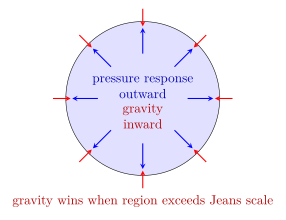
图 1 表示 pressure communication 与 gravity 的竞争;箭头不是完整 local force field。
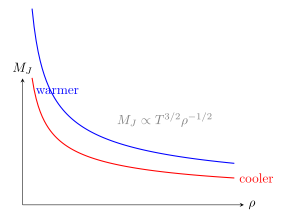
图 2 显示密度升高和温度降低均减小 fragmentation mass scale。
2. Protostars and pre-main-sequence evolution / 原恒星与主序前演化
Knowledge ID: P12-U03-L03-K02
Collapse 中 angular momentum 形成 disk;中心 hydrostatic object 仍由 accretion 和 gravitational contraction 发光,尚未由 stable core-H fusion 支撑其长期 luminosity。Protostellar jets/outflows 沿 rotation/magnetic axis 清除 envelope,并带走 angular momentum。Kelvin–Helmholtz timescale
\[t_{\rm KH}\sim\frac{GM^2}{RL}\]
估计只靠 gravitational energy 维持 luminosity 的时间。Low-mass pre-main-sequence star 沿 Hayashi/Henyey-type track 收缩;达到足够核心温度后稳定 H burning,才称到达 main sequence。Dust extinction 使这些对象常需 IR/radio 观测。
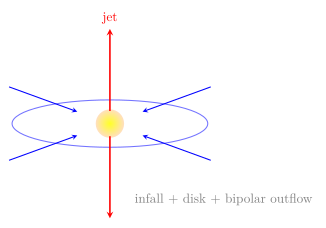
图 3 显示 accretion 与 outflow 可同时发生;jet 不是所有落入物质的反弹。
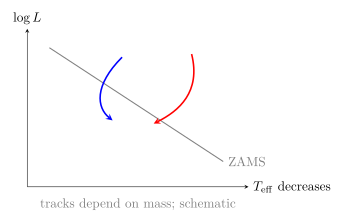
图 4 表示不同质量 pre-main-sequence tracks 汇入 zero-age main sequence,并非所有星走同一路径。
3. Main-sequence lifetime and mass dependence / 主序寿命与质量依赖
Knowledge ID: P12-U03-L03-K03
Main-sequence lifetime 的一阶账本是
\[t_{\rm MS}\sim\frac{f\eta Mc^2}{L},\]
\(f\) 是可参与核心 H burning 的质量分数,\(\eta\approx0.007\) 是 H-to-He mass-energy efficiency。Main-sequence 上 \(L\) 随 \(M\) 增长远快于线性,所以大质量星虽然 fuel 多,却消耗更快、寿命更短。局部近似 \(L\propto M^\alpha\) 给 \(t_{\rm MS}\propto M^{1-\alpha}\),但 \(\alpha\) 随质量区间变化,mixing/rotation/metallicity 也改变 \(f,L\)。
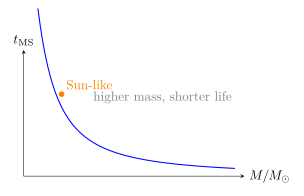
图 5 是 log-like trend,不是一条跨所有质量的单一幂律。
4. Giants, shell burning, and mass loss / 巨星、壳层燃烧与质量损失
Knowledge ID: P12-U03-L03-K04
核心 H 耗尽后,inert He core 收缩升温,外侧 H-rich shell 继续 fusion;envelope 扩张并冷却,星移向 H–R 右上。随后是否/如何点燃 He 取决于 core mass 与 degeneracy。更晚阶段可出现多重 shell burning。
巨星/超巨星通过 radiation pressure on lines/dust、pulsation、chromospheric/wave driving 等产生 winds;binary 中 Roche-lobe overflow 更可快速转移/剥离 envelope。质量损失既改变未来 fuel/core growth,也使 initial mass 不能直接等同 final mass。
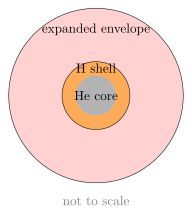
图 6 区分 inert core、burning shell 与 envelope;“壳层”不是固体壳。
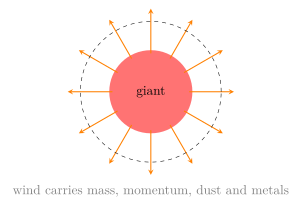
图 7 是 isotropic wind 基准;真实 winds 可 clumpy、bipolar 或 binary-shaped。
5. End states as a function of initial mass / 末态对初始质量的依赖
Knowledge ID: P12-U03-L03-K05
粗略 single-star solar-metallicity map:低/中质量星抛出 envelope 后留下 electron-degenerate white dwarf;更大 initial mass 建成 iron core 并 core-collapse,可能留下 neutron star 或 black hole。分界不是一个只由 \(M_{\rm init}\) 决定的阶跃:winds 随 metallicity,rotation/mixing 改 core mass,binary stripping/merger 改 path,爆炸机制与 fallback 决定 remnant。
最终 nucleosynthesis 也分通道:低质量 AGB winds 输送 C、N 和 s-process elements;massive-star winds 与 supernovae 输送 O、alpha/iron-group 等;compact-object mergers 另贡献 r-process。下一 Unit 专门研究 compact objects,故本课只建立接口。
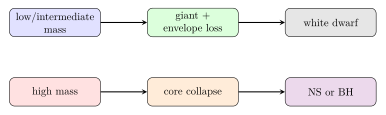
图 8 是 single-star skeleton;binary channels 可在两行之间跳转。
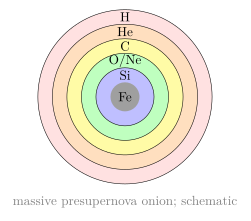
图 9 表示 successive burning shells;层厚不按比例,composition 也非纯元素。
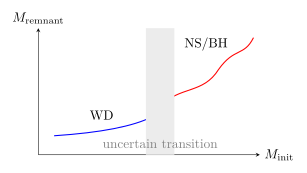
图 10 把 initial–final relation 画成有散布/不确定区的映射,而非精确阶梯。
Worked examples / 完整例题
Worked Example 1 — Molecular cloud 的 Jeans scale
已知: \(T=10.0\,\mathrm K\),\(\mu=2.33\),\(\rho=3.87\times10^{-17}\,\mathrm{kg\,m^{-3}}\)。系统/坐标: uniform infinite isothermal gas;扰动波数只取大小。先算
\[c_s=\sqrt{\frac{kT}{\mu m_u}}=188\,\mathrm{m\,s^{-1}}.\]
于是
\[\lambda_J=c_s\sqrt{\frac{\pi}{G\rho}}=6.55\times10^{15}\,\mathrm m=0.212\,\mathrm{pc},\]
\[M_J=5.7\times10^{30}\,\mathrm{kg}=2.9M_\odot.\]
两位有效数字。温度降低应减小 \(c_s,\lambda_J,M_J\),趋势正确。Turbulence、magnetic field 和 nonuniform geometry 会改变临界值。
Worked Example 2 — Free-fall time
已知: 使用 Example 1 的 density;忽略 pressure/rotation/magnetic field。系统边界: uniform sphere,从静止坍缩。
\[t_{\rm ff}=\sqrt{\frac{3\pi}{32G\rho}} =1.07\times10^{13}\,\mathrm s=3.39\times10^5\,\mathrm{yr}.\]
密度越高,\(t_{\rm ff}\propto\rho^{-1/2}\) 越短,合理。观测 star-formation time 可更长,因为前述支撑、feedback 与 replenishment 未纳入。
Worked Example 3 — 两太阳质量星的主序寿命
已知: \(M=2M_\odot\),在该简化区间取 \(L=16L_\odot\),相同 fuel fraction;太阳主序寿命基准 \(10\,\mathrm{Gyr}\)。模型: \(t\propto M/L\)。
\[\frac{t}{t_\odot}=\frac{2}{16}=0.125, \qquad t=1.25\,\mathrm{Gyr}.\]
三位有效数字仅反映输入精度;实际 mixing、metallicity 与 mass loss 改变寿命。尽管 fuel 多一倍,luminosity 高 16 倍,故寿命短,解释一致。
Worked Example 4 — 质量损失账本
已知: \(M_{\rm init}=2.00M_\odot\),white-dwarf remnant \(M_f=0.620M_\odot\)。系统边界: star + ejected envelope 分开;只做质量守恒。
\[\Delta M=1.38M_\odot, \qquad \frac{\Delta M}{M_{\rm init}}=0.690.\]
即 \(69.0\%\) 初始质量回到 interstellar medium。质量维度与 fraction 均正确。不能从这两个数推出 wind history;binary transfer 还可能使质量进入 companion 而非直接逃离系统。
Lesson synthesis / 本课综合
演化是一串反馈:cooling/overdensity 降低 Jeans barrier → collapse 将 \(\Omega\) 转为热、disk 与 outflow 重分配角动量 → H ignition 建立长期 hydrostatic main sequence → core composition 变化迫使 shell burning 与 envelope expansion → winds/binary interaction 改 final core → collapse/degeneracy 决定 remnant。初始质量是第一控制量,但不是唯一控制量。
Formula-and-decision table
| Question | Relation | Conditions | Limitation |
|---|---|---|---|
| collapse scale | \(\lambda_J,M_J\) | uniform isothermal medium | turbulence/B/geometry |
| collapse clock | \(t_{\rm ff}\) | pressureless sphere | lower bound-like scale |
| contraction clock | \(t_{\rm KH}=GM^2/(RL)\) | gravitational luminosity | structure coefficient |
| main-sequence clock | \(t\sim f\eta Mc^2/L\) | stable H burning | \(f,L\) evolve |
| remnant mapping | \(M_{\rm init}\rightarrow M_{\rm final}\) | specified \(Z\), rotation, binarity | boundaries not universal |
Model boundaries / 模型边界
- Jeans criterion is a local linear baseline, not a complete star-formation recipe.
- A protostar can burn deuterium without yet being a stable H-burning main-sequence star.
- \(L\propto M^\alpha\) is piecewise; do not extrapolate to brown dwarfs or supermassive stars.
- Giant evolution includes thermal pulses and uncertain mass-loss prescriptions.
- Single-star end-state maps fail for close binaries, mergers and chemically homogeneous evolution.
Misconception clinic / 误区诊所
- “任何分子云都会坍缩。” 扰动必须越过 Jeans/magnetic/turbulent constraints。
- “Protostar 已经靠氢聚变稳定。” 其主要能量可来自 accretion/virial contraction。
- “质量越大寿命越长,因为 fuel 更多。” Luminosity 增长更快,反而寿命短。
- “Red giant 是核心冷却膨胀。” 核心通常收缩升温,膨胀的是 envelope。
- “8 \(M_\odot\) 是永恒精确分界。” metallicity、overshoot、rotation、binarity 与 mass loss 会移动边界。
Practice and retrieval / 练习与检索
- [K01] \(T\) 变 4 倍、\(\rho\) 不变时 \(M_J\) 变多少?
- [K01] \(\rho\) 增大 100 倍时 \(t_{\rm ff}\) 变多少?
- [K02] 写出 protostar luminosity 的两个非主序来源。
- [K02] 为什么形成中的星常有 bipolar outflow?
- [K03] 若 \(L\propto M^4\),则 \(t_{\rm MS}\propto M\) 的哪次幂?
- [K03] 一颗 \(4M_\odot\)、\(L=256L_\odot\) 的星寿命相对太阳多少?
- [K04] 核心 H 耗尽后为什么 envelope 可膨胀?
- [K04] 列出两种 mass-loss mechanism。
- [K05] 为什么 end state 更直接依赖 final core mass 而非 initial mass?
- [综合] 给出 close binary 改写 single-star end state 的两种途径。
Answer 1
\(M_J\propto T^{3/2}\),变 \(4^{3/2}=8\) 倍。
Answer 2
\(t_{\rm ff}\propto\rho^{-1/2}\),变为 \(1/10\)。
Answer 3
Accretion shock luminosity 与 gravitational contraction;也可有 deuterium burning,但不等于稳定 core-H main sequence。
Answer 4
Disk/rotation 与磁场把 inflow 的对称性打破,沿极轴较易喷出并带走 angular momentum。
Answer 5
\(t\propto M/L\propto M^{-3}\)。
Answer 6
\(t/t_\odot=4/256=1/64\),若太阳 10 Gyr 则约 \(0.156\,\mathrm{Gyr}\)。
Answer 7
Inert core 收缩升温、H shell burning 增强 luminosity,envelope 重新建立结构并膨胀冷却;不是简单气体热胀公式。
Answer 8
Radiation/dust-driven wind、line-driven wind、pulsation、binary Roche-lobe overflow,任两种。
Answer 9
Degeneracy limit、iron-core collapse 与 fallback 由死亡前 core 决定;winds/transfer 已把 initial mass 大幅改变。
Answer 10
Donor 被剥离可留下 He star/white dwarf;accretor/merger 增质量并可能 core-collapse;common envelope 也可制造紧致双星。
Exit ticket / 离堂检验
用一张三列小表比较 \(1M_\odot\) 与 \(20M_\odot\) single stars:主序寿命、巨星阶段、典型 end state;每格必须注明至少一个模型条件。
References and source notes / 参考资料与来源说明
本课所有 TikZ 均依据正文方程原创绘制,未复制来源插图;来源文字经重组表述。
- OpenStax Astronomy 2e, 21.1 Star Formation — molecular clouds、protostars、disks/outflows;核对 2026-08-30。
- OpenStax Astronomy 2e, 21.2 H–R Diagram and Stellar Evolution — pre-main-sequence and hydrogen ignition;核对 2026-08-30。
- OpenStax Astronomy 2e, 22.4 Further Evolution of Stars — helium/shell burning 与 single-star mass dependence;核对 2026-08-30。
- OpenStax Astronomy 2e, Chapter 23 Summary — white dwarf、core collapse 与 binary channels;核对 2026-08-30。
- NASA Science, Stars: Birth, Life, Death — mass-dependent lifetime and life-cycle overview;核对 2026-08-30。
- Yale University, Astrophysical Flows lecture notes — Jeans dispersion relation、以 \(\lambda_J/2\) 为半径的 Jeans mass 与 uniform-sphere free-fall time;核对 2026-08-30。
- MIT OpenCourseWare 8.902, Astrophysics II full lecture notes — sound-crossing/free-fall competition、Jeans length 与 \(t_{\rm ff}\sim(G\rho)^{-1/2}\);核对 2026-08-30。
Source-to-content map
| Source | Used for | Knowledge ID / Section | Model boundary or convention |
|---|---|---|---|
| OpenStax 21.1 | collapse outcome, protostar morphology | K01–K02 | observational narrative |
| OpenStax 21.2 | pre-main-sequence to ZAMS | K02 | tracks depend on mass |
| OpenStax 22.4 | giant/shell evolution | K04 | simplified single stars |
| OpenStax Ch.23 | end states | K05 | threshold values are model-dependent |
| NASA Stars | mass–lifetime overview | K03–K05 | broad categories |
| Yale Astrophysical Flows | Jeans length/mass and exact uniform-sphere \(t_{\rm ff}\) | K01, Worked Example 1 | this lesson defines \(M_J\) inside radius \(\lambda_J/2\) |
| MIT OCW 8.902 | dispersion relation and timescale interpretation | K01 | infinite uniform medium is a baseline, not a bounded cloud model |
复习与拓展
- 增补 virial parameter、Bonnor–Ebert sphere 与 magnetically critical mass-to-flux ratio。
- 用 MESA-like tracks 比较 metallicity 与 rotation 对 lifetime/final core 的影响。
- 下一课 White Dwarfs and Neutron Stars 深入 degeneracy-supported remnants。