
Learning objectives / 学习目标
- 按 membership、mass、dynamical state 和 environment 区分 groups、clusters、superclusters,而非只数可见 galaxies;
- 推导/计算 virial、hydrostatic X-ray 与 lensing mass estimator,比较 equilibrium、geometry 与 line-of-sight systematics;
- 从 continuity–Euler–Poisson 的 linearized picture 解释 overdensity growth、Jeans support 和 growth factor;
- 说明 redshift survey 如何从 angular position+redshift 构造 cosmic web,并量化 window、completeness、bias、redshift-space distortions;
- 区分 collisionless N-body 与 hydrodynamics,设计 resolution/convergence/conservation/observation-forward tests 并识别 subgrid dependence。
Prerequisites / 先修知识
- Galactic Dynamics 的 rotation curves、dark halo 与 tracer inference;
- Galaxies and AGN 的 galaxy evolution、gas and feedback;
- Virial theorem \(2K+U=0\)、hydrostatic equilibrium、gravitational lensing basics;
- Fourier wavelength/wavenumber、Poisson statistics、correlation and numerical time stepping。
Scope and conventions / 范围与约定
- Cluster radius常用 \(r_\Delta\):mean enclosed density \(\Delta\) times critical/reference density;\(M_{200c}\) 与 \(M_{500c}\) 不可无转换混用。
- Member selection uses sky+redshift/phase space;foreground/background interlopers bias velocity dispersion。
- Virial/hydrostatic estimators assume approximate equilibrium;merging clusters need explicit nonthermal pressure/substructure treatment。
- Lensing measures projected total mass weighted by geometry;deprojection and mass-sheet degeneracy are model issues。
- Density contrast \(\delta=(\rho-\bar\rho)/\bar\rho\);linear theory requires \(\lvert\delta\rvert\ll1\)。
- Survey comoving coordinates require a fiducial cosmology;galaxy field is a biased, selected tracer of matter。
- Simulation result is conditional on initial conditions、cosmology、resolution、solver and subgrid model;visual realism is not validation。
Notation and modeling contract / 符号与建模契约
| Symbol | Meaning | SI / convention |
|---|---|---|
| \(R,r_\Delta,M_\Delta\) | projected/radial scale and overdensity mass | m/Mpc, kg/\(M_\odot\) |
| \(\sigma_v\) | line-of-sight velocity dispersion | \(\mathrm{m\,s^{-1}}\) |
| \(T_X\) | X-ray gas thermodynamic temperature | K |
| \(k_BT_X\) | X-ray thermal-energy scale | J or keV |
| \(\rho_g\) | intracluster-gas mass density | \(\mathrm{kg\,m^{-3}}\) |
| \(\kappa,\gamma\) | lensing convergence and shear | 1 |
| \(\delta,D(a)\) | density contrast and linear growth factor | 1 |
| \(P(k),\xi(r)\) | power spectrum and two-point correlation | convention-dependent |
| \(b_g\) | galaxy bias | 1 |
| \(m_p,\epsilon\) | simulation particle mass and force softening | kg, m |
1. Galaxy groups and clusters / 星系群与星系团
Knowledge ID: P12-U05-L03-K01
Groups contain a few to tens of luminous members and often have lower velocity dispersion/hot-gas temperature;rich clusters contain hundreds–thousands of galaxies、dark-matter-dominated potential and X-ray-emitting intracluster medium(ICM)。Superclusters are larger associations not necessarily virialized as a whole;cluster boundary is convention and phase-space based,not a solid edge。
A cluster catalog requires finding algorithm、redshift/richness threshold、centering and selection function。Optical richness, Sunyaev–Zel'dovich signal, X-ray luminosity/temperature and weak lensing select different populations and scatters at fixed mass。
Cluster galaxies undergo ram-pressure stripping、tidal harassment、mergers and strangulation;central/satellite distinction and radius affect quenching。Because crossing/relaxation times can be comparable to merger times,substructure/velocity multimodality reveals non-equilibrium。
星系团的物理图景是“三种主要成分共处一个势阱”:galaxies 像近乎无碰撞的示踪粒子,稀薄热等离子体会碰撞、形成 shock 并发 X-rays,dominant dark matter 主要以引力作用。群与团的差别不只是成员数,还体现在 velocity scale、gas temperature、baryon partition 和 relaxation state;同一对象在不同 finder 或 mass definition 下也可能有不同边界。
环境作用要比较时间尺度。Ram pressure 取决于 ICM density 与 satellite velocity,可先剥离外层 gas;strangulation 切断后续补给,效果较慢;tidal field 改变 stellar/gas orbits;mergers 在低 relative velocity 的 groups 中反而可能更有效。因此从“团内 red fraction 较高”到具体 quenching mechanism 之间仍需 phase-space position、gas tails 和 stellar ages 等证据。
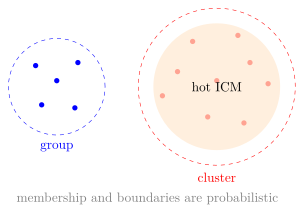
图 1 对比 group/cluster,但圆并非 sharp virial wall。
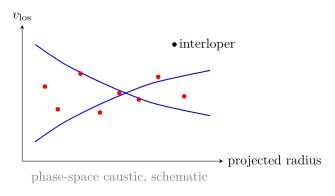
图 2 显示 membership 需联合 projected radius/velocity;单 redshift cut 会纳入 interlopers。
2. Virial mass, lensing mass, and hot gas / 位力质量、透镜质量与热气体
Knowledge ID: P12-U05-L03-K02
若 cluster relaxed、spherical and isotropic,virial theorem gives scale estimator:
\[M\sim\frac{3\sigma_v^2R}{G},\]
coefficient depends on density profile、projected radius and anisotropy。Interlopers/subclusters inflate \(\sigma_v\);dynamical friction/velocity bias may make galaxies imperfect tracers。
Hot gas hydrostatic equilibrium:
\[M(<r)=-\frac{k_BT(r)r}{G\mu m_p} \left(\frac{d\ln\rho_g}{d\ln r}+\frac{d\ln T}{d\ln r}\right).\]
Turbulence、bulk motion、cosmic rays/magnetic pressure and calibration make hydrostatic bias。X-ray brightness roughly \(\propto\int n_e^2\Lambda(T,Z)dl\),so clumping disproportionately brightens dense gas。
Lensing convergence \(\kappa=\Sigma/\Sigma_{\rm crit}\) measures projected total mass through image shear/magnification or strong-lensing arcs:
\[\Sigma_{\rm crit}=\frac{c^2}{4\pi G}\frac{D_s}{D_lD_{ls}}.\]
Lensing avoids equilibrium assumption but faces shape noise、line-of-sight structure、source redshifts、mass-sheet and deprojection degeneracies。Agreement/disagreement among virial–X-ray–lensing is a physical diagnostic。
三种质量估计可以看成对同一势阱的不同问法。Virial dynamics 问“galaxies 需要多深的势阱才能具有这些速度”;hydrostatic X-ray 问“什么引力能平衡测得的气体压强梯度”;lensing 则问“沿视线投影的曲率需要多少面密度”。它们的观测量、投影方式和 equilibrium assumptions 不同,所以偏差模式本身能诊断 merger、nonthermal pressure 或 line-of-sight structure。
特别要统一 aperture 与 mass definition。将 \(M_{500c}\) 的 X-ray 值、未截断的 projected lensing mass 和某个 virial radius 内的 dynamical mass 直接并排比较没有意义。应先把 posterior 通过共同 profile/geometry 转换到同一 \(M_\Delta\),同时传播 covariance;否则所谓“质量张力”可能只是定义不一致。
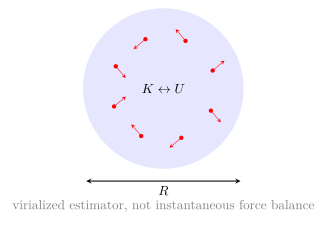
图 3 的 arrows 表 velocity samples;virial theorem 是 time-averaged energy relation。
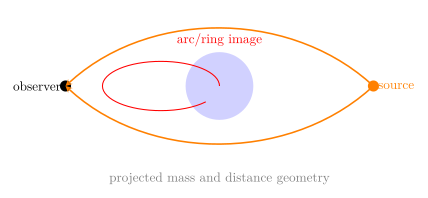
图 4 表示 lensing rays and arc,曲线是 null paths projection,不是 matter trajectory。
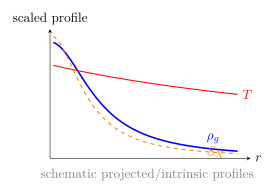
图 5 提醒 X-ray surface brightness 与 \(\rho_g^2\) projection related,不能直接当 density。
3. Gravitational instability and growth of perturbations / 引力不稳定与扰动增长
Knowledge ID: P12-U05-L03-K03
Write \(\rho(\mathbf x,t)=\bar\rho(t)[1+\delta(\mathbf x,t)]\)。For pressureless matter on subhorizon scales,linear perturbation obeys:
\[\ddot\delta+2H\dot\delta-4\pi G\bar\rho_m\delta=0.\]
Terms represent acceleration、Hubble drag and gravitational self-amplification。Matter-dominated Einstein–de Sitter growing mode \(D(a)\propto a\);radiation、dark energy and curvature alter growth。Linear modes evolve independently,nonlinear \(\delta\gtrsim1\) couples modes and forms halos/filaments/voids。
For a static fluid with sound speed \(c_s\),Jeans dispersion relation:
\[\omega^2=c_s^2k^2-4\pi G\rho, \qquad k_J=\frac{\sqrt{4\pi G\rho}}{c_s}.\]
\(k<k_J\)(large wavelength)unstable,\(k>k_J\) pressure-supported oscillation。In expanding multi-component universe, baryons、dark matter and radiation have distinct transfer functions;the static Jeans formula is intuition, not full cosmological solution。
引力不稳定不是凭空生成结构,而是放大初始微小起伏。Overdense region 的引力使物质流入,进一步增加 overdensity;宇宙膨胀产生阻尼,pressure/free streaming 可抹平小尺度。哪一种效应占优随成分和时代改变:cold dark matter 较早建立势阱,baryons 在复合前与 photons 耦合,复合后才更自由地落入这些势阱。
Linear theory 的价值在于每个 Fourier mode 可独立演化并由 growth factor/transfer function 描述;它的边界同样清楚。一旦 density contrast 接近 unity,mode coupling、shell crossing、shock 和 virialization 出现,不能继续把 \(D(a)\) 乘上初始场当作真实密度。图 6 的阈值因此是“切换模型”的提醒,不是所有区域在同一瞬间坍缩。
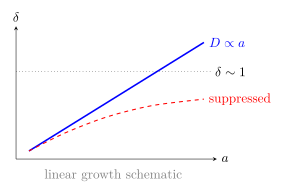
图 6 比较 growing modes;crossing \(\delta\sim1\) marks need for nonlinear treatment, not instant collapse。
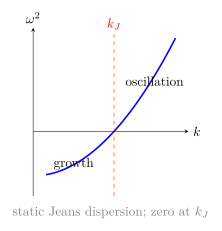
图 7 的 sign of \(\omega^2\) 分隔 exponential growth 与 pressure oscillation。
4. Cosmic web and large-scale surveys / 宇宙网与大尺度巡天
Knowledge ID: P12-U05-L03-K04
Nonlinear gravity turns initial density field into halos connected by filaments/walls around voids—the cosmic web。Redshift surveys measure \((\alpha,\delta,z)\),adopt cosmology to map to comoving positions;peculiar velocity distorts radial coordinate,creating fingers-of-God and coherent Kaiser anisotropy。
Two-point statistics:
\[\xi(r)=\langle\delta_g(\mathbf x)\delta_g(\mathbf x+\mathbf r)\rangle, \qquad P(k)=\langle\lvert\delta_g(\mathbf k)\rvert^2\rangle,\]
Fourier transforms under ideal homogeneity。Galaxy bias \(\delta_g\approx b_g\delta_m\) on large linear scales is only a first approximation;bias can be scale/stochastic/type dependent。
DESI-like surveys construct 3D maps from multiple tracers; random catalogs、angular completeness、fiber assignment、redshift failures and window convolution must match data。BAO feature is a standard-ruler correlation scale,not a visible rigid shell around each galaxy。
宇宙网的“节点—丝状体—墙—空洞”来自各向异性坍缩:matter 先沿一个主轴压扁成 wall,再沿第二轴形成 filament,最后在 nodes 聚集成 halos。这个几何图景很直观,但定量科学依赖统计量而非肉眼挑丝。Power spectrum、correlation function、topology 或 void statistics 都必须配套 covariance 和 survey response。
Redshift survey 的径向坐标同时含 Hubble expansion 与 peculiar velocity,所以 map 是 redshift space。Dense cluster 被随机速度拉成长指状,large-scale coherent infall 又产生角向 anisotropy。图 9 所示 BAO bump 必须同 random catalog、window matrix 和 mock covariance 联合拟合;若先看数据再选尺度范围,还会引入 analysis-choice bias。
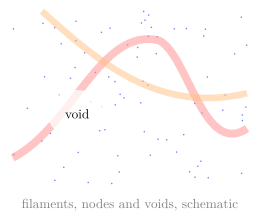
图 8 是 cosmic-web topology 教学图,random dots/curves 不对应真实 survey。
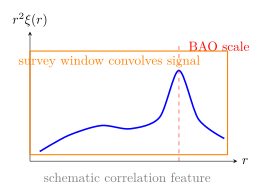
图 9 说明 BAO bump measurement depends on survey window/covariance,not visual inspection of map。
5. N-body and hydrodynamic simulations / N 体与流体数值模拟
Knowledge ID: P12-U05-L03-K05
Collisionless N-body approximates dark matter distribution by massive simulation particles sampling phase-space distribution;particles are not literal dark-matter particles。Gravity often solved by tree、particle-mesh or hybrid methods,softening \(\epsilon\) suppresses artificial close-force divergence。
Cosmological hydrodynamics adds gas conservation:
\[\frac{\partial\rho}{\partial t}+\nabla\cdot(\rho\mathbf v)=0,\]
plus momentum/energy equations、gravity and cooling/heating。Methods include Eulerian/adaptive meshes、SPH and moving mesh。Star formation、stellar/AGN feedback、black-hole growth often occur below resolution and use subgrid models calibrated/tested statistically。
Verification asks whether code solves equations(shock tubes、orbits、conservation);validation asks whether model reproduces independent universe observations。Required tests:mass/force/time resolution convergence、box size/cosmic variance、initial-condition seeds、solver comparison、conservation and synthetic-observation pipeline using same selection as data。
N-body particle 是连续 phase-space distribution 的数值采样,一个粒子常代表数百万到数亿 solar masses,绝不是一颗真实暗物质微粒。Softening 也不是把 gravity“改写”为新理论,而是控制有限采样下的人工近距离 scattering;太大抹去真实小结构,太小又可能增加 two-body artifacts,所以必须随分辨率做收敛测试。
加入气体后,数值难点从轨道积分扩展到 shocks、contact discontinuities、mixing、cooling 和多尺度 feedback。Star-forming cloud 或 black-hole accretion disk 往往远小于 cell/particle size,只能以 subgrid probability/energy injection 表示。可信结论应在改变 resolution、solver 和 subgrid parameters 后保持关键 observables,且用同一 telescope PSF、noise、selection 将 simulation 变成 mock catalog 再比较。
图 10 的最后一格因此不是美化输出,而是物理检验的一部分。若观测只看 surface-brightness-limited galaxies,模拟也必须施加同样阈值;若 data mass 来自 lensing proxy,不能拿 simulation true halo mass 无散射地对比。只有把 measurement operator 纳入,才能判断 discrepancy 属于 cosmology、baryonic model 还是 survey pipeline。

图 10 给出从 initial modes 到 mock catalog 的闭环;直接比“漂亮图”会跳过 survey response。
Worked Examples / 完整例题
Worked Example 1 — Cluster virial mass scale
已知: line-of-sight velocity dispersion \(\sigma_v=1000\,\mathrm{km\,s^{-1}}\),characteristic radius \(R=1.00\,\mathrm{Mpc}\)。
研究对象/边界: spherical、relaxed、isotropic cluster;member sample clean。
参考系: cluster rest frame。
模型: \(M\sim3\sigma_v^2R/G\)。
\[M\sim\frac{3(1.00\times10^6)^2(3.0857\times10^{22})}{6.6743\times10^{-11}} =1.39\times10^{45}\,\mathrm{kg} =6.97\times10^{14}M_\odot.\]
结果: \(M\sim6.97\times10^{14}M_\odot\)。
检查: \(M\propto\sigma^2R\);单位为 \(\mathrm{kg}\)。
边界: coefficient/profile/interlopers and merger state can shift estimate;report aperture and mass definition。
Worked Example 2 — X-ray hydrostatic mass
已知: \(k_BT=8.00\,\mathrm{keV}\),\(r=1.00\,\mathrm{Mpc}\),\(\mu=0.600\),\(d\ln\rho_g/d\ln r=-2.50\),isothermal so \(d\ln T/d\ln r=0\)。
研究对象: spherical ICM in hydrostatic equilibrium;thermal pressure only。
计算: \(k_BT=1.2817\times10^{-15}\,\mathrm J\)。
\[M(<r)=\frac{(1.2817\times10^{-15})(3.0857\times10^{22})}{(6.6743\times10^{-11})(0.600)(1.6726\times10^{-27})}(2.50) =7.42\times10^{14}M_\odot.\]
结果: \(M(<1\,\mathrm{Mpc})\approx7.42\times10^{14}M_\odot\)。
检查: negative density slope with leading minus gives positive mass。
边界: nonthermal pressure would make thermal-only hydrostatic mass biased low if omitted。
Worked Example 3 — Linear growth from high redshift
已知: matter-dominated approximation \(D\propto a\);at \(z_i=99\),\(\delta_i=1.00\times10^{-3}\);normalize \(a_0=1\)。
研究对象: one linear pressureless mode;ignore radiation/dark energy。
方程: \(a_i=(1+z_i)^{-1}=0.0100\)。
\[\delta_0=\delta_i\frac{a_0}{a_i}=0.100.\]
结果: today \(\delta=0.100\),仍 moderately linear。
检查: overdensity grows with expansion in matter era;not \(a^{-1}\)。
边界: Real late dark energy suppresses growth;once \(\delta\sim1\),linear extrapolation fails。
Worked Example 4 — N-body mass resolution
已知: comoving box side \(L=100h^{-1}\,\mathrm{Mpc}\),\(N=512^3\) equal-mass particles,\(\Omega_m=0.300\),\(\rho_{c,0}=2.775\times10^{11}h^2M_\odot\,\mathrm{Mpc^{-3}}\)。
系统边界: all matter represented by particles;periodic box。
计算:
\[M_{\rm box}=\Omega_m\rho_cL^3 =0.300(2.775\times10^{11}h^2)(100h^{-1})^3 =8.325\times10^{16}h^{-1}M_\odot.\]
\[m_p=\frac{M_{\rm box}}{512^3}=6.20\times10^8h^{-1}M_\odot.\]
If reliable halo needs at least 1000 particles,\(M_{\rm halo,min}\sim6.20\times10^{11}h^{-1}M_\odot\)。
结果: particle mass and rough resolved-halo threshold as above。
检查: increasing \(N\) by factor 8 at fixed box improves \(m_p\) by factor 8。
边界: 1000 is analysis criterion, not theorem;force/time resolution and baryonic model also matter。
Lesson synthesis / 课程综合
Clusters are laboratories because three independent sectors see the same potential:galaxy phase-space、hot gas pressure、lensed background light。Cosmic surveys then measure the population/spatial statistics of halos/galaxies,while linear theory links them to initial perturbations and simulations handle nonlinear growth。A complete test must carry the same mass definition、selection and observation operator from equations to mocks to data。
Formula-and-decision table / 公式与决策表
| Need | Relation | Use when | Main limitation |
|---|---|---|---|
| virial mass | \(M\sim3\sigma_v^2R/G\) | relaxed isotropic member sample | profile/interlopers/substructure |
| hydrostatic mass | log-gradient equation | spherical thermal equilibrium | nonthermal pressure/clumping |
| lensing strength | \(\kappa=\Sigma/\Sigma_{\rm crit}\) | calibrated source shapes/redshifts | projection/mass sheet |
| linear growth | \(\ddot\delta+2H\dot\delta-4\pi G\bar\rho\delta=0\) | pressureless \(\lvert\delta\rvert\ll1\) | nonlinear/baryonic scales |
| clustering | \(P(k)\) or \(\xi(r)\) | window/selection-corrected tracer field | bias/covariance/RSD |
| mass resolution | \(m_p=\Omega_m\rho_cL^3/N\) | uniform particle load | force/time/subgrid resolution |
Model boundaries / 模型边界
- Richness–mass and X-ray/SZ selection have intrinsic scatter and orientation effects。
- Virial theorem does not apply instantaneously to strongly merging/non-bound superclusters。
- Hydrostatic mass needs 3D pressure gradients;projected X-ray spectra/images require deprojection。
- Weak lensing shape noise and uncorrelated line-of-sight mass broaden individual cluster estimates。
- Linear growth/Jeans intuition fails after shell crossing and mode coupling。
- Survey cosmology and galaxy bias enter coordinate/statistics inference;random catalogs must match footprint/selection。
- Simulations cannot resolve arbitrary small scales;subgrid success in one observable does not guarantee unique physical truth。
Misconception clinic / 误区诊所
- “Supercluster 是更大、已位力化的 cluster。” 多数 supercluster 整体不在 virial equilibrium。
- “三种 cluster mass 应逐点完全相等。” They measure projected/thermal/dynamical quantities with different assumptions and apertures。
- “X-ray 最亮处就是总质量峰。” Emissivity roughly density squared;mergers can separate gas and total mass。
- “Dark matter clumps 因 pressureless 就在所有尺度瞬间坍缩。” Expansion and initial amplitude set growth time;baryons have pressure/coupling。
- “Cosmic web map 是物质本身的完整三维照片。” It is selected tracer field in redshift space under fiducial cosmology。
- “Simulation particles 就是实际 dark-matter particles。” Each is a phase-space macro-sample carrying enormous effective mass。
Practice and retrieval / 练习与提取
- [K01] 为什么 richness-selected 与 X-ray-selected cluster samples 不完全相同?
- [K01] 列出两项表明 cluster 未 relaxed 的观测特征。
- [K02] \(\sigma_v\) 被 interlopers inflate 10%,virial \(M\) bias factor 近似多少?
- [K02] Bullet-like merger 中 gas/X-ray 与 lensing mass peaks 分离为何重要?
- [K03] Matter era \(a\) 从 0.2 到 0.5,linear growing mode 增几倍?
- [K03] \(k>k_J\) 的 static fluid mode 是 collapse 还是 oscillation?
- [K04] Redshift-space fingers-of-God 的物理来源是什么?
- [K04] 为什么 survey random catalog 也必须遵循 angular/redshift selection?
- [K05] Fixed box 将每维 particles 从 256 加至 512,particle mass improvement factor?
- [综合] 设计 cluster mass calibration + cosmological abundance analysis 的 closure tests。
Answer 1
Richness depends on galaxy occupation/background/centering;X-ray depends on dense hot gas、cool cores/clumping and flux limits。At fixed true mass their scatters/covariances and morphology selection differ。
Answer 2
Examples: multimodal velocity distribution、multiple X-ray peaks、shock fronts、BCG/gas/lensing centroid offsets、large temperature asymmetry。
Answer 3
\(M\propto\sigma^2\),factor \(1.1^2=1.21\),即约 21% high,assuming \(R\) unchanged。
Answer 4
Collisional gas shocks/lags while galaxies and lensing-inferred dominant mass pass through more nearly collisionlessly;separation tests whether total mass follows baryonic gas alone。Quantitative inference still needs lensing/systematic modeling。
Answer 5
\(D\propto a\),growth factor \(0.5/0.2=2.5\)。
Answer 6
\(\omega^2>0\),pressure-supported oscillation in the static Jeans model;expanding/multi-component case requires full equations。
Answer 7
Virial random velocities within clusters add line-of-sight Doppler redshift, stretching compact real-space structures radially in redshift space。
Answer 8
Pair counts must compare data to unclustered sample with identical footprint、fiber completeness、depth and \(n(z)\);otherwise survey geometry mimics clustering。
Answer 9
Total \(N\) increases by \((512/256)^3=8\),so particle mass decreases by factor 8。
Answer 10
Predefine \(M_\Delta\);calibrate selection/richness with shear and source-redshift systematics;cross-check X-ray/SZ/dynamics;inject clusters into survey;use hydro simulations for observable scatter without circularly tuning target cosmology;test mocks, blinded likelihood, covariance, mass-bias priors and posterior predictive abundance/clustering across redshift。
Exit ticket / 课末检核
- 若 hydrostatic mass systematically 20% below lensing mass,列出至少四种 astrophysical/measurement explanations and tests。
- 一幅 simulation cosmic web 与 DESI map “看起来一样”。说明为什么这还不是 cosmological validation,并给出三项 quantitative comparisons。
References and source notes / 参考资料与来源说明
- OpenStax, Astronomy 2e, 28.3 The Distribution of Galaxies in Space — groups、clusters、lensing、superclusters and voids;accessed 2026-08-30.
- OpenStax, Astronomy 2e, 28.4 The Challenge of Dark Matter — cluster hot gas、motions、lensing and dark-matter mass discrepancy;accessed 2026-08-30.
- OpenStax, Astronomy 2e, 28.5 The Formation and Evolution of Galaxies and Structure in the Universe — perturbation growth、filaments/voids and simulation context;accessed 2026-08-30.
- NASA, Bullet Cluster dark-matter explanation — X-ray gas vs lensing mass separation and observational logic;accessed 2026-08-30.
- DESI Collaboration, The DESI Survey and Large-Scale Structure Catalogs — redshift tracers、3D mapping、random/completeness weights and clustering-ready catalogs;accessed 2026-08-30.
- Illustris Project, Project overview and Simulation methods/data cautions — N-body gravity、moving-mesh hydro、subgrid galaxy physics and caveats;accessed 2026-08-30.
- V. Springel, “E pur si muove: Galilean-invariant cosmological hydrodynamical simulations on a moving mesh,” MNRAS 401, 791 (2010), arXiv — finite-volume moving mesh, convergence tests and cosmological hydro methodology;accessed 2026-08-30.
所有 TikZ 均按 mass-estimator、growth and survey-response equations 原创;未复制 Bullet Cluster、DESI 或 Illustris images。
Source-to-content map / 来源—内容映射
| Source | Used for | Knowledge ID / Section | Model boundary or convention |
|---|---|---|---|
| OpenStax 28.3 | groups/clusters, lensing, cosmic distribution | K01, K02, K04 | superclusters not assumed virialized |
| OpenStax 28.4 | hot gas/dark mass evidence | K02 | multiple mass components/probes |
| OpenStax 28.5 | perturbation growth and simulations | K03, K04, K05 | qualitative before precision cosmology |
| NASA Bullet Cluster | separated gas and lensing mass | K02 | collision geometry and lensing systematics |
| DESI survey/LSS docs | 3D tracers and catalog corrections | K04 | fiducial cosmology, completeness/randoms |
| Illustris docs | N-body/hydro/subgrid workflow | K05 | resolution/model caveats explicit |
| Springel 2010 | moving-mesh solver and verification | K05 | numerical method, not unique baryonic truth |
复习与拓展
- 下一课:\(H(a)\) and cosmological geometry enter redshift-to-distance, critical density, growth and cluster mass functions。
- 与 Unit 12.6:BAO、RSD、cluster abundance and weak lensing become parameter probes only after bias/selection modeling。
- 可扩展:Jeans derivation in expanding coordinates、spherical collapse、Press–Schechter、halo model、SZ effect、weak-lensing shear calibration、TreePM/SPH/AMR convergence suites。