
Learning objectives / 学习目标
学完本课后,你应能:
- 为一个明确系统边界建立 energy-flow ledger,计算一步效率、串联系统效率和 round-trip efficiency;
- 用第二定律判断热机的 Carnot 上限,并解释为何效率损失最终表现为 entropy generation;
- 从太阳辐照、风动能、水头、地热温差和核结合能写出资源到电力的首要功率尺度;
- 用 energy、power、specific energy、power density、capacity factor、state of charge 和 duration 比较储能与发电技术;
- 定量分析高压输电、\(I^2R\) 损耗、供需平衡、频率响应、curtailment 与 demand response;
- 识别 nameplate rating、平均产能、可调度性和可靠容量之间的区别。
Prerequisites / 先修知识
- Energy Conservation and Power:\(E\)、\(P=dE/dt\) 与效率;
- 热力学第一、第二定律,absolute temperature 与 entropy;
- 直流电路中的 \(P=VI=I^2R\);
- 面积、体积、密度、平均值与简单时间积分。
Scope and conventions / 范围与约定
- 默认 SI;电网能量常同时给出 \(\mathrm{kWh}\),并使用 \(1\ \mathrm{kWh}=3.60\ \mathrm{MJ}\)。
- 所有比较必须声明系统边界:装置端、厂站端、输电端还是完整生命周期;本课不做经济成本与生命周期排放排名。
- “储能”不是能量来源;充电能量来自边界外部。fuel cell 是能量转换器,只有与外部制氢和储氢合并时才构成储能链。
- nameplate power 是额定瞬时功率,不等于年平均功率;capacity factor 也不等于 thermodynamic efficiency。
- 风、光时间序列均为 weather-dependent;间歇性不自动等同“不可靠”,系统可靠性取决于组合、互联、储能、备用和需求响应。
Notation and modeling contract / 符号与建模契约
| Symbol | Meaning | SI / convention |
|---|---|---|
| \(E,P\) | energy, power | J, W |
| \(\eta\) | conversion efficiency | 1 or percent |
| \(T_h,T_c\) | hot/cold reservoir temperature | K |
| \(G\) | solar irradiance | \(\mathrm{W\,m^{-2}}\) |
| \(C_p\) | wind-turbine power coefficient | 1 |
| \(Q\) | hydro volume flow rate | \(\mathrm{m^3\,s^{-1}}\) |
| \(H\) | hydraulic head | m |
| \(E_{\rm cap}\) | usable storage capacity | J or Wh |
| \(P_r\) | rated power | W |
| \(D=E_{\rm cap}/P_r\) | rated discharge duration | s or h |
| \(CF\) | capacity factor | 1 |
| \(SOC\) | state of charge | 0–1 |
1. Conversion efficiency and thermodynamic limits / 转换效率与热力学极限
Knowledge ID: P14-U02-L01-K01
效率是同一系统边界内“有用输出”与输入之比:
\[\eta=\frac{E_{\rm useful,out}}{E_{\rm in}} =\frac{P_{\rm useful,out}}{P_{\rm in}} \quad\text{(steady operation)}.\]
若三个独立转换级串联,边界之间没有旁路流,则总效率为乘积:
\[\eta_{\rm chain}=\eta_1\eta_2\eta_3.\]
第一定律只要求能量守恒;第二定律还限制能量的“可用性”。在 \(T_h\) 与 \(T_c\) 两热库之间循环工作的热机满足:
\[\eta\leq\eta_{\rm C}=1-\frac{T_c}{T_h},\]
其中温度必须用 kelvin。任何有限温差传热、摩擦、混合或电阻都会产生 entropy,使实际效率低于 reversible limit。非热机(如 hydro turbine、motor、PV)不能直接套 Carnot 公式;它们有各自的物理上限与材料损耗。
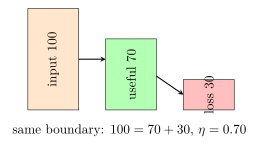
图 1 是能量账本而非“能量消失图”:损失仍是能量,只是通常进入低温热库,难以完全转回有用功。
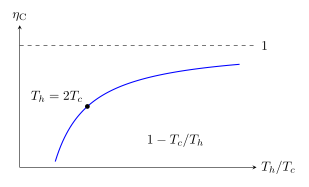
图 2 表明提高 \(T_h\) 有 diminishing returns,且任何有限 \(T_h\) 都不可能达到 \(100\%\) 热机效率。
2. Solar, wind, hydro, geothermal, and nuclear resources / 太阳、风、水、地热与核能
Knowledge ID: P14-U02-L01-K02
资源的首要尺度来自能流密度和几何截面,而不是技术名称:
\[P_{\rm PV}=\eta_{\rm PV}GA,\]
\[P_{\rm wind}=\frac12\rho_{\rm air}Av^3C_p, \qquad C_p\leq\frac{16}{27}\ \text{(ideal Betz limit)},\]
\[P_{\rm hydro}=\eta_h\rho_wgQH.\]
地热电站利用地球内部热流驱动热机,受 reservoir temperature 与 reinjection 约束;核裂变把核结合能转为热,再经 steam cycle 发电,因此热端仍受第二定律约束。对一次反应,释放能量可写成:
\[Q_{\rm nuc}=\Delta mc^2.\]
这些式子给出 instantaneous potential;年能量还要积分天气、流量、检修和调度:\(E=\int P(t)dt\)。
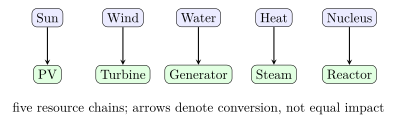
图 3 强制先写“原始能流 → 转换器”,避免把储能与一次资源混为一谈。
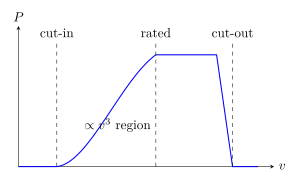
图 4 区分理想 \(v^3\) scaling 与真实 turbine power curve:达到额定后控制系统限功,过强风时停机保护。
3. Batteries, fuel cells, thermal, mechanical, and field storage / 电池、燃料电池及多种储能
Knowledge ID: P14-U02-L01-K03
储能装置至少有两种独立额定量:能量容量 \(E_{\rm cap}\) 与充放电功率 \(P_r\)。典型物理库存为:
\[E_{\rm battery}\simeq VQ_e, \qquad E_{\rm thermal}=mc\Delta T,\]
\[E_{\rm grav}=mgh, \qquad E_{\rm flywheel}=\frac12I\omega^2, \qquad E_C=\frac12CV^2.\]
electrochemical cell 的 maximum reversible electrical work 由 Gibbs free energy 给出,\(W_{\rm elec,max}=-\Delta G\);fuel cell 持续消耗外部 fuel,若要作为储能需把 electrolyzer、compression/storage 与 fuel cell 全链纳入。round-trip efficiency 为:
\[\eta_{\rm rt}=\frac{E_{\rm discharged}}{E_{\rm charged}}.\]
还要声明 usable depth of discharge、自放电、cycle/calendar ageing、温度与安全边界。
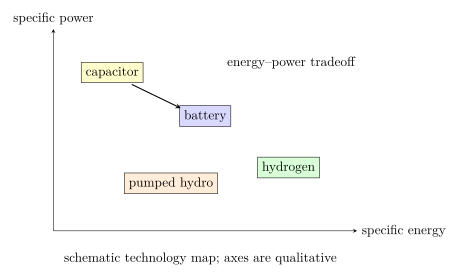
图 5 是 Ragone-style map:高 power 与高 energy 是不同设计目标,位置仅示意,不能当成数据库数值。
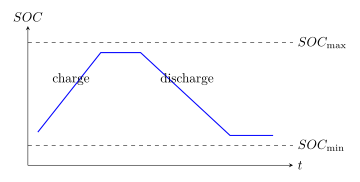
图 6 表示 operating window;容量不是“从零到化学极限”的全部能量,而是满足寿命和安全要求的 usable interval。
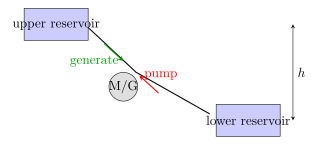
图 7 将 pumped hydro 的两个方向和系统边界画清;同一 machine 可在 motor/pump 与 turbine/generator 状态间切换。
4. Power density, energy density, capacity, and intermittency / 功率密度、能量密度、容量与间歇性
Knowledge ID: P14-U02-L01-K04
能量回答“总共能做多少”,功率回答“多快”。对额定功率 \(P_r\)、可用容量 \(E_{\rm cap}\):
\[D=\frac{E_{\rm cap}}{P_r}\]
是满功率 duration。specific energy \(E/m\)、volumetric energy density \(E/V\) 与 power density \(P/A\) 或 \(P/m\) 必须注明分母。generator 的 capacity factor 定义为:
\[CF=\frac{\int_{t_0}^{t_1}P(t)\,dt}{P_r(t_1-t_0)}.\]
\(CF<1\) 可来自昼夜/天气、流量、燃料、维护、调度或 curtailment;它不是效率。variable generation 的输出可预测但不可完全控制,系统评价必须同时看 correlation、forecast error 与需求的 coincidence。
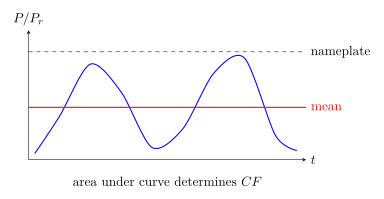
图 8 强调 capacity factor 是整段时间的面积比,而不是某个时刻的输出除以额定功率。
5. Grid transport, stability, and demand matching / 电网传输、稳定与供需匹配
Knowledge ID: P14-U02-L01-K05
对近似 unity power factor 的输电链,传送相同 active power \(P\) 时 \(I=P/V\),线路热损耗:
\[P_{\rm loss}=I^2R=\frac{P^2R}{V^2}.\]
因此变压器升高电压能显著降低损耗;真实 AC grid 还受 reactive power、voltage stability、thermal limits 与同步约束。电网几乎必须逐时满足:
\[P_{\rm generation}+P_{\rm discharge} =P_{\rm load}+P_{\rm charge}+P_{\rm loss}.\]
短时失配首先体现为 frequency deviation;惯量/fast inverter response 在毫秒至秒尺度减缓变化,governor、automatic generation control、storage 和 demand response 在随后秒至小时恢复平衡。长期 adequacy 则看 peak demand、outage correlation 与 transmission availability。
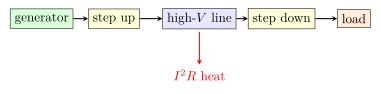
图 9 将升压、线路和降压分开;高压不减少待传 active power,而是通过降低 current 降低 conductor heating。
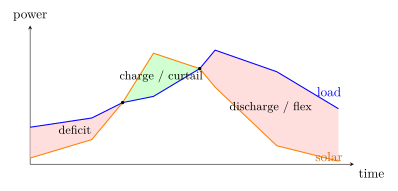
图 10 展示“能量足够”仍可能“时刻不匹配”;绿色盈余必须被储存、传走、移荷或弃电,红色缺口需由可调资源补上。
Worked examples / 完整例题
Worked Example 1 — 热机链的上限与实际输出
已知: 热源 \(T_h=800\ \mathrm K\)、冷源 \(T_c=300\ \mathrm K\),输入热功率 \(P_h=120\ \mathrm{MW}\);实际热机达到 Carnot efficiency 的 \(55.0\%\),generator efficiency 为 \(96.0\%\)。
研究对象与边界: 从热源进入热机到 generator terminals;冷源与 waste heat 位于边界外。
模型理由: 两热库近似恒温、steady cyclic engine;用 Carnot 作上限,不把它当实际效率。
\[\eta_C=1-\frac{300}{800}=0.625,\]
\[\eta_{\rm engine}=0.550(0.625)=0.34375, \qquad \eta_{\rm chain}=0.34375(0.960)=0.330.\]
\[P_e=(0.330)(120\ \mathrm{MW})=39.6\ \mathrm{MW}.\]
检查: \(0<\eta_{\rm chain}<\eta_C\);waste heat and generator loss 合计 \(120-39.6=80.4\ \mathrm{MW}\)。温度用 kelvin,三位有效数字。若 \(T_h\to T_c\),上限趋零,极限正确。
Worked Example 2 — 风机的可提取功率与 Betz audit
已知: rotor radius \(r=45.0\ \mathrm m\),\(v=10.0\ \mathrm{m\,s^{-1}}\),\(\rho=1.20\ \mathrm{kg\,m^{-3}}\),实际 \(C_p=0.420\),generator/mechanical efficiency \(\eta_g=0.920\)。
研究对象与坐标: 穿过 rotor disk 的水平 air stream;wind direction 为 \(+x\)。
模型: steady uniform upstream flow,忽略 wake shear;适用于瞬时 scale estimate。
\[A=\pi r^2=6.36\times10^3\ \mathrm{m^2},\]
\[P_{\rm wind}=\frac12\rho Av^3=3.82\ \mathrm{MW},\]
\[P_e=P_{\rm wind}C_p\eta_g =(3.82)(0.420)(0.920)=1.48\ \mathrm{MW}.\]
检查: \(C_p=0.420<16/27=0.593\);功率随 \(v^3\),若风速减半,未到控制区时功率约降为八分之一。结果并非全年平均功率。
Worked Example 3 — Pumped hydro 的容量、时长与 round trip
已知: \(m=8.00\times10^8\ \mathrm{kg}\) water,usable head \(h=420\ \mathrm m\);发电效率 \(0.900\)、pumping efficiency \(0.880\),rated discharge power \(P_r=500\ \mathrm{MW}\)。
系统边界: upper/lower reservoir 与 motor-generator;忽略蒸发和 head change。
正方向: downward discharge releases positive electrical energy。
\[E_g=mgh=(8.00\times10^8)(9.81)(420) =3.30\times10^{12}\ \mathrm J.\]
\[E_{\rm out}=0.900E_g=2.97\times10^{12}\ \mathrm J =825\ \mathrm{MWh}.\]
\[D=\frac{825\ \mathrm{MWh}}{500\ \mathrm{MW}}=1.65\ \mathrm h, \qquad \eta_{rt}=0.880(0.900)=0.792.\]
检查: \(mgh\) 单位为 J;\(825/500\) 给 h。若 head 在放水时明显下降,必须积分 \(\rho gQH(t)\),此常数-head 结果会偏高。
Worked Example 4 — 升压输电与晚峰调度
已知: 向负载传输 \(P=100\ \mathrm{MW}\),线路等效电阻 \(R=2.00\ \Omega\);比较 \(V_1=20.0\ \mathrm{kV}\) 与 \(V_2=200\ \mathrm{kV}\),假设 unity power factor。另有 \(80.0\ \mathrm{MWh}\) usable battery,晚峰可连续放电 \(2.00\ \mathrm h\)。
系统边界: 等效单相 active-power model;变压器损耗暂忽略。
模型理由: 展示 \(I^2R\) scaling,而非完整三相潮流。
\[I_1=\frac{100\times10^6}{20.0\times10^3}=5.00\ \mathrm{kA}, \qquad P_{L1}=I_1^2R=50.0\ \mathrm{MW}.\]
\[I_2=0.500\ \mathrm{kA}, \qquad P_{L2}=0.500\ \mathrm{MW}.\]
升压十倍使 current 降十倍、line loss 降为百分之一。battery 的 energy-limited average contribution:
\[P_b=\frac{80.0\ \mathrm{MWh}}{2.00\ \mathrm h}=40.0\ \mathrm{MW}.\]
检查: 第一个低压方案损耗占传送功率一半,已暴露模型/设计不可行;真实三相系统应使用 line-to-line voltage、power factor 和 reactive power。battery 若额定功率低于 \(40.0\ \mathrm{MW}\),则还受 power limit 限制。
Lesson synthesis / 全课整合
一套可执行的 energy-system workflow 是:
- 画系统边界与 energy carrier;
- 逐级写守恒并乘 efficiency,热机另做 Carnot/entropy audit;
- 从资源 flux 和 capture area 求 instantaneous power scale;
- 把 \(E_{\rm cap}\)、\(P_r\)、duration、\(SOC\)、\(\eta_{rt}\) 分开;
- 对完整时间序列积分得到 energy 与 \(CF\);
- 加入 transmission loss、ramp、frequency/voltage service 与 peak coincidence;
- 最后才比较技术组合,并声明未包含的成本、材料、生态和生命周期边界。
Formula-and-decision table / 公式与决策表
| Need | Relation | Use only when | Main caution |
|---|---|---|---|
| conversion efficiency | \(\eta=E_{out}/E_{in}\) | same stated boundary | useful output must be defined |
| heat-engine ceiling | \(1-T_c/T_h\) | cyclic engine, two reservoirs | kelvin; not a PV limit |
| wind capture | \(\tfrac12\rho Av^3C_p\) | steady upstream flow | real power curve has controls |
| hydro power | \(\eta\rho gQH\) | known flow and net head | integrate varying head |
| storage duration | \(D=E_{cap}/P_r\) | both ratings usable together | power and energy are independent |
| capacity factor | \(E/(P_r\Delta t)\) | defined interval and nameplate | not efficiency or availability |
| line heating | \(P^2R/V^2\) | simplified active-power line | AC grids also need reactive power |
| grid balance | generation + discharge = load + charge + loss | common time resolution | correlation and forecast error matter |
Model boundaries / 模型边界
- Carnot limit assumes reversible cyclic heat engine between two reservoirs; finite-rate devices add irreversibility。
- Betz limit belongs to an ideal unconfined actuator disk; terrain, wake interaction and control alter farm output。
- \(mgh\) pumped-storage estimate assumes fixed usable head; reservoirs, penstock friction and environmental constraints reduce it。
- \(VQ_e\) is an approximate battery energy ledger; terminal voltage varies with \(SOC\), current and temperature。
- A single capacity factor cannot establish reliability; coincidence with load and correlated weather/outages must be modeled。
- The line-loss example is not an AC power-flow solution; voltage, reactive power, stability and contingency constraints remain。
- This lesson maps physics, not environmental justice, mineral supply, land use, costs or lifecycle emissions。
Misconception clinic / 易错概念诊所
| Misconception | Correction |
|---|---|
| “loss” means energy vanished | energy is conserved; useful work degraded mainly to dispersed heat |
| high capacity factor means high efficiency | \(CF\) is time utilization; efficiency is output/input energy |
| a 100 MWh battery can always provide 100 MW | only if its independent power rating permits it; duration then is 1 h |
| fuel cell stores electricity | fuel cell converts fuel; storage chain must include fuel production and storage |
| variable renewable output is wholly unpredictable | it is variable and forecast-imperfect, but forecastable; system flexibility manages residuals |
| high voltage creates energy | transformers trade voltage for current; they reduce \(I^2R\) loss but do not create power |
Practice and retrieval / 练习与检索
- [K01] 两级效率分别 \(80\%\) 与 \(90\%\),总效率与每输入 \(100\ \mathrm J\) 的 loss 各是多少?
Answer 1
\(\eta=0.80\times0.90=0.72\);useful output \(72\ \mathrm J\),总 loss \(28\ \mathrm J\)。不能把两个百分数直接相加或只减一次。
- [K01] \(T_h=600\ \mathrm K\)、\(T_c=300\ \mathrm K\) 的热机能否达到 \(60\%\) efficiency?
Answer 2
\(\eta_C=1-300/600=0.50\);\(60\%\) 超过 Carnot ceiling,不可能。温度必须用 kelvin。
- [K02] 风速由 \(8.0\) 增至 \(10.0\ \mathrm{m\,s^{-1}}\),在 cubic region 其 available wind power 比值?
Answer 3
\((10/8)^3=1.953\),约增至 \(1.95\) 倍;若已进入 rated-control region 则不能套此比值。
- [K02] 水电站 \(Q=25.0\ \mathrm{m^3\,s^{-1}}\)、\(H=60.0\ \mathrm m\)、\(\eta=0.85\),求功率。
Answer 4
\(P=0.85(1000)(9.81)(25.0)(60.0)=1.25\times10^7\ \mathrm W=12.5\ \mathrm{MW}\)。
- [K03] \(400\ \mathrm V\)、\(250\ \mathrm{Ah}\) battery 的 nominal energy 为多少?若 usable fraction \(80\%\) 呢?
Answer 5
\(E=VQ=400\times250=100\ \mathrm{kWh}\);usable energy \(80.0\ \mathrm{kWh}\)。Ah 是 charge,不是 energy。
- [K03] \(2.00\times10^6\ \mathrm{kg}\) flywheel equivalent mass lifted \(120\ \mathrm m\),可回收 efficiency \(75\%\),求电能。
Answer 6
\(E=0.75mgh=0.75(2.00\times10^6)(9.81)(120)=1.77\times10^9\ \mathrm J=491\ \mathrm{kWh}\)。
- [K04] \(50\ \mathrm{MW}\) plant 一年输出 \(1.31\times10^5\ \mathrm{MWh}\),求 \(CF\)。
Answer 7
\(CF=131000/(50\times8760)=0.299\),即 \(29.9\%\)。这不说明转换效率为 \(29.9\%\)。
- [K04] \(240\ \mathrm{MWh}\) / \(60\ \mathrm{MW}\) storage 的 duration?若 round-trip efficiency \(75\%\),充入多少电能才能得到 \(240\ \mathrm{MWh}\)?
Answer 8
\(D=4.00\ \mathrm h\);所需 charging energy \(240/0.75=320\ \mathrm{MWh}\)。
- [K05] 固定 \(P,R\) 时,线路电压加倍,current 与 heating loss 如何变化?
Answer 9
\(I=P/V\) 减半;\(P_{loss}=I^2R\) 变为四分之一。真实 AC 还要检查 insulation 与 reactive-power limits。
- [综合] 某地全年太阳能量大于全年负载能量,为何仍可能发生停电?给出三项物理补救。
Answer 10
年积分不保证逐时 equality;夜间、连阴天、peak mismatch、transmission outage 均会造成 instantaneous deficit。可组合地域互联、储能、可调发电、需求响应和 reserve;还需容量与频率/电压服务。
Exit ticket / 迁移检验
给定“一座 \(100\ \mathrm{MW}\) solar farm 配 \(100\ \mathrm{MWh}\) battery”的宣传语,写出在判断其可满足“连续 \(100\ \mathrm{MW}\) 晚峰四小时”之前必须追问的五个量。
Exit-ticket benchmark
至少包括:solar hourly profile/forecast、battery power rating、usable capacity 与初始 \(SOC\)、round-trip/ discharge efficiency、晚峰 load profile;还应问 transmission limit、reserve、degradation 与连续阴天情景。仅凭两个 nameplate 数字无法满足四小时所需 \(400\ \mathrm{MWh}\)。
References and source notes / 参考资料与使用说明
以下权威直接来源均在 2026-08-31 实际打开核对;正文重新组织,所有 TikZ 依据方程原创绘制,未复制来源插图。
- U.S. Department of Energy, Solar Photovoltaic Performance and Efficiency Basics — PV efficiency definition and loss mechanisms。
- U.S. Department of Energy, Energy Sources and Hydropower — resource distinctions and hydro conversion chain。
- Sandia National Laboratories / DOE, U.S. DOE Energy Storage Handbook — electrochemical, thermal, mechanical, hydrogen storage and grid services taxonomy。
- U.S. Department of Energy, Keeping the Lights On: Essential Reliability Services — frequency response, balancing and voltage control time scales。
- NREL, Grid Integration and the Carrying Capacity of the U.S. Grid to Incorporate Variable Renewable Energy — variability, flexibility, transmission and demand-side integration。
- U.S. Department of Energy, Systems Development and Integration: Energy Storage and Power Generation — hydrogen/fuel-cell integration and curtailment context。
- OpenStax, University Physics Volume 2, Section 4.5 — The Carnot Cycle — reversible-cycle efficiency、Carnot principle 与 second-law ceiling。
- U.S. Department of Energy WINDExchange, Small Wind Guidebook — swept area、power coefficient and the ideal Betz limit \(C_p\leq16/27\)。
Source-to-content map
| Source | Used for | Knowledge ID / Section | Model boundary or convention |
|---|---|---|---|
| DOE PV basics | conversion efficiency and PV losses | K01–K02 | device efficiency, not capacity factor |
| DOE Energy Sources / Hydropower | resource chains and hydro model | K02 | resource potential differs from delivered electricity |
| DOE/Sandia ESHB | storage classes, ratings and services | K03–K05 | technologies require independent power/energy ratings |
| DOE reliability services | frequency, balancing, voltage | K05 | U.S. 60 Hz examples; principles general |
| NREL grid integration | variability, flexibility, carrying capacity | K04–K05 | system outcome depends on operations and transmission |
| DOE hydrogen integration | fuel-cell storage chain | K03, model boundaries | include production, storage and reconversion boundary |
| OpenStax Carnot cycle | reversible heat-engine ceiling and second-law basis | K01 | two fixed-temperature reservoirs; real engines are irreversible and remain below the ceiling |
| DOE Small Wind Guidebook | wind power coefficient and Betz limit | K02 | \(C_p\leq16/27\) applies to an ideal, unconfined actuator disk; real rotors have further aerodynamic, mechanical and electrical losses |
复习与拓展
- Climate and Planetary Energy Balance 将把 solar flux 与 thermal radiation 放入行星尺度能量账本。
- 可扩展到 lifecycle energy return、materials intensity、dispatch optimization、AC power flow 与 probabilistic adequacy。
- 与 Unit 14.1 Feedback and Control 的接口:grid-forming inverter、governor、battery management system 与 model-predictive dispatch。