
Learning objectives / 学习目标
学完本课后,你应能:
- 从 random walk 推出扩散距离标度,并用 Fick law、osmotic pressure 与 Péclet number 选择输运模型;
- 用 electrochemical potential 和 Nernst equation 判断离子驱动力,以 capacitor–conductance model 解释膜电位与动作电位;
- 用 freely jointed chain 与 worm-like chain 区分 contour length、persistence length、entropic elasticity 和高力失效区;
- 以 free-energy budget、detailed-balance breaking、stall force 和 efficiency 分析分子马达的非平衡能量转换;
- 从 Reynolds number、stress–strain relation、bending scaling 与 flow resistance 解释跨尺度 biomechanics;
- 对所有模型声明 system boundary、thermal reservoir、continuum assumption、time/length scale 与适用极限。
Prerequisites / 先修知识
- temperature、entropy、chemical potential、Boltzmann factor 与 free energy;
- Brownian motion、probability distribution、gradient、ordinary/partial differential equations;
- electric potential、capacitance、current、resistance 与 RC time constant;
- stress、strain、Young modulus、viscosity 与 laminar flow;
- Atmosphere and Ocean 中的 transport、feedback、dimensionless number 与 model hierarchy。
Scope and conventions / 范围与约定
- 默认实验室参考系;空间坐标会在具体问题中声明。浓度 \(c\) 用 \(\mathrm{mol\,m^{-3}}\) 或 number density,但同一方程内不混用。
- flux \(\mathbf J\) 的正方向与坐标正方向一致;membrane potential 定义为 \(V_m=V_{in}-V_{out}\)。
- electrochemical potential 采用 \(\widetilde\mu_i=\mu_i^0+RT\ln a_i+z_iF\phi\);稀溶液时才以 concentration 近似 activity。
- polymer 的 contour coordinate 为 \(s\);\(L_c\) 是 contour length,\(\ell_p\) 是 persistence length,\(R\) 是 end-to-end distance 的大小。
- molecular motor 的 load force \(F_L>0\) 表示反向阻碍 forward step;每周期可用 free energy magnitude 写作 \(\lvert\Delta G_{chem}\rvert\)。
- tissue 可呈 nonlinear、anisotropic、viscoelastic、poroelastic 与 active behavior;linear elasticity 和 Poiseuille flow 只作局部、低速、理想几何模型。
Notation and modeling contract / 符号与建模契约
| Symbol | Meaning | SI / convention |
|---|---|---|
| \(D\) | diffusion coefficient | \(\mathrm{m^2\,s^{-1}}\) |
| \(c,\mathbf J\) | concentration and molar flux | \(\mathrm{mol\,m^{-3}}\); \(\mathrm{mol\,m^{-2}\,s^{-1}}\) |
| \(\Pi\) | osmotic pressure | Pa |
| \(\mathrm{Pe}\) | Péclet number \(UL/D\) | 1 |
| \(\widetilde\mu_i\) | electrochemical potential of species \(i\) | \(\mathrm{J\,mol^{-1}}\) |
| \(V_m,E_i\) | membrane and equilibrium potentials | V |
| \(C_m,g_i\) | membrane capacitance and conductance | F; S |
| \(L_c,\ell_p,R\) | contour length, persistence length, end-to-end distance | m |
| \(k_BT\) | thermal energy per molecule | J |
| \(\Delta G_{chem}\) | chemical free-energy change per cycle | J |
| \(F_L,d,v\) | opposing load, step length, mean speed | N; m; \(\mathrm{m\,s^{-1}}\) |
| \(\sigma,\varepsilon,E\) | stress, strain, Young modulus | Pa; 1; Pa |
| \(\mathrm{Re}\) | Reynolds number \(\rho UL/\eta\) | 1 |
1. Diffusion, osmosis, and molecular transport / 扩散、渗透与分子输运
Knowledge ID: P14-U04-L01-K01
在 fluid 中,分子不断受到周围分子的热碰撞。单个轨迹不可预测,但大量独立、有限方差的小步在长时间极限形成 diffusion。对一维 unbiased Brownian motion,displacement distribution 是
\[p(x,t)=\frac{1}{\sqrt{4\pi Dt}}\exp\left(-\frac{x^2}{4Dt}\right), \qquad \left\langle x^2\right\rangle=2Dt.\]
三维各 Cartesian component 独立时 \(\langle r^2\rangle=6Dt\)。因此典型扩散时间不是 \(L/v\) 而是 \(t_D\sim L^2/D\):长度增加十倍,时间增加约百倍。
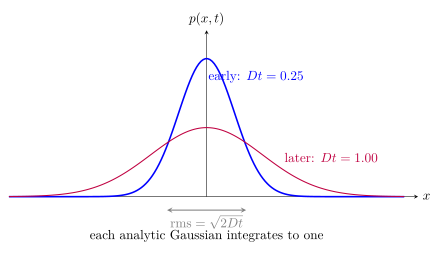
图 1 表示同一粒子 ensemble 的 Gaussian spreading;曲线不是一颗粒子的空间外形。两条解析 Gaussian 在全空间均严格归一化,图域已扩展到尾部近零;随 \(Dt\) 增大,峰值下降、宽度按 \(\sqrt t\) 增长。
宏观上 conservation law \(\partial c/\partial t+\nabla\cdot\mathbf J=0\) 与 Fick's first law
\[\mathbf J=-D\nabla c\]
给出 diffusion equation \(\partial c/\partial t=D\nabla^2c\)。负号说明 passive diffusive flux 指向较低 chemical potential;在 ideal dilute solution 且 constant \(T,D\) 时才可直接说“从高 concentration 到低 concentration”。有流体速度 \(\mathbf u\) 时,总 flux 为 \(\mathbf J=c\mathbf u-D\nabla c\),\(\mathrm{Pe}=UL/D\) 比较 advection 与 diffusion。
若 semipermeable membrane 允许 solvent 通过而阻挡 solute,平衡条件是 solvent chemical potential 跨膜相等;ideal dilute non-electrolyte 的 van't Hoff limit 为
\[\Pi=c_sRT.\]
真实 membrane 的 solute permeability、reflection coefficient、activity coefficient 与 hydrostatic pressure 都会修正净水流,不能把 osmosis 误写成“水被溶质粒子吸走”。
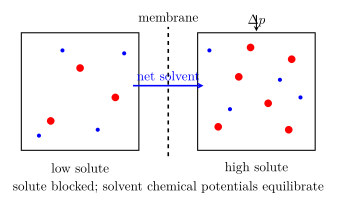
图 2 是 osmotic system boundary:红点为被膜阻挡的 solute,蓝点为 solvent。净流持续到 pressure 与 mixing contribution 共同使 solvent chemical potential 平衡;示意图 not to scale。
2. Membranes, electrochemical potentials, and action potentials / 膜、电化学势与动作电位
Knowledge ID: P14-U04-L01-K02
对价态 \(z_i\) 的 ion,chemical 和 electrical contributions 必须合并:
\[\widetilde\mu_i=\mu_i^0+RT\ln a_i+z_iF\phi.\]
若 membrane 只对 ion \(i\) permeable,zero net electrochemical driving force 给出 Nernst equation
\[E_i=\frac{RT}{z_iF}\ln\left(\frac{a_{i,out}}{a_{i,in}}\right),\]
这里 \(E_i=V_{in}-V_{out}\)。多个 ions 同时 permeable 时,\(V_m\) 不等于任一 Nernst potential;它由各 channel conductance/permeability 与 pumps 维持的 gradients 共同决定。
lipid bilayer 把 charge separation 储存在很薄的 dielectric layer 中,近似 capacitor;ion channels 提供 selective, gated conductance。空间均匀的 membrane patch 可写
\[C_m\frac{dV_m}{dt}=I_{ext}-\sum_i g_i(V_m-E_i).\]
Na–K pump 长时维持 concentration gradients;一次 action potential 的 millisecond waveform 主要来自 voltage-gated conductance 的动态,而不是 pump 在每个 spike 中瞬时搬运全部 charge。
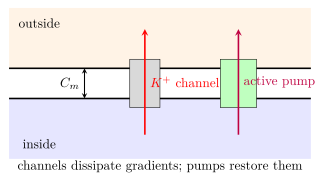
图 3 把 membrane patch 画成 nonequilibrium circuit:channel current 沿 instantaneous electrochemical force,pump 以 metabolic free energy 维持长期离子梯度。箭头为机制方向,不按通量大小比例。
action potential 的 positive feedback 是 depolarization 增加 Na conductance,Na influx 又进一步 depolarize;随后 Na-channel inactivation 与 delayed K conductance 使 membrane repolarize。threshold 是 nonlinear dynamics 的 separatrix-like behavior,不是一颗 ion 获得的固定能量。
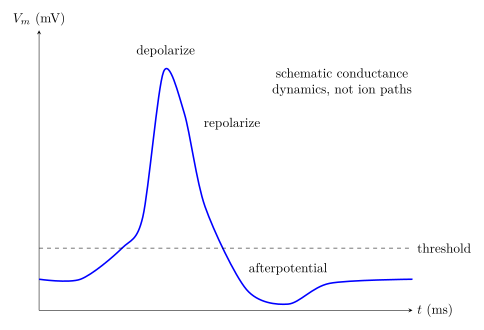
图 4 是典型 waveform 的定性图,不宣称特定神经元的精确幅度/时间。不同 cell type、temperature、channel expression 与 myelination 会改变曲线和 propagation speed。
3. Polymer physics of biomolecules / 生物大分子的聚合物物理
Knowledge ID: P14-U04-L01-K03
DNA、RNA、unfolded proteins 与 cytoskeletal filaments 都是具有许多 internal degrees of freedom 的 chains。最简单的 freely jointed chain(FJC)由 \(N\) 个固定长度 \(b\)、相互独立取向的 segments 组成;无外力时
\[\left\langle R^2\right\rangle=Nb^2, \qquad R_{rms}=b\sqrt N.\]
这说明 contour length \(L_c=Nb\) 与 typical end-to-end distance 不同。弱拉伸 Gaussian regime 中,减少可达 conformations 会产生 entropic restoring force:
\[F\approx\frac{3k_BT}{Nb^2}x, \qquad x\ll L_c.\]
接近 full extension 时 Gaussian approximation 会错误地允许 \(x>L_c\),必须使用 nonlinear FJC/WLC force law,并在更高力下加入 bond stretching、unfolding 或 structural transitions。
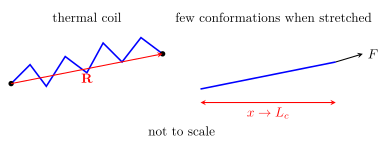
图 5 对比同一 chain 的 coiled ensemble 与 stretched state;蓝折线不是实际 chemical-bond angle 的精确结构,而是 coarse-grained polymer。
semiflexible worm-like chain(WLC)用 tangent correlation 定义 persistence length:
\[\left\langle\mathbf t(s)\cdot\mathbf t(0)\right\rangle=e^{-s/\ell_p}.\]
\(L_c\ll\ell_p\) 时 chain 近 rigid rod;\(L_c\gg\ell_p\) 时长尺度上 flexible;\(L_c\sim\ell_p\) 时 semiflexible。对 ideal WLC,\(L_c\gg\ell_p\) 时 \(\langle R^2\rangle\approx2\ell_pL_c\)。\(\ell_p\) 会受 temperature、ionic strength、binding proteins 与 sequence/structure 影响,不能当作所有环境下的常数标签。
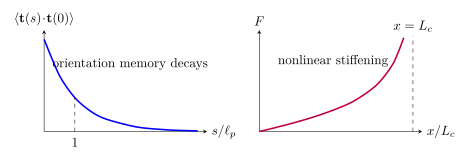
图 6 左图是 WLC orientation correlation,右图是 approaching-contour-length 的 qualitative force–extension curve;高力区的真实 chemical stretching 未画入。
4. Molecular motors and nonequilibrium energy conversion / 分子马达与非平衡能量转换
Knowledge ID: P14-U04-L01-K04
molecular motor 处在 \(k_BT\) 与工作尺度相当的涨落环境中。它不靠“消除 Brownian motion”前进,而是以 ATP hydrolysis、ion-motive force 或其他 chemical affinity 打破 detailed balance,将随机 transitions 偏置成 net cycle current。稳态一个 forward cycle 的 free-energy ledger 可写
\[\lvert\Delta G_{chem}\rvert =F_Ld+Q_{diss}+\Delta G_{other},\]
其中 \(d\) 是 net step,\(F_Ld\) 是对外 load work,\(Q_{diss}\ge0\) 是向 environment 的耗散。tight-coupling idealization 下 stall condition 近似 \(F_{stall}d\le\lvert\Delta G_{chem}\rvert\);真实 motor 可能有 futile cycles、backsteps、slippage 与 load-dependent stoichiometry。
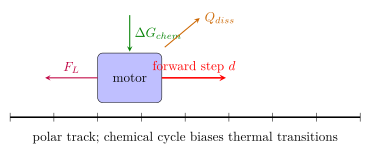
图 7 是 energy-flow diagram,不把 ATP 画成机械“燃料颗粒”。马达方向来自 track polarity 与 state-dependent kinetics;所有箭长均 schematic。
若用简化 linear force–velocity relation \(v=v_0(1-F_L/F_{stall})\),mechanical power 为 \(P=F_Lv\),在 \(F_L=F_{stall}/2\) 达 toy-model maximum;真实 curve、ATP concentration 与 compliance 可移动 optimum。efficiency 定义必须声明 input:
\[\eta=\frac{F_Lv}{r\lvert\Delta G_{chem}\rvert}\le1,\]
\(r\) 是 chemical cycles per second。stall 时 \(v=0\),因此 output power 为零,即使 force 最大。
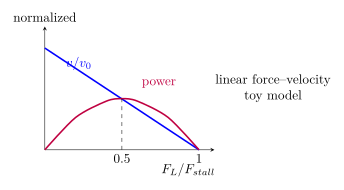
图 8 区分 force、speed 与 power:不能由“stall force 大”推出“stall 时做功快”。
5. Biomechanics across scales / 跨尺度生物力学
Knowledge ID: P14-U04-L01-K05
biomechanics 必须先问尺度与 loading rate。microorganism 在 fluid 中常有 \(\mathrm{Re}=\rho UL/\eta\ll1\),inertia 几乎即时被 viscosity 抹去;large animals 的 limbs、heart valves 与 impact 可处在明显 inertial regime。低 Reynolds number 下 time-reversible reciprocal stroke 不能产生 net swimming(在 Newtonian unbounded fluid 的 ideal limit),需要 nonreciprocal shape cycle、boundary 或 non-Newtonian effect。
对长直圆管中 steady incompressible Newtonian laminar flow,Poiseuille relation 为
\[Q=\frac{\pi r^4}{8\eta L}\Delta p,\]
显示 radius 的四次方敏感性;但血液在微血管中是 cell suspension,vessel 可 compliant,flow 可 pulsatile,branching network 也不是单根 rigid tube。
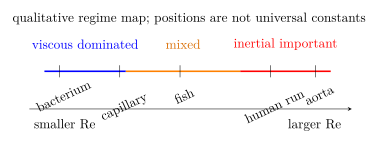
图 9 采用 qualitative smaller \(\mathrm{Re}\) → larger \(\mathrm{Re}\) 轴,强调 \(\mathrm{Re}\) 取决于 \(\rho,U,L,\eta\) 而不是物种名称;同一 organism 内可跨多个 regime,实例位置均为 schematic ranges 的提示而非数值刻度。
组织受力常呈 nonlinear stress–strain curve。small-strain tangent modulus \(E_t=d\sigma/d\varepsilon\) 只是 local slope;tendon 的 toe region 来自 collagen crimp recruitment,软组织还可有 hysteresis、relaxation 与 active prestress。对几何相似的 solid beam,bending stress 大致随 \(Mc/I\),而 weight 随 \(L^3\)、cross-sectional capacity 随 \(L^2\),所以等比例放大通常不能保持相同 safety factor。
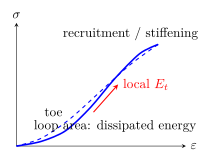
图 10 是 generic loading–unloading curve;不是任何特定 tissue 的 material certificate。sample orientation、hydration、strain rate、preconditioning 与 health state 必须报告。
Worked examples / 完整例题
Worked Example 1 — molecule 跨越 cell 的 diffusion time
已知: small molecule diffusion coefficient \(D=1.00\times10^{-10}\ \mathrm{m^2\,s^{-1}}\),一维净 displacement scale \(L=10.0\ \mathrm{\mu m}\)。
研究对象与边界: quiescent homogeneous cytosol toy model;无 binding、reaction、crowding 与 advection。
参考系/坐标: \(x=0\) 为释放位置,\(+x\) 沿 cell diameter。
模型理由: long-time Brownian limit,使用 \(\langle x^2\rangle=2Dt\)。
\[t=\frac{L^2}{2D} =\frac{(10.0\times10^{-6})^2}{2(1.00\times10^{-10})} =0.500\ \mathrm s.\]
单位/有效数字: \(\mathrm{m^2}/(\mathrm{m^2\,s^{-1}})=\mathrm s\);三位有效数字。
方向/统计检查: 这是 RMS scale,不保证每颗 molecule 在 \(0.500\) s 正好到达边界。
极限/解释: \(L\) 加倍使时间四倍;active transport 或 flow 可改变 scaling,crowding 常使 effective \(D\) 更小。
Worked Example 2 — potassium Nernst potential
已知: \(T=310\ \mathrm K\),\([K^+]_{out}=4.00\ \mathrm{mmol\,L^{-1}}\),\([K^+]_{in}=140\ \mathrm{mmol\,L^{-1}}\),\(z=+1\),\(R=8.314\ \mathrm{J\,mol^{-1}\,K^{-1}}\),\(F=96485\ \mathrm{C\,mol^{-1}}\)。
研究对象与边界: membrane only permeable to \(K^+\);ideal activities,no pressure/active flux。
参考系/符号: \(E_K=V_{in}-V_{out}\)。
模型理由: zero \(K^+\) electrochemical-potential difference。
\[E_K=\frac{RT}{F}\ln\left(\frac{4.00}{140}\right) =\frac{(8.314)(310)}{96485}(-3.555) =-9.50\times10^{-2}\ \mathrm V=-95.0\ \mathrm{mV}.\]
单位/有效数字: \((\mathrm{J\,mol^{-1}})/(\mathrm{C\,mol^{-1}})=\mathrm V\);三位有效数字。
sign check: inside 需要 negative potential 才能抵消 \(K^+\) 向外的 chemical drive,所以负号合理。
边界/解释: real resting \(V_m\) 还受 Na, Cl 与 pumps 影响;concentration 可比因单位相同而 dimensionless。
Worked Example 3 — freely jointed chain 的尺寸与弱拉伸力
已知: \(N=100\),segment length \(b=1.00\ \mathrm{nm}\),\(T=300\ \mathrm K\);把 chain 的 mean extension 维持在 \(x=5.00\ \mathrm{nm}\)。取 \(k_B=1.380649\times10^{-23}\ \mathrm{J\,K^{-1}}\)。
研究对象与边界: ideal FJC in dilute solution;segments independent,\(x\ll L_c=100\ \mathrm{nm}\)。
参考系/坐标: pulling axis 为 \(+x\);报告 restoring-force magnitude。
模型理由: weak-extension Gaussian entropic-spring regime。
\[R_{rms}=b\sqrt N=(1.00\ \mathrm{nm})(10.0)=10.0\ \mathrm{nm},\]
\[F=\frac{3k_BTx}{Nb^2} =\frac{3(1.380649\times10^{-23})(300)(5.00\times10^{-9})} {100(1.00\times10^{-9})^2} =6.21\times10^{-13}\ \mathrm N=0.621\ \mathrm{pN}.\]
单位/有效数字: \(\mathrm{J\,m/m^2=N}\);三位有效数字。
direction check: applied holding force points \(+x\),polymer restoring force points \(-x\)。
极限/解释: \(x\to0\) gives \(F\to0\);接近 \(100\) nm 时 linear law 失效并显著 stiffen。
Worked Example 4 — motor 的 energy bound、work 与 efficiency
已知: 每个 ATP cycle 可用 free-energy magnitude \(\lvert\Delta G\rvert=20.0k_BT\),\(T=310\ \mathrm K\),step \(d=8.00\ \mathrm{nm}\);motor 在 \(F_L=5.00\ \mathrm{pN}\) 下每秒 \(80.0\) steps。
研究对象与边界: tightly coupled one-ATP-per-step toy motor;steady load,无 elastic storage accumulation。
参考系/方向: forward displacement positive,\(F_L\) opposes motion;use magnitudes for efficiency。
模型理由: first/second-law energy ledger gives upper bound and dissipation。
\[\lvert\Delta G\rvert=20.0(1.380649\times10^{-23})(310) =8.56\times10^{-20}\ \mathrm J,\]
\[F_{stall}\le\frac{\lvert\Delta G\rvert}{d} =\frac{8.56\times10^{-20}}{8.00\times10^{-9}} =1.07\times10^{-11}\ \mathrm N=10.7\ \mathrm{pN}.\]
每步外功 \(W=F_Ld=4.00\times10^{-20}\ \mathrm J\),故
\[\eta=\frac{W}{\lvert\Delta G\rvert}=0.467, \qquad P=(80.0)W=3.20\times10^{-18}\ \mathrm W.\]
单位/有效数字: \(\mathrm{N\,m=J}\),steps per second 乘 J gives W;三位有效数字。
limit check: energy bound 大于 applied load;\(\eta<1\),余量耗散或进入未计自由能通道。
解释: 实际 ATP free energy、coupling ratio、backsteps 与 load dependence 都需 measurement,\(10.7\) pN 不是 universal motor value。
Worked Example 5 — vessel radius 对 laminar resistance 的敏感性
已知: rigid cylindrical vessel 由 radius \(r_1=2.00\ \mathrm{mm}\) 缩至 \(r_2=1.50\ \mathrm{mm}\);\(\Delta p,\eta,L\) 不变。
研究对象与边界: steady incompressible Newtonian laminar flow;忽略 pulsatility、compliance 与 cells。
参考系/方向: pressure drop 沿 \(+x\) drive flow;求 flow-rate ratio。
模型理由: Poiseuille equation isolates geometric scaling。
\[\frac{Q_2}{Q_1}=\left(\frac{r_2}{r_1}\right)^4 =\left(\frac{1.50}{2.00}\right)^4 =0.316.\]
若要保持原 \(Q\),所需 pressure drop ratio 为 \(\Delta p_2/\Delta p_1=1/0.316=3.16\)。
单位/有效数字: ratios dimensionless;三位有效数字。
方向/合理性: radius 减小增加 hydraulic resistance,flow 不可能在同压差下增大。
模型边界/解释: 结果展示 \(r^4\) sensitivity;真实 stenosis 可能有 separation、turbulence、non-Newtonian blood 与 elastic wall,需 CFD/measurement 扩展。
Lesson synthesis / 全课综合
living-system physics 可按 fluctuation–free-energy–transport–mechanics workflow 组织:
- 定义 system、reservoir、species、membrane/geometry、reference frame 与 observation scale;
- 先判断 equilibrium 还是 driven steady state,并写 chemical/electrical/mechanical free-energy ledger;
- 用 \(t_D\sim L^2/D\)、\(\mathrm{Pe}\)、\(\mathrm{Re}\)、\(L_c/\ell_p\) 等 dimensionless/scaling tests 选模型;
- 写 conservation law,再加入 constitutive relation:Fick、conductance、polymer force law、stress–strain 或 viscous flow;
- 对 active process 明确 energy source、cycle rate、load work、dissipation 与 detailed-balance breaking;
- 用 sign、units、thermal scale \(k_BT\)、limiting cases 与 order of magnitude 检查;
- 把 idealized parameter 与 biological variability 分开,说明 measurement protocol 和 uncertainty。
这些主题不是五个孤立章节:membrane channels 做 diffusive transport,ion gradients 储存 free energy;cytoskeletal polymers 同时是 entropic objects、motor tracks 与 cell mechanics 的结构;tissue behavior又由分子结构、fluid transport、active contraction 和 geometry 共同涌现。
Formula-and-decision table / 公式与决策表
| Question | Relation | Use when | Main limitation |
|---|---|---|---|
| Brownian spread? | \(\langle x^2\rangle=2Dt\) | homogeneous long-time 1-D diffusion | binding, crowding, anomalous diffusion |
| Diffusive flux? | \(\mathbf J=-D\nabla c\) | dilute, near-local-equilibrium, constant scalar \(D\) | activity and tensor/space-dependent \(D\) |
| Advection or diffusion? | \(\mathrm{Pe}=UL/D\) | compare transport mechanisms | reaction adds Damköhler-type scales |
| Ideal osmotic pressure? | \(\Pi=c_sRT\) | dilute impermeant solute | nonideality and membrane leakage |
| Ion equilibrium? | \(E_i=(RT/z_iF)\ln(a_{out}/a_{in})\) | one ion at zero net electrochemical drive | multiple permeabilities and active currents |
| Membrane dynamics? | \(C_m\dot V=I_{ext}-\sum g_i(V-E_i)\) | lumped membrane patch | spatial cable effects and channel noise |
| Ideal-chain size? | \(R_{rms}=b\sqrt N\) | FJC with independent segments | stiffness, excluded volume, interactions |
| Semiflexible regime? | \(\langle\mathbf t(s)\cdot\mathbf t(0)\rangle=e^{-s/\ell_p}\) | WLC-like chain | environment-dependent and non-WLC structure |
| Motor energy bound? | \(F_{stall}d\le\lvert\Delta G_{chem}\rvert\) | declared coupling per cycle | slippage, futile cycles, multiple steps |
| Viscous or inertial? | \(\mathrm{Re}=\rho UL/\eta\) | chosen biological scale | complex/non-Newtonian fluids |
| Tube flow? | \(Q=\pi r^4\Delta p/(8\eta L)\) | steady Newtonian laminar rigid tube | compliance, cells, branches, pulsation |
| Local tissue stiffness? | \(E_t=d\sigma/d\varepsilon\) | specified strain/rate/orientation | nonlinear anisotropic history dependence |
Model boundaries / 模型边界
- Fickian diffusion: requires coarse-graining beyond collision time and no long-memory anomalous transport; reaction/binding can make apparent diffusion non-Gaussian.
- van't Hoff osmosis: dilute ideal solute and selective membrane; tonicity depends on nonpenetrating solutes, not total osmolality alone.
- Nernst potential: equilibrium for one ion; an action potential is a driven transient with multiple time-dependent conductances.
- Lumped membrane: ignores axial current and cable propagation; long axons require spatial voltage equations and myelin geometry.
- FJC/WLC: coarse-grained equilibrium models; sequence, electrostatics, torsion, self-avoidance, folding and active stresses may matter.
- Motor tight coupling: one chemical cycle per mechanical step is not universal; efficiencies depend on declared input/output and operating point.
- Continuum biomechanics: fails when observation scale approaches cell/molecular heterogeneity; tissue parameters depend on rate, direction and preparation.
- Linear elasticity: local small-strain approximation; living tissue often active, viscoelastic and remodeling.
- Poiseuille flow: rigid circular straight tube, Newtonian steady fully developed laminar flow; real circulation violates several assumptions.
Misconception clinic / 误区诊所
- “diffusion 是分子沿浓度梯度直线游走。” 错。单分子轨迹随机;gradient 只在 ensemble flux 中形成 bias。
- “osmosis 是高浓度溶质把水吸过去。” 不严谨。驱动力来自跨膜 solvent chemical potential,pressure 可抵消它。
- “Nernst potential 就是 cell resting potential。” 只有单一 permeant ion equilibrium 才相同;真实 cell 有多个 currents 和 pumps。
- “Na–K pump 直接制造每个 spike 的上升沿。” spike 上升主要来自 gated channel currents;pump 维持长期 gradients。
- “polymer 像普通 Hooke spring,任何拉伸都线性。” entropic spring 仅弱拉伸近线性,接近 contour length 强烈 stiffen。
- “molecular motor 克服了 Brownian motion,所以没有随机性。” motor 利用非平衡 cycle 偏置 stochastic transitions,仍有 dwell-time 和 backstep fluctuations。
- “stall force 最大,所以 stall power 最大。” stall 时 velocity 为零,mechanical output power 也为零。
- “一种 Young modulus 足以描述组织。” tissue response 依 strain、rate、orientation、history、hydration 与 active state。
- “Poiseuille 的 \(r^4\) 对所有血流都精确。” stenosis、pulsatility、compliance、cells 与 branches 可使模型失效。
Practice and retrieval / 练习与检索
- [K01] 某 protein 的 \(D=5.0\times10^{-11}\ \mathrm{m^2\,s^{-1}}\),一维 RMS displacement 达 \(2.0\ \mathrm{\mu m}\) 需多久?
Answer 1
\(t=L^2/(2D)=(2.0\times10^{-6})^2/[2(5.0\times10^{-11})]=0.040\ \mathrm s\)。这是 ensemble RMS time scale,不是 first-passage time。
- [K01] \(U=10\ \mathrm{\mu m\,s^{-1}}\)、\(L=20\ \mathrm{\mu m}\)、\(D=100\ \mathrm{\mu m^2\,s^{-1}}\),求 \(\mathrm{Pe}\) 并解释。
Answer 2
\(\mathrm{Pe}=UL/D=(10)(20)/100=2.0\);advection 与 diffusion 同量级,不能只保留其中一个。单位用相同 \(\mathrm{\mu m}\) 系统一致消去。
- [K02] 对 \(z=+2\) ion,若 \(a_{out}/a_{in}=100\),与 \(z=+1\) 相比同温 Nernst potential 有何变化?
Answer 3
\(E=(RT/zF)\ln100\);价态从 \(+1\) 变 \(+2\) 使 magnitude 减半且 sign 仍为正。此结论假设相同 activity ratio。
- [K02] membrane patch 有 \(C=100\ \mathrm{pF}\)、总 conductance \(g=10.0\ \mathrm{nS}\),求 passive time constant。
Answer 4
\(\tau=C/g=(100\times10^{-12})/(10.0\times10^{-9})=1.00\times10^{-2}\ \mathrm s=10.0\ \mathrm{ms}\)。若 conductance 随 voltage/time 变化,单一 \(\tau\) 只作 local estimate。
- [K03] FJC segment 数增至原来的四倍、\(b\) 不变,\(R_{rms}\) 和 contour length 如何变?
Answer 5
\(R_{rms}=b\sqrt N\) 变为 2 倍;\(L_c=Nb\) 变为 4 倍。把两者混同会错误估计 coil size。
- [K03] \(L_c=10\ \mathrm{\mu m}\) 的 filament 若 \(\ell_p=50\ \mathrm{nm}\) 与 \(\ell_p=5\ \mathrm{mm}\),分别属于何种 WLC regime?
Answer 6
第一种 \(L_c/\ell_p=200\gg1\),长尺度 flexible;第二种 \(L_c/\ell_p=0.002\ll1\),近 rigid rod。rigid/flexible 是相对 observation length 的判断。
- [K04] motor 每步 input \(90\ \mathrm{pN\,nm}\)、load work \(45\ \mathrm{pN\,nm}\),其余进入耗散,thermodynamic efficiency 是多少?
Answer 7
\(\eta=45/90=0.500\)。必须确认二者是同一 cycle 和相同 free-energy bookkeeping;这不等同于 speed 或 power efficiency curve。
- [K04] 在线性 force–velocity toy model 中,load 从 \(0\) 增至 \(F_{stall}\) 时,speed、force 和 power 各怎样?
Answer 8
speed 线性降至零,force 增大;\(P=Fv\) 在两端均为零,在 \(F_{stall}/2\) 达最大。真实 motor curve 可非线性。
- [K05] 一个 micro-swimmer 以完全 reciprocal 的开合动作在 unbounded Newtonian fluid、\(\mathrm{Re}\ll1\) 中运动,周期平均位移为何为零?
Answer 9
Stokes-flow equations 在该 idealization 下 time reversible;reciprocal stroke 的后半程精确撤销前半程。要前进需 nonreciprocal shape cycle、boundary、inertia 或 non-Newtonian effect。
- [综合] 设计一个跨膜 motor-protein transport model,至少列出四个不能遗漏的 ledger 或尺度检查。
Answer 10
可包括:ion/solute mass conservation;electrochemical-potential difference;ATP/ion-gradient free-energy input;load work and heat dissipation;diffusion/advection \(\mathrm{Pe}\);motor step/track polarity;membrane capacitance/current;thermal scale \(k_BT\);coupling stoichiometry 与 stochastic uncertainty。缺少任何关键边界都可能把 passive flux 误认 active work。
Exit ticket / 迁移检验
某 cell 中,cargo 从 membrane 附近移动到 nucleus:短时呈 random diffusion,随后沿 microtubule 作有方向的 stop-and-go motion。请提出能区分 passive diffusion、advection 与 motor transport 的最小量化方案。
Exit-ticket benchmark
从 single-particle trajectories 计算 mean displacement 与 mean-square displacement:unbiased diffusion 给 mean 近零、MSD 约线性;steady drift 给 mean \(\propto t\)、长时 MSD 含 \(t^2\);motor motion 有 track-aligned velocity、discrete dwell/backsteps 和 ATP/load dependence。还需测 local \(D\)、flow \(U\)、\(\mathrm{Pe}\)、track orientation,控制 ATP depletion / motor inhibitor,并报告 localization error、finite-track 与 binding-state model;仅凭“轨迹看起来直”不能定机制。
References and source notes / 参考资料与使用说明
以下权威直接来源均在 2026-08-31 实际打开并核对。正文为重新组织的物理叙述,全部 TikZ 依据方程原创绘制;未复制来源插图。
- OpenStax, College Physics 2e, 12.7 Molecular Transport Phenomena: Diffusion, Osmosis, and Related Processes — diffusion scaling、selective membranes、osmosis 与 active transport 的基础框架。
- NCBI Bookshelf, Purves et al., The Forces that Create Membrane Potentials — concentration 与 electrical forces、Nernst equilibrium 的神经科学教材说明。
- MIT OpenCourseWare, 20.410J Molecular, Cellular and Tissue Biomechanics — Lecture Notes — statistical thermodynamics、FJC/WLC、motility 与 multiscale biomechanics 的课程结构。
- NCBI Bookshelf, Alberts et al., Molecular Motors — kinesin/myosin mechanochemical cycles、directionality 与 processivity。
- PMC, Bao and Suresh, Multiscale mechanobiology: mechanics at the molecular, cellular, and tissue levels — FJC/WLC、single-molecule force 与跨尺度 mechanobiology 的综述。
- APS Physics / Physical Review Letters, Ariga et al., Nonequilibrium Energetics of Molecular Motor Kinesin — kinesin nonequilibrium dissipation 与 energy-accounting 的实验/理论背景。
Source-to-content map
| Source | Used for | Knowledge ID / Section | Model boundary or convention |
|---|---|---|---|
| OpenStax 12.7 | diffusion, selective membrane, osmosis | K01 | pedagogical dilute-membrane limit;正文补充 chemical-potential boundary |
| Purves, NCBI Bookshelf | Nernst balance and ion driving forces | K02 | \(V_{in}-V_{out}\) sign convention stated explicitly |
| MIT OCW 20.410J | polymers, motors, multiscale biomechanics | K03, K04, K05 | course spans molecular to tissue scales; models selected at Catalog [UG1→EXT] level |
| Alberts, Molecular Motors | mechanochemical cycles and processivity | K04 | biological mechanisms motivate, not replace, energy ledger |
| Bao & Suresh review | FJC/WLC and multiscale mechanics | K03, K05 | measured parameters depend on molecular/tissue protocol |
| Ariga et al. PRL | nonequilibrium dissipation in kinesin | K04 | single-motor system; no claim of universal efficiency |
复习与拓展
- Medical Imaging 将把 diffusion、relaxation、wave propagation、inverse problem 与 stochastic counts 转化为 observable image contrast。
- 可扩展:Smoluchowski/Fokker–Planck equation、reaction–diffusion、Goldman–Hodgkin–Katz equation、cable theory、Hodgkin–Huxley bifurcations、excluded-volume polymers、fluctuation theorems 与 active matter。
- 与后续 Emergence and Collective Dynamics 的接口:许多 cell/tissue patterns 来自 local transport、active force 与 feedback 的 collective dynamics。