
Learning objectives / 学习目标
学完本课后,你应能:
- 为一项技术比较声明 functional unit、system boundary、time horizon 与 inventory,并用 mass/energy ledger 检查遗漏;
- 区分 benefit、hazard、exposure、dose–response、risk 与 risk management;
- 在多重 physical/resource constraints 下识别 feasible set、dominated option 与 Pareto frontier;
- 传播 measurement uncertainty,区分 aleatory variability、epistemic uncertainty 与 scenario choice;
- 使用 sensitivity、scenario、expected value、robustness 与 precaution,且说明每种工具的适用边界;
- 用 absolute risk、natural frequency、共同 denominator、uncertainty interval 与 traceable source 向非专业受众传达证据。
Prerequisites / 先修知识
- energy、power、efficiency、mass balance 与 SI units;
- probability、conditional probability、expectation 与 standard deviation;
- Energy Conversion and Storage 中的 capacity、efficiency、energy density 与 system matching;
- Climate and Planetary Energy Balance 中的 forcing、feedback、scenario 与 attribution;
- Networks and Information Flow 中的 cascades、robustness 与 information measures。
Scope and conventions / 范围与约定
- 本课提供 decision support,不把物理计算冒充伦理、法律或政策决定;value judgments、distributional effects 与 stakeholder rights 必须另行明示。
- 所有比较先定义 functional unit,例如“提供 \(1.00\ \mathrm{kWh}\) delivered electricity”或“完成 \(10^4\) 次操作”,而不是只比较 device mass。
- life-cycle inventory 的正号表示 resource use or release;recycling credit、avoided burden 与 allocation rule 必须单列,禁止隐含负号。
- risk probability 必须附 exposure population、time horizon 与 consequence;expected loss 只在 consequence 可合理标量化时使用。
- uncertainty interval 必须说明 coverage/assumption;scenario 是 coherent conditional future,不是赋予了 probability 的 forecast,除非明确建立 probability model。
- monetary、energy、mass、health 与 equity metrics 不直接相加;若做 weighted score,先 normalization 并披露 weights。
Notation and modeling contract / 符号与建模契约
| Symbol | Meaning | SI / convention |
|---|---|---|
| \(F\) | functional-unit service delivered | stated per study |
| \(a_i\) | activity level of process \(i\) | process-specific |
| \(e_i\) | inventory factor per activity | e.g. \(\mathrm{kg\,CO_2e\,kWh^{-1}}\) |
| \(B\) | life-cycle inventory total | stated impact unit |
| \(P(H)\) | probability of hazardous event | per stated horizon |
| \(P(E\mid H)\) | exposure probability conditional on hazard | 1 |
| \(C\) | consequence per exposed case/event | stated unit |
| \(\mathbb E[L]\) | expected loss | consequence unit |
| \(\mathbf x\) | decision vector | mixed units |
| \(g_j(\mathbf x)\) | physical/resource constraint | stated |
| \(u(x)\) | standard uncertainty of \(x\) | same unit as \(x\) |
| \(R_{\max}\) | maximum regret across scenarios | objective unit |
1. System boundaries and life-cycle accounting / 系统边界与生命周期核算
Knowledge ID: P14-U06-L01-K01
life-cycle assessment(LCA)首先定义 goal and scope、functional unit 与 system boundary,再做 inventory、impact assessment 与 interpretation。对某一 inventory quantity,
\[B=\sum_i a_i e_i,\]
其中 \(a_i\) 是 unit-process activity,\(e_i\) 是每单位 activity 的 energy/material/emission factor。等式看似简单,困难在于 boundary、allocation、data quality 与 functional equivalence。
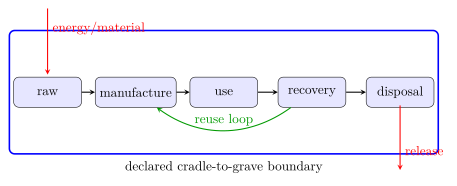
图 1 把 raw acquisition、manufacture、use、recovery 与 disposal 放进同一 boundary;绿色回路的 recycling credit 需要明确 allocation,不能凭箭头自动视为零影响。
functional unit 使不同技术提供同一 service。例如比较 lamps 必须归一到 lumen-hour 与 lifetime;比较 vehicles 可归一到 passenger-kilometre,并说明 occupancy。只报“每 kg product”可能比较了不同功能。
对每个 unit process 应检查:
\[\Delta m_{\mathrm{system}} =m_{\mathrm{in}}-m_{\mathrm{out}}, \qquad \Delta E_{\mathrm{system}} =E_{\mathrm{in}}-E_{\mathrm{out}},\]
并解释 storage/accumulation。mass 或 energy “消失”通常意味着遗漏 stream、单位换算错误或 boundary 不一致。
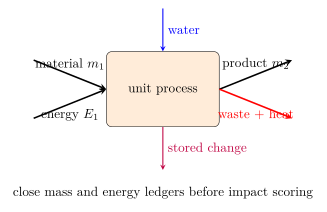
图 2 是 inventory ledger,不是 Sankey to scale;若声称按比例,箭宽也必须量化。
2. Benefit, hazard, exposure, and risk / 收益、危害、暴露与风险
Knowledge ID: P14-U06-L01-K02
benefit 是目标服务或 desirable outcome;hazard 是 potential source of harm;exposure 是 receptor 与 hazard 的 contact/intensity/time;risk 把 hazard、dose–response、exposure 与 uncertainty 综合。hazard 存在不等于 risk 高,risk 低也不等于 hazard 不存在。
一个简化 event-tree expectation 可写
\[\mathbb E[L] =P(H)\,P(E\mid H)\,P(D\mid E,H)\,C,\]
其中 \(D\) 表示 damage event,\(C\) 是 consequence。若有多个 outcome,应求和:
\[\mathbb E[L]=\sum_sP_sC_s.\]
expected value 会压缩 tail severity、distribution across people 与 irreversibility;对 catastrophic low-probability outcomes,必须同时报告 distribution/tails 与 safeguards。
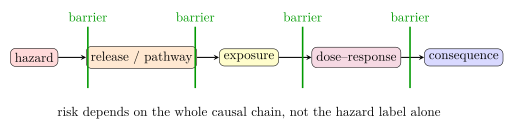
图 3 是 serial causal-chain/pathway view:barriers 可降低 release、exposure 或 consequence,但每道 barrier 的 failure dependence 必须建模。它没有 bow-tie 所需的多 threat branches、central event 与多 consequence branches,因此不把它命名为 bow-tie。
dose–response curve 的 threshold、linearity 与 susceptible subgroup 需由 evidence 决定,不能从一条 fitted curve 外推无限远。risk assessment 与 risk management 也要分开:前者整合证据与 uncertainty,后者结合 priorities、law、equity 与 feasibility 选择行动。
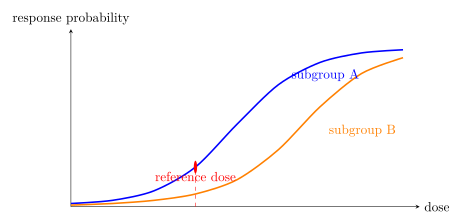
图 4 用两个不同 midpoint/slope 的 schematic subgroup sigmoid curves 表示 between-subgroup/model variability;它不表示所有 hazards 都有 threshold,也不能把 population-average curve 无条件外推到 susceptible subgroup。
3. Tradeoffs under physical and resource constraints / 物理与资源约束下的权衡
Knowledge ID: P14-U06-L01-K03
decision vector \(\mathbf x\) 必须满足 conservation、capacity、time、land、materials 与 budget 等 constraints:
\[g_j(\mathbf x)\le0, \qquad h_r(\mathbf x)=0.\]
feasible set 外的高 benefit 方案不是“较贵选择”,而是物理上不可行。多目标 \(f_1,f_2,\ldots\) 中,若不存在另一方案同时不差且至少一项更好,方案称 Pareto-efficient。Pareto frontier 显示 tradeoff,却不自动选出一点;选择需要 disclosed values/weights。
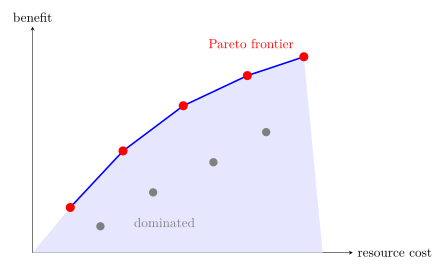
图 5 中 red points 是 non-dominated options;frontier 上仍需选择,不存在“physics 自动给出的最佳社会方案”。
若把多个 metrics scalarize,必须先把每个 objective 转成统一的 loss/cost convention(smaller is better)。令 \(f_m\) 都是 loss-oriented metric,\(s_m>0\) 是公开的 normalization scale,\(w_m\ge0\) 是公开权重;若权重解释为份额,另声明 \(\sum_mw_m=1\)。于是
\[J(\mathbf x)=\sum_mw_m \frac{f_m(\mathbf x)-f_m^{\mathrm{ref}}}{s_m},\]
\(f_m^{\mathrm{ref}}\) 是同一 loss orientation 下的 reference。直接把 joule、dollar 与 expected injury 相加量纲错误;normalization 修复数学单位,却不消除 value choice。若原 metric 是 benefit \(b_m\),需先转换成 loss(例如 \(f_m=-b_m\) 或相对 shortfall),不能把 benefit 与 cost 用相同正权重直接相加。
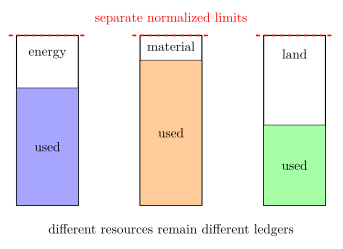
图 6 用三本独立 resource ledgers 防止“一个总分”遮蔽 material bottleneck。
4. Uncertainty, scenario analysis, and precaution / 不确定度、情景分析与审慎原则
Knowledge ID: P14-U06-L01-K04
measurement uncertainty 表示在已用信息下赋予 measurand 的 value dispersion。若 \(y=f(x_1,\ldots,x_n)\) 且 linearization 合理,
\[u_c^2(y) =\sum_i\left(\frac{\partial f}{\partial x_i}\right)^2u^2(x_i) +2\sum_{i<j} \frac{\partial f}{\partial x_i} \frac{\partial f}{\partial x_j} \operatorname{cov}(x_i,x_j).\]
independence 不能默认为真;shared calibration、common model 与 correlated weather 可产生 covariance。aleatory variability 描述 system variation,epistemic uncertainty 描述 knowledge limitation;数据增加通常更能缩小后者。
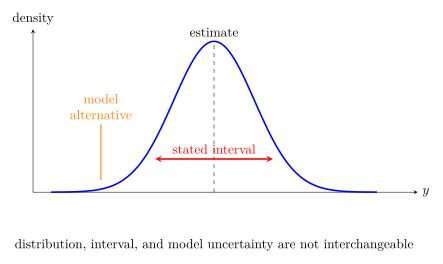
图 7 区分 within-model distribution 与 separate structural alternative;把二者合成一个小 error bar 会低估 uncertainty。
scenario analysis 选择 internally coherent inputs,比较 conditional outcomes:
\[y_s=f(\mathbf x_s,\theta_s).\]
scenario \(s\) 不一定有 probability。若 probability defensible,可算 expected utility;若不可,可在明确 objective 后比较 robust/minimax-regret rule。以下把 \(J(a,s)\) 明确定义为 action \(a\) 在 scenario \(s\) 下的 loss/cost(smaller is better):
\[R_{\max}(a) =\max_s \left[ J(a,s)-\min_{a'}J(a',s) \right].\]
若改用 utility \(U\)(larger is better),对应 regret 应写成 \(\max_{a'}U(a',s)-U(a,s)\)。minimax regret 只是 objective-dependent decision rule,不是跨价值体系的 universal optimum。
precautionary principle 不等于“任何不确定就禁止”。在 plausible serious or irreversible harm 且 evidence incomplete 时,它要求不把不确定性当作拖延的自动理由;行动应 proportionate、non-discriminatory、reviewable,并配 monitoring 与 evidence update。
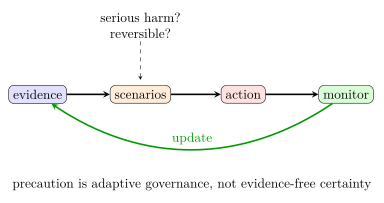
图 8 把 precaution 画成 evidence–action–monitoring loop;若措施不可复查、无 data collection,它失去 adaptive character。
5. Communicating quantitative evidence to non-specialists / 向非专业受众传达定量证据
Knowledge ID: P14-U06-L01-K05
quantitative communication 的最低信息包是:
- main claim 与 decision context;
- numerator、denominator、time horizon 与 population;
- absolute amount/risk,必要时再给 relative change;
- uncertainty range、assumptions 与 model boundary;
- comparison baseline 与 alternative;
- traceable source、date and update trigger。
若 baseline risk 从 \(2/1000\) 降到 \(1/1000\),relative reduction 是 \(50\%\),absolute reduction 只有 \(1/1000=0.1\) percentage point;两者都真,但只报 relative number 会夸大感受。
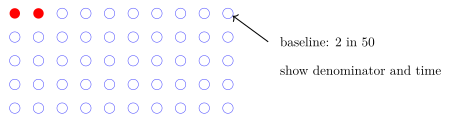
图 9 使用 natural frequency 而非孤立 percentage;若比较 intervention,应以同样 50-person denominator 画第二组。
visualization 也可能误导:truncated axis 放大差异,area/volume icon 造成非线性视觉比例,dual axes 暗示伪相关。好的 chart 让标题陈述结论、axes 含 units、data points 与 uncertainty visible,并区分 measured、modeled 与 scenario values。
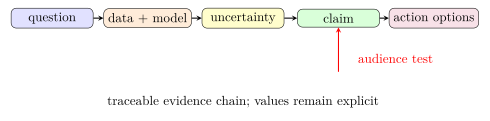
图 10 体现 communication 不是压缩成 slogan,而是把 evidence chain 变得可审查。
Worked examples / 完整例题
Worked Example 1 — 用共同 functional unit 比较两种照明方案
已知: 目标服务为 \(800\ \mathrm{lm}\) 持续 \(10\,000\ \mathrm h\)。方案 A:一只 device,manufacturing inventory \(12.0\ \mathrm{kg\,CO_2e}\)、power \(10.0\ \mathrm W\)、lifetime \(10\,000\ \mathrm h\)。方案 B:每只 lifetime \(1000\ \mathrm h\),需 10 只,每只 manufacturing \(0.500\ \mathrm{kg\,CO_2e}\)、power \(60.0\ \mathrm W\)。electricity factor \(0.400\ \mathrm{kg\,CO_2e\,kWh^{-1}}\)。
研究对象与边界: cradle-to-use toy inventory;同为 \(800\ \mathrm{lm}\),含 replacement manufacture 与 operating electricity,不含 fixture/transport/end-of-life。
参考系/符号: emissions positive;functional unit 是 \(8.00\times10^6\ \mathrm{lm\,h}\)。
模型理由: 先保证 service equivalence,再做 inventory sum。
方案 A 使用电量
\[E_A=(0.0100\ \mathrm{kW})(10\,000\ \mathrm h) =100\ \mathrm{kWh},\]
\[B_A=12.0+(100)(0.400) =52.0\ \mathrm{kg\,CO_2e}.\]
方案 B:
\[E_B=(0.0600)(10\,000) =600\ \mathrm{kWh},\]
\[B_B=10(0.500)+(600)(0.400) =245\ \mathrm{kg\,CO_2e}.\]
relative reduction 为
\[\frac{245-52.0}{245}=0.788=78.8\%.\]
单位/有效数字: power converted to kW;inventory 三位有效数字。
检查: 两方案 lumen-hours 与 time horizon 相同;use-stage plus manufacture sums close。
模型边界/解释: 数值是教学 toy data,不是产品声明;改变 grid factor、lifetime、transport 或 end-of-life 会改变结果。
Worked Example 2 — hazard、exposure 与 expected harm
已知: 某 facility 每年 initiating hazardous event probability \(P(H)=0.0200\);event 发生时 exposed fraction \(P(E\mid H)=0.100\);exposed person 的 conditional fatality probability \(P(D\mid E,H)=0.0500\);邻近 population \(N=1.00\times10^6\)。mitigation 将 exposure fraction 减半,其余不变。
研究对象与边界: one-year event-tree toy model;按条件概率链式分解,这些 conditional probabilities 已包含依赖,不另假设 independence。toy model 仍假设 population-average conditional rates 可用于所声明 population,并省略 common-cause、heterogeneity、evacuation delay 与 multi-year correlation,除非另行建模。
参考系/符号: consequence 用 expected fatalities per year。
模型理由: 显式拆分 hazard frequency 与 exposure。
baseline expected fatalities:
\[\mathbb E[L_0] =(0.0200)(0.100)(0.0500)(1.00\times10^6) =100\ \mathrm{yr^{-1}}.\]
mitigation 后
\[\mathbb E[L_1] =(0.0200)(0.0500)(0.0500)(1.00\times10^6) =50.0\ \mathrm{yr^{-1}}.\]
单位/有效数字: probabilities dimensionless;population gives persons per year;三位有效数字。
检查: exposure 减半使 expectation 线性减半;hazard frequency 未被错误称为减少。
模型边界/解释: expected value 不表示每年“恰有 100 人”;低频高后果 tail、population distribution 与 barrier dependence 需完整 probabilistic risk assessment。
Worked Example 3 — 两类 devices 的 resource-constrained portfolio
已知: type 1 每台 power \(2.00\ \mathrm W\)、performance score 8;type 2 每台 power \(5.00\ \mathrm W\)、score 14。可安装最多 6 台,total power 不超过 \(20.0\ \mathrm W\)。求 integer portfolio 的 maximum score。
研究对象与边界: \(n_1,n_2\) 为 nonnegative integers;score additive,无 interaction、reliability 或 cost difference。
参考系/约束:
\[n_1+n_2\le6, \qquad 2n_1+5n_2\le20.\]
模型理由: 用小型 integer search 展示 physical constraints。
按 \(n_2\) 枚举最佳 feasible \(n_1\):
| \(n_2\) | largest feasible \(n_1\) | power / W | score |
|---|---|---|---|
| 0 | 6 | 12 | 48 |
| 1 | 5 | 15 | 54 |
| 2 | 4 | 18 | 60 |
| 3 | 2 | 19 | 58 |
| 4 | 0 | 20 | 56 |
故
\[(n_1,n_2)=(4,2), \qquad \text{score}=60.\]
单位/有效数字: power in W;score dimensionless。
检查: 6 devices、18 W 均满足 constraints;增加 type 2 会触发 power constraint 并减少 total score。
模型边界/解释: 若加入 mass、failure correlation 或 nonadditive performance,optimum 可能改变;score 的定义本身也是 decision assumption。
Worked Example 4 — 不确定度传播与诚实的风险沟通
已知: baseline incident probability estimate \(p_0=0.0200\)、\(u(p_0)=0.0040\);intervention estimate \(p_1=0.0120\)、\(u(p_1)=0.0030\)。暂按 independent standard uncertainties,求 absolute reduction per \(10\,000\) operations。
研究对象与边界: difference estimator \(\Delta p=p_0-p_1\);normal/linear approximation;不含 model bias 或 shared-data covariance。
参考系/符号: positive \(\Delta p\) 表示 fewer incidents。
模型理由: 用 GUM-style propagation 避免只报 relative percentage。
\[\Delta p=0.0080, \qquad u(\Delta p) =\sqrt{0.0040^2+0.0030^2} =0.0050.\]
每 \(10\,000\) operations 的 best estimate:
\[N_{\mathrm{avoided}} =(10\,000)(0.0080) =80, \qquad u(N_{\mathrm{avoided}})=50.\]
approximate expanded interval \(k=2\) 为
\[80\pm100,\]
即约 \(-20\) 到 \(180\) avoided incidents per \(10\,000\)。relative best estimate reduction 是 \(40\%\),但 uncertainty 很大。
单位/有效数字: probabilities dimensionless;result 是 incidents per \(10\,000\) operations。
检查: interval 跨越 zero,说明现有 evidence 与 “no reduction” compatible;负 lower endpoint 表示 estimator uncertainty,不是“避免负事故”的物理数量。
沟通版本: “最佳估计每 1 万次操作少 80 起;按当前抽样误差,约 95% 的近似区间从多 20 起到少 180 起。需更多数据检验真实效果。”
模型边界: 若 estimates correlated,必须加入 covariance;若 probability near bounds,normal interval 可能不合适。
Lesson synthesis / 全课综合
可执行的 evidence-to-decision workflow:
- 写清 decision question、functional unit、population、time horizon 与 alternatives;
- 画 system boundary,建立 mass/energy/material/release inventory,并做单位与守恒检查;
- 分开 benefit、hazard、exposure、dose–response 与 consequence;
- 写 feasible constraints,再画 Pareto tradeoffs;不要先给 arbitrary total score;
- 列出 measurement、parameter、model、scenario 与 value uncertainty;
- 用 sensitivity 找 drivers,用 scenarios 检验 conditional futures,用 robust/precaution rules 处理 deep uncertainty;
- 明确哪些结论是 measured、modeled、assumed 或 valued;
- 用共同 denominator、absolute quantities、uncertainty、source 与 update condition 向受众呈现。
Formula-and-decision table / 公式与决策表
| Question | Relation | Use when | Main limitation |
|---|---|---|---|
| Inventory total? | \(B=\sum_i a_i e_i\) | boundary and functional unit fixed | allocation and missing processes may dominate |
| Ledger closed? | input \(-\) output \(=\) accumulation | unit process with measured streams | incomplete species/heat paths hide residual |
| Expected consequence? | \(\mathbb E[L]=\sum_sP_sC_s\) | probabilities and commensurate consequences defensible | tails, equity and irreversibility compressed |
| Feasible decision? | \(g_j(\mathbf x)\le0\), \(h_r(\mathbf x)=0\) | physical/resource constraints known | model may omit institutional constraints |
| Scalar loss score? | \(J=\sum_mw_m(f_m-f_m^{ref})/s_m\) | all \(f_m\) loss-oriented, \(s_m>0\), \(w_m\ge0\) disclosed | normalization and value choices remain |
| Standard uncertainty? | \(u_c^2=\sum c_i^2u_i^2+2\sum c_ic_j\operatorname{cov}_{ij}\) | local linearization valid | structural uncertainty not captured |
| Scenario result? | \(y_s=f(\mathbf x_s,\theta_s)\) | coherent conditional assumptions | scenario is not automatically probable |
| Robust choice? | minimize \(R_{\max}\) | probabilities not defensible, regret meaningful | conservative and objective-dependent |
| Absolute risk change? | \(\Delta p=p_0-p_1\) | same population/time/baseline | confounding and model bias may remain |
Model boundaries / 模型边界
- LCA compares potential impacts under declared boundary; it is not automatically site-specific actual risk assessment。
- functional unit equality is necessary but not sufficient:quality、reliability 与 rebound effects may differ。
- emission/resource factors vary by time, location, technology and allocation;database precision is not physical certainty。
- expected loss is informative for repeated commensurate outcomes, but can hide catastrophic tails and unequal burden。
- Pareto analysis maps tradeoffs; weights, rights and acceptable thresholds are not supplied by physics。
- GUM-style propagation treats stated measurement model; it does not absorb unknown unknowns or omitted mechanisms。
- Monte Carlo output is only as credible as input distributions, correlations and model structure。
- scenarios explore conditions; assigning equal probability merely because there are three scenarios is unjustified。
- precaution requires plausible harm, scientific examination, proportionality, review and monitoring;it is neither zero-risk demand nor evidence-free ban。
- communication aids understanding but cannot repair a biased boundary or invalid model。
Misconception clinic / 误区诊所
- “operating efficiency 高,所以 life-cycle impact 必低。” 错。manufacture、lifetime、capacity factor、infrastructure 与 disposal 都可能改变 ranking。
- “boundary 越窄,结果越精确。” 只会让表内数字更精细;遗漏 upstream/downstream 可造成更大 bias。
- “hazardous 就等于 high risk。” 错。risk 还需 exposure、dose–response、time 与 consequence。
- “expected value 小即可忽略。” 对 irreversible catastrophic tail、unequal exposure 或 correlated failure 不够。
- “Pareto frontier 给出唯一最优方案。” 错。它只排除 dominated options。
- “error bar 包含所有未知。” 错。通常只覆盖 stated statistical/measurement model。
- “三条 scenarios 就各有 \(1/3\) probability。” 错。scenario set 不是 probability distribution。
- “precaution 意味禁止所有新技术。” 错。措施应与 plausible harm 比例相称,并可复查、监测和更新。
- “relative reduction 50% 就一定很大。” 需同时报告 baseline 与 absolute change。
- “plain language 可以省略 assumptions。” 错。简洁应保留 denominator、units、range、source 与 boundary。
Practice and retrieval / 练习与检索
- [K01] 比较两种电池时,一种按 \(\mathrm{kg\,CO_2e\,kg^{-1}}\),另一种按 \(\mathrm{kg\,CO_2e\,kWh^{-1}}\) 报告。能直接排序吗?
Answer 1
不能。需共同 functional unit,例如 lifetime delivered \(\mathrm{kWh}\),并纳入 usable depth、cycle life、efficiency 与 replacement;mass-based 与 service-based denominator 不同。
- [K01] 一个 process 输入 \(100\ \mathrm{kg}\) material,输出 product \(72\ \mathrm{kg}\)、solid waste \(20\ \mathrm{kg}\)、measured gas \(5\ \mathrm{kg}\),无 storage。ledger residual 是多少,意味着什么?
Answer 2
residual \(=100-(72+20+5)=3\ \mathrm{kg}\)。在无 accumulation 假设下,需查 unmeasured emissions、moisture、sampling 或单位;不能直接把 3 kg 记为“损失”。
- [K02] hazard-event annual probability \(0.010\),event 下 exposure probability \(0.20\),exposed consequence probability \(0.04\)。individual annual risk 是多少?
Answer 3
toy chain 给 \((0.010)(0.20)(0.04)=8.0\times10^{-5}\ \mathrm{yr^{-1}}\)。必须声明各 conditional probability 的 population、time horizon、conditioning events 与 homogeneity assumptions;链式乘法本身不要求 independence。
- [K02] barrier A 降低 event probability,barrier B 降低 exposure。为什么不能把二者都写成“hazard reduced”?
Answer 4
A 作用于 initiating frequency,B 作用于 pathway/contact;两者在 causal chain 的位置不同,failure dependence、monitoring metric 与 residual risk 也不同。
- [K03] option A 的 energy use 和 water use 都不高于 B,且 energy 更低。哪个 dominated?
Answer 5
在只考虑这两个 minimization metrics 且其他条件相同的前提下,B 被 A dominated。若 reliability 或 equity 不同,则需加入目标后重判。
- [K03] 为什么不能直接最小化 \(E+m+C\),其中 \(E\) 用 joule、\(m\) 用 kg、\(C\) 用 dollar?
Answer 6
不同量纲不能直接相加。需先用 reference scales normalization,再披露 weights;即便数学上 dimensionless,weights 仍是价值选择。
- [K04] \(y=x_1-x_2\),\(u(x_1)=3\)、\(u(x_2)=4\),independent。求 \(u(y)\);若正相关会怎样?
Answer 7
independent 时 \(u(y)=\sqrt{3^2+4^2}=5\)。一般 \(u^2(y)=u_1^2+u_2^2-2\operatorname{cov}(x_1,x_2)\);正 covariance 会降低 difference uncertainty,不能盲目 root-sum-square。
- [K04] 一项 plausible harm 可能严重且不可逆,但 probability 无法可靠估计。列出合格 precaution action 的三项特征。
Answer 8
至少应 proportionate to plausible harm、基于最佳可得 scientific evaluation、可复查并配 monitoring/data collection;还应比较 action 与 inaction consequences,避免把 zero risk 当目标。
- [K05] baseline risk 从 \(4/10\,000\) 降到 \(2/10\,000\)。写出 relative 与 absolute reduction。
Answer 9
relative reduction \(=(4-2)/4=50\%\);absolute reduction \(=2/10\,000=0.02\) percentage point。沟通时必须给 time horizon 与 population。
- [K05 综合] 某图只显示从 \(99.0\) 到 \(100.0\) 的 y-axis,两个 values 为 99.2 与 99.8。为什么可能误导?怎样改?
Answer 10
truncated axis 会把 \(0.6\) absolute difference 视觉放大。应说明为何 truncation relevant,标注 full numeric values/uncertainty,并提供 zero-based inset 或 effect-size context;若 measure 本就只在窄 range 有意义,也要明确。
Exit ticket / 迁移检验
你要向社区解释一项新储能项目。写出一页 evidence brief 的骨架,必须同时覆盖物理服务、life-cycle boundary、风险链、资源 tradeoff、不确定度与可更新决策。
Exit-ticket benchmark
标题先写可检验结论;声明 functional unit(例如 delivered MWh over project life)、boundary 与 alternatives;列 energy/material/emission ledgers;把 hazard、exposure、consequence 与 barriers 分开;给 Pareto tradeoffs 而非隐藏总分;用 absolute natural frequencies and common time horizon 报风险;区分 measured/modelled/scenario,给 uncertainty/correlation;列监测指标、review date 与 action triggers;最后附 direct sources and assumptions。
References and source notes / 参考资料与使用说明
以下权威直接来源均在 2026-08-31 实际打开并核对。正文重新组织,全部图依据方程原创绘制;例题数值为明确标注的教学模型,未冒充来源实测值。
- International Organization for Standardization, ISO 14040:2006 — Life cycle assessment: Principles and framework — goal/scope、inventory、impact assessment、interpretation 与 limitations。
- U.S. Environmental Protection Agency, Life Cycle Assessment: Principles and Practice — functional unit、system boundary、unit-process inventory、LCIA 与 interpretation。
- U.S. Department of Energy / Argonne National Laboratory, R&D GREET Life Cycle Assessment Model — vehicle/fuel/material product systems、life-cycle stages 与 per-service comparison。
- U.S. Environmental Protection Agency, Conducting a Human Health Risk Assessment — hazard identification、dose–response、exposure 与 risk characterization。
- BIPM/JCGM, Guides in Metrology — GUM and supplements — measurement model、standard uncertainty、covariance 与 Monte Carlo propagation。
- U.S. Environmental Protection Agency, Guiding Principles for Monte Carlo Analysis — variability/uncertainty analysis、transparency 与 reproducibility。
- OECD, Understanding and Applying the Precautionary Principle in the Energy Transition — Chapter 2 — precaution 的适用条件、比例性、review、hazard/exposure distinction 与争议边界。
- Centers for Disease Control and Prevention, Clear Communication Index — Explaining numeric probability — natural frequencies、absolute risk、words plus visuals。
- National Academies of Sciences, Engineering, and Medicine, Communicating Science Effectively — The Complexities of Communicating Science — uncertainty、numeracy、audience mental models 与 numerical plus verbal formats。
- Boyd, S. and Vandenberghe, L., Stanford University, Convex Optimization — book and course materials — multicriterion optimization、Pareto optimality 与 positive-weight scalarization 的条件和限制。
- Intergovernmental Panel on Climate Change, AR6 WGII, Chapter 17 — Decision-Making Options for Managing Risk — scenario-focused decision support、robust/no-regret approaches、deep uncertainty、monitoring 与 iterative risk management。
Source-to-content map
| Source | Used for | Knowledge ID / Section | Model boundary or convention |
|---|---|---|---|
| ISO 14040 | LCA phases, goal/scope and limitations | K01 | framework standard; detailed factor choices remain study-specific |
| EPA LCA Principles | boundary, functional unit, inventory ledger and interpretation | K01, K03 | LCIA indicates potential impacts, not site-specific absolute risk |
| DOE/Argonne GREET | product systems and service-normalized life-cycle comparison | K01, K03 | technology and database assumptions are version/location dependent |
| EPA Human Health Risk Assessment | hazard, dose–response, exposure and characterization | K02 | health-risk framework; toy event tree here is simplified |
| Boyd–Vandenberghe | Pareto optimality and positive-weight scalarization | K03 | objectives must share a disclosed loss orientation and scaling |
| BIPM/JCGM GUM | standard uncertainty and covariance propagation | K04 | stated measurement model; structural uncertainty separate |
| EPA Monte Carlo Principles | variability/uncertainty, transparency and reproducibility | K04 | simulation credibility depends on inputs/correlation/model |
| IPCC AR6 WGII Chapter 17 | scenarios, robustness/no-regret framing, deep uncertainty and iterative monitoring | K04 | minimax regret is one objective-dependent rule, not a universal optimum |
| OECD Precautionary Principle | serious harm, scientific uncertainty, proportionality and review | K02, K04 | precaution is risk-management guidance, not zero-risk formula |
| CDC Clear Communication Index | natural frequencies, absolute risk and visuals | K05 | audience testing still required |
| National Academies | uncertainty communication and numeracy | K04, K05 | communication effectiveness is context-dependent |
复习与拓展
- 可扩展:input–output LCA、discounting and intergenerational equity、value of information、Bayesian decision theory、multi-criteria decision analysis、distributional risk 与 participatory modeling。
- 与 Networks and Information Flow 的接口:infrastructure cascade risk 需要把 topology、physical flow、barrier dependence 与 evidence communication 联合建模。