
Learning objectives / 学习目标
完成本课后,你应当能够:
- 用带方向的矢量式计算两点质量之间的引力,并说明作用—反作用与惯性质量、引力质量的角色。
- 对离散质量与连续质量分布叠加引力场,区分场、力、势和势能。
- 准确陈述壳层定理的对称性与区域条件,写出球对称分布内外的 \(g(r)\)。
- 从功定义得到引力势,验证 \(\mathbf g=-\boldsymbol\nabla\Phi\),并正确选取零势能面。
- 从能量守恒推导逃逸速度,列出孤立、球对称、无阻力、无后续推进等假设。
- 用量纲、方向、连续性、极限与数量级检查引力模型。
Prerequisites / 先修知识
- 矢量与坐标分量:位移矢量、单位矢量和径向方向。
- Newton 定律与惯性系:受力图、作用—反作用与惯性质量。
- 功、势能与机械能守恒:保守力、势能零点与能量账。
- 会做一元微积分、简单三维矢量运算和量纲检查;连续分布积分只在正文需要处引入。
0. Notation and modeling contract / 记号与建模协议
| Symbol | Meaning |
|---|---|
| \(m_1,m_2\) | interacting masses |
| \(\mathbf r_i\) | position of mass \(i\) in one inertial frame |
| \(\mathbf r_{12}=\mathbf r_2-\mathbf r_1\) | vector from 1 to 2 |
| \(\Phi\) | gravitational potential, energy per unit test mass |
| \(\mathbf g\) | gravitational field or free-fall acceleration |
| \(M(r)\) | mass enclosed by a sphere of radius \(r\) |
| \(U=m\Phi\) | potential energy of test mass \(m\) in a prescribed field |
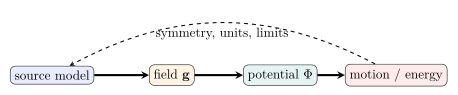
每次建模依次回答:源质量在哪里?研究对象是谁?是否可视为点质量或球对称体?参考系是否惯性?系统是否孤立?最后才代入公式。
Knowledge 1 — Universal law of gravitation / 万有引力定律
Knowledge ID: P01-U07-L01-K01
1.1 Pair law with direction
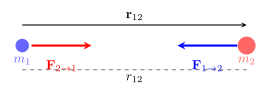
质量 \(m_1\) 对质量 \(m_2\) 的力为
\[\mathbf F_{1\to2} =-G\frac{m_1m_2}{r_{12}^3}\mathbf r_{12} =-G\frac{m_1m_2}{r_{12}^2}\hat{\mathbf r}_{12}.\]
负号表示力与“从 1 指向 2”的单位矢量反向,即吸引。交换下标后
\[\mathbf F_{2\to1}=-\mathbf F_{1\to2},\]
两力大小相等、方向相反、作用在不同物体上。平方反比只描述点质量;有限物体必须积分,或先证明其外场等效于点质量。
1.2 Scaling and dimensions
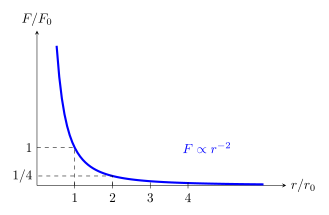
若距离变为 \(\lambda r\),力变为原来的 \(\lambda^{-2}\)。量纲检验给出
\[[G]=\frac{[F][r]^2}{[m]^2}=\mathrm{m^3\,kg^{-1}\,s^{-2}}.\]
1.3 Worked Example 1 — gravity on a low-altitude payload
已知。 地球质量 \(M_\oplus=5.9722\times10^{24}\ \mathrm{kg}\)、半径 \(R_\oplus=6.371\times10^6\ \mathrm m\);小载荷质量 \(m=1000\ \mathrm{kg}\),高度相对 \(R_\oplus\) 可忽略。
研究对象、系统与参考系。 研究对象是载荷;取地球—载荷为相互作用系统,在近似地心惯性系中求地球对载荷的力。
坐标与正方向。 以地心为原点,径向向外为 \(+\hat{\mathbf r}\);因此引力分量应为负。
模型及理由。 地球近似球对称,载荷尺度远小于 \(R_\oplus\),故地球外场可用中心点质量模型;暂忽略自转与空气。
方程与计算。 矢量式与大小分别为
\[\mathbf F=-\frac{GM_\oplus m}{R_\oplus^2}\hat{\mathbf r}, \qquad F=\frac{GM_\oplus m}{R_\oplus^2}.\]
代入 SI 数据,
\[F=\frac{GM_\oplus m}{R_\oplus^2} =(9.820\ \mathrm{m/s^2})(1000\ \mathrm{kg}) =9.82\times10^3\ \mathrm N.\]
SI、有效数字与检查。 \([GMm/R^2]=\mathrm{kg\,m\,s^{-2}}=\mathrm N\);结果取三位有效数字。径向分量为 \(-9.82\times10^3\ \mathrm N\),确实指向地心;若高度增大,\(F\propto r^{-2}\) 应减小。
物理解释。 载荷也以同样大小的力拉地球,但地球加速度仅为 \(F/M_\oplus\);第三定律保证相等的是一对内力,不是两物体的加速度。
Knowledge 2 — Gravitational field and superposition / 引力场与叠加
Knowledge ID: P01-U07-L01-K02
2.1 Field separates source from probe
在测试质量足够小、不显著改变源分布时,定义
\[\mathbf g(\mathbf r)=\lim_{m\to0}\frac{\mathbf F}{m}.\]
点质量 \(M_i\) 产生的总场为
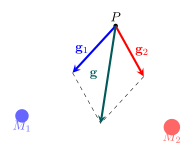
\[\mathbf g(\mathbf r) =-G\sum_i M_i\frac{\mathbf r-\mathbf r_i}{\lvert\mathbf r-\mathbf r_i\rvert^3},\]
连续质量密度 \(\rho(\mathbf r')\) 则给出
\[\mathbf g(\mathbf r) =-G\int \rho(\mathbf r') \frac{\mathbf r-\mathbf r'}{\lvert\mathbf r-\mathbf r'\rvert^3} \,d^3r'.\]
叠加的是矢量分量,不能先把各力大小相加。
2.2 Radial field geometry
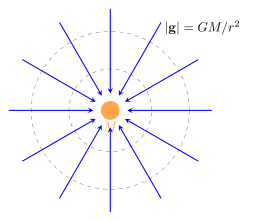
孤立点质量的场线径向向内,球面面积随 \(r^2\) 增长,故相同“通量”分布到更大面积。这是平方反比几何的直观图景,不是对所有几何形状均可直接使用的证明。
2.3 Worked Example 2 — zero field between Earth and Moon
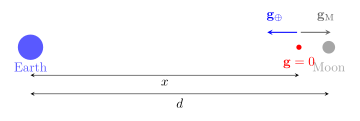
已知。 \(M_\oplus=5.9722\times10^{24}\ \mathrm{kg}\)、\(M_{\mathrm M}=7.342\times10^{22}\ \mathrm{kg}\),瞬时地月距离 \(d=3.844\times10^8\ \mathrm m\)。
研究对象、系统与参考系。 求一质量可忽略试探粒子所在点的总场;源系统只含地球与月球,并在瞬时惯性系中把两源位置冻结。
坐标与正方向。 原点在地心,\(+x\) 从地球指向月球;在线段内,地球场沿 \(-x\)、月球场沿 \(+x\)。
模型及理由。 两天体在该距离尺度上近似球对称点质量;仅求某一瞬时的 Newtonian 场相消点,不引入随地月转动的非惯性项。
方程与计算。 令零场点距地心为 \(x\),则两场大小相等:
\[\frac{GM_\oplus}{x^2} =\frac{GM_{\mathrm M}}{(d-x)^2},\]
\[x=\frac{d}{1+\sqrt{M_{\mathrm M}/M_\oplus}}\]
代入完整 SI 数据:
\[x= \frac{3.844\times10^8\ \mathrm m} {1+\sqrt{(7.342\times10^{22}\ \mathrm{kg})/(5.9722\times10^{24}\ \mathrm{kg})}} =3.46033\times10^8\ \mathrm m =3.46\times10^8\ \mathrm m.\]
故
\[d-x=(3.844\times10^8-3.46033\times10^8)\ \mathrm m =3.84\times10^7\ \mathrm m.\]
SI、有效数字与检查。 \(G\) 在等式两侧约去,\(x\) 单位为米;\(0<x<d\),且零点更靠近质量较小的月球,符合数量级判断。代回可得两场大小相同、方向相反。
物理解释。 这是惯性系中的两场相消点,不是旋转系中的 Earth–Moon \(L_1\);后者还必须加入离心项,因此位置不同。
Knowledge 3 — Shell theorem and spherical bodies / 壳层定理与球对称天体
Knowledge ID: P01-U07-L01-K03
3.1 Two statements, two domains
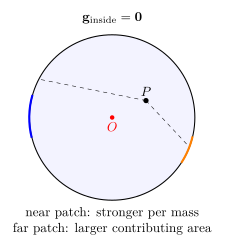
对均匀薄球壳:
- 壳外点的场等于全部质量集中在球心的点质量场;
- 壳内任意点的净场为零。
对由同心均匀薄壳组成的任意球对称密度 \(\rho(r)\),半径 \(r\) 处只有包围质量决定场:
\[\mathbf g(r)=-\frac{GM(r)}{r^2}\hat{\mathbf r}, \qquad M(r)=4\pi\int_0^r\rho(s)s^2\,ds.\]
壳层定理不能用于非球对称天体,也不能把球内点误当成“全部质量集中于中心”;球内只取 \(M(r)\)。
3.2 Uniform solid sphere
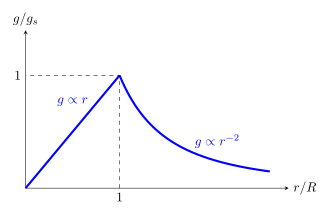
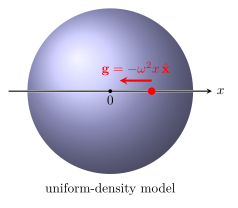
若半径 \(R\)、总质量 \(M\) 的实心球密度均匀,则 \(M(r)=M(r/R)^3\),所以
\[\mathbf g(r)= \begin{cases} -\dfrac{GM}{R^3}\mathbf r, & 0\le r\le R,\\[6pt] -\dfrac{GM}{r^2}\hat{\mathbf r}, & r\ge R. \end{cases}\]
场在中心为零,在表面连续且大小最大;球内大小与 \(r\) 成正比。若密度不均匀,仍用 \(M(r)\),不再必为直线。
3.3 Worked Example 3 — ideal tunnel through a uniform Earth
已知。 取理想均匀地球 \(M_\oplus=5.9722\times10^{24}\ \mathrm{kg}\)、\(R_\oplus=6.371\times10^6\ \mathrm m\);一小质点在穿过地心的真空直隧道中运动。本题目标是求质点从一端出发、到达另一端再返回起点的完整周期。
研究对象、系统与参考系。 研究对象为质点,系统为地球—质点;取不随地球自转的地心惯性系。
坐标与正方向。 隧道轴为 \(x\) 轴,地心为 \(x=0\),任选一端为 \(+x\)。恢复加速度必须与位移异号。
模型及理由。 地球密度严格均匀且球对称,故包围质量 \(M(x)=M_\oplus\lvert x\rvert^3/R_\oplus^3\),壳层定理给出线性恢复力;令隧道横截面趋于零,使挖除质量相对地球总质量可忽略,并忽略空气、自转和摩擦。
方程与计算。 对带符号坐标 \(x\),
\[\ddot x=-\frac{GM_\oplus}{R_\oplus^3}x=-\omega^2x.\]
因此为简谐运动,周期
\[T=2\pi\sqrt{\frac{R_\oplus^3}{GM_\oplus}} =2\pi\sqrt{\frac{R_\oplus}{g_s}} =2\pi\sqrt{ \frac{(6.371\times10^6\ \mathrm m)^3} {(6.67430\times10^{-11}\ \mathrm{m^3\,kg^{-1}\,s^{-2}}) (5.9722\times10^{24}\ \mathrm{kg})}} =5.0608\times10^3\ \mathrm s =84.4\ \mathrm{min}.\]
从一端面穿过地心到达另一端面只走半个振动周期:
\[t_{\rm end\to end}=\frac T2 =2.5304\times10^3\ \mathrm s =42.2\ \mathrm{min}.\]
SI、有效数字与检查。 \(R^3/(GM)\) 的量纲为 \(\mathrm{s^2}\);周期取三位有效数字。负号保证 \(x>0\) 时 \(a_x<0\);在线性模型中 \(T\) 与振幅无关,且数值接近近地圆轨道周期,符合二者共享 \(\sqrt{R^3/(GM)}\) 尺度的预期。
物理解释。 质点越远离中心,包围质量越大,净恢复力越强,所以理想运动为简谐运动。真实地球密度分层,运动不会严格满足该周期。
Knowledge 4 — Gravitational potential and potential energy / 引力势与引力势能
Knowledge ID: P01-U07-L01-K04
4.1 Potential is field work per unit mass
定义势差
\[\Phi(B)-\Phi(A)=-\int_A^B\mathbf g\cdot d\mathbf r.\]
对于孤立点质量并取 \(\Phi(\infty)=0\),
\[\Phi(r)=-\frac{GM}{r}, \qquad U(r)=m\Phi(r)=-\frac{GMm}{r}.\]
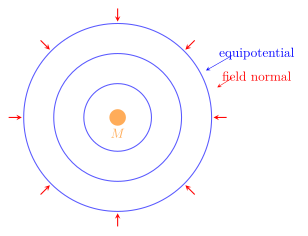
力和场由势的负梯度给出:
\[\mathbf g=-\boldsymbol\nabla\Phi, \qquad \mathbf F=-\boldsymbol\nabla U.\]
\(\Phi\) 是源场的性质,单位 \(\mathrm{J/kg}=\mathrm{m^2/s^2}\);\(U\) 属于所选相互作用系统,并随测试质量改变。零点可平移,但势差和场不变。
4.2 Potential of a uniform sphere
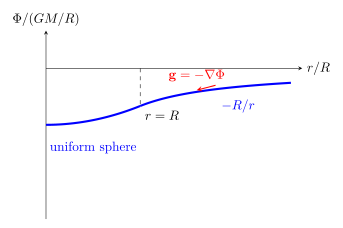
球外势仍为 \(-GM/r\)。球内还要加上所有外层球壳的常量势贡献:
\[\Phi(r)= \begin{cases} -\dfrac{GM}{2R^3}\left(3R^2-r^2\right), & 0\le r\le R,\\[6pt] -\dfrac{GM}{r}, & r\ge R. \end{cases}\]
注意:薄球壳内部 \(\mathbf g=\mathbf0\) 只说明 \(\Phi\) 为常数,不说明 \(\Phi=0\)。均匀球的 \(\Phi\) 与 \(d\Phi/dr\) 在表面都连续。
4.3 Worked Example 4 — lifting from the center of a uniform sphere
已知。 质量 \(m=2.00\ \mathrm{kg}\) 的小物体从理想均匀地球中心缓慢移到表面;\(GM_\oplus/R_\oplus=6.257\times10^7\ \mathrm{J/kg}\)。
研究对象、系统与参考系。 研究对象为小物体,势能属于地球—物体系统;取地心惯性系。外力准静态搬运,使初末动能均可忽略。
坐标与正方向。 径向向外为正,路径由 \(r=0\) 到 \(r=R_\oplus\),故外力所做功应为正。
模型及理由。 地球视为静止、均匀、球对称体;均匀球内势公式包含外层球壳的常量势贡献。
方程与计算。 准静态过程满足 \(W_{\rm ext,min}=\Delta U\):
\[\Delta U=m\left[\Phi(R_\oplus)-\Phi(0)\right] =m\frac{GM_\oplus}{2R_\oplus}.\]
代入得
\[\Delta U =(2.00\ \mathrm{kg})\frac{6.257\times10^7\ \mathrm{J/kg}}{2} =6.26\times10^7\ \mathrm J.\]
SI、有效数字与检查。 \((\mathrm{kg})(\mathrm{J/kg})=\mathrm J\),结果按 \(m\) 取三位有效数字。\(\Phi(R)>\Phi(0)\),所以 \(\Delta U>0\);若 \(m\to0\),所需功线性趋零。
物理解释。 外壳在球内虽不产生净场,却贡献负的常量势;若错误地只用包围质量计算势,会漏掉搬运过程的一部分能量账。
Knowledge 5 — Escape speed / 逃逸速度
Knowledge ID: P01-U07-L01-K05
5.1 Energy threshold
从半径 \(r_0\) 以速率 \(v_0\) 发射,机械能为
\[E=\frac12mv_0^2-\frac{GMm}{r_0}.\]
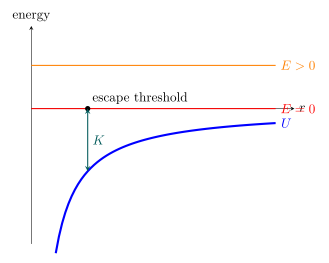
最低逃逸条件是在 \(r\to\infty\) 时 \(v\to0\),故 \(E=0\):
\[v_{\mathrm{esc}}(r_0)=\sqrt{\frac{2GM}{r_0}}.\]
若希望无穷远仍有速率 \(v_\infty\),则
\[v_0^2=v_\infty^2+\frac{2GM}{r_0}.\]
该结果与小物体质量无关,但不是“任何现实发射都只需这个速度”。它假设:源为静止球对称体或可视为点质量;只有保守引力;无大气阻力;发射后不再推进;忽略自转和其他天体;Newtonian 近似有效。若从旋转赤道顺行发射,地面已有惯性系切向速度,所需火箭增量会改变。
圆轨道速率 \(v_c=\sqrt{GM/r}\),因此同一半径
\[v_{\mathrm{esc}}=\sqrt2\,v_c.\]
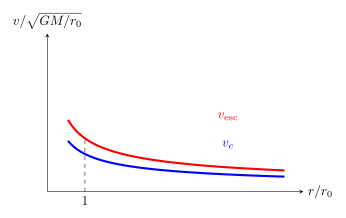
5.2 Worked Example 5 — escape from Earth's surface
已知。 \(M_\oplus=5.9722\times10^{24}\ \mathrm{kg}\)、\(R_\oplus=6.371\times10^6\ \mathrm m\),从地表发射一质量可忽略物体。
研究对象、系统与参考系。 研究对象为发射物,系统为地球—发射物;在地心惯性系中比较地表与无穷远的机械能。
坐标与正方向。 径向向外为正;为避免先撞击地球,取初速度具有向外分量。阈值速率本身在球对称模型中只依赖大小。
模型及理由。 地球外场按球对称点质量处理,忽略大气、自转、其他天体与后续推进,因此机械能守恒;临界逃逸在无穷远满足 \(v_\infty=0\)。
方程与计算。 由
\[\frac12mv_{\rm esc}^2-\frac{GM_\oplus m}{R_\oplus}=0\]
得到
\[v_{\mathrm{esc}} =\sqrt{\frac{2GM_\oplus}{R_\oplus}} =\sqrt{ \frac{2(6.67430\times10^{-11}\ \mathrm{m^3\,kg^{-1}\,s^{-2}}) (5.9722\times10^{24}\ \mathrm{kg})} {6.371\times10^6\ \mathrm m}} =1.1186\times10^4\ \mathrm{m/s} =11.2\ \mathrm{km/s}.\]
SI、有效数字与检查。 \(GM/R\) 的量纲是 \(\mathrm{m^2/s^2}\),开方得到速率;结果取三位有效数字。对应圆轨道速率为 \(7.91\ \mathrm{km/s}\),且 \(v_{\rm esc}/v_c=\sqrt2\),与解析关系一致;若 \(R\) 增大,阈值按 \(R^{-1/2}\) 降低。
物理解释。 \(11.2\ \mathrm{km/s}\) 是地心惯性系中的瞬时初速阈值,不等同于包含重力损失、阻力和火箭方程的实际发射 \(\Delta v\)。
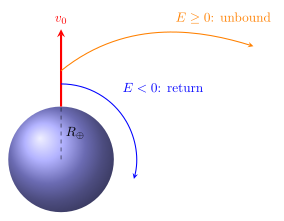
6. Lesson synthesis / 全课整合
6.1 From mass model to motion
- 选择源质量模型:点质量、球对称体或一般密度分布。
- 对一般分布用矢量积分;有严格球对称时才使用壳层定理。
- 若需要局部加速度,求 \(\mathbf g\);若连接两个位置或判断束缚,优先求 \(\Phi\) 与能量。
- 球内场用包围质量,球内势还必须计入外层壳的常量贡献。
- 写明零势能面、参考系、非引力功和边界条件。
- 用方向、单位、\(r\to0\)、\(r\to\infty\)、表面连续性及数量级审核。
6.2 Formula and decision table
| Task | Equation | Conditions |
|---|---|---|
| Point-mass pair force | \(\mathbf F=-Gm_1m_2\mathbf r/r^3\) | bodies pointlike or exterior spherical |
| Discrete superposition | \(\mathbf g=\sum_i\mathbf g_i\) | Newtonian linear field |
| Continuous distribution | \(\mathbf g=-G\int\rho(\mathbf r') (\mathbf r-\mathbf r')/\lvert\mathbf r-\mathbf r'\rvert^3\,d^3r'\) | prescribed density |
| Spherical field | \(\mathbf g=-GM(r)\hat{\mathbf r}/r^2\) | exact spherical symmetry |
| Point/spherical exterior potential | \(\Phi=-GM/r\) | isolated finite source, exterior |
| Field from potential | \(\mathbf g=-\boldsymbol\nabla\Phi\) | differentiable region |
| Escape threshold | \(v_{\rm esc}=\sqrt{2GM/r}\) | isolated spherical source, no losses |
6.3 Model boundaries
- 非球形天体需要多极展开或数值积分;“距中心相同”一般不保证场相同。
- 靠近强引力天体、速度接近光速、需要光线弯曲或引力波时应使用广义相对论。
- 星系尺度若只使用可见物质,Newtonian 计算可能与观测不符;这不是随意修改 \(G\) 的许可,而是模型与物质成分需另行检验。
- 无限均匀宇宙不能直接沿用 \(\Phi(\infty)=0\);该边界条件只适合孤立有限源。
- \(g\approx9.81\ \mathrm{m/s^2}\) 是地表附近局部近似,不是全空间常量。
7. Misconception clinic / 易错概念诊所
| Misconception | Correction |
|---|---|
| “质量大的物体下落加速度更大。” | 在相同外场且忽略阻力时,\(\mathbf a=\mathbf g\) 与测试质量无关。 |
| “作用—反作用互相抵消,所以物体不动。” | 它们作用在不同物体;只在把两物体选为一个系统时成为内力。 |
| “球壳内部没有引力,所以势为零。” | 场为零意味着势为常数;若取无穷远为零,该常数通常为负。 |
| “球内也可把全部质量放在中心。” | 球内场只由 \(M(r)\) 决定;外层球壳场相消。 |
| “所有近似球形物体都严格服从壳层定理。” | 定理要求严格球对称;扁率、山脉和密度异常会产生修正。 |
| “势能是物体本身储存的量。” | 引力势能属于所选相互作用系统,零点也需声明。 |
| “逃逸速度要求始终竖直发射。” | 在理想球对称场中阈值只取决于初始速率;方向影响轨迹与是否撞击天体。 |
| “到达逃逸速度后引力消失。” | 引力始终存在;只是总能量不再为负。 |
8. Practice and retrieval / 练习与检索
A. Conceptual questions
- 两个质量相差一千倍的物体相互吸引,谁受力更大?谁的加速度更大?
- 为什么不能把两个不同方向引力的大小直接相加?
- 薄球壳内部的场和势分别有什么特点?
- 为什么均匀实心球内部 \(g(r)\) 随 \(r\) 增大,而外部随 \(r\) 减小?
- 在轨道高度仍有很强引力,宇航员为何可呈现失重?
B. Quantitative and derivation questions
- 距点质量的距离加倍,场强与势的大小各变为多少?
- 证明均匀球内 \(g(r)=GM r/R^3\)。
- 在地表上方高度 \(h=R_\oplus\) 处求 \(g/g_s\) 与逃逸速度相对地表值的比。
- 质量 \(500\ \mathrm{kg}\) 的探测器从 \(r=2R_\oplus\) 缓慢移到 \(3R_\oplus\),求地球—探测器势能变化。
- 从 \(\Phi=-GM/r\) 验证径向场 \(\mathbf g=-GM\hat{\mathbf r}/r^2\)。
- 一颗球对称行星的表面重力与地球相同、半径为 \(2R_\oplus\)。求其质量与逃逸速度相对地球的比。
- 发射体在半径 \(r_0\) 处速度为 \(1.10v_{\rm esc}\),求其无穷远速率,以 \(v_{\rm esc}\) 表示。
Answers / 参考答案
1. 两力大小相等;质量较小者加速度较大,比例与质量成反比。
2. 力是矢量,必须按分量或平行四边形相加。
3. \(\mathbf g=\mathbf0\);\(\Phi\) 在壳内为空间常数,但取无穷远为零时通常不为零。
4. 球内 \(M(r)\propto r^3\),所以 \(g=GM(r)/r^2\propto r\);球外 \(M\) 固定,故 \(g\propto r^{-2}\)。
5. 人与飞船共同自由落体,支持力近零;失重不等于局部引力场为零。
6. \(g\) 变为 \(1/4\),\(\lvert\Phi\rvert\) 变为 \(1/2\)。
7. \(\rho=3M/(4\pi R^3)\),故 \(M(r)=4\pi\rho r^3/3=M(r/R)^3\),代入 \(g=GM(r)/r^2\)。
8. \(r=2R_\oplus\),所以 \(g/g_s=1/4\),\(v_{\rm esc}/v_{\rm esc,s}=1/\sqrt2\)。
9.
\[\Delta U=GM_\oplus m\left(\frac{1}{2R_\oplus}-\frac{1}{3R_\oplus}\right)
=\frac{GM_\oplus m}{6R_\oplus}
\approx5.21\times10^9\ \mathrm J.\]
10. \(d\Phi/dr=GM/r^2\),故 \(\mathbf g=-(d\Phi/dr)\hat{\mathbf r}\)。
11. 由 \(g=GM/R^2\) 得 \(M/M_\oplus=4\);\(v_{\rm esc}=\sqrt{2gR}\),故速率比为 \(\sqrt2\)。
12.
\[v_\infty^2=v_0^2-v_{\rm esc}^2=(1.10^2-1)v_{\rm esc}^2,\]
因而 \(v_\infty=0.458v_{\rm esc}\)。
Exit ticket
不查公式,画出均匀实心球的 \(g(r)\) 与 \(\Phi(r)\),标出中心、表面和无穷远;用一句话解释为什么球内计算场时可忽略外层壳,而计算势时不能忽略。
9. References and source notes / 参考资料与使用说明
9.1 Source-to-content map
| Source | Used for | Knowledge ID / Section | Model boundary or convention |
|---|---|---|---|
| OpenStax, University Physics Volume 1, §13.1 Newton's Law of Universal Gravitation | 成对定律、延展体、叠加与壳层定理 | K01–K03 | 点质量;壳层结论要求球对称 |
| OpenStax, §13.2 Gravitation Near Earth's Surface | 高度依赖、球形地球近似与局部 \(g\) | K01, K03 | 区分中心距与离地高度;局部匀强场只属近似 |
| OpenStax, §13.3 Gravitational Potential Energy and Total Energy | 势能符号、参考零点与逃逸阈值 | K04, K05 | 孤立保守系统;本文取 \(\Phi(\infty)=0\) |
| MIT OpenCourseWare 8.01SC, Lesson 5 videos: Gravity | 方向、叠加流程与本科层级交叉核验 | K01, K02 | Newtonian 惯性系与经典低速范围 |
| NIST, 2022 CODATA wallet card | \(G\) 的数值、单位与测量不确定度 | conventions, examples | \(G\) 是实验测量量,不是精确定义常数 |
| NASA GRACE-FO, What is Gravity? | 场的物理解释与轨道自由落体 | K02, K05 | “微重力”不等于局部引力为零 |
9.2 Bibliographic and modeling notes
OpenStax §§13.1–13.3 form the introductory derivation spine. MIT 8.01SC provides an independent calculus-based mechanics cross-check; NIST supplies the measured constant; NASA supplies the orbital free-fall interpretation. All prose, examples, tables and figures here are newly synthesized rather than copied.