
Learning objectives / 学习目标
- 把 Fermat principle 精确写成 stationary optical path,而非无条件的 shortest path。
- 对平面镜与平面折射界面构造 optical-path function,并由一阶导数导出 reflection law 与 Snell law。
- 从 Helmholtz equation 的 high-frequency ansatz 得到 eikonal equation,并连接 ray tangent 与 phase gradient。
- 从变分形式推出 \(d(n\hat{\mathbf t})/ds=\nabla n\),判断光线向高折射率区域弯曲的方向。
- 说明 ray reversibility 的成立条件,并识别非互易或时变系统的例外。
Prerequisites / 先修知识
- Models of Light:\(\mathcal L=\int n\,ds\) 与 \(\phi=k_0\mathcal L\)。
- 微分、stationary point、Euler–Lagrange equation 的基本概念。
- 平面波相位、wavefront normal 与 Snell law。
Scope and conventions / 范围与约定
- 介质先假设 linear、stationary、isotropic、local,折射率 \(n(\mathbf r)>0\) 为实数。
- 路径参数 \(s\) 是几何弧长,单位切向量 \(\hat{\mathbf t}=d\mathbf r/ds\)。
- 入射角、反射角、折射角都相对界面法线测量,范围取 \(0\le\theta<\pi/2\)。
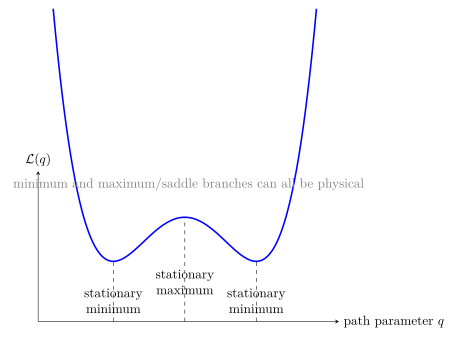
- “stationary”意为任意端点固定的小路径变分使一阶变化 \(\delta\mathcal L\) 为零;可以是 minimum、maximum 或 saddle。
- Ray approximation 需要 \(n\) 与振幅在一个波长尺度上缓慢变化;sharp interface 作为分段光滑极限单独处理。
Notation and modeling contract / 符号与建模契约
| Symbol | Meaning | SI unit |
|---|---|---|
| \(C\) | candidate path between fixed endpoints | — |
| \(\mathcal L[C]=\int_C n\,ds\) | optical-path functional | m |
| \(T[C]=\mathcal L[C]/c\) | travel-time functional for phase index | s |
| \(S(\mathbf r)\) | eikonal, with phase \(k_0S\) | m |
| \(\hat{\mathbf t}=d\mathbf r/ds\) | unit ray tangent | 1 |
| \(k_0=\omega/c\) | vacuum wavenumber | \(\mathrm{rad\,m^{-1}}\) |
| \(\theta_i,\theta_r,\theta_t\) | incidence, reflection, transmission angles | rad or degree |
Knowledge 1 — Stationary optical path / 光程平稳原理
Knowledge ID: P05-U01-L02-K01
在固定起点 \(A\) 与终点 \(B\) 之间,给每条候选曲线 \(C\) 定义
\[\mathcal L[C]=\int_C n(\mathbf r)\,ds, \qquad T[C]=\frac{1}{c}\mathcal L[C].\]
费马原理的准确形式是
\[\boxed{\delta\mathcal L[C]=0}\]
对实际 ray 成立。若把实际路径做端点固定的小扰动 \(C\to C+\delta C\),一阶 optical-path change 消失,只剩二阶或更高阶变化。因而邻近路径的 phase \(k_0\mathcal L\) 变化较慢,波幅在高频极限中能相干累积;非平稳路径的相位快速转动并相互抵消。
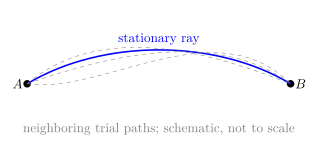
“平稳”比“最短”更一般。单个平面界面的直接折射常对应 minimum;成像系统中也可能存在 local maximum 或 saddle,且同一对端点可能由多条 stationary rays 相连。若只搜索全局最短路径,会丢掉 secondary images、multiple reflections 与 caustic branches。
在均匀介质中 \(n\) 为常数,stationary length 是两点间直线。这既可由三角不等式理解,也可由一般 ray equation 在 \(\nabla n=0\) 时得到 \(d\hat{\mathbf t}/ds=0\)。
对任意参数 \(u\) 写 \(ds=\lvert\mathbf r'(u)\rvert du\),functional 为
\[\mathcal L=\int n(\mathbf r)\lvert\mathbf r'\rvert\,du.\]
Euler–Lagrange equation 化为
\[\boxed{\frac{d}{ds}\left(n\hat{\mathbf t}\right)=\nabla n}.\]
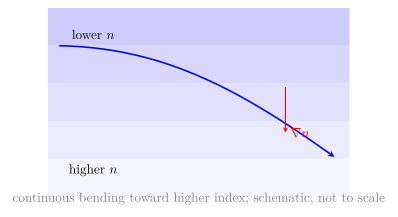
将其分解到法向可见:只有 \(\nabla n\) 垂直于 ray 的分量改变方向,光线向更高 \(n\) 的区域弯曲。
Knowledge 2 — Reflection and refraction from Fermat's principle / 由费马原理导出反射与折射
Knowledge ID: P05-U01-L02-K02
Reflection / 反射
令点 \(A=(0,a)\)、\(B=(D,b)\) 位于平面镜 \(y=0\) 同侧,反射点 \(P=(x,0)\)。介质均匀,故除去共同因子 \(n\) 后候选路径长度为
\[\ell(x)=\sqrt{x^2+a^2}+\sqrt{(D-x)^2+b^2}.\]
stationary condition 给
\[\frac{d\ell}{dx} =\frac{x}{\sqrt{x^2+a^2}} -\frac{D-x}{\sqrt{(D-x)^2+b^2}} =0.\]
两项分别是 \(\sin\theta_i\) 与 \(\sin\theta_r\),且角度均在第一象限,因此
\[\boxed{\theta_i=\theta_r}.\]
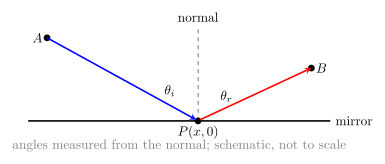
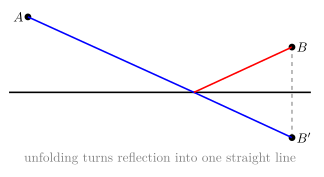
等价几何法是把 \(B\) 关于镜面反射为 \(B'\);任意 broken path \(A\to P\to B\) 与直线路径 \(A\to P\to B'\) 等长。最短直线与镜面交点就是反射点。这一构造适用于平面镜,但变分法可推广到曲面。
Refraction / 折射
令界面上方折射率 \(n_1\)、下方 \(n_2\);\(A=(0,a)\)、\(B=(D,-b)\),穿越点仍为 \(P=(x,0)\)。光程函数为
\[\mathcal L(x)=n_1\sqrt{x^2+a^2}+n_2\sqrt{(D-x)^2+b^2}.\]
对 \(x\) 求导并令零:
\[n_1\frac{x}{\sqrt{x^2+a^2}} =n_2\frac{D-x}{\sqrt{(D-x)^2+b^2}},\]
即
\[\boxed{n_1\sin\theta_1=n_2\sin\theta_2}.\]
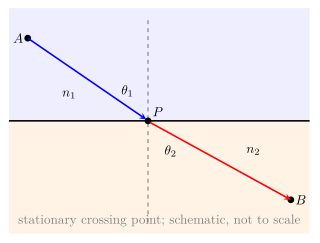
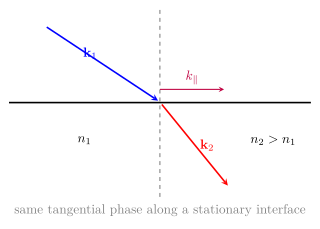
Snell law 不是说光“偏爱短距离”;进入较慢的高 \(n\) 区域时,路径会以牺牲一部分几何距离来减少在慢区的行程。界面平移对称性也可解释为 tangential wavevector conservation:
\[k_1\sin\theta_1=k_2\sin\theta_2, \qquad k_j=n_jk_0.\]
Knowledge 3 — Ray approximation and eikonal viewpoint / 光线近似与程函观点
Knowledge ID: P05-U01-L02-K03
考虑 scalar Helmholtz equation
\[\nabla^2U+k_0^2n^2(\mathbf r)U=0.\]
令场分成缓变 amplitude 与快变 phase:
\[U(\mathbf r)=A(\mathbf r)e^{ik_0S(\mathbf r)}.\]
代回并按 \(k_0\) 次数排序。最高的 \(k_0^2\) 项给
\[\boxed{\lvert\nabla S\rvert^2=n^2(\mathbf r)},\]
这就是 eikonal equation。\(S=\mathrm{constant}\) 是 wavefront,\(\nabla S\) 垂直 wavefront;单位 ray tangent 为
\[\hat{\mathbf t}=\frac{\nabla S}{n}.\]
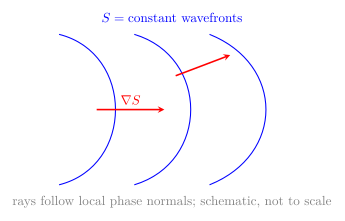
下一阶项给 amplitude transport,而不是 ray path;因此 eikonal alone 无法在 caustic 给有限强度。近似要求
\[\frac{\lvert\nabla A\rvert}{k_0n\lvert A\rvert}\ll1, \qquad \frac{\lvert\nabla n\rvert}{k_0n^2}\ll1.\]
由 eikonal characteristics 或变分法都得到
\[\frac{d}{ds}(n\hat{\mathbf t})=\nabla n.\]
例如 \(n\) 随高度 \(y\) 增大而减小,\(\nabla n\) 向下,近水平 ray 就向下弯;mirage 与 gradient-index lens 都是这一机制,而不是界面上的一次折转。
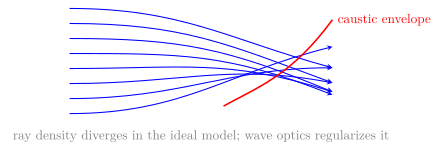
多条 characteristic 可能交叉,形成 caustic。几何光学把有限能量压到零宽区域而预测发散;真实波场以 Airy-like diffraction structure 平滑它。
Knowledge 4 — Reversibility of optical paths / 光路可逆性
Knowledge ID: P05-U01-L02-K04
若 \(n(\mathbf r)\) 是静态标量且材料 reciprocal,同一几何曲线反向积分有
\[\int_A^B n\,ds=\int_B^A n\,ds.\]
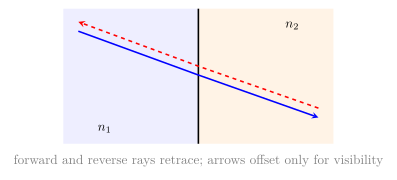
因此从 \(A\) 到 \(B\) 的 stationary path 反向仍为从 \(B\) 到 \(A\) 的 stationary path;反射定律与 Snell law 在交换入射、出射方向后形式不变。reversibility 是几何路径陈述,不保证任意实际装置的反向功率相同;aperture clipping、gain/loss distribution 与 detector/source coupling 仍会改变通量。
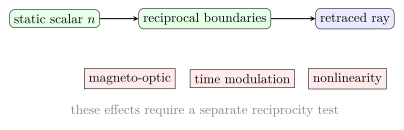
可逆性的模型边界包括:
- magneto-optic Faraday rotation 由外加磁场破坏 time-reversal symmetry;
- time-modulated index 可在正反向给不同频率/路径;
- nonlinear medium 的 \(n\) 依赖强度,反向注入不一定重现原场分布;
- moving media 与 active nonreciprocal elements 需用更完整的 reciprocity analysis。
Worked Examples / 完整例题
Worked Example 1 — 平面镜反射点
点 \(A=(0,2.00\,\mathrm m)\) 与 \(B=(6.00\,\mathrm m,1.00\,\mathrm m)\) 位于镜面 \(y=0\) 上方。求 stationary reflection point、总路程与入射角。
研究对象: 从 \(A\) 经镜面一次反射到 \(B\) 的光线。
参考系/系统: 镜面静止的二维实验室坐标系;角度相对 \(+y\) 法线。
模型: 均匀介质、理想平面镜、ray approximation。
方程与计算: 将 \(B\) 映射为 \(B'=(6.00,-1.00)\,\mathrm m\)。直线 \(AB'\) 从 \(y=2.00\) 降到 \(-1.00\),在下降 \(2/3\) 时穿过 \(y=0\):
\[x_P=\frac{2}{3}(6.00\,\mathrm m)=4.00\,\mathrm m.\]
\[\ell=\sqrt{(4.00)^2+(2.00)^2}+\sqrt{(2.00)^2+(1.00)^2} =6.71\,\mathrm m.\]
\[\theta_i=\tan^{-1}\left(\frac{4.00}{2.00}\right)=63.4^\circ, \qquad \theta_r=\tan^{-1}\left(\frac{2.00}{1.00}\right)=63.4^\circ.\]
检查: 两角相等且方向分别指向/离开镜面;展开后的距离 \(\sqrt{6.00^2+3.00^2}=6.71\,\mathrm m\) 相符;长度量纲与三位有效数字正确。
Worked Example 2 — 数值求折射界面穿越点
\(A=(0,1.00\,\mathrm m)\) 位于 \(n_1=1.00\) 区域,\(B=(1.20\,\mathrm m,-1.50\,\mathrm m)\) 位于 \(n_2=1.50\) 区域,界面为 \(y=0\)。求穿越点 \(P=(x,0)\) 与两角。
研究对象: 跨越一个平面介质界面的 stationary ray。
参考系/系统: 界面静止,\(x\) 沿界面,\(y\) 为法向。
模型: 分段均匀、各向同性、无损;忽略界面厚度。
方程与计算: 解
\[\frac{x}{\sqrt{x^2+1.00^2}} =1.50\frac{1.20-x}{\sqrt{(1.20-x)^2+1.50^2}}.\]
数值根为
\[x=0.630\,\mathrm m.\]
因此
\[\theta_1=\tan^{-1}\left(\frac{0.630}{1.00}\right)=32.2^\circ,\]
\[\theta_2=\tan^{-1}\left(\frac{1.20-0.630}{1.50}\right)=20.8^\circ.\]
检验 Snell law:
\[n_1\sin\theta_1=0.533, \qquad n_2\sin\theta_2=0.533.\]
检查: 进入较高 \(n\) 后向法线弯,故 \(\theta_2<\theta_1\);两侧无量纲 Snell quantities 相等;\(0<x<1.20\,\mathrm m\),几何位置有效。
Worked Example 3 — 线性渐变折射率中的小角弯曲
介质折射率为 \(n(y)=1.500-(2.00\times10^{-2}\,\mathrm{m^{-1}})y\)。一条 ray 从 \(y=0\) 水平沿 \(+x\) 发射,求传播 \(x=2.00\,\mathrm m\) 后的小角近似偏移和方向。
研究对象: 平滑 GRIN 介质中的单条近水平 ray。
参考系/系统: 介质静止,\(+y\) 向上。
模型: \(\lvert dy/dx\rvert\ll1\),把 \(n\) 在起点附近取 \(n_0=1.500\);忽略 amplitude transport。
方程与计算: ray equation 的法向分量给
\[\frac{d^2y}{dx^2}\approx\frac{1}{n_0}\frac{dn}{dy} =-1.33\times10^{-2}\,\mathrm{m^{-1}}.\]
初始 \(y(0)=0\)、\(y'(0)=0\),故
\[y(2.00)\approx\frac12\frac{d^2y}{dx^2}x^2 =-2.67\times10^{-2}\,\mathrm m.\]
\[\theta\approx y'(x)=\frac{d^2y}{dx^2}x =-2.67\times10^{-2}\,\mathrm{rad}=-1.53^\circ.\]
检查: \(dn/dy<0\) 表示较高 \(n\) 在下方,偏移为负正好向高 \(n\) 弯;curvature 单位 \(\mathrm{m^{-1}}\);\(\lvert\theta\rvert\ll1\) 支持小角近似。
Worked Example 4 — 用 Snell law 验证光路可逆
光从水 \(n_w=1.333\) 以 \(40.0^\circ\) 入射到空气 \(n_a=1.000\)。求空气角;再从空气沿相反方向入射,验证返回水中的角度。
研究对象: 同一平面界面的正、反两条 ray。
参考系/系统: 界面静止;角度均对同一法线取锐角。
模型: reciprocal、各向同性、无损介质;角度低于全反射临界条件。
方程与计算:
\[\sin\theta_a=\frac{n_w}{n_a}\sin40.0^\circ=0.857,\]
\[\theta_a=59.0^\circ.\]
反向时
\[\sin\theta'_w=\frac{n_a}{n_w}\sin59.0^\circ=0.643, \qquad \theta'_w=40.0^\circ.\]
检查: 正反 Snell quantities 相同;方向箭头反转但几何线重合;\(40.0^\circ<\sin^{-1}(1/1.333)=48.6^\circ\),正向确有透射 ray。
Lesson synthesis / 本课综合
Fermat principle 把几何光学压缩为一个变分陈述:固定端点的实际 ray 使 \(\int n\,ds\) 一阶平稳。对离散界面,它给 reflection 与 Snell law;对平滑 \(n(\mathbf r)\),它给 \(d(n\hat{\mathbf t})/ds=\nabla n\)。从 wave equation 的高频展开又得到 \(\lvert\nabla S\rvert=n\),说明 stationary ray 是 phase front 的 characteristic。静态 reciprocal 系统中 functional 反向不变,于是路径可逆;caustic、sharp structure、非互易与强波动效应则标出模型边界。
Formula-and-decision table / 公式与决策表
| Need | Formula | Conditions | Main caution |
|---|---|---|---|
| stationary path | \(\delta\int n\,ds=0\) | fixed endpoints, ray approximation | stationary need not be globally shortest |
| ray in smooth \(n\) | \(d(n\hat{\mathbf t})/ds=\nabla n\) | isotropic differentiable index | sharp interfaces need matching |
| reflection | \(\theta_i=\theta_r\) | ideal stationary interface | angles are from the normal |
| refraction | \(n_1\sin\theta_1=n_2\sin\theta_2\) | isotropic interface | transmitted ray may not exist under TIR |
| eikonal | \(\lvert\nabla S\rvert^2=n^2\) | high-frequency, slowly varying amplitude/index | does not set finite caustic intensity |
| ray direction | \(\hat{\mathbf t}=\nabla S/n\) | positive scalar \(n\) | phase convention fixes propagation sign |
| reversibility | \(\mathcal L_{A\to B}=\mathcal L_{B\to A}\) | static reciprocal scalar medium | nonreciprocal/time-varying systems can fail |
Model boundaries / 模型边界
- Fermat functional with scalar \(n\) omits anisotropy; crystals require direction-dependent phase surfaces.
- Stationary phase does not choose amplitudes; transport equation, boundary coefficients and diffraction are still needed.
- Geometrical intensity diverges at ideal caustics; wave optics supplies a finite pattern.
- At discontinuous \(n\), smooth ray equation is replaced by phase matching/Snell law.
- Absorbing media have complex \(n\); path phase and attenuation may require complex eikonal methods.
- Reversibility requires reciprocity and a stationary system; Faraday rotators, moving/time-modulated media and nonlinear state dependence are exceptions.
Misconception clinic / 误区诊所
- “费马原理就是光永远走最短几何距离。” 它平稳的是 optical path,且 stationary point 不一定是 minimum。
- “光先试遍所有路径,再决定最快一条。” 这是拟人化;高频 wave amplitude 的 stationary-phase limit 才是物理桥梁。
- “进入高折射率介质时总是少走几何路。” 真正被平稳的是 \(n\,ds\) 的积分,结果由端点几何共同决定。
- “eikonal 方程能给完整强度。” 它主要给 phase 与 ray;amplitude 需下一阶 transport equation。
- “光路可逆说明任何器件正反透射功率相同。” 它首先是几何路径结论;通光孔径、损耗、增益与耦合仍需另算。
Practice and retrieval / 练习与提取
- K01 概念: stationary optical path 与 minimum optical path 有何差别?
Answer
stationary 只要求所有端点固定的一阶变分为零;它可以是局部极小、极大或 saddle,而 minimum 只是其中一种。
- K01 均匀介质: 为什么均匀介质中的 ray 是直线?
Answer
\(\nabla n=0\) 时 \(d(n\hat{\mathbf t})/ds=0\);常数 \(n\) 于是给 \(d\hat{\mathbf t}/ds=0\),方向不变。
- K02 反射: 点 \(A,B\) 距平面镜同高且水平相距 \(D\),反射点在哪里?
Answer
对称性或镜像展开都给反射点在两点水平坐标的中点;此时两段角度相等。
- K02 计算: 光从 \(n_1=1.00\) 以 \(30.0^\circ\) 入射到 \(n_2=1.50\),求折射角。
Answer
\[\theta_2=\sin^{-1}\left(\frac{1.00}{1.50}\sin30.0^\circ\right)=19.5^\circ.\]
- K02 方向: \(n_2>n_1\) 时,为什么 ray 向法线弯?
Answer
Snell law 给 \(\sin\theta_2=(n_1/n_2)\sin\theta_1<\sin\theta_1\),在锐角范围内故 \(\theta_2<\theta_1\)。
- K03 推导: 写出 eikonal ansatz 与最高阶方程。
Answer
\[U=Ae^{ik_0S}, \qquad \lvert\nabla S\rvert^2=n^2.\]
- K03 判断: 为什么 sharp aperture edge 附近不能只用 eikonal rays?
Answer
edge 使 amplitude/边界在波长尺度急变,违反缓变条件并产生 diffraction;ray model 会漏掉阴影区波场。
- K03 方向: 若 \(dn/dy>0\),一条近水平 ray 初始将向哪边弯?
Answer
向 \(+y\),因为 ray equation 的法向驱动与 \(\nabla n\) 同向,即向较高折射率区域弯。
- K04 可逆: 空气到玻璃的折射 ray 反向后为什么能回到原入射线?
Answer
Snell law 在交换两介质与两角后形式不变,静态标量 optical-path integral 也与积分方向无关。
- 综合边界: Faraday rotator 中能否直接用本课的几何可逆性?
Answer
不能直接用。外磁场使介质非互易,反向传播的偏振演化不简单撤销正向变化,必须用磁光本构与 reciprocity analysis。
Exit ticket / 离堂检核
- 从一个界面穿越点 \(x\) 的 optical-path function 出发,逐行推导 Snell law,并解释每个正弦的几何来源。
- 说明 \(\delta\int n\,ds=0\)、\(\lvert\nabla S\rvert=n\) 与 \(d(n\hat{\mathbf t})/ds=\nabla n\) 三者分别属于哪种视角、如何描述同一 ray。
References and source notes / 参考资料与来源说明
Source-to-content map
| Source | Used for | Knowledge ID / section | Model boundary or convention |
|---|---|---|---|
| MIT OCW 2.71 Lecture 2 | Fermat functional, reflection/refraction | K01–K02 | geometrical optics; wavelength small versus features |
| MIT OCW 18.325 Chapter 2 | eikonal characteristics, multipathing, caustics | K03 | high-frequency asymptotics; multiple travel-time branches |
| MIT Mathematics 18.300 Lecture 24 | stationary travel time and ray equation | K01, K03 | explicitly distinguishes extrema from minima |
| Open Yale PHYS 201 Lecture 16 | short-wavelength interpretation and unified derivations | K01–K03 | undergraduate geometrical-optics approximation |
| Caltech Feynman Lectures I.26 | least-time intuition, Snell construction, reciprocity | K01–K02, K04 | isotropic reciprocal propagation; intuition refined here to stationary path |
资料和链接实际核对日期:2026-08-28。例题与练习为原创并独立复算;TikZ 为基于方程的原创示意图,未按比例者均已标注。
复习与拓展
- Radiometry and Photometry:ray bundle 的功率与 phase-space measure。
- Reflection and Refraction:加入 Fresnel amplitude、total internal reflection 与 apparent depth。
- Lenses and Optical Systems:stationary optical path 导出成像与 ABCD systems。
- Imaging Quality and Aberrations:不同 stationary rays 的 optical-path error 形成像差。
- Resolution and Fourier Optics:在 ray approximation 失效处恢复完整波动传播。