
Learning objectives / 学习目标
- 从界面切向相位匹配或光程平稳性推出反射定律与 Snell 定律。
- 以“相对法线的角”为唯一角度定义,判断折向法线或离开法线。
- 推导全反射的两个必要条件,并解释临界角处与临界角以上的界面场。
- 用 \(n(\lambda)\) 分析棱镜偏折、最小偏向与光谱次序。
- 从近轴几何推导视深,并识别平行平板造成的横向位移与模型边界。
Prerequisites / 先修知识
- Models of Light 中的 ray approximation。
- Fermat's Principle 中的 optical path length。
- Radiometry and Photometry 中的能流与亮度概念。
- 正弦、反正弦、相似三角形与小角近似。
Scope and conventions / 范围与约定
- 界面局部视为平面;介质均匀、各向同性、静止,折射率取实数 \(n>0\)。
- 所有入射角、反射角、折射角均取光线与界面法线直线的非负最小夹角;传播解满足 \(0^\circ\le\theta\le90^\circ\),不是与界面的夹角。
- 介质 1 是入射侧,介质 2 是透射侧;法线可任选方向,但图和方程必须始终一致。
- 本课只求几何方向;反射与透射的振幅、相位和能量比例需用 Fresnel coefficients。
- 几何光学要求界面变化尺度与光学元件尺寸远大于波长;临界角附近的 evanescent field 不能仅靠光线模型描述。
- 棱镜公式先假定外界为空气、棱镜均匀;视深公式只用于近法线观察。
Notation and modeling contract / 符号与建模契约
| Symbol | Meaning | SI unit |
|---|---|---|
| \(\theta_i,\theta_r,\theta_t\) | incidence, reflection, transmission angles from the normal | rad or degree |
| \(n_1,n_2\) | refractive indices of incident and transmitted media | 1 |
| \(\theta_c\) | critical angle in the higher-index incident medium | rad or degree |
| \(A\) | prism apex angle | rad or degree |
| \(\delta\) | total prism deviation angle | rad or degree |
| \(h\) | true normal depth below a plane interface | m |
| \(h'\) | paraxial apparent depth | m |
| \(t\) | thickness of a plane-parallel slab | m |
Knowledge 1 — Law of reflection / 反射定律
Knowledge ID: P05-U02-L01-K01
直觉:界面不会凭空提供切向“节拍差”
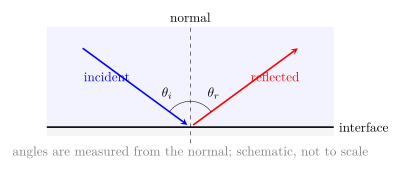
平整、静止的界面对所有切向位置等价。入射波在界面上某处达到波峰时,反射波必须以同一切向相位速率接续,否则边界上相位会在相邻点断裂。令界面切向为 \(x\),则
\[k_{i,x}=k_{r,x}.\]
反射前后仍在同一介质,\(k_i=k_r\),于是
\[k_i\sin\theta_i=k_r\sin\theta_r \quad\Longrightarrow\quad \boxed{\theta_r=\theta_i}.\]
入射线、反射线与法线还必须共面;这就是完整的 law of reflection。
由 Fermat 原理复核
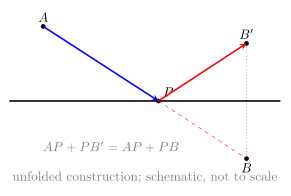
把真实反射路径展开:将像点 \(B'\) 关于镜面反射为 \(B\)。任意反射点 \(P\) 的路径 \(AP+PB'\) 等于直线路径 \(AP+PB\);最短路径是 \(A\) 到 \(B\) 的直线。镜面对称立即给出入射角与反射角相等。这个构造也说明光路可逆。
反射定律只规定方向,不说明“反射多少”。粗糙面仍在每个微小面元上服从局部反射定律,但不同面元的法线不同,宏观上形成 diffuse reflection。
Knowledge 2 — Snell's law / 斯涅尔定律
Knowledge ID: P05-U02-L01-K02
模型:跨界面保持频率与切向波矢
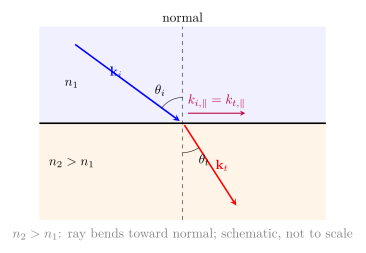
静止界面不改变频率,故 \(\omega_i=\omega_t\)。边界上相位匹配又要求
\[k_i\sin\theta_i=k_t\sin\theta_t.\]
非磁透明介质中 \(k=n\omega/c\),所以
\[\boxed{n_1\sin\theta_i=n_2\sin\theta_t}.\]
若 \(n_2>n_1\),则 \(\theta_t<\theta_i\),折向法线;若 \(n_2<n_1\) 且仍有传播解,则 \(\theta_t>\theta_i\),离开法线。真正保持不变的是 \(n\sin\theta\),不是角度本身。
由光程平稳性推导
两点 \(A=(-a,h_1)\)、\(B=(b,-h_2)\) 之间的路径在界面 \(P=(x,0)\) 折转,其光程为
\[\mathcal L(x)=n_1\sqrt{(x+a)^2+h_1^2} +n_2\sqrt{(b-x)^2+h_2^2}.\]
令 \(d\mathcal L/dx=0\):
\[n_1\frac{x+a}{AP}=n_2\frac{b-x}{PB}.\]
几何上两比值分别为 \(\sin\theta_i\) 与 \(\sin\theta_t\),故得到 Snell 定律。这是“最短时间”的局部平稳形式;复杂系统中驻值不必是全局最小值。
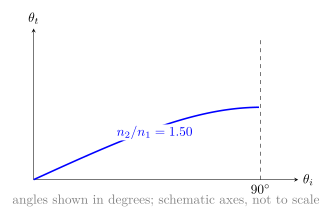
图中的曲线表达 \(\theta_t=\arcsin[(n_1/n_2)\sin\theta_i]\);它不是直线,因此大角度时不能用 \(n_1\theta_i\approx n_2\theta_t\)。
Knowledge 3 — Total internal reflection and critical angle / 全反射与临界角
Knowledge ID: P05-U02-L01-K03
两个必要条件
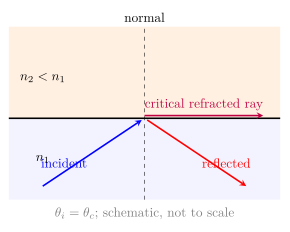
只有光从高折射率介质射向低折射率介质,即 \(n_1>n_2\),折射角才会随入射角增长得更快。令临界状态 \(\theta_t=90^\circ\):
\[n_1\sin\theta_c=n_2, \qquad \boxed{\theta_c=\arcsin\left(\frac{n_2}{n_1}\right)}.\]
因此全反射条件是
\[n_1>n_2 \quad\text{且}\quad \theta_i>\theta_c.\]
在 \(\theta_i=\theta_c\) 时,理想几何光线沿界面传播;在 \(\theta_i>\theta_c\) 时,不存在实数传播角 \(\theta_t\),但低折射率侧仍有指数衰减的 evanescent field。若另一介质在几个衰减长度内靠近,可能发生 frustrated total internal reflection,所以“全反射”不等于“界面另一侧场处处为零”。
受限导光的几何条件
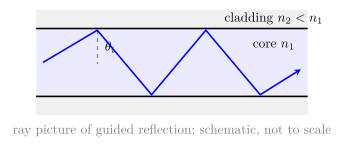
阶跃折射率光纤用高折射率 core 包围在低折射率 cladding 中。芯内光线撞击界面时若满足 \(\theta_i>\theta_c\),即可反复全反射;真实 fiber mode 则是由 Maxwell 方程与边界条件决定的离散模式,不应把锯齿光线当作所有尺度上的真实轨迹。
Knowledge 4 — Dispersion and prism spectra / 色散与棱镜光谱
Knowledge ID: P05-U02-L01-K04
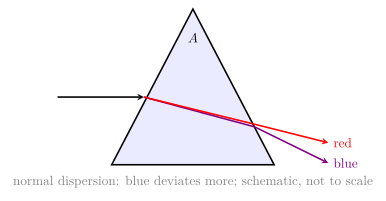
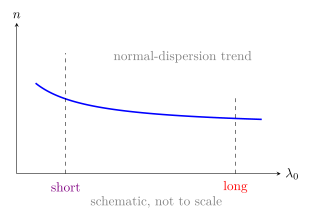
透明材料的折射率一般依赖真空波长:\(n=n(\lambda_0)\)。在多数可见光正常色散区,短波蓝紫光的 \(n\) 大于长波红光,所以蓝紫光偏折更强。
对棱镜顶角 \(A\),两次折射的内部角满足
\[r_1+r_2=A,\]
总偏向角为
\[\delta=i_1+i_2-A.\]
在对称、最小偏向状态,\(i_1=i_2=i\) 且 \(r_1=r_2=A/2\),因此在空气中
\[\boxed{n(\lambda_0)= \frac{\sin[(A+\delta_{\min})/2]}{\sin(A/2)}}.\]
最小偏向不是“偏向最小所以没有色散”;不同波长有不同的 \(n\),因而各自有不同的 \(\delta_{\min}\)。
色散强弱可由 \(dn/d\lambda_0\) 或棱镜的角色散 \(d\delta/d\lambda_0\) 衡量。靠近吸收共振可能出现 anomalous dispersion;此时简单的“蓝光一定折得更多”不再是普适规律。
Knowledge 5 — Apparent depth and plane interfaces / 视深与平面界面
Knowledge ID: P05-U02-L01-K05
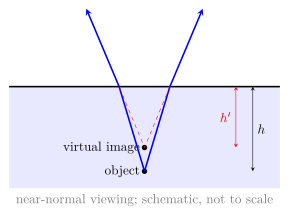
视深是反向延长所得的虚像位置
物点位于介质 1 中,真实法向深度为 \(h\);观察者位于介质 2。出射光线折射后,眼睛按直线反向延长,得到深度 \(h'\) 的虚像。对近法线光线,\(\sin\theta\approx\tan\theta\),同一横向距离 \(x\) 给出
\[\tan\theta_1\approx\frac{x}{h}, \qquad \tan\theta_2\approx\frac{x}{h'}.\]
结合 \(n_1\theta_1\approx n_2\theta_2\):
\[\boxed{h'=\frac{n_2}{n_1}h}.\]
水中物体从空气近法线观察时 \(n_2<n_1\),所以 \(h'<h\)。大视角时,不同出射线的反向延长不严格交于一点,单一“视深”只是近轴近似。
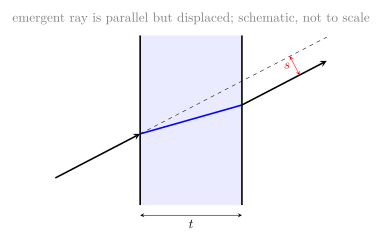
平行平板:方向复原但位置平移
空气中的光穿过厚度 \(t\)、折射角 \(r\) 的平行平板后,出射光与入射光平行,但横向位移为
\[\boxed{s=t\frac{\sin(i-r)}{\cos r}}.\]
原因是第二界面的法线与第一界面平行,Snell 定律使角度恢复;有限厚度却使实际路径与无平板路径错开。
Worked Examples / 完整例题
Worked Example 1 — Air-to-glass refraction
一束光从空气以 \(\theta_i=42.0^\circ\) 入射到 \(n_2=1.520\) 的玻璃,求反射角与折射角。
研究对象: 单色窄光束与局部平面界面。
参考系/系统: 界面静止实验室系;介质 1 为空气 \(n_1=1.000\),介质 2 为玻璃。
坐标与角度: 角度均从界面法线量起。
模型: 均匀、各向同性、透明介质;几何光学。
反射定律直接给出
\[\theta_r=\theta_i=42.0^\circ.\]
Snell 定律给出
\[\sin\theta_t=\frac{n_1}{n_2}\sin42.0^\circ =\frac{1.000}{1.520}(0.6691)=0.4402,\]
\[\boxed{\theta_t=26.1^\circ}.\]
检查: \(n_2>n_1\),结果确实折向法线;角度无量纲。三位有效数字。若 \(n_2\to n_1\),公式给 \(\theta_t\to\theta_i\)。
Worked Example 2 — Glass-to-air total internal reflection
折射率 \(1.500\) 的玻璃向空气界面发出 \(50.0^\circ\) 入射光。判断是否全反射。
研究对象: 玻璃内部的一条几何光线。
参考系/系统: 静止玻璃—空气平面界面。
坐标与角度: \(\theta_i\) 从玻璃侧法线量起。
模型: \(n_1=1.500\)、\(n_2=1.000\),无吸收。
\[\theta_c=\arcsin\left(\frac{1.000}{1.500}\right) =41.8^\circ.\]
因 \(50.0^\circ>41.8^\circ\),故发生 total internal reflection。
\[\boxed{\theta_r=50.0^\circ,\quad\text{无传播折射光线}}.\]
检查: 只有从高 \(n\) 到低 \(n\) 才可能满足条件;把 Snell 定律形式代入会得到 \(\sin\theta_t=1.149>1\),正好表明实角传播解不存在。角度本质上无量纲,结果按三位有效数字报告;界面空气侧仍可有 evanescent field。
Worked Example 3 — Refractive index from minimum prism deviation
空气中一棱镜顶角 \(A=60.0^\circ\),某单色光的最小偏向角 \(\delta_{\min}=40.0^\circ\)。求折射率。
研究对象: 棱镜中的对称最小偏向光路。
参考系/系统: 棱镜静止,外界为空气。
坐标: 每一界面角均相对各自法线。
模型: 均匀棱镜、单色、几何光学。
\[n=\frac{\sin[(A+\delta_{\min})/2]}{\sin(A/2)} =\frac{\sin50.0^\circ}{\sin30.0^\circ} =1.532.\]
\[\boxed{n=1.53}.\]
检查: 折射率无量纲且大于 1;若 \(\delta_{\min}\to0\),该式给 \(n\to1\)。输入角精度支持三位有效数字。
Worked Example 4 — Apparent depth of a pool
水深 \(h=2.40\,\mathrm m\),水的折射率 \(n_1=1.333\)。从空气中近法线观察池底,求视深。
研究对象: 池底一点发出的近轴光束。
参考系/系统: 水面静止;观察者在空气 \(n_2=1.000\)。
坐标: 深度取垂直水面向下的正幅值。
模型: 平面界面、近法线、小角度。
\[h'=\frac{n_2}{n_1}h =\frac{1.000}{1.333}(2.40\,\mathrm m) =1.80\,\mathrm m.\]
\[\boxed{h'=1.80\,\mathrm m}.\]
检查: 单位为 m;从高折射率介质向低折射率介质观察应显得更浅,\(h'<h\);当 \(n_1=n_2\) 时 \(h'=h\)。三位有效数字。
Lesson synthesis / 本课综合
界面问题可统一为“频率不变 + 切向相位匹配”:同一介质中的反射给 \(\theta_r=\theta_i\);跨介质传播给 \(n_1\sin\theta_i=n_2\sin\theta_t\);当高折射率侧要求的 \(\sin\theta_t\) 超过 1,传播折射光转为 evanescent field 并出现全反射。再把 \(n\) 的波长依赖加入,就得到棱镜色散;把折射光反向延长,则得到平面界面的虚像与视深。
Formula-and-decision table / 公式与决策表
| Need | Formula | Conditions | Main caution |
|---|---|---|---|
| reflected direction | \(\theta_r=\theta_i\) | smooth stationary local plane | angles are from normal |
| transmitted direction | \(n_1\sin\theta_i=n_2\sin\theta_t\) | isotropic transparent media | choose the physical branch |
| TIR test | \(\theta_c=\arcsin(n_2/n_1)\) | \(n_1>n_2\) | requires \(\theta_i>\theta_c\) |
| prism index | \(n=\sin[(A+\delta_{\min})/2]/\sin(A/2)\) | prism in air, minimum deviation | each wavelength has its own \(n\) |
| paraxial apparent depth | \(h'=(n_2/n_1)h\) | plane interface, near-normal view | fails at wide viewing angles |
| slab displacement | \(s=t\sin(i-r)/\cos r\) | parallel faces | direction restored, position not |
Model boundaries / 模型边界
- Ray optics ignores diffraction, interference and subwavelength surface structure.
- Snell 定律给方向,不给 Fresnel amplitude、phase 或能量比例;吸收介质还需复折射率。
- 全反射的低折射率侧存在 evanescent field;有限间隙可产生 frustrated TIR。
- \(n(\lambda)\) 的正常色散趋势不适用于所有共振附近波段,也不能跨不透明吸收带随意外推。
- \(h'=(n_2/n_1)h\) 只在小角近轴观察下给唯一像点。
- 平行平板式忽略多重反射、干涉、楔角和表面粗糙度。
Misconception clinic / 误区诊所
- “角度从界面量起。” 本课所有光学角都从法线量起;从界面量会把 \(\theta\) 换成 \(90^\circ-\theta\)。
- “进入高折射率介质一定减小光的频率。” 静止界面保持频率;改变的是相速与波长。
- “全反射时另一侧完全没有电磁场。” 没有传播折射波,但一般仍有 evanescent field。
- “白光经棱镜后红光折得更多。” 在普通玻璃可见光正常色散区通常蓝紫光 \(n\) 更大、偏折更强。
- “水底真的升高了。” 视深是折射线反向延长形成的虚像位置,不是物体机械位移。
Practice and retrieval / 练习与提取
- K01 方向: 一束光相对镜面本身成 \(25.0^\circ\) 入射。反射角(相对法线)是多少?
Answer
相对法线的入射角为 \(90.0^\circ-25.0^\circ=65.0^\circ\),故反射角也是 \(65.0^\circ\)。
- K02 计算: 光从空气以 \(30.0^\circ\) 入射水面,取 \(n_{\mathrm w}=1.333\),求折射角。
Answer
\[\theta_t=\arcsin\left(\frac{1.000}{1.333}\sin30.0^\circ\right) =22.0^\circ.\]
- K02 概念: 光跨越静止界面时,频率、相速和波长中哪些保持不变?
Answer
频率保持不变;相速变为 \(c/n\),介质波长变为 \(\lambda_0/n\),所以通常改变。
- K03 计算: 金刚石 \(n_1=2.42\) 到空气 \(n_2=1.00\) 的临界角是多少?
Answer
\[\theta_c=\arcsin(1.00/2.42)=24.4^\circ.\]
- K03 判断: 空气中的光以 \(80^\circ\) 射向玻璃,能否全反射?
Answer
不能。全反射首先要求从高折射率介质射向低折射率介质;空气到玻璃不满足 \(n_1>n_2\)。
- K04 推理: 普通玻璃棱镜中 \(n_{450\,\mathrm{nm}}>n_{650\,\mathrm{nm}}\)。哪种光的最小偏向角更大?
Answer
\(450\,\mathrm{nm}\) 蓝光的折射率更大,因此两界面合成偏折更强,\(\delta_{\min}\) 更大。
- K04 计算: 空气中 \(A=50.0^\circ\) 的棱镜对某光有 \(\delta_{\min}=30.0^\circ\)。求 \(n\)。
Answer
\[n=\frac{\sin40.0^\circ}{\sin25.0^\circ}=1.52.\]
- K05 计算: 空气中近法线观察厚 \(5.00\,\mathrm{cm}\)、\(n=1.50\) 的玻璃板底面,视深是多少?
Answer
\[h'=\frac{1.00}{1.50}(5.00\,\mathrm{cm})=3.33\,\mathrm{cm}.\]
- K05 计算: 厚 \(1.00\,\mathrm{cm}\) 的玻璃平板 \(n=1.50\),空气中入射角 \(45.0^\circ\)。求横向位移。
Answer
先由 Snell 定律得 \(r=28.1^\circ\),再算 \[s=(1.00\,\mathrm{cm})\frac{\sin(45.0^\circ-28.1^\circ)}{\cos28.1^\circ} =0.329\,\mathrm{cm}=3.29\,\mathrm{mm}.\]
- 综合边界: 为什么不能用一条折射光线描述临界角以上低折射率侧的全部物理?
Answer
Snell 定律不再给实数传播角,但 Maxwell 边界条件仍要求存在指数衰减的 evanescent field;其穿透深度、相位和受挫全反射都超出单纯光线模型。
Exit ticket / 离堂检核
- 不背公式,从“频率不变、切向波矢连续”重建反射定律、Snell 定律和临界角条件。
- 画出水中物点被空气中观察者看到的两条近轴光线,标出真实深度、视深、实线与反向延长虚线。
References and source notes / 参考资料与来源说明
Source-to-content map
| Source | Used for | Knowledge ID / section | Model boundary or convention |
|---|---|---|---|
| OpenStax University Physics Vol. 3, 1.3 Refraction | Snell law, bending direction, worked-problem checks | K02 | angles from interface normal; transparent media |
| OpenStax University Physics Vol. 3, 1.4 Total Internal Reflection | critical angle and TIR conditions | K03 | \(n_1>n_2\) and incidence above critical angle |
| OpenStax University Physics Vol. 3, 1.5 Dispersion | wavelength-dependent index and prism spectrum | K04 | normal visible dispersion is not universal |
| OpenStax University Physics Vol. 3, 2.3 Images Formed by Refraction | plane-interface apparent depth | K05 | near-normal paraxial approximation |
| MIT OCW 2.71, Lecture 2: Geometrical Optics | Fermat derivations and phase/geometric interpretation | K01–K02 | stationary optical path; ideal planar interface |
| MIT OCW 8.03SC, Lecture 16: 2D and 3D Waves, Snell's Law | wavevector derivation, reflection/refraction/TIR consistency | K01–K03 | homogeneous wave regions and phase matching |
资料和链接实际打开核对日期:2026-08-28。所有图均按本文方程原创绘制;例题与练习独立复算。
复习与拓展
- Fermat's Principle:用光程平稳性统一反射与折射。
- Mirrors:把局部反射定律应用到曲面并建立成像符号约定。
- Lenses and Optical Systems:把球面折射串联成透镜与矩阵系统。
- Polarization States:在界面处进一步区分 s/p polarization 与 Brewster angle。