
Learning objectives / 学习目标
- 严格区分 radiant energy、radiant flux、irradiance、radiant intensity 与 radiance,并写出 SI units。
- 用 solid angle、projected area 和 inverse-square law 计算点源到有限探测器的功率。
- 用 CIE photopic spectral luminous efficiency \(V(\lambda)\) 把 spectral radiometric quantity 转为对应 photometric quantity。
- 建立 étendue \(dG=n^2\cos\theta\,dA\,d\Omega\) 与 radiance invariance,判断 passive concentration 是否可能。
- 识别 point source、resolved extended source、Lambertian source 与 coherent beam 等模型边界。
Prerequisites / 先修知识
- Models of Light:ray model、能流与 photon energy。
- Fermat's Principle:ray bundle 与折射率。
- 球面几何、微分面积、积分、功率和 SI units。
Scope and conventions / 范围与约定
- 辐射度量用下标 \(e\)(energetic),光度量用下标 \(v\)(visual)。
- 本课将中文“强度”限定为 radiant intensity \(I_e\);面上接收功率密度写作 irradiance \(E_e\),避免把二者混叫 intensity。
- \(dA_\perp=dA\cos\theta\) 中,\(\theta\) 是面法线与从接收面指向 source 的 viewing direction \(\hat{\boldsymbol\omega}=-\hat{\mathbf k}\) 之间的锐角;出射问题则取出射方向。不要把它与入射传播矢量的有向夹角混用。
- solid angle 的 SI coherent unit 是 steradian,量纲为 1,但单位符号 \(\mathrm{sr}\) 保留。
- Étendue conservation 先限于 lossless、passive、geometrical、incoherent ray transport;coherent diffraction-limited beams 需用 mode/phase-space 的波动版本。
Notation and modeling contract / 符号与建模契约
| Symbol | Meaning | SI unit |
|---|---|---|
| \(Q_e\) | radiant energy | J |
| \(\Phi_e=dQ_e/dt\) | radiant flux or radiant power | W |
| \(E_e=d\Phi_e/dA\) | irradiance on a surface | \(\mathrm{W\,m^{-2}}\) |
| \(I_e=d\Phi_e/d\Omega\) | radiant intensity in a direction | \(\mathrm{W\,sr^{-1}}\) |
| \(L_e=d^2\Phi_e/(dA\cos\theta\,d\Omega)\) | radiance | \(\mathrm{W\,m^{-2}\,sr^{-1}}\) |
| \(\Omega\) | solid angle | sr |
| \(V(\lambda)\) | CIE photopic luminous efficiency | 1 |
| \(K_m\) | maximum photopic luminous efficacy | \(\mathrm{lm\,W^{-1}}\) |
| \(G\) | étendue | \(\mathrm{m^2\,sr}\) |
Knowledge 1 — Radiant energy, power, intensity, and radiance / 辐射能、功率、强度与辐亮度
Knowledge ID: P05-U01-L03-K01
辐射度学描述 optical radiation 携带的能量,而不先问人眼是否敏感。最上层是 radiant energy \(Q_e\);对时间求率得到 radiant flux
\[\Phi_e=\frac{dQ_e}{dt}.\]
其余量都是对 flux 再按几何变量取密度:
\[E_e=\frac{d\Phi_e}{dA}, \qquad I_e=\frac{d\Phi_e}{d\Omega},\]
\[\boxed{L_e=\frac{d^2\Phi_e}{dA\cos\theta\,d\Omega}}.\]
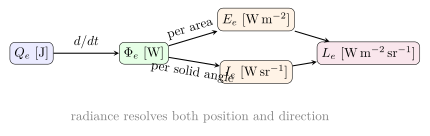
Irradiance 回答“某个面单位面积收到多少功率”;radiant intensity 回答“点状源朝某方向每单位立体角发出多少功率”;radiance 则在指定位置和指定方向同时分辨 ray density。它是成像、相机曝光、radiative transfer 与 étendue 的核心。
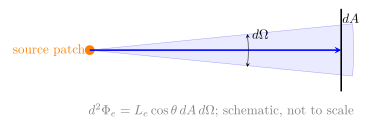
若表面是 Lambertian emitter,它的 radiance 与观察方向无关;但 projected area 随 \(\cos\theta\) 减小,所以 radiant intensity obeys cosine law。对 uniform Lambertian patch 面积 \(A\)、radiance \(L_e\),法向 radiant exitance 为
\[M_e=\int_{\mathrm{hemisphere}}L_e\cos\theta\,d\Omega=\pi L_e.\]
Radiance 不是“总功率除面积”;它还保留 direction。只有把方向积分后才得到 irradiance 或 exitance。
Knowledge 2 — Solid angle and inverse-square spreading / 立体角与平方反比扩散
Knowledge ID: P05-U01-L03-K02
立体角是单位球面上的面积。距观察点 \(r\) 的小面积 \(dA\) 对观察点张开的 solid angle 为
\[d\Omega=\frac{dA\cos\theta}{r^2}.\]
圆锥半角为 \(\alpha\) 时
\[\Omega_{\mathrm{cone}}=2\pi(1-\cos\alpha).\]
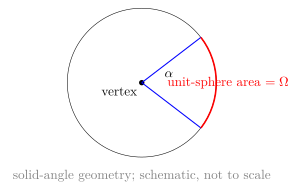
对 point source,\(I_e\) 只依赖方向,不随 \(r\) 改变。一个朝向 source 的小 detector 接收
\[d\Phi_e=I_e\,d\Omega =I_e\frac{dA\cos\theta}{r^2},\]
因此
\[\boxed{E_e=\frac{I_e\cos\theta}{r^2}}.\]
isotropic point source 满足球面总 flux \(\Phi_e=4\pi I_e\),故法向 irradiance
\[E_e(r)=\frac{\Phi_e}{4\pi r^2}.\]
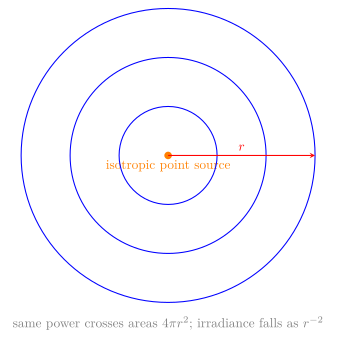
倾斜 detector 还要乘 \(\cos\theta\);这是 projected area,不是额外的 inverse-square law。
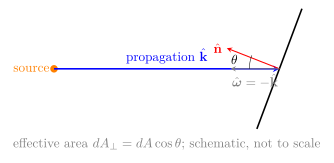
平方反比仅适用于 unresolved point source、无吸收、无聚焦且 far enough that source size is negligible。对 resolved extended uniform-radiance object,距离增大时单个 image element 对应更大物面积与更小 solid angle,radiance ideally 不变;“看起来表面亮度不随距离降为 \(1/r^2\)”并不违背能量守恒。
Knowledge 3 — Photometric quantities and visual response / 光度量与视觉响应
Knowledge ID: P05-U01-L03-K03
Photometry 不是另一种能量守恒,而是把可见光谱按标准人眼响应加权。对任何 spectral radiometric quantity \(X_{e,\lambda}(\lambda)\),对应 photopic quantity 为
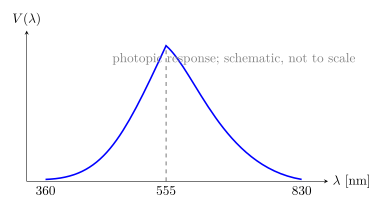
\[\boxed{X_v=K_m\int_{360\,\mathrm{nm}}^{830\,\mathrm{nm}} X_{e,\lambda}(\lambda)V(\lambda)\,d\lambda}.\]
在 SI 中,频率 \(540\times10^{12}\,\mathrm{Hz}\) 的 monochromatic radiation 的 maximum luminous efficacy 取
\[K_m=683\ \mathrm{lm\,W^{-1}}.\]
\(V(\lambda)\) 是 photopic(明视觉)效率函数,归一化峰值在约 \(555\,\mathrm{nm}\);暗视觉用另一函数 \(V'(\lambda)\),不能混用。
Radiometric 与 photometric quantities 的几何定义一一平行:
| Radiometric | Photometric | Photometric unit |
|---|---|---|
| radiant flux \(\Phi_e\) | luminous flux \(\Phi_v\) | lumen (lm) |
| radiant intensity \(I_e\) | luminous intensity \(I_v\) | candela (cd) |
| irradiance \(E_e\) | illuminance \(E_v\) | lux (lx) |
| radiance \(L_e\) | luminance \(L_v\) | \(\mathrm{cd\,m^{-2}}\) |
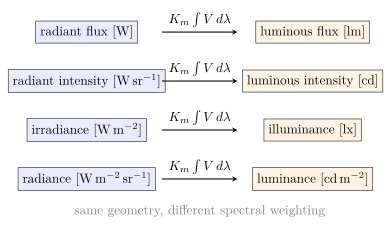
相同 radiant watts 的蓝、绿、红光可有极不相同的 lumens;相反,同样 lux 也不保证相同辐射功率或 photochemical hazard。光度量只代表特定标准视觉响应,不是所有生物效应的通用权重。
Knowledge 4 — Étendue and conservation of brightness / 光学扩展量与亮度守恒
Knowledge ID: P05-U01-L03-K04
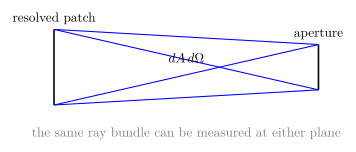
一个 ray bundle 不只占据空间面积,还占据方向空间。微分 étendue 定义为
\[\boxed{dG=n^2\cos\theta\,dA\,d\Omega}.\]
对 lossless passive geometrical optics,bundle 的 \(G\) 沿系统守恒。功率微元为
\[d\Phi_e=L_e\cos\theta\,dA\,d\Omega =\frac{L_e}{n^2}dG.\]
因此 same medium 中 radiance \(L_e\) 沿 ray 不变;跨 refractive interface 时不变量是 \(L_e/n^2\)(在本课的 radiance 定义与无损条件下)。
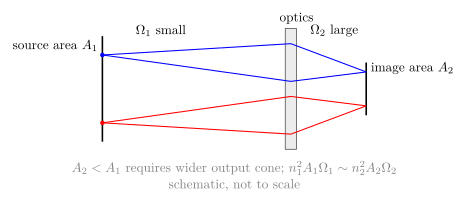
小面积 \(A\) 接受轴对称半角 \(u\) 的 cone 时,projected solid-angle integral 为 \(\pi\sin^2u\),所以
\[G=n^2A\pi\sin^2u=A\pi\mathrm{NA}^2, \qquad \mathrm{NA}=n\sin u.\]
若被动系统把 source area 压小,必须扩大 output angular spread 或舍弃 rays;不能同时把 \(A\) 与 \(\Omega\) 都压小而保持全部功率。
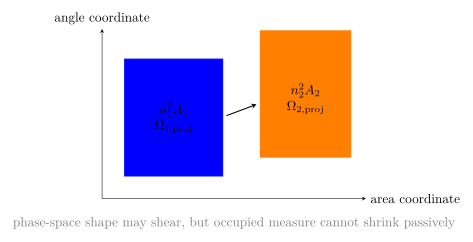
这就是“brightness conservation”:ideal lens 可以把较大 source 成像成较小 spot,但 output cone 变大;若 output NA 有上限,最大 concentration 也有上限。吸收、vignetting 和 scattering 只会降低可用 radiance,不能提高它。
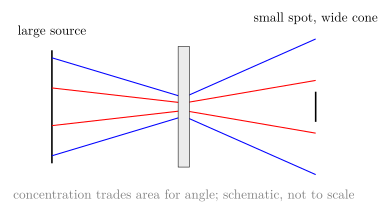
Radiance invariance 与 inverse-square law 并不冲突。点源 irradiance 随 \(r^{-2}\),因为 fixed detector 截获的 solid angle 变小;resolved extended surface 的 radiance 不随距离变,因为 area 和 solid angle 的几何变化正好配对。
Worked Examples / 完整例题
Worked Example 1 — 各向同性源的 radiant intensity 与 irradiance
一个各向同性点源总 radiant flux 为 \(\Phi_e=60.0\,\mathrm W\)。求 radiant intensity,以及距源 \(r=3.00\,\mathrm m\)、探测面正对光源处的 irradiance。
研究对象: 点源发出的稳态辐射与小面积探测面。
参考系/系统: source 与 detector 静止;无吸收自由空间。
模型: isotropic unresolved point source,detector normal 对准 source。
方程与计算:
\[I_e=\frac{\Phi_e}{4\pi} =\frac{60.0}{4\pi} =4.77\ \mathrm{W\,sr^{-1}}.\]
\[E_e=\frac{I_e}{r^2} =\frac{4.77}{(3.00)^2} =0.531\ \mathrm{W\,m^{-2}}.\]
检查: \(\mathrm{W\,sr^{-1}}/\mathrm{m^2}=\mathrm{W\,m^{-2}}\),steradian 量纲为 1;\(r\) 加倍时 \(E_e\) 变四分之一;三位有效数字。
Worked Example 2 — 圆形探测器张开的立体角
半径 \(a=1.00\,\mathrm{cm}\) 的圆形 detector 与其轴上的点源相距 \(r=0.500\,\mathrm m\),面正对 source。若 source isotropically emits \(10.0\,\mathrm W\),求 detector 的 exact solid angle 与接收功率。
研究对象: 点源到圆盘的全部 rays。
参考系/系统: 圆盘静止、轴线穿过 source。
模型: 无吸收、无遮挡;使用轴上圆盘 exact solid angle。
方程与计算:
\[\Omega=2\pi\left(1-\frac{r}{\sqrt{r^2+a^2}}\right) =1.26\times10^{-3}\ \mathrm{sr}.\]
\[\Phi_{\mathrm{det}}=\Phi_e\frac{\Omega}{4\pi} =(10.0)\frac{1.26\times10^{-3}}{4\pi} =1.00\times10^{-3}\ \mathrm W.\]
检查: 小角近似 \(\Omega\approx\pi a^2/r^2=1.26\times10^{-3}\,\mathrm{sr}\) 一致;接收 fraction 为 \(1.00\times10^{-4}\);三位有效数字。
Worked Example 3 — 单色 radiant flux 转 luminous flux
频率 \(540\times10^{12}\,\mathrm{Hz}\) 的 monochromatic beam 有 radiant flux \(2.00\,\mathrm{mW}\),并均匀分布在 \(0.100\,\mathrm{sr}\) 内。求 luminous flux 与 luminous intensity。
研究对象: 标准 photopic observer 对该单色 beam 的光度量。
参考系/系统: steady beam;只计给定角锥。
模型: 使用 SI defining luminous efficacy \(K_m=683\,\mathrm{lm\,W^{-1}}\);方向内均匀。
方程与计算:
\[\Phi_v=K_m\Phi_e =(683)(2.00\times10^{-3}) =1.37\ \mathrm{lm}.\]
\[I_v=\frac{\Phi_v}{\Omega} =\frac{1.366}{0.100} =13.7\ \mathrm{cd}.\]
检查: \(\mathrm{lm/sr}=\mathrm{cd}\);若频率移离视觉峰而 radiant watts 不变,\(V(\lambda)<1\) 使 lumens 减少;三位有效数字。
Worked Example 4 — Étendue 限制下的面积压缩
空气中一个均匀 source 面积 \(A_1=1.00\,\mathrm{cm^2}\),被系统以 \(\mathrm{NA}_1=0.200\) 全部接收。若无损系统把它成像到 \(A_2=0.250\,\mathrm{cm^2}\),求至少需要的 output NA。
研究对象: 轴对称 incoherent ray bundle。
参考系/系统: 输入与输出都在空气;passive lossless optics。
模型: small-area cone,\(G=A\pi\mathrm{NA}^2\),忽略 vignetting。
方程与计算:
\[G_1=A_1\pi\mathrm{NA}_1^2 =(1.00\times10^{-4})\pi(0.200)^2 =1.26\times10^{-5}\ \mathrm{m^2\,sr}.\]
由 \(G_2=G_1\),
\[\mathrm{NA}_2=\mathrm{NA}_1\sqrt{\frac{A_1}{A_2}} =(0.200)\sqrt{\frac{1.00}{0.250}} =0.400.\]
检查: 面积压为四分之一时 angular-width measure 必须增四倍,故 NA 加倍;NA 无量纲且小于空气中的上限 1;若系统只允许 \(\mathrm{NA}_2=0.200\),就不能无损接收全部 bundle。
Lesson synthesis / 本课综合
从 \(Q_e\) 到 \(\Phi_e\) 是时间率;从 \(\Phi_e\) 到 \(E_e\)、\(I_e\)、\(L_e\) 是对 area、solid angle 或二者取密度。inverse-square law 源自同一方向功率扩散到 \(r^2\) 增长的面积;photometry 则在相同几何量上加 CIE \(V(\lambda)\) 光谱权重。把 ray bundle 视为面积—方向 phase space 后,étendue conservation 说明被动系统可以交换 spot area 与 angular spread,却不能在保留全部功率的同时压缩二者;这就是 brightness conservation 的几何核心。
Formula-and-decision table / 公式与决策表
| Need | Formula | Conditions | Main caution |
|---|---|---|---|
| radiant power | \(\Phi_e=dQ_e/dt\) | any radiation energy flow | unit is W, not J |
| irradiance | \(E_e=d\Phi_e/dA\) | receiving surface | do not confuse with radiant intensity |
| radiant intensity | \(I_e=d\Phi_e/d\Omega\) | directional point-source model | unit is \(\mathrm{W\,sr^{-1}}\) |
| radiance | \(L_e=d^2\Phi_e/(dA\cos\theta\,d\Omega)\) | position and direction resolved | projected area is essential |
| point-source spreading | \(E_e=I_e\cos\theta/r^2\) | far/unresolved source, no focusing | not a law for resolved surface radiance |
| cone solid angle | \(\Omega=2\pi(1-\cos\alpha)\) | circular cone | use radians in small-angle approximation |
| photopic conversion | \(X_v=K_m\int X_{e,\lambda}V\,d\lambda\) | standard photopic response | spectrum is required except monochromatic case |
| étendue | \(dG=n^2\cos\theta\,dA\,d\Omega\) | geometrical optics | passive lossless systems cannot reduce \(G\) |
| NA form | \(G=A\pi\mathrm{NA}^2\) | uniform area, axial cone | assumes the appropriate filled cone |
Model boundaries / 模型边界
- Point-source inverse-square law fails in the near field, for resolved extended sources, guided beams, focused systems or absorbing/scattering media.
- Radiance invariance requires lossless propagation along a ray; absorption and vignetting reduce it.
- Lambertian is an angular model, not a claim that every matte surface is perfectly diffuse.
- Photopic \(V(\lambda)\) represents a standardized visual response; it does not predict scotopic vision, color appearance or photochemical hazard by itself.
- Étendue conservation is a geometrical/incoherent statement; diffraction-limited coherent beams are better described by optical modes and uncertainty-like phase-space limits.
- Real detectors integrate over finite area, angle, wavelength and time and have calibration uncertainty.
Misconception clinic / 误区诊所
- “Intensity 就是 \(\mathrm{W\,m^{-2}}\)。” 在辐射度学标准命名中 \(I_e\) 是 radiant intensity,单位 \(\mathrm{W\,sr^{-1}}\);\(\mathrm{W\,m^{-2}}\) 是 irradiance \(E_e\)。
- “所有光量都按 \(1/r^2\) 降低。” point-source irradiance 如此,resolved source 的 radiance 在理想自由空间中不变。
- “一瓦绿光与一瓦红光同样亮。” radiant power 相同,photopic luminous flux 因 \(V(\lambda)\) 不同而不同。
- “lens 能把任意大光源全部压到任意小 spot。” étendue 要求面积压缩以角扩展或功率损失为代价。
- “steradian 有长度量纲。” solid angle 量纲为 1;\(\mathrm{sr}\) 是为清楚表达几何密度而保留的单位名。
Practice and retrieval / 练习与提取
- K01 单位: 哪个量的单位是 \(\mathrm{W\,m^{-2}\,sr^{-1}}\)?
Answer
Radiance \(L_e\);它同时按 projected area 与 solid angle 归一化。
- K01 区分: radiant intensity 与 irradiance 分别回答什么问题?
Answer
\(I_e\) 描述 source 朝某方向每单位 solid angle 的功率;\(E_e\) 描述 receiving surface 每单位面积收到的功率。
- K02 计算: \(12.0\,\mathrm W\) isotropic point source 在 \(r=2.00\,\mathrm m\) 的法向 irradiance 是多少?
Answer
\[E_e=\frac{12.0}{4\pi(2.00)^2}=0.239\ \mathrm{W\,m^{-2}}.\]
- K02 投影: 在相同 \(r\),detector normal 与 ray 成 \(60.0^\circ\),相对正对 source 的接收功率比例是多少?
Answer
\[\frac{\Phi(60^\circ)}{\Phi(0)}=\cos60.0^\circ=0.500.\]
- K02 立体角: 半角 \(30.0^\circ\) 的 cone solid angle 是多少?
Answer
\[\Omega=2\pi(1-\cos30.0^\circ)=0.842\ \mathrm{sr}.\]
- K03 计算: \(540\times10^{12}\,\mathrm{Hz}\) 的 \(1.00\,\mathrm{mW}\) 单色辐射对应多少 luminous flux?
Answer
\[\Phi_v=(683)(1.00\times10^{-3})=0.683\ \mathrm{lm}.\]
- K03 概念: 为什么只给总 radiant power 通常不能求白光灯的 lumens?
Answer
因为必须知道 spectral power distribution 才能与 \(V(\lambda)\) 加权积分;不同光谱的同 watts 可有不同 lumens。
- K04 判断: lossless lens 把 image area 减半而接收全部 bundle,output angular measure 至少怎样变化?
Answer
在相同 \(n\) 下 \(A\Omega_{\mathrm{proj}}\) 守恒,所以 projected angular measure 至少加倍。
- K04 计算: 输入输出均在空气,\(A_2=A_1/9\)。若保留全部 rays,\(\mathrm{NA}_2/\mathrm{NA}_1\) 是多少?
Answer
\[A_1\mathrm{NA}_1^2=A_2\mathrm{NA}_2^2 \quad\Rightarrow\quad \frac{\mathrm{NA}_2}{\mathrm{NA}_1}=3.\]
- 综合: 远离一面均匀发光、仍被相机分辨的墙时,为什么每个像素可近似保持亮度而相机总收光仍下降?
Answer
理想 free-space radiance 沿 ray 不变;但墙在视场中占的像素数/总 solid angle 减少,所以整幅图来自墙的总功率下降,能量仍守恒。
Exit ticket / 离堂检核
- 从 \(d^2\Phi_e=L_e\cos\theta\,dA\,d\Omega\) 出发,说明 irradiance、radiant intensity 与 flux 分别通过什么积分得到。
- 给一个“把大面积 LED 无损压到小光纤芯”的提案,用 \(G=A\pi\mathrm{NA}^2\) 判断还缺哪个条件,并说明 brightness conservation 的结论。
References and source notes / 参考资料与来源说明
Source-to-content map
| Source | Used for | Knowledge ID / section | Model boundary or convention |
|---|---|---|---|
| NIST Radiometry and Photometry Review | standard quantities, units, spectral scope | K01, K03 | standard terminology; photometry is visually weighted |
| NIST Realization of the candela | \(V(\lambda)\), \(K_m\), inverse-square calibration | K02–K03 | photopic 360–830 nm; detector-based realization |
| CIE TN 002:2014 | spectral weighting relation for photometric quantities | K03 | standardized \(V(\lambda)\); photometric weighting is effect-specific |
| Cornell CS667 Radiometry Notes | solid angle, projected area, radiance and invariance | K01–K02, K04 | geometrical, incoherent, macroscopic radiometry |
| Stanford CS348B Radiometry II | throughput/étendue and radiance conservation | K04 | rays conserved; no attenuation or scattering |
资料和链接实际核对日期:2026-08-28。所有数值题独立复算;TikZ 图为原创,未按比例者均明确标注。
复习与拓展
- Reflection and Refraction:界面改变 ray direction,并以 Fresnel factors 改变 radiance。
- The Eye and Cameras:aperture、exposure、sensor irradiance 与视觉响应。
- Optical Instruments:aperture、light gathering 与 étendue matching。
- Imaging Quality:PSF 将 radiance 分配到 image plane。
- Nonimaging optics:concentration limit、compound parabolic concentrator 与 illumination design。