
Learning objectives / 学习目标
- 区分 physical ray、normalized ket、有限维 \(\mathbb C^N\) 与函数空间 \(L^2\)。
- 正确使用 bra、ket、inner product、orthonormal basis 与 discrete/continuous completeness。
- 判断算符的线性、adjoint 与 Hermiticity,并说明无限维中 operator domain 为什么不可省略。
- 对有限维 Hermitian operator 求 eigenvalues、projectors 与 spectral decomposition,并说明连续谱推广。
- 用 unitary matrix 变换 components 和 operator matrices,证明 expectation value 与概率幅不依赖 basis。
Prerequisites / 先修知识
- Quantum Harmonic Oscillator:number states、ladder operators 与 orthonormal expansion。
- Wave Functions and Probability:归一化、复振幅与 position wavefunction。
- 复向量、矩阵乘法、eigenvalue problem、复共轭与 Fourier transform。
Scope and conventions / 范围与约定
- Hilbert space \(\mathcal H\) 取复数域;inner product 对第一槽 conjugate-linear、第二槽 linear:\(\langle\phi\vert(c\psi)\rangle=c\langle\phi\vert\psi\rangle\)。
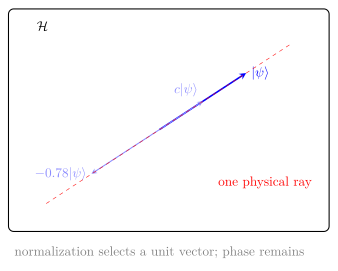
- normalized state vector 满足 \(\langle\psi\vert\psi\rangle=1\)。相差非零复数的 ket 表示同一 ray;归一化后仅剩 global phase \(e^{i\chi}\)。
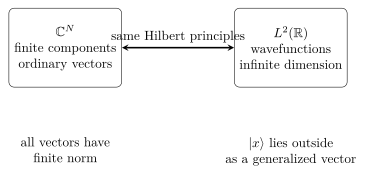
- 有限维例主要在 \(\mathbb C^N\);一维位置波函数属于 \(L^2(\mathbb R)\)。
- 连续“本征态” \(\lvert x\rangle,\lvert p\rangle\) 是 delta-normalized generalized vectors,不是 \(L^2\) 中普通归一化 ket。严格语言需 rigged Hilbert space,本课只给操作边界。
- 有限维中 Hermitian matrix 与 self-adjoint operator 等价;无限维 unbounded operator 还必须比较 domain,不能只看形式上的 integration by parts。
- 本课建立形式体系,不提前展开下一课的 measurement projection postulate。
Notation and modeling contract / 符号与建模契约
| Symbol | Meaning | Mathematical type |
|---|---|---|
| \(\mathcal H\) | Hilbert space | complete complex inner-product space |
| \(\lvert\psi\rangle\) | ket representing a state vector | element of \(\mathcal H\) |
| \(\langle\psi\rvert\) | adjoint bra | element of dual space |
| \(\langle\phi\vert\psi\rangle\) | inner product | complex scalar |
| \(\hat A\) | linear operator | map on a specified domain in \(\mathcal H\) |
| \(\hat A^\dagger\) | adjoint operator | operator determined by inner product and domains |
| \(a_n\) | eigenvalue or basis label, by context | scalar |
| \(\hat P_n\) | orthogonal projector onto eigenspace | Hermitian idempotent operator |
| \(U\) | unitary basis-change matrix | \(U^\dagger U=I\) |
| \(\psi(x)\) | position representation \(\langle x\vert\psi\rangle\) | square-integrable function |
Knowledge 1 — Hilbert space and state vectors / 希尔伯特空间与态矢
Knowledge ID: P07-U04-L01-K01
Hilbert space 是带正定 inner product 且对其范数完备的复向量空间。“完备”表示每个 Cauchy sequence 都收敛到空间内的向量,使极限过程不会把物理态带出空间。
有限 \(N\) 能级系统可用 \(\mathbb C^N\);一维无自旋粒子的 position representation 使用
\[L^2(\mathbb R)=\left\{\psi: \int_{-\infty}^{\infty}\lvert\psi(x)\rvert^2dx<\infty\right\}\]
(严格说按“几乎处处相等”取 equivalence classes)。
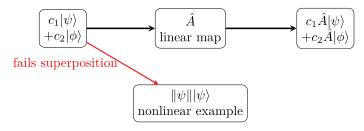
态的线性叠加
\[\lvert\psi\rangle=c_1\lvert\psi_1\rangle+c_2\lvert\psi_2\rangle\]
仍是向量,但未必 normalized。物理上 normalized ket 与 \(e^{i\chi}\lvert\psi\rangle\) 给出相同 ray;global phase 不改变任何 bra-ket probability or expectation。不同分量之间的 relative phase 则可改变干涉。
Knowledge 2 — Bras, kets, and inner products / 左矢、右矢与内积
Knowledge ID: P07-U04-L01-K02
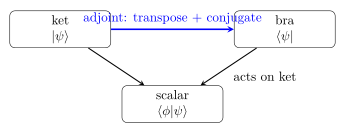
ket 的 adjoint 是 bra:若列向量
\[\lvert\psi\rangle= \begin{pmatrix}c_1\\c_2\\\vdots\end{pmatrix},\]
则
\[\langle\psi\rvert= \begin{pmatrix}c_1^*&c_2^*&\cdots\end{pmatrix}.\]
inner product 满足
\[\langle\phi\vert\psi\rangle =\langle\psi\vert\phi\rangle^*, \qquad \langle\psi\vert\psi\rangle\ge0,\]
且只有 zero vector 的 norm 为 0。Cauchy–Schwarz inequality 为
\[\lvert\langle\phi\vert\psi\rangle\rvert^2 \le\langle\phi\vert\phi\rangle \langle\psi\vert\psi\rangle.\]
orthonormal discrete basis \(\{\lvert n\rangle\}\) 满足
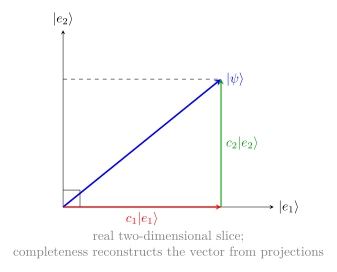
\[\langle m\vert n\rangle=\delta_{mn}, \qquad \sum_n\lvert n\rangle\langle n\rvert=\hat I.\]
于是
\[\lvert\psi\rangle=\sum_n c_n\lvert n\rangle, \qquad c_n=\langle n\vert\psi\rangle, \qquad \sum_n\lvert c_n\rvert^2=1.\]
连续 position basis 形式上满足
\[\langle x\vert x'\rangle=\delta(x-x'), \qquad \int_{-\infty}^{\infty}\lvert x\rangle\langle x\rvert\,dx=\hat I.\]
这不是“不可数多个单位向量”的普通正交基,而是 generalized spectral resolution。
Knowledge 3 — Linear and Hermitian operators / 线性与厄米算符
Knowledge ID: P07-U04-L01-K03
linear operator 满足
\[\hat A(c_1\lvert\psi\rangle+c_2\lvert\phi\rangle) =c_1\hat A\lvert\psi\rangle+c_2\hat A\lvert\phi\rangle.\]
adjoint 由
\[\langle\phi\vert\hat A\psi\rangle =\langle\hat A^\dagger\phi\vert\psi\rangle\]
定义,并同时依赖 inner product 与允许的 domains。有限维 Hermitian operator 满足 \(A=A^\dagger\);其 expectation value 为实数:
\[\langle A\rangle_\psi =\langle\psi\vert\hat A\lvert\psi\rangle =\langle A\rangle_\psi^*.\]
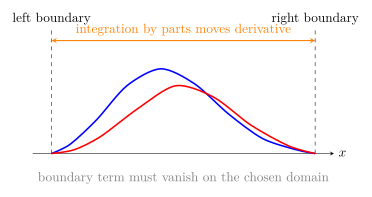
对 momentum operator \(\hat p=-i\hbar d/dx\),integration by parts 给
\[\langle\phi\vert\hat p\psi\rangle -\langle\hat p\phi\vert\psi\rangle =-i\hbar\left[\phi^*(x)\psi(x)\right]_{\rm boundary}.\]
只有指定边界条件使 boundary form 消失时,形式对称才成立;self-adjoint 还要求 \(D(\hat p)=D(\hat p^\dagger)\)。在整条实线适当衰减的函数上、或环上 periodic boundary condition 下,可建立自伴 momentum;在有限区间随意令两端为零则会出现更细的 domain 问题。
Knowledge 4 — Eigenvalues, eigenstates, and spectral decomposition / 本征值、本征态与谱分解
Knowledge ID: P07-U04-L01-K04
本征方程为
\[\hat A\lvert a,\lambda\rangle =a\lvert a,\lambda\rangle,\]
其中 \(\lambda\) 可标记简并子空间内的独立态。Hermitian operator 的本征值为实,不同本征值的本征态正交。有限维 spectral theorem 给
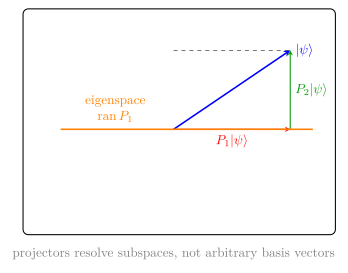
\[\hat A=\sum_a a\hat P_a, \qquad \hat P_a=\sum_\lambda \lvert a,\lambda\rangle\langle a,\lambda\rvert.\]
projectors 满足
\[\hat P_a^\dagger=\hat P_a, \qquad \hat P_a\hat P_b=\delta_{ab}\hat P_a, \qquad \sum_a\hat P_a=\hat I.\]
对函数 \(f\),
\[f(\hat A)=\sum_a f(a)\hat P_a.\]
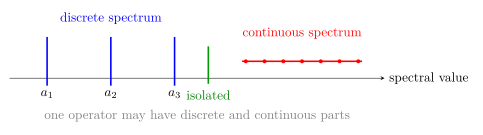
这使 exponential、square root 等 operator functions 具有清楚定义。连续谱用 projection-valued measure 更严格;形式上常写
\[\hat A=\int a\lvert a\rangle\langle a\rvert\,da,\]
但 \(\lvert a\rangle\) 通常是 generalized eigenvector。若同时有离散与连续谱,二者的 sum 与 integral 都要保留。
Knowledge 5 — Basis changes and representations / 基底变换与表象
Knowledge ID: P07-U04-L01-K05
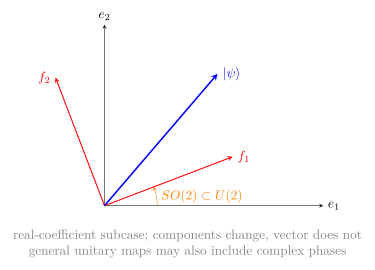
设两个 orthonormal bases 为 \(\{\lvert e_i\rangle\}\) 与 \(\{\lvert f_\alpha\rangle\}\)。定义
\[U_{i\alpha}=\langle e_i\vert f_\alpha\rangle.\]
\(U\) 为 unitary。若 \(c_i=\langle e_i\vert\psi\rangle\)、\(d_\alpha=\langle f_\alpha\vert\psi\rangle\),则
\[c_i=\sum_\alpha U_{i\alpha}d_\alpha, \qquad \mathbf c=U\mathbf d.\]
operator matrices 变换为
\[A^{(f)}=U^\dagger A^{(e)}U.\]
于是 expectation value invariant:
\[\mathbf d^\dagger A^{(f)}\mathbf d =\mathbf c^\dagger A^{(e)}\mathbf c.\]
position and momentum are continuous representations of the same ket:
\[\psi(x)=\langle x\vert\psi\rangle, \qquad \widetilde\psi(p)=\langle p\vert\psi\rangle,\]
采用 convention
\[\langle x\vert p\rangle =\frac{1}{\sqrt{2\pi\hbar}}e^{ipx/\hbar},\]
则
\[\psi(x)=\frac{1}{\sqrt{2\pi\hbar}} \int_{-\infty}^{\infty}e^{ipx/\hbar}\widetilde\psi(p)\,dp,\]
\[\widetilde\psi(p)=\frac{1}{\sqrt{2\pi\hbar}} \int_{-\infty}^{\infty}e^{-ipx/\hbar}\psi(x)\,dx.\]
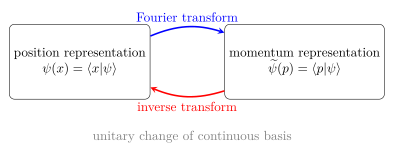
Fourier normalization conventions may distribute \(2\pi\) and \(\hbar\) differently;one calculation must use one convention consistently。
Worked examples / 完整例题
Example 1 — 复向量归一化与 overlap
已知: \(\lvert v\rangle=(1,i,2)^T/\sqrt6\),\(\lvert w\rangle=(1,1,0)^T/\sqrt2\)。
系统与 basis: 三维复 Hilbert space 的指定 orthonormal basis;无空间 frame 依赖。
模型理由: 有限维 inner product 是 conjugate transpose 乘 column。
计算: 两者范数均为 1,且
\[\langle v\vert w\rangle =\frac{1-i}{\sqrt{12}}, \qquad \lvert\langle v\vert w\rangle\rvert^2=\frac16.\]
检查: Cauchy–Schwarz 给模方不超过 1,\(1/6\) 合法;若忘记把 \(i\) 共轭为 \(-i\) 会得到错误相位。
解释: overlap 是 basis-independent scalar;模方可在下一课解释为相应投影概率。
Example 2 — Hermitian matrix 的 spectral decomposition
已知:
\[A=\begin{pmatrix}2&-i\\i&2\end{pmatrix}.\]
对象与 basis: 二维 Hilbert space;给定 matrix representation。
模型: 有限维,Hermitian 与 self-adjoint 无 domain 差别。
求解: eigenvalues 为 \(a_-=1\)、\(a_+=3\)。可取
\[\lvert a_-\rangle=\frac1{\sqrt2}\begin{pmatrix}i\\1\end{pmatrix}, \qquad \lvert a_+\rangle=\frac1{\sqrt2}\begin{pmatrix}-i\\1\end{pmatrix}.\]
projectors 为
\[P_-=\frac12\begin{pmatrix}1&i\\-i&1\end{pmatrix}, \qquad P_+=\frac12\begin{pmatrix}1&-i\\i&1\end{pmatrix}.\]
所以 \(A=P_-+3P_+\)。
检查: \(P_\pm^2=P_\pm\)、\(P_-P_+=0\)、\(P_-+P_+=I\);trace \(=1+3=4\)、determinant \(=3\),与原矩阵相符。
解释: spectral decomposition 把 operator 的作用拆成正交本征子空间上的标量乘法。
Example 3 — 同一态在两个基底中的 components
已知: 在 \(z\) basis,\(\lvert\psi\rangle=(\sqrt3/2,i/2)^T\);新基 \(\lvert+\rangle=(1,1)^T/\sqrt2\)、\(\lvert-\rangle=(1,-1)^T/\sqrt2\)。
系统与 basis: 二维抽象 Hilbert space;这里只做 unitary basis change。
计算:
\[d_+=\langle+\vert\psi\rangle =\frac{\sqrt3+i}{2\sqrt2}, \qquad d_-=\langle-\vert\psi\rangle =\frac{\sqrt3-i}{2\sqrt2}.\]
\[\lvert d_+\rvert^2+\lvert d_-\rvert^2 =\frac12+\frac12=1.\]
检查: unitary change preserves norm;重新组合 \(d_+\lvert+\rangle+d_-\lvert-\rangle\) 恢复原 ket。
解释: components 和它们的相位改变,但 physical vector 没有改变。
Example 4 — Gaussian 的连续基变换
已知:
\[\psi(x)=\frac{1}{(\pi\sigma^2)^{1/4}} e^{-x^2/(2\sigma^2)}.\]
系统与 convention: 一维全空间,采用本课 \(\langle x\vert p\rangle=(2\pi\hbar)^{-1/2}e^{ipx/\hbar}\)。
模型: \(\psi\in L^2(\mathbb R)\);\(\lvert x\rangle,\lvert p\rangle\) 是 generalized bases。
Fourier transform:
\[\widetilde\psi(p) =\left(\frac{\sigma^2}{\pi\hbar^2}\right)^{1/4} e^{-\sigma^2p^2/(2\hbar^2)}.\]
两表象均归一化,并给
\[\Delta x=\frac{\sigma}{\sqrt2}, \qquad \Delta p=\frac{\hbar}{\sqrt2\sigma}, \qquad \Delta x\Delta p=\frac\hbar2.\]
单位检查: \(\psi\) 单位 \(\mathrm{m^{-1/2}}\),\(\widetilde\psi\) 单位 \((\mathrm{kg\,m\,s^{-1}})^{-1/2}\)。
解释: Fourier transform 是 unitary basis change;不是把态物理地“变换”成另一态。
Lesson synthesis / 全课综合
本课的抽象结构可压缩为四层:
- State: physical state 是 Hilbert-space ray;ket 是其代表。
- Geometry: inner product 给 norm、angle、orthogonality 与 projection amplitudes。
- Dynamics/quantities: linear operators 作用于 ket;自伴结构保证实谱与正交谱分解。
- Coordinates: basis 只给 components;unitary transformation 同时变换 state components 与 operator matrix,scalar predictions 不变。
这四层必须保持分离:不能把 wavefunction 当成抽象态本身,也不能把某一 basis 下的 diagonal matrix 当成 operator 的唯一存在方式。
Formula-and-decision table / 公式与决策表
| Purpose | Formula | Domain | Caution |
|---|---|---|---|
| norm | \(\lVert\psi\rVert^2=\langle\psi\vert\psi\rangle\) | Hilbert vector | rays ignore nonzero scalar representatives |
| discrete completeness | \(\sum_n\lvert n\rangle\langle n\rvert=I\) | complete orthonormal basis | incomplete sets do not reconstruct every state |
| continuous completeness | \(\int\lvert x\rangle\langle x\rvert dx=I\) | generalized basis | \(\lvert x\rangle\) is not unit-normalizable |
| adjoint | \(\langle\phi\vert A\psi\rangle=\langle A^\dagger\phi\vert\psi\rangle\) | specified domains | boundary terms matter |
| spectral form | \(A=\sum_a aP_a\) | finite/discrete self-adjoint case | use projectors for degeneracy |
| operator function | \(f(A)=\sum_a f(a)P_a\) | same spectral resolution | continuous spectrum adds an integral |
| basis change | \(A^{(f)}=U^\dagger A^{(e)}U\) | orthonormal bases | transform states and operators consistently |
| Fourier kernel | \(\langle x\vert p\rangle=(2\pi\hbar)^{-1/2}e^{ipx/\hbar}\) | chosen convention | do not mix normalization conventions |
Model boundaries / 模型边界
- Finite-dimensional matrix statements are safest; infinite-dimensional operators may be unbounded and not defined on every Hilbert vector.
- “Hermitian” is often classroom shorthand for self-adjoint. For differential operators, domains and boundary conditions are part of the operator.
- Continuous eigenkets are distributions. Manipulations with delta functions are formal shorthand justified by spectral theory or rigged Hilbert spaces.
- Not every linear operator has an orthonormal eigenbasis. The spectral theorem used here relies on Hermitian/self-adjoint structure.
- Degenerate spectral decomposition is unique at the projector level, while basis vectors inside a degenerate eigenspace are not unique.
- A nonorthonormal or overcomplete set needs a dual frame or metric; the simple coefficient formula \(c_n=\langle n\vert\psi\rangle\) assumes orthonormality.
Misconception clinic / 易错诊所
- “相差 global phase 的 ket 是不同态。” 它们是同一 ray;relative phase 才影响干涉。
- “bra 只是 ket 的转置。” 必须 transpose 并 complex conjugate。
- “\(\lvert x\rangle\) 是 norm 为 1 的普通向量。” 它 delta-normalized,不属于 \(L^2\)。
- “形式上分部积分相等就证明 differential operator 自伴。” 还要指定 domain 并比较 adjoint domain。
- “简并时 spectral decomposition 必须选唯一的一组 eigenvectors。” 唯一的是 eigenspace projector;子空间内 basis 可旋转。
- “换表象会改变物理态。” 它只改变 components 和 matrix representation,invariant scalar prediction 不变。
Practice and retrieval / 练习与提取
1. Global 与 relative phase
比较 \((1,i)^T/\sqrt2\)、\(e^{i\pi/3}(1,i)^T/\sqrt2\) 与 \((1,-i)^T/\sqrt2\)。
Answer 1
前两者只差 global phase,表示同一 ray;第三个态改变了分量的 relative phase,一般是不同物理态。
2. Bra 的构造
若 \(\lvert\psi\rangle=(2,-i,1+i)^T\),写出 \(\langle\psi\rvert\) 与 norm squared。
Answer 2
\(\langle\psi\rvert=(2,i,1-i)\);norm squared 为 \(4+1+2=7\)。
3. Cauchy–Schwarz
normalized states 的 overlap 模为什么不可能大于 1?何时等号成立?
Answer 3
Cauchy–Schwarz 给 \(\lvert\langle\phi\vert\psi\rangle\rvert^2\le1\);等号当且仅当两向量线性相关,即 normalized ket 只差 phase。
4. 完备性展开
在 orthonormal basis 中证明 \(\sum_n\lvert c_n\rvert^2=1\)。
Answer 4
插入 \(I=\sum_n\lvert n\rangle\langle n\rvert\):\(1=\langle\psi\vert\psi\rangle=\sum_n\langle\psi\vert n\rangle\langle n\vert\psi\rangle=\sum_n\lvert c_n\rvert^2\)。
5. 线性诊断
映射 \(F(\lvert\psi\rangle)=\langle\psi\vert\psi\rangle\lvert\psi\rangle\) 是否线性?
Answer 5
否。\(F(c\psi)=\lvert c\rvert^2cF(\psi)\),一般不等于 \(cF(\psi)\);也不保持叠加。
6. Hermitian 检查
矩阵 \(B=\begin{pmatrix}1&2+i\\2-i&0\end{pmatrix}\) 是否 Hermitian?其 trace 能否支持实 eigenvalues?
Answer 6
是,off-diagonal 元互为共轭、diagonal 为实;trace 为 1,实数。Hermiticity 保证全部 eigenvalues 为实,trace 是其和。
7. Domain 与 boundary term
在 \([0,L]\) 上,什么简单边界关系可使 momentum 的 boundary form \(-i\hbar[\phi^*\psi]_0^L\) 消失?
Answer 7
一组可行的 self-adjoint family 是 \(\psi(L)=e^{i\theta}\psi(0)\),并对 domain 中所有函数使用同一 \(\theta\);则两端乘积相消。仅说“函数可微”不够。
8. Spectral function
若 \(A=1P_1+3P_3\),写出 \(A^2\) 与 \(e^{-itA/\hbar}\)。
Answer 8
利用正交 projectors,\(A^2=P_1+9P_3\),\(e^{-itA/\hbar}=e^{-it/\hbar}P_1+e^{-3it/\hbar}P_3\)。
9. 连续完备性
用 \(I=\int\lvert x\rangle\langle x\rvert dx\) 重建 ket,并指出系数是什么。
Answer 9
\(\lvert\psi\rangle=\int\lvert x\rangle\langle x\vert\psi\rangle dx=\int\psi(x)\lvert x\rangle dx\);系数函数是 position representation \(\psi(x)\)。
10. Basis invariance
若 \(\mathbf c=U\mathbf d\)、\(A_f=U^\dagger A_eU\),证明 expectation invariant。
Answer 10
\(\mathbf d^\dagger A_f\mathbf d=\mathbf d^\dagger U^\dagger A_eU\mathbf d=(U\mathbf d)^\dagger A_e(U\mathbf d)=\mathbf c^\dagger A_e\mathbf c\)。
Exit ticket / 退出检核
- 用 state、components、basis、operator matrix 四个词解释“position wavefunction 与 momentum wavefunction为何是同一态”。
- 给出一个有限维中正确、但在无限维 differential operator 上需要增加 domain 条件的命题,并说明缺少条件会造成什么风险。
References and source notes / 参考资料与来源说明
以下权威直接来源于 2026-08-29 实际打开核验;正文重新组织,并未复制来源插图。
- MIT OpenCourseWare, 8.05 Quantum Physics II, Chapter 2: Spin One-Half, Bras, Kets, and Operators.
- MIT OpenCourseWare, 8.05 Quantum Physics II, Chapter 3: Linear Algebra—Vector Spaces and Operators.
- MIT OpenCourseWare, 8.05 Quantum Physics II, Chapter 4: Dirac’s Bra and Ket Notation.
- MIT OpenCourseWare, 8.04 Quantum Physics I, Lecture Notes 8: Momentum, Expectation Values, and Operators.
- MIT OpenCourseWare, 8.04 Quantum Physics I, Lecture Notes 9: Observables and Hermitian Operators.
- David Tong, University of Cambridge, Quantum Mechanics, Section 3: The Formalism of Quantum Mechanics.
Source-to-content map / 来源—内容映射
| Source | Used for | Knowledge ID / Section | Model boundary or convention |
|---|---|---|---|
| MIT 8.05 Chapter 2 | finite-dimensional bras, kets and operators | K01–K03 | complex finite-dimensional spaces |
| MIT 8.05 Chapter 3 | vector spaces, adjoints, eigenvectors and unitary maps | K01–K05 | linear algebra foundation |
| MIT 8.05 Chapter 4 | Dirac notation and completeness | K02, K04–K05 | discrete bra-ket convention |
| MIT 8.04 Notes 8 | wavefunction/operator representations | K03, K05 | position and momentum representations |
| MIT 8.04 Notes 9 | Hermitian operators and real expectation values | K03–K04 | observable-operator context |
| Tong Section 3 | Hilbert-space formalism and spectral viewpoint | K01–K05 | discrete and continuous basis boundary |
复习与拓展
- 下一课在本课 projectors 和 spectra 上加入 measurement probabilities、post-measurement state 与 uncertainty relations。
- Quantum Time Evolution 将把 self-adjoint Hamiltonian 的 spectral function \(e^{-iHt/\hbar}\) 解释为 unitary evolution。
- Spin 将以 \(\mathbb C^2\)、Pauli matrices 和 basis rotations 提供最小但完整的实例。