
Learning objectives / 学习目标
完成本课后,你应能:
- 在 interaction picture 中推导 Dyson expansion 与一阶 transition amplitude。
- 区分 complex amplitude、probability 与 rate,并解释有限观测时间的 sinc-squared 谱宽。
- 从离散终态求和过渡到 continuum density of states,说明 Fermi golden rule 的适用条件与单位。
- 用 symmetry 判定 matrix element 是否为零,区分 selection rule 与 energy conservation。
- 比较 adiabatic condition 与 sudden condition,计算相位、overlap 与失败机制。
Prerequisites / 先修知识
- Quantum Time Evolution:unitary evolution 与 pictures。
- Time-Independent Approximation Methods:小参数、简并与 gap。
- Orbital Angular Momentum:parity、\(m\) 与 angular momentum matrix elements。
- Fourier transform、complex exponential 与 continuum integral。
Scope and conventions / 范围与约定
- \(\hat H(t)=\hat H_0+\lambda\hat V(t)\);\(\hat H_0\lvert n\rangle=E_n\lvert n\rangle\),\(\omega_{fi}=(E_f-E_i)/\hbar\)。
- 初态在 \(t=0\) 为 \(\lvert i\rangle\)。amplitude \(c_f\) 无量纲,probability \(P_{fi}=\lvert c_f\rvert^2\),rate \(\Gamma\) 的单位为 \(\mathrm{s^{-1}}\)。
- 只到一阶 amplitude / 二阶 probability;若 \(P\) 不再远小于 1,需要 nonperturbative two-level dynamics 或 rate equations。
- Selection rules 是特定 interaction operator 与 symmetry 的结论,不是所有作用下永恒不变的禁令。
- adiabatic theorem 假设非退化、有限 gap、平滑改变;sudden approximation 假设脉冲期间 state vector 来不及演化。
Notation and modeling contract / 符号与建模契约
| Symbol | Meaning | Unit |
|---|---|---|
| \(\hat V_I(t)\) | interaction-picture perturbation | J |
| \(c_f^{(r)}\) | \(r\) 阶 transition amplitude | 1 |
| \(\omega_{fi}\) | Bohr angular frequency | \(\mathrm{s^{-1}}\) |
| \(\rho(E)\) | 每单位能量的终态密度 | \(\mathrm{J^{-1}}\) 或 \(\mathrm{eV^{-1}}\) |
| \(M_{fi}\) | relevant matrix element | J |
| \(\Gamma_{i\to f}\) | transition rate | \(\mathrm{s^{-1}}\) |
| \(\tau\) | Hamiltonian change timescale | s |
| \(\Delta E\) | instantaneous gap | J |
1. Time-dependent perturbation theory / 含时微扰论
Knowledge ID: P07-U07-L02-K01
interaction-picture state obeys
\[i\hbar\frac{d}{dt}\lvert\psi_I(t)\rangle=\hat V_I(t)\lvert\psi_I(t)\rangle, \qquad \hat V_I(t)=e^{i\hat H_0t/\hbar}\hat V(t)e^{-i\hat H_0t/\hbar}.\]
积分迭代给出 Dyson series。到一阶:
\[\lvert\psi_I(t)\rangle\approx \left[1-\frac{i}{\hbar}\int_0^t\hat V_I(t')dt'\right]\lvert i\rangle,\]
\[c_f^{(1)}(t)= -\frac{i}{\hbar}\int_0^t e^{i\omega_{fi}t'}V_{fi}(t')dt'.\]
这是一项 frequency-matching integral:外场 Fourier component 要与 \(\omega_{fi}\) 匹配。更高阶含 time ordering,因为不同时刻的 \(V_I\) 一般不 commute。
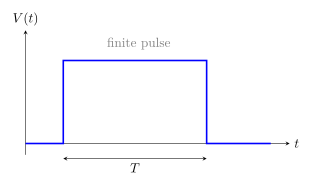
图 1 的有限矩形脉冲包含一系列 Fourier frequencies;\(T\) 越长,共振峰越窄。
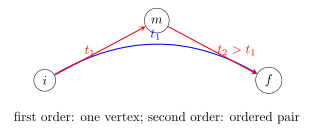
图 2 把 Dyson terms 画成 ordered interaction histories;中间态 \(m\) 不必是最终可观测态。
2. Transition amplitudes and probabilities / 跃迁振幅与概率
Knowledge ID: P07-U07-L02-K02
对 harmonic perturbation \(V(t)=2H'\cos\omega t\),吸收项在 \(\omega\approx\omega_{fi}>0\) 附近给出
\[P_{fi}(T)\approx\frac{4\lvert H'_{fi}\rvert^2}{\hbar^2} \frac{\sin^2[(\omega_{fi}-\omega)T/2]}{(\omega_{fi}-\omega)^2}.\]
共振处极限为 \(P\approx\lvert H'_{fi}\rvert^2T^2/\hbar^2\)。峰高增长为 \(T^2\)、宽度约 \(1/T\),但对 continuum 积分后的总概率增长为 \(T\)。amplitudes 能相干相加;只有在终态 orthogonal 或 phase information 丢失后才可直接加 probabilities。
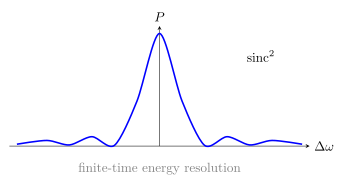
图 3 的旁瓣提醒我们 finite-time pulse 不是 exact delta function。
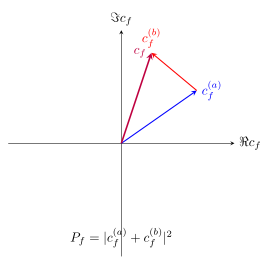
图 4 显示两条不可区分路径必须先加 complex amplitudes,interference term 可能正也可能负。
3. Fermi's golden rule / 费米黄金规则
Knowledge ID: P07-U07-L02-K03
当终态近似连续、matrix element 与 density of states 在有限 linewidth 内缓变,长时间极限使 sinc-squared kernel 成为 delta distribution:
\[\Gamma_{i\to\mathcal C}=\frac{2\pi}{\hbar}\lvert M_{fi}\rvert^2\rho(E_f), \qquad E_f=E_i+\hbar\omega\]
(吸收情形;发射改变能量符号)。\(\rho\) 的定义必须与 state normalization 一致。golden rule 是 weak-coupling、Markov-like long-time window 的 rate;非常短时仍是 quadratic survival,极长时 depletion 又破坏“初态布居不变”的推导。
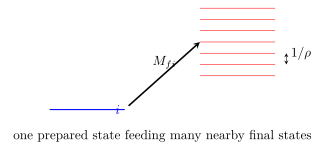
图 5 说明 continuum density 将单个小 probability 转成有限总 rate。
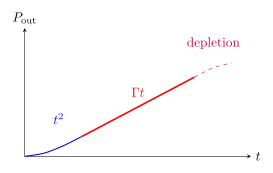
图 6 划出 golden-rule linear window;它既不是 \(t=0\) 的精确行为,也不能无限延伸到 probability 超过 1。
4. Selection rules / 选择定则
Knowledge ID: P07-U07-L02-K04
若 \(V\) 在某 symmetry 下有确定 transformation,matrix element 可因 integrand parity 或 angular momentum algebra 为零。例如 electric-dipole operator \(\mathbf d=q\mathbf r\) 是 odd parity,因此连接相反 parity states;central-field orbital rule 为 \(\Delta\ell=\pm1\),spherical component 给 \(\Delta m=0,\pm1\)。但 finite wavelength、magnetic dipole、quadrupole、external-field mixing 会允许原本 electric-dipole-forbidden 的弱跃迁。
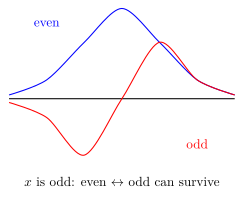
图 7 展示 parity selection 的 integrand 逻辑,而非把“allowed”当作 probability 必为 1。
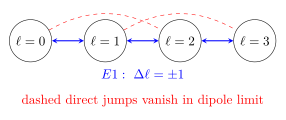
图 8 是 electric-dipole orbital rule 的 schematic;spin 与 total angular momentum 需使用对应 coupled basis。
5. Adiabatic and sudden approximations / 绝热与突然近似
Knowledge ID: P07-U07-L02-K05
若 instantaneous eigenstates 满足 \(H(t)\lvert n(t)\rangle=E_n(t)\lvert n(t)\rangle\),一个常用局域 adiabatic criterion 是
\[\frac{\hbar\lvert\langle m(t)\rvert\dot H(t)\lvert n(t)\rangle\rvert} {\lvert E_m(t)-E_n(t)\rvert^2}\ll1.\]
系统随后同一 instantaneous branch,并积累 dynamical phase 与可能的 geometric phase。相反,若 pulse duration \(\tau\ll\hbar/\Delta E\),Schrödinger-picture state 在 pulse 中近似不变;pulse 后对新 eigenbasis 的概率是 overlaps \(\lvert\langle n_{\rm new}\vert\psi_{\rm old}\rangle\rvert^2\)。
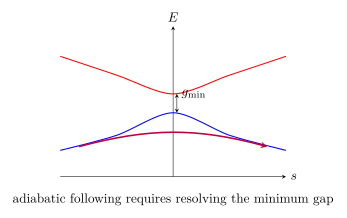
图 9 的 avoided crossing 显示最小 gap 控制困难程度;exact crossing 或 degeneracy 需额外分析。
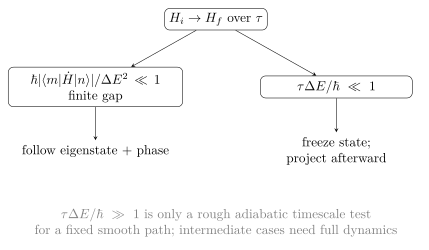
图 10 明确两个极限的不同“保持不变”:adiabatic 保持 branch label,sudden 保持 state vector。绝热分支使用 matrix-element-weighted criterion;单独的 \(\tau\Delta E/\hbar\gg1\) 只是在路径形状固定且平滑、gap 不闭合时的粗略 timescale heuristic。
Worked Examples / 完整例题
Worked Example 1 — 弱共振脉冲的一阶概率
已知。 两能级 gap 与 drive 共振,\(\lvert H'_{fi}\rvert=0.0500\,\mu\mathrm{eV}\),\(T=0.200\,\mathrm{ns}\)。
系统、参考系与模型。 孤立二能级,能量以 \(H_0\) eigenbasis 表示;weak harmonic drive、first order。
计算。 共振极限 \(P=(H'T/\hbar)^2\)。用 \(\hbar=6.58212\times10^{-16}\,\mathrm{eV\,s}\),\(H'T/\hbar=0.01519\),故 \(P=2.31\times10^{-4}\)。
检查与解释。 组合无量纲且 \(P\ll1\),自洽;若把 \(T\) 增大到使 \(P\sim1\),应改用 Rabi oscillation 而非继续二次增长。
Worked Example 2 — Golden-rule continuum rate
已知。 \(\lvert M\rvert=2.00\,\mu\mathrm{eV}\),\(\rho=1.00\times10^3\,\mathrm{eV^{-1}}\)。
系统与模型。 一个 prepared discrete state 耦合到 narrow energy shell 内近似平坦的 continuum;初态 depletion 可忽略。
计算。 \(\Gamma=(2\pi/\hbar)M^2\rho=2\pi(4.00\times10^{-12})(10^3)/(6.58212\times10^{-16})=3.82\times10^7\,\mathrm{s^{-1}}\)。lifetime \(\tau=1/\Gamma=26.2\,\mathrm{ns}\)。
检查与解释。 \(M^2\rho\) 单位 eV,除以 \(\hbar\) 得 \(\mathrm{s^{-1}}\);短于 reservoir correlation time 或接近 \(26\,\mathrm{ns}\) 大幅 depletion 时,simple linear law 需修正。
Worked Example 3 — Harmonic oscillator 的 dipole selection
已知。 perturbation \(V(t)=-qE(t)x\),初态 \(\lvert0\rangle\)。
系统、坐标与模型。 一维 oscillator,\(x\) 从 equilibrium 向右为正;electric-dipole approximation。
推导。 \(x=\sqrt{\hbar/(2m\omega_0)}(a+a^\dagger)\),所以 \(\langle n\rvert x\lvert0\rangle=\sqrt{\hbar/(2m\omega_0)}\delta_{n1}\)。一阶只连接 \(n=1\)。
检查与解释。 \(x\) 是 odd operator,基态 even,因此终态必须 odd;\(n=3\) 虽为 odd,但 linear ladder operator 仍使其 matrix element 为零,说明 parity rule 只是必要而非充分条件。
Worked Example 4 — 磁场方向突然转动
已知。 spin-\(1/2\) 初态沿旧磁场为 \(\lvert+z\rangle\),磁场瞬时转到与 \(z\) 夹角 \(60.0^\circ\) 的方向 \(\mathbf n\),magnitude 不变。
系统、参考系与模型。 实验室系;switch time \(\tau\ll\hbar/\Delta E\),使用 sudden approximation。
计算。 state 不变,但新 ground/excited basis 中 \(P_{+\mathbf n}=\lvert\langle+\mathbf n\vert+z\rangle\rvert^2=\cos^2(30^\circ)=0.750\),\(P_{-\mathbf n}=0.250\)。
检查与解释。 probabilities 和为 1;若旋转无限慢且 gap 不闭合,adiabatic limit 会给 \(P_{+\mathbf n}\to1\),两极限清楚不同。
Lesson synthesis / 全课综合
建模顺序:指定 \(H_0\) eigenbasis 与 drive;把 matrix element、phase factor 和 pulse envelope 分开;先算 amplitude 再平方;continuum 才引入 \(\rho\) 与 rate;用 symmetry 在积分前筛掉零矩阵元;最后比较 \(\tau\) 与 \(\hbar/\Delta E\),判断 adiabatic、sudden 或必须完整求解。
Formula-and-decision table / 公式与决策表
| Need | Formula | Use when | Limitation |
|---|---|---|---|
| 一阶振幅 | \(c_f^{(1)}=-(i/\hbar)\int e^{i\omega_{fi}t}V_{fi}(t)dt\) | weak drive | \(P\) 必须远小于 1 |
| 有限时共振 | \(P\propto\sin^2(\Delta\omega T/2)/\Delta\omega^2\) | square pulse | envelope 改变 line shape |
| Golden rule | \(\Gamma=(2\pi/\hbar)\lvert M\rvert^2\rho\) | weak coupling to continuum | short-time 与 depletion regimes 失效 |
| E1 parity | initial/final parity opposite | electric-dipole operator | 其他 multipoles 可绕开 |
| E1 orbital rule | \(\Delta\ell=\pm1\),\(\Delta m=0,\pm1\) | central-field dipole approximation | coupled angular momenta 需重写 |
| Adiabatic test | \(\hbar\lvert\langle m\rvert\dot H\lvert n\rangle\rvert/\Delta E^2\ll1\) | smooth finite-gap path | degeneracy 附近危险 |
| Sudden test | \(\tau\Delta E/\hbar\ll1\) | ultrashort change | pulse area 很大时仍可发生 kick |
Model boundaries / 模型边界
- First-order amplitude 不保持长期 exact unitarity;\(P\sim1\) 时必须 resummation。
- Golden rule 需要 continuum coarse graining;对少数离散态会出现 coherent recurrence。
- Density of states 与 matrix-element normalization 必须配套,否则 rate 的体积因子错误。
- Selection rules 依赖 perturbation multipolarity、polarization、external-field mixing 和 chosen quantum numbers。
- Adiabatic condition 是 matrix-element weighted,不仅是“变化慢”;gap closing 尤其危险。
- Sudden approximation 不是“Hamiltonian 无影响”,而是 pulse 后 state 在新 basis 中被重新分解。
- Environmental decoherence 会把 coherent amplitude dynamics 变成 master-equation behavior,留待 Unit 7.8。
Misconception clinic / 误区诊所
- “振幅就是概率。” 振幅可复且能相干相加;概率是绝对值平方。
- “能量不完全相等就绝不跃迁。” finite time 有 linewidth;exact delta 只来自受控 long-time limit。
- “Golden rule 对单一离散终态也给恒定 rate。” 离散两能级通常表现为 coherent oscillation。
- “selection rule 说 forbidden 就永远为零。” 它只针对指定 operator order 与 symmetry;弱 higher-multipole transition 可非零。
- “adiabatic 表示系统停在原始 vector。” 它跟随 instantaneous eigenvector;sudden 才近似冻结原 vector。
- “slow compared with laboratory second 即 adiabatic。” 应比较 internal gap timescale \(\hbar/\Delta E\)。
Practice and retrieval / 练习与提取
- K01: 写出一阶 interaction-picture amplitude,并解释 exponential phase。
- K01: 为什么 second-order Dyson integral 有 \(t_2>t_1\)?
- K02: square pulse 长度加倍时,共振峰高度和宽度怎样变?
- K02: 两路径振幅 \(a\) 与 \(ia\) 相加,probability 是多少(以 \(\lvert a\rvert^2\) 表示)?
- K03: 若 \(M\) 加倍、\(\rho\) 减半,\(\Gamma\) 变为几倍?
- K03: 说明 golden-rule rate 的单位。
- K04: 一维 parity-even 初态在 odd perturbation 下可连接何种 parity?
- K04: 为什么 \(\Delta\ell=0\) 的 E1 transition 在 central field 中消失?
- K05: sudden quench 后如何求新能量测量概率?
- 综合: drive 接近 continuum threshold 且 density rapidly varies 时,应修改哪一步?
Answers / 答案
- \(c_f^{(1)}=-(i/\hbar)\int e^{i\omega_{fi}t}V_{fi}(t)dt\);phase 记录未扰初末态的相对演化并选择 resonant Fourier component。
- time-ordering 保证 evolution operator 的因果顺序;当不同时刻的 \(V_I\) 不 commute 时不可把顺序丢掉。
- 中心峰 \(P(0)\propto T^2\) 变 4 倍,特征宽度 \(\propto1/T\) 减半。
- \(\lvert a+ia\rvert^2=2\lvert a\rvert^2\)。
- \(\Gamma\propto M^2\rho\),故变为 \(4\times1/2=2\) 倍。
- \(M^2\rho\) 为能量,除以 \(\hbar\)(energy·time)得 \(\mathrm{s^{-1}}\)。
- odd operator 使 integrand 只有在 final parity 与 initial 相反时为 even,故连接 odd final state。
- dipole operator 是 rank-1 odd tensor;angular integral 的三角/奇偶条件排除 \(\ell_f=\ell_i\)。
- state vector 近似保持 \(\lvert\psi_{\rm old}\rangle\),概率为 \(\lvert\langle n_{\rm new}\vert\psi_{\rm old}\rangle\rvert^2\)。
- 不能把 \(M\) 与 \(\rho\) 从 sinc kernel 中取出;应保留能量依赖并对 finite-time kernel 作积分,必要时使用 threshold dynamics。
Exit ticket / 离堂检验
- 画出“amplitude → probability → continuum sum → rate”的逻辑链,并给出每一步单位。
- 对同一 quench 分别描述 adiabatic 与 sudden 极限中“保持”的对象。
References and source notes / 参考资料与来源说明
以下来源均于 2026-08-30 实际打开核验。
- MIT OCW 8.06 (2018), Chapter 4: Time-Dependent Perturbation Theory
- MIT OCW 8.06, Time-Dependent Perturbation Theory and Adiabatic Approximation
- MIT OCW 8.06 (2018), Chapter 6: Adiabatic Approximation
- University of Texas at Austin, Upper-Division Quantum Mechanics Notes
- Cornell ECE 5310 Quantum Optics Lecture Map
Source-to-content map
| Source | Used for | Knowledge ID / Section | Model boundary or convention |
|---|---|---|---|
| MIT Chapter 4 | interaction picture, finite-time kernel, golden rule | K01–K03 | first-order amplitude convention stated |
| MIT time-dependent lecture map | selection rules, lifetimes and teaching sequence | K01–K04 | videos treated as direct course material |
| MIT Chapter 6 | adiabatic theorem, gap criterion | K05 | nondegenerate finite-gap path |
| UT Austin notes | independent derivation check | K01–K05 | notation converted to \(\omega_{fi}\) |
| Cornell ECE 5310 | density-matrix and two-level limits, decoherence boundary | K02–K05 | used to delimit coherent model |
复习与拓展
- 下一课把 stationary Lippmann–Schwinger expansion 与 Born approximation 联系起来。
- Unit 7.8 用 density operator 描述 phase information 丢失后的 dynamics。
- Atomic Physics 用 E1 selection rules、golden rule 与 lifetime 解释 spectra。
- 可扩展为 exact driven two-level simulation,比较 perturbative sinc 与 Rabi formula。