
Learning objectives / 学习目标
- 由 incident plane wave 与 outgoing spherical wave 定义 \(f(\theta,\phi)\)、\(d\sigma/d\Omega\) 和 total cross section。
- 从 Lippmann–Schwinger equation 得到 first Born approximation,并解释 momentum transfer \(\mathbf q\)。
- 对 central potential 展开 partial waves,计算 \(\delta_\ell\)、\(\sigma_\ell\) 与 optical theorem。
- 用 phase shift 通过 \(\pi/2\) 识别 resonance,区分 resonance energy、width 与 lifetime。
- 检查 flux normalization、reduced mass、short-range 条件、unitarity 与 identical-particle 修正边界。
Prerequisites / 先修知识
- Wave Functions and Probability:probability current。
- Central Potentials:radial equation、\(\ell\) barrier。
- Approximation Methods:Born series 的小参数思想。
- Legendre polynomial、solid angle 与 Fourier transform。
Scope and conventions / 范围与约定
- 两体弹性散射化为相对坐标,质量取 reduced mass \(\mu\);center-of-mass frame 中 \(k=\sqrt{2\mu E}/\hbar\)。
- 入射沿 \(+z\),远场 \(r\) 大于 potential range;\(f\) 的单位是 length,cross section 单位是 \(\mathrm{m^2}\)。
- 默认 distinguishable particles、real short-range central potential;Coulomb long range 需要 modified asymptotics。
- plane-wave normalization 与 Green function convention 固定为本课公式;换 convention 时 \(2\pi\) 因子必须整体一致。
- 本课不处理 inelastic channels、spin-dependent scattering、relativistic S-matrix 或 many-body targets。
Notation and modeling contract / 符号与建模契约
| Symbol | Meaning | Unit |
|---|---|---|
| \(\mathbf k,\mathbf k'\) | incident/final wave vector | \(\mathrm{m^{-1}}\) |
| \(\mathbf q=\mathbf k'-\mathbf k\) | momentum-transfer wave vector | \(\mathrm{m^{-1}}\) |
| \(f(\theta,\phi)\) | scattering amplitude | m |
| \(d\sigma/d\Omega\) | differential cross section | \(\mathrm{m^2\,sr^{-1}}\) |
| \(\delta_\ell\) | partial-wave phase shift | rad |
| \(S_\ell=e^{2i\delta_\ell}\) | elastic partial S matrix | 1 |
| \(\Gamma\) | resonance energy width | J 或 eV |
1. Scattering amplitude and differential cross section / 散射振幅与微分截面
Knowledge ID: P07-U07-L03-K01
远离 localized target,stationary solution 采用 asymptotic form
\[\psi(\mathbf r)\sim e^{ikz}+f(\theta,\phi)\frac{e^{ikr}}{r}.\]
plane wave 提供 incident flux \(j_{\rm in}=\hbar k/\mu\);spherical wave 在 solid angle \(d\Omega\) 中的 radial flux 给
\[\frac{d\sigma}{d\Omega}=\frac{r^2j_{\rm sc}}{j_{\rm in}}=\lvert f(\theta,\phi)\rvert^2, \qquad \sigma=\int\lvert f\rvert^2d\Omega.\]
\(f\) 的 phase 虽不直接出现在单一角度强度中,却通过 interference、optical theorem 与多中心散射可测。
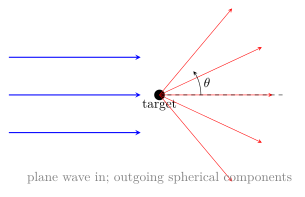
图 1 给出 scattering boundary condition;红箭头是 far-field directions,不是 classical trajectories。
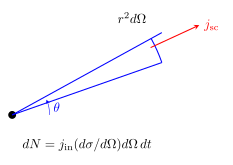
图 2 把 detector area、solid angle 与 cross section 的 operational definition 对齐。
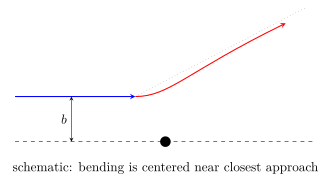
图 3 用 impact parameter 提供 \(\ell\sim kb\) 的直觉;quantum calculation 仍由 wave amplitude 完成。
2. Born approximation / 玻恩近似
Knowledge ID: P07-U07-L03-K02
Lippmann–Schwinger equation 是
\[\lvert\psi^{(+)}\rangle=\lvert\mathbf k\rangle+ \frac{1}{E-H_0+i0}\,V\lvert\psi^{(+)}\rangle.\]
以 incident plane wave 替换右侧 exact state 得 first Born amplitude
\[f_B(\mathbf q)=-\frac{\mu}{2\pi\hbar^2} \int e^{-i\mathbf q\cdot\mathbf r}V(\mathbf r)d^3r, \qquad \mathbf q=\mathbf k'-\mathbf k.\]
对 elastic scattering,\(q=2k\sin(\theta/2)\)。因此 angular pattern 是 potential 的 spatial Fourier transform。Born approximation 适合 weak potential 或 high energy;它常在低能强散射、near resonance 和长程 Coulomb forward direction 失效。
判断 Born 是否可信时,不能只说“入射能量很高”。还要比较势在一个穿越时间内积累的相位是否很小,并查看算出的 partial amplitudes 是否接近 unitarity 上限。若 Born 结果随耦合增强无限长大,而精确弹性通道必须满足 \(\sin^2\delta_\ell\le1\),这就是近似已经越界的直接信号。对于长程势,远距离的大量微小偏转还能累积成显著 forward amplitude,因而需要修改渐近态而非简单截断积分。
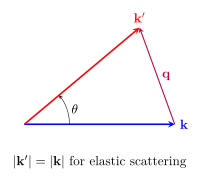
图 4 定义 momentum-transfer triangle;注意本课 \(\mathbf q\) 是 wave-vector transfer,真实 momentum transfer 为 \(\hbar\mathbf q\)。
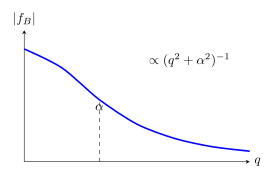
图 5 是 Yukawa-type potential 的 Born amplitude:较短 range(较大 \(\alpha\))使 Fourier pattern 更宽。
3. Partial-wave analysis / 分波分析
Knowledge ID: P07-U07-L03-K03
central potential 保持 \(\ell\),可将 amplitude 写成
\[f(\theta)=\frac{1}{k}\sum_{\ell=0}^{\infty}(2\ell+1)e^{i\delta_\ell}\sin\delta_\ell\,P_\ell(\cos\theta).\]
各通道 cross section 与总截面为
\[\sigma_\ell=\frac{4\pi}{k^2}(2\ell+1)\sin^2\delta_\ell, \qquad \sigma=\sum_\ell\sigma_\ell.\]
elastic unitarity 给 \(\lvert S_\ell\rvert=1\)。forward amplitude 还满足 optical theorem:
\[\sigma_{\rm tot}=\frac{4\pi}{k}\operatorname{Im}f(0).\]
低能 \(kR\ll1\) 时 centrifugal barrier 抑制 \(\ell>0\),通常由 \(s\) wave 主导;但 identical fermions 的 symmetry 可排除某些 channels。
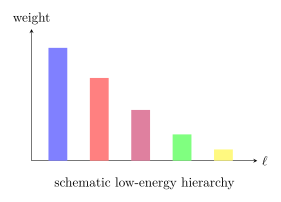
图 6 不是 universal numerical spectrum,而是 \(kR\) 小时 high-\(\ell\) 通道被 barrier 过滤的图景。
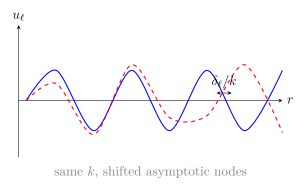
图 7 将 phase shift 解释为相对 free radial wave 的远场节点偏移;它汇总了 potential region 的全部影响。
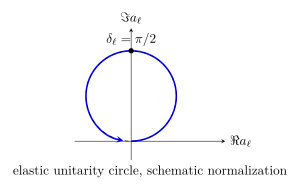
图 8 的 Argand trajectory 表示 elastic amplitude 受 unitarity 约束,不可任意增大。
4. Resonances and phase shifts / 共振与相移
Knowledge ID: P07-U07-L03-K04
当 centrifugal barrier 或 attractive pocket 支持 quasi-bound state,某个 \(\delta_\ell(E)\) 在 \(E_r\) 附近迅速通过 \(\pi/2\)。Breit–Wigner form 可写为
\[\sin^2\delta_\ell(E)\approx \frac{(\Gamma/2)^2}{(E-E_r)^2+(\Gamma/2)^2}, \qquad \tau\sim\frac{\hbar}{\Gamma}.\]
\(\Gamma\) 是 energy width,不是 rate;\(\Gamma/\hbar\) 才是 inverse-time scale。background phase 与 overlapping channels 会使 line shape 不对称,不能每个峰都机械拟合成 isolated Lorentzian。
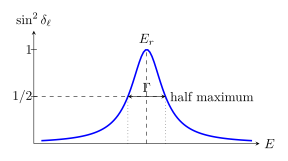
图 9 使用 \(E_r=3\)、\(\Gamma=1\) 的 normalized Lorentzian schematic;半高交点严格位于 \(E_r\pm\Gamma/2\),两点之差才是 full width at half maximum。
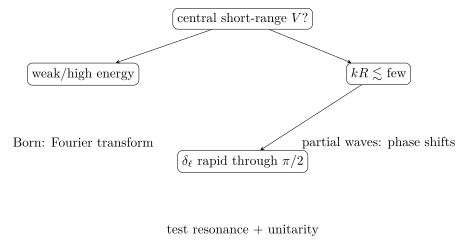
图 10 是 scattering decision map;Born 与 partial waves 不是互斥语言,但控制条件不同。
Worked Examples / 完整例题
Worked Example 1 — 由 amplitude 积分 total cross section
已知。 \(f(\theta)=a\cos\theta\),\(a=2.00\,\mathrm{fm}\)。
系统、参考系与模型。 distinguishable elastic scattering,入射沿 \(+z\),azimuthal symmetry。
计算。 \(d\sigma/d\Omega=a^2\cos^2\theta\);\(\sigma=2\pi a^2\int_0^\pi\cos^2\theta\sin\theta d\theta=4\pi a^2/3=16.8\,\mathrm{fm^2}\)。
检查与解释。 \(f\) 是 length,因此截面为 area;前后方向最大、\(90^\circ\) 为 node。结果非负且 finite。
Worked Example 2 — Yukawa Born amplitude
已知。 用 \(f_B=-A/(q^2+\alpha^2)\),\(A=1.00\,\mathrm{nm^{-1}}\)、\(\alpha=2.00\,\mathrm{nm^{-1}}\)、\(k=3.00\,\mathrm{nm^{-1}}\),\(\theta=60.0^\circ\)。
系统与模型。 center-of-mass elastic scattering;weak screened potential,first Born valid。
计算。 \(q=2k\sin30^\circ=3.00\,\mathrm{nm^{-1}}\),\(f_B=-1/(9+4)\,\mathrm{nm}=-0.0769\,\mathrm{nm}\),\(d\sigma/d\Omega=5.92\times10^{-3}\,\mathrm{nm^2\,sr^{-1}}\)。
检查与解释。 \(A/(q^2+\alpha^2)\) 单位 nm;large angle 增大 \(q\) 并压低强度,符合 screened smooth potential 的 forward peaking。
Worked Example 3 — 低能 \(s\)-wave scattering length
已知。 \(a_s=0.400\,\mathrm{nm}\)、\(k=0.200\,\mathrm{nm^{-1}}\),采用 \(f_0=-a_s/(1+ika_s)\)。
系统与模型。 distinguishable particles、short-range potential、仅 \(s\) wave。
计算。 \(\sigma=4\pi\lvert f_0\rvert^2=4\pi a_s^2/(1+k^2a_s^2)=2.00\,\mathrm{nm^2}\)(3 s.f.)。
检查与解释。 \(ka_s=0.0800\ll1\),接近 threshold limit \(4\pi a_s^2=2.01\,\mathrm{nm^2}\);denominator 提供 elastic unitarity correction。
Worked Example 4 — \(p\)-wave resonance 的 unitarity peak
已知。 \(\ell=1\),\(k_r=2.00\,\mathrm{fm^{-1}}\),resonance center 有 \(\delta_1=\pi/2\)。
系统与模型。 单一 elastic channel,background 可忽略。
计算。 \(\sigma_1=(4\pi/k_r^2)(2\ell+1)\sin^2\delta_1=(4\pi/4)3=3\pi=9.42\,\mathrm{fm^2}\)。
检查与解释。 达到该 partial wave 的 unitarity maximum;若测得更大且仍声称单一 \(p\) channel,说明 normalization、inelastic channels 或背景处理有误。
Lesson synthesis / 全课综合
从 observable 倒推理论:先用 flux 定义 \(d\sigma/d\Omega\);弱/高能时用 potential Fourier transform 的 Born picture;central potential 下用 phase shifts 保证 unitarity;低能只保留少数 \(\ell\);若 \(\delta_\ell\) 快速过 \(\pi/2\),再用 resonance width 连接 lifetime。每一步都要声明 reduced mass、normalization 与 asymptotic range。
更具体地说,实验给出的角分布不是势函数的“照片”。Born 近似下它主要读取势的傅里叶分量,但测量通常只给振幅绝对值平方,phase information 还要借助干涉或 optical theorem。分波方法则把同一信息重新组织为各角动量通道的相移:低能粒子只能穿透少数 centrifugal barriers,高能粒子可调用更多 \(\ell\)。因此判断一个峰是否为共振,不能只看截面变大,还要检查相移随能量的连续变化、峰宽是否与 lifetime 相容,以及各通道的 unitarity 是否满足。
Formula-and-decision table / 公式与决策表
| Need | Formula | Use when | Limitation |
|---|---|---|---|
| Differential cross section | \(d\sigma/d\Omega=\lvert f\rvert^2\) | elastic same-\(k\) convention | inelastic 需 flux ratio |
| Born amplitude | \(f_B=-(\mu/2\pi\hbar^2)\int e^{-i\mathbf q\cdot\mathbf r}Vd^3r\) | weak/high-energy potential | resonance/strong low-energy failure |
| Momentum transfer | \(q=2k\sin(\theta/2)\) | elastic CM scattering | lab frame may differ |
| Partial amplitude | \(f=(1/k)\sum(2\ell+1)e^{i\delta_\ell}\sin\delta_\ell P_\ell\) | central potential | noncentral mixes \(\ell,m\) |
| Partial cross section | \(\sigma_\ell=4\pi(2\ell+1)\sin^2\delta_\ell/k^2\) | elastic channel | absorption gives complex phase shift |
| Optical theorem | \(\sigma_{\rm tot}=4\pi\operatorname{Im}f(0)/k\) | consistent normalization | long-range subtleties |
| Lifetime-width | \(\tau\sim\hbar/\Gamma\) | isolated exponential resonance | overlapping resonances complicate |
Model boundaries / 模型边界
- Coulomb potential 不够 short range,standard plane-plus-spherical asymptotics 与 partial sums 需修正。
- Inelastic scattering 有 \(k_f/k_i\) flux factor,\(d\sigma/d\Omega\) 不再仅为 \(\lvert f\rvert^2\)。
- Born approximation 可能违反 partial-wave unitarity,尤其 near resonance。
- Identical particles 要 (anti)symmetrize \(f(\theta)\pm f(\pi-\theta)\) 并避免 double counting final states。
- Spin、internal target excitation 与 coupled channels 将 \(S_\ell\) 推广为 matrix。
- Breit–Wigner 只适合 isolated pole plus slowly varying background。
- Cross section 是 ensemble flux ratio,不是单粒子几何“撞中面积”。
Misconception clinic / 误区诊所
- “散射粒子沿图中的红线经典飞行。” 红线标记 outgoing wave directions;quantum amplitude 在所有方向同时存在。
- “\(f\) 就是 probability。” \(f\) 有长度单位且带 phase;\(\lvert f\rvert^2\) 才给每立体角截面。
- “Born 对高 barrier 也因能量高就总有效。” 应检验 integrated phase/coupling;forward long-range 部分仍可能失败。
- “高 \(\ell\) 永远不重要。” 低能 short-range 时常被抑制;高能时可有许多 partial waves。
- “phase shift 只是任意整体相位。” 它是 interacting 与 free asymptotic radial wave 的相对相位,影响可观测截面。
- “任何峰都是新粒子/准束缚态。” threshold cusp、interference 与 detector acceptance 也可造峰,需 phase motion 与 channel analysis。
Practice and retrieval / 练习与提取
- K01: 说明 \(f\) 的单位并由 flux 推出 cross-section 单位。
- K01: 若 isotropic \(f=a\),求 total cross section。
- K02: elastic scattering 中 \(\theta=180^\circ\) 时 \(q\) 是多少?
- K02: 为什么 Born amplitude 反映 potential 的 spatial scale?
- K03: \(\delta_0=0.20\)、\(k=1.0\,\mathrm{nm^{-1}}\),求 \(\sigma_0\)。
- K03: 写出 optical theorem 并说明它体现什么守恒。
- K03: \(kR\ll1\) 时为何 \(s\) wave 常主导?
- K04: 若 \(\Gamma=1.0\,\mu\mathrm{eV}\),估算 lifetime。
- K04: isolated resonance center 的 \(\delta_\ell\) 约多少?
- 综合: 强低能势出现窄峰时,应选 Born 还是 partial-wave method?列出两项审计。
Answers / 答案
- outgoing wave 为 \(f e^{ikr}/r\),故 \(f\) 为 m;\(\lvert f\rvert^2\) 为 \(\mathrm{m^2\,sr^{-1}}\)(steradian 无量纲但保留标签)。
- \(\sigma=\int\lvert a\rvert^2d\Omega=4\pi\lvert a\rvert^2\)。
- \(q=2k\sin90^\circ=2k\)。
- \(f_B\) 是 \(V(\mathbf r)\) 在 \(\mathbf q\) 的 Fourier transform;窄 real-space structure 产生宽 \(q\) distribution,反之亦然。
- \(\sigma_0=4\pi\sin^2(0.20)/k^2=0.496\,\mathrm{nm^2}\)。
- \(\sigma_{\rm tot}=4\pi\operatorname{Im}f(0)/k\);它把 forward interference 与散射出去的总 flux 联系起来,体现 unitarity/probability conservation。
- centrifugal barrier 约 \(\ell(\ell+1)\hbar^2/(2\mu r^2)\) 阻挡 high-\(\ell\) wave 进入 range \(R\)。
- \(\tau\sim\hbar/\Gamma=6.582\times10^{-16}/10^{-6}=6.58\times10^{-10}\,\mathrm{s}=0.658\,\mathrm{ns}\)。
- \(\delta_\ell\approx\pi/2\)(modulo background phase convention)。
- 选 partial waves/coupled-channel treatment;检查 \(\lvert S_\ell\rvert\) 的 unitarity 与 phase shift 是否快速通过 \(\pi/2\),Born 在强低能/共振处通常不可靠。
Exit ticket / 离堂检验
- 用一条式子把 \(f\)、\(d\sigma/d\Omega\) 与 detector count rate 连接起来。
- 解释“Born 看 Fourier transform、partial waves 看 phase shifts”怎样描述同一 potential,而非两个不同实验。
References and source notes / 参考资料与来源说明
以下来源均于 2026-08-30 实际打开核验。
- MIT OCW 8.06 (2018), Chapter 7: Scattering
- MIT OCW 8.06, Scattering and Identical Particles lectures
- University of Texas at Austin, Upper-Division Quantum Mechanics Notes
- MIT OCW 22.101 Applied Nuclear Physics, Lecture 7: Partial Waves and Phase Shifts
- MIT OCW 8.06 (2016), Readings and detailed scattering syllabus
Source-to-content map
| Source | Used for | Knowledge ID / Section | Model boundary or convention |
|---|---|---|---|
| MIT Chapter 7 | asymptotic amplitude, phase shifts, Born series | K01–K04 | short-range elastic convention |
| MIT scattering lectures | cross-section pedagogy, optical theorem, hard-sphere/resonance context | K01–K04 | original figures not copied |
| UT Austin notes | independent formula and normalization check | K01–K04 | \(\mathbf q\) defined as wave vector transfer |
| MIT 22.101 Lecture 7 | partial-wave and phase-shift method | K03–K04 | nuclear examples used only for method |
| MIT 8.06 readings | topic boundaries including low-energy and resonance scattering | K02–K04 | course syllabus as direct map |
复习与拓展
- 下一课加入 exchange symmetry 后,identical-particle angular pattern 会出现 \(f(\theta)\pm f(\pi-\theta)\)。
- Atomic/nuclear units 将使用 resonance width、cross section 与 selection rules。
- 可数值积分 radial equation,提取 \(\delta_\ell\) 并验证 optical theorem。
- 多通道扩展以 unitary \(S\) matrix 取代 scalar \(e^{2i\delta_\ell}\)。