
Learning objectives / 学习目标
- 区分 identical 与 merely similar particles,解释 permutation 不是物理轨迹交换。
- 构造二粒子 symmetric/antisymmetric states,并处理非正交轨道的 normalization。
- 从 antisymmetry 推导 Pauli exclusion,而不是把它作为额外排斥力。
- 推导 direct 与 exchange matrix elements,解释 exchange hole、singlet–triplet splitting 的条件。
- 构造、归一化并使用 \(N\)-fermion Slater determinant,说明 single-determinant model 的边界。
Prerequisites / 先修知识
- Spin 与 Addition of Angular Momentum。
- Quantum Scattering:amplitude interference。
- Tensor product、permutation group 的基本概念、determinant properties。
Scope and conventions / 范围与约定
- 单粒子完整坐标写作 \(x=(\mathbf r,s)\),包含空间与 spin;不能只对 spatial part 施加 fermionic antisymmetry。
- 交换算符 \(P_{12}\) 只互换 labels:\(P_{12}\Psi(x_1,x_2)=\Psi(x_2,x_1)\)。
- 三维 ordinary particles:integer-spin bosons 取 \(+\),half-integer-spin fermions 取 \(-\);spin–statistics theorem 的 relativistic proof 不在本课范围。
- observables 必须 permutation symmetric。交换相互作用是 antisymmetrization 与 ordinary interaction 的结果,不是新增经典力。
- SI;many-body energy 可用 J 或 eV。
Notation and modeling contract / 符号与建模契约
| Symbol | Meaning | Unit |
|---|---|---|
| \(P_{ij}\) | particle-label permutation operator | 1 |
| \(\eta\) | exchange eigenvalue,boson \(+1\)、fermion \(-1\) | 1 |
| \(\phi_a(x)\) | normalized spin-orbital | appropriate wave-function unit |
| \(S=\langle a\vert b\rangle\) | orbital overlap | 1 |
| \(J_{ab}\) | direct interaction integral | J |
| \(K_{ab}\) | exchange integral | J |
| \(\Phi\) | Slater determinant | many-body normalization unit |
1. Indistinguishability and exchange / 不可分辨性与交换
Knowledge ID: P07-U08-L01-K01
对 identical particles,交换 labels 后所有 measurement statistics 不变:
\[\lvert\Psi(x_1,x_2)\rvert^2=\lvert\Psi(x_2,x_1)\rvert^2.\]
在三维 single-valued quantum mechanics 中,可选 exchange eigenstates
\[P_{12}\lvert\Psi\rangle=\eta\lvert\Psi\rangle, \qquad \eta=\pm1.\]
global minus sign 不改变单次 probability,却会在“直接路径”和“交换路径”的 amplitude 相加时产生可测 interference。labels 是计算坐标,不是能给每个 identical particle 佩戴的永久姓名牌。
不可分辨性也约束 observable:可测算符必须在粒子交换下保持不变,否则它等价于假设实验装置能够读取并不存在的永久标签。实际探测器可以区分位置、动量或自旋结果,却不能回答“这一次左侧点击究竟属于编号 1 还是编号 2”。因此概率计算必须把产生同一记录的所有 assignments 先按 bosonic/fermionic sign 合并,再取绝对值平方;把它们当作两种经典互斥事件相加会丢失 exchange interference。
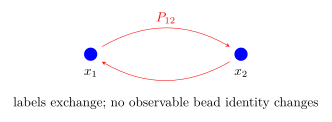
图 1 明确 permutation 是 Hilbert-space operation,而不是两条 classical worldline 被拖动。
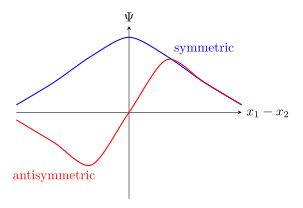
图 2 用 relative coordinate 显示 bosonic even 与 fermionic odd exchange parity;\(x_1=x_2\) 处 antisymmetric spatial wave vanishes。
2. Symmetric bosonic and antisymmetric fermionic states / 对称玻色态与反对称费米态
Knowledge ID: P07-U08-L01-K02
若 \(\phi_a,\phi_b\) 正交,二粒子 states 为
\[\Psi_\pm(x_1,x_2)=\frac{1}{\sqrt2} [\phi_a(x_1)\phi_b(x_2)\pm\phi_b(x_1)\phi_a(x_2)].\]
非正交时 normalization 改为 \([2(1\pm\lvert S\rvert^2)]^{-1/2}\)。对两个 electrons,总态必须 antisymmetric:spin singlet(antisymmetric spin)配 symmetric spatial part,triplet(symmetric spin)配 antisymmetric spatial part。
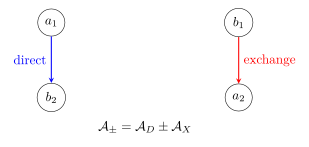
图 3 表示不可区分 assignment amplitudes 的加减;它不是两个 mutually exclusive classical events。
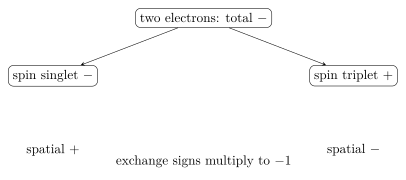
图 4 是 spin–space symmetry bookkeeping;遗漏 spin 会错误地宣称所有 electron spatial states 必须 antisymmetric。
3. Pauli exclusion principle / 泡利不相容原理
Knowledge ID: P07-U08-L01-K03
若两个 fermions 试图占据同一完整 spin-orbital \(\phi_a\),
\[\Psi_-(x_1,x_2)=\frac{1}{\sqrt2} [\phi_a(x_1)\phi_a(x_2)-\phi_a(x_1)\phi_a(x_2)]=0.\]
因此“同一 spatial orbital”仍可容纳两个 opposite-spin electrons,因为它们的 spin-orbitals 不同;同一完整 spin-orbital 才被排除。Pauli principle 是 state-space restriction,不是短程 repulsive potential。
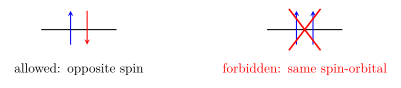
图 5 对比 spatial orbital 与 spin-orbital 的占据规则。
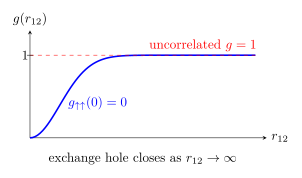
图 6 从非负 separation \(r_{12}=0\) 开始:parallel-spin pair correlation 在 coincidence 为零,并在大距离单调趋近 normalized uncorrelated reference \(g=1\)。exchange hole 可降低 Coulomb repulsion expectation,却不是新增 force field。
4. Exchange interaction / 交换相互作用
Knowledge ID: P07-U08-L01-K04
对 symmetric two-body interaction \(U(1,2)\) 与 orthonormal orbitals,
\[\langle\Psi_\pm\rvert U\lvert\Psi_\pm\rangle=J_{ab}\pm K_{ab},\]
\[J_{ab}=\iint\lvert a(1)\rvert^2U(1,2)\lvert b(2)\rvert^2d1d2,\]
\[K_{ab}=\iint a^*(1)b^*(2)U(1,2)b(1)a(2)d1d2.\]
\(K\) 需要 orbital overlap;轨道相隔很远时趋零。对 electrons,spatial symmetry 与 spin multiplet 绑定,因此 exchange energy 导致 singlet–triplet splitting。其 sign 与 magnitude 依赖 orbitals、interaction 和 model,不应背成“triplet 永远更低”的无条件定律。
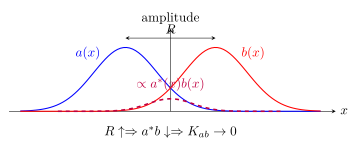
图 7 让两个 orbital tails 在中央同时非零,并单独画出与 \(a^*(x)b(x)\) 成比例的 overlap product;增大中心间距 \(R\) 会压低该 product,从而使 exchange integral \(K_{ab}\to0\)。
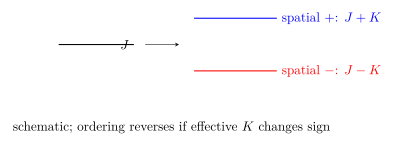
图 8 把 exchange splitting 与 ordinary two-body interaction expectation 联系起来。
5. Slater determinants / 斯莱特行列式
Knowledge ID: P07-U08-L01-K05
\(N\) 个 orthonormal spin-orbitals 构成 normalized fermionic state:
\[\Phi(x_1,\ldots,x_N)=\frac{1}{\sqrt{N!}} \det[\phi_i(x_j)].\]
交换任意两 particle coordinates 等于交换 determinant 两列,自动变号;两行相同则 determinant 为零,自动实现 Pauli principle。单个 determinant 精确描述 noninteracting independent particles,也构成 Hartree–Fock 基础;强 correlation 一般需要多个 determinants 的 linear combination。
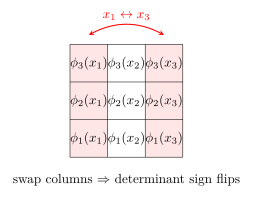
图 9 以三粒子 matrix 展示 antisymmetry 的线性代数来源。
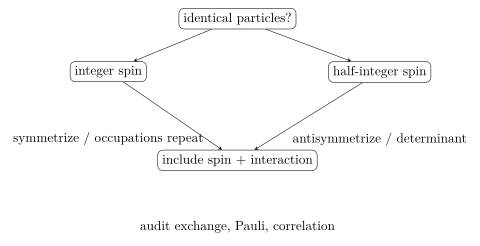
图 10 是 many-particle state construction workflow。
Worked Examples / 完整例题
Worked Example 1 — 非正交轨道的 exchange normalization
已知。 normalized \(a,b\) 的 overlap \(S=0.300\)(real)。
系统与模型。 两个 identical particles,single-particle overlap 已含 spatial/spin coordinates。
计算。 \(N_+=[2(1+S^2)]^{-1/2}=0.677\),\(N_-=[2(1-S^2)]^{-1/2}=0.741\)。states 为 \(N_+[a(1)b(2)+b(1)a(2)]\) 与 \(N_-[a(1)b(2)-b(1)a(2)]\)。
检查与解释。 \(S\to0\) 时两者都趋 \(1/\sqrt2\);\(S\to1\) 时 antisymmetric normalization diverges because numerator itself tends to zero—Pauli exclusion 的极限。
Worked Example 2 — 一维盒中的 bosons 与 spin-polarized fermions
已知。 两个不相互作用、同质量粒子在 \(L=1.00\,\mathrm{nm}\) infinite well;单粒子 \(E_n=n^2E_1\),电子质量给 \(E_1=0.376\,\mathrm{eV}\)。
系统、坐标与模型。 \(0<x<L\);比较 spinless bosons 与相同 spin 的 fermions。
计算。 bosonic ground state 可两者占 \(n=1\):\(E_B=2E_1=0.752\,\mathrm{eV}\)。fermions 必占 \(n=1,2\):\(E_F=(1+4)E_1=1.88\,\mathrm{eV}\)。
检查与解释。 差 \(1.13\,\mathrm{eV}\) 不是额外 repulsive potential,而是 allowed-state space 不同;若 electrons spin opposite,则可共占 spatial \(n=1\)。
Worked Example 3 — 两电子同一 spatial orbital 的 spin
已知。 两 electrons 都在 normalized spatial orbital \(\phi(\mathbf r)\)。
系统与模型。 完整 state 包含 spatial 与 spin;fermionic total state 必须 antisymmetric。
推导。 spatial product \(\phi(1)\phi(2)\) symmetric,因此 spin 必须是 singlet \((\lvert\uparrow\downarrow\rangle-\lvert\downarrow\uparrow\rangle)/\sqrt2\)。三个 triplet spin states 都 symmetric,若强行配同一 spatial orbital,总态违反 antisymmetry。
检查与解释。 结论允许两 electrons 共占一个 spatial orbital,但其 complete spin-orbitals 不同;这正是 atomic closed shell 的基础。
Worked Example 4 — Direct 与 exchange splitting
已知。 两 orthogonal orbitals 对 interaction 给 \(J=5.00\,\mathrm{eV}\)、\(K=0.300\,\mathrm{eV}\)。
系统与模型。 two-electron spatial states;忽略 spin-dependent Hamiltonian,spin 只通过 symmetry 配对。
计算。 symmetric spatial expectation \(J+K=5.30\,\mathrm{eV}\),antisymmetric spatial expectation \(J-K=4.70\,\mathrm{eV}\),splitting \(2K=0.600\,\mathrm{eV}\)。对应 singlet spatial \(+\)、triplet spatial \(-\)。
检查与解释。 能量单位正确;这个 ordering 依赖给定正 \(K\) 和模型。若 orbitals separated,\(K\to0\),splitting 消失。
Lesson synthesis / 全课综合
先把完整 single-particle coordinate(含 spin)写全,再由 particle species 选择 symmetric 或 antisymmetric sector;two-particle 问题显式加减 assignments,many-fermion 问题用 Slater determinant;最后才计算 interaction expectation,于是 direct/exchange terms 自然出现。Pauli 与 exchange 均来自 Hilbert-space symmetry,不应重新包装成 classical force。
在实际解题中,最容易漏掉的是“完整单粒子态”四个字。若两个电子空间轨道相同而自旋相反,它们仍占据不同 spin-orbitals,因而不违反 Pauli;若只画空间波函数便会误判。另一方面,反对称性造成的 coincidence node 会改变两体相互作用的期望值,所以 exchange energy 虽不是新力,却能真实改变光谱和磁性。判断能级顺序时必须实际计算 \(J\)、\(K\) 并结合 spin–space 对称性,不能只凭“平行自旋更稳定”的口诀。
Formula-and-decision table / 公式与决策表
| Need | Formula | Use when | Limitation |
|---|---|---|---|
| Exchange eigenvalue | \(P_{12}\Psi=\pm\Psi\) | identical particles in 3D | spin–statistics proof not supplied |
| Orthogonal two-state form | \([a(1)b(2)\pm b(1)a(2)]/\sqrt2\) | \(\langle a\vert b\rangle=0\) | nonorthogonal normalization differs |
| Nonorthogonal norm | \([2(1\pm\lvert S\rvert^2)]^{-1/2}\) | two normalized orbitals | antisymmetric state vanishes at \(S=1\) |
| Interaction energy | \(J\pm K\) | symmetric two-body \(U\) | sign/order model-dependent |
| Slater determinant | \((N!)^{-1/2}\det[\phi_i(x_j)]\) | orthonormal spin-orbitals | one determinant misses correlation |
| Identical scattering | \(f(\theta)\pm f(\pi-\theta)\) | indistinguishable final assignments | angular double counting must be handled |
Model boundaries / 模型边界
- Relativistic spin–statistics theorem is assumed, not derived.
- Anyons in effectively two-dimensional topological systems are beyond \(\eta=\pm1\) classification.
- Spatial antisymmetry alone is insufficient for fermions; the full spin-orbital state matters.
- Slater determinant basis assumes orthonormal spin-orbitals; nonorthogonal determinants require overlap matrices.
- Exchange energy is not a pair potential depending only on distance and can be nonlocal in orbital language.
- Hartree–Fock single determinant lacks dynamical correlation; configuration interaction or other many-body methods may be needed.
- At high temperature/low density, exchange effects can become small but particle identity does not disappear.
Misconception clinic / 误区诊所
- “identical 表示质量恰好相同。” 还需所有 intrinsic quantum numbers 相同;不同 isotope 或 internal state 可 distinguish。
- “交换时两个粒子真的绕路。” permutation changes labels in state representation, not measured trajectories。
- “fermions 不能在同一位置。” 同 spin spatial antisymmetry makes coincidence zero;opposite-spin electrons 可有 nonzero spatial coincidence。
- “Pauli 是一种强排斥力。” 它限制 allowed states,不在 Hamiltonian 增加 classical force term。
- “exchange interaction 没有 Coulomb 就仍是同样的能量项。” \(K\) is an interaction matrix element;无相应 interaction 时未必有 energy splitting。
- “单一 Slater determinant 是任意 fermion system 的 exact state。” 它自动 antisymmetrizes,但不能自动表示所有 correlation。
Practice and retrieval / 练习与提取
- K01: 为什么 \(\lvert\Psi(1,2)\rvert^2=\lvert\Psi(2,1)\rvert^2\) 不足以区分 boson/fermion?
- K01: 写出 exchange operator 的 eigenvalues。
- K02: 对 orthogonal \(a,b\) 构造 normalized symmetric state。
- K02: 两 electrons 的 spin triplet 应配何种 spatial symmetry?
- K03: 两 fermions 占同一完整 spin-orbital 时 determinant 为什么为零?
- K03: 两 opposite-spin electrons 能否占同一 spatial orbital?
- K04: overlap 趋零时 exchange integral 怎样变化?
- K04: 若 \(J=2.0\,\mathrm{eV},K=0.10\,\mathrm{eV}\),求两 spatial symmetry energies。
- K05: 交换 Slater determinant 的两 particle coordinates 会怎样?
- 综合: 对 spin-polarized identical fermions(等价地,symmetric spin sector),为何 spatial scattering amplitude 是 \(f(\theta)-f(\pi-\theta)\)?
Answers / 答案
- modulus equality 只说明 statistics unchanged;phase 可为 \(+\) 或 \(-\),二者在 exchange interference 中不同。
- 三维 ordinary particles 为 \(+1\) 与 \(-1\)。
- \([a(1)b(2)+b(1)a(2)]/\sqrt2\)。
- symmetric spin triplet 配 antisymmetric spatial state,使 total sign 为 \(-\)。
- determinant 有两相同行,故为零;等价地 antisymmetrized terms exact cancel。
- 可以,因为两 complete spin-orbitals \(\phi\uparrow\) 与 \(\phi\downarrow\) orthogonal。
- \(K\to0\),exchange splitting 消失。
- symmetric \(J+K=2.10\,\mathrm{eV}\);antisymmetric \(J-K=1.90\,\mathrm{eV}\)。
- 交换两 columns,使 total wave function 乘 \(-1\)。
- detector outcome cannot tell direct from exchanged assignment;symmetric spin state 要求 antisymmetric spatial sector,因此两条不可分辨 amplitudes 在平方前相减。若是 spin singlet,spatial sector symmetric,符号改为加号;还须按选定 angular domain 避免 double counting。
Exit ticket / 离堂检验
- 用一句话分别定义 indistinguishability、Pauli exclusion 与 exchange energy,避免把三者混为一谈。
- 给出一个 single determinant 可靠和一个不可靠的物理场景。
References and source notes / 参考资料与来源说明
以下来源均于 2026-08-30 实际打开核验。
- MIT 5.73, Chapter XI: Identical Particles
- MIT OCW 8.322 Quantum Theory II: Identical Particles lecture notes
- MIT OCW 8.06, Scattering and Identical Particles lectures
- UC San Diego Physics 212C, Advanced Quantum Mechanics Notes
- MIT OCW 8.513 Many-Body Theory, Identical Particles and Second Quantization
- MIT OCW 8.333, Lecture Note 22: Hilbert Space of Identical Particles
Source-to-content map
| Source | Used for | Knowledge ID / Section | Model boundary or convention |
|---|---|---|---|
| MIT 5.73 XI | symmetrization, determinants, Pauli | K01–K03, K05 | full spin-orbital coordinate emphasized |
| MIT 8.322 | identical-particle formalism | K01–K05 | graduate notation simplified to UG2 |
| MIT 8.06 lectures | exchange in scattering | K01–K04 | distinguishable baseline stated |
| UCSD 212C | Slater determinants and exclusion | K02–K05 | second quantization left as review hook |
| MIT 8.513 | exchange and occupation-number context | K04–K05 | many-body extension boundary |
| MIT 8.333 | identical-particle Hilbert space | K01–K03 | statistics link without redoing thermodynamics |
复习与拓展
- 下一课 formalizes tensor-product spaces and entanglement; exchange symmetry is a constraint within a composite Hilbert space, not identical to entanglement itself。
- Atomic structure uses Slater determinants, exchange, Hund rules and configuration interaction。
- Quantum statistics revisits occupation numbers and thermodynamic consequences。
- Scattering extension compares bosonic enhancement and fermionic suppression at symmetric angles。