
Learning objectives / 学习目标
完成本课后,你应能:
- 区分 absorption、spontaneous emission 与 stimulated emission 的初末态、对入射场的依赖和相干性。
- 在明确频谱密度约定后写出 Einstein rate equations,并由 Planck distribution 推导 \(A\)、\(B\) 系数及简并度关系。
- 从 electric-dipole interaction \(\hat H_{\mathrm{int}}=-\hat{\mathbf d}\cdot\mathbf E\) 解释 transition dipole、偏振选择与“能量允许但矩阵元为零”。
- 从指数衰减推导 Lorentzian natural line,正确区分角频率 FWHM 与普通频率 FWHM。
- 用 optical Bloch steady state 计算饱和布居、散射率和 power-broadened linewidth,并判断理想二能级模型何时失效。
Prerequisites / 先修知识
- Electronic and Molecular Spectroscopy:电子跃迁、荧光与光谱结构。
- Time-Dependent Processes:跃迁振幅、Fermi golden rule 与 selection rules。
- Energy and Momentum of Electromagnetic Fields:电磁能量密度与 photon momentum。
- 指数衰减、Fourier transform、复振幅和概率守恒。
Scope and conventions / 范围与约定
- 研究两个裸能级 \(\lvert1\rangle,\lvert2\rangle\),\(E_2>E_1\),\(\omega_0=(E_2-E_1)/\hbar\),能级简并度分别为 \(g_1,g_2\)。
- Einstein \(B\) 系数统一乘每单位普通频率的各向同性谱能量密度 \(u_\nu(\nu)\),单位 \(\mathrm{J\,m^{-3}\,Hz^{-1}}\)。若改用 \(u_\omega\),系数关系会出现 \(2\pi\) 因子;本课不混用。
- \(\Gamma\) 表示 excited-state population decay rate,单位 \(\mathrm{s^{-1}}\);若仅有一个 radiative channel,\(\Gamma=A_{21}=1/\tau\)。
- laser detuning 定义为 \(\Delta=\omega_L-\omega_0\);Rabi frequency 定义为 \(\Omega=\mathbf d_{21}\cdot\mathbf E_0/\hbar\) 的大小,后课继续固定这一 convention。
- 电偶极公式默认自由空间、Markov approximation、weak system–vacuum coupling。碰撞、Doppler、inhomogeneous、cavity Purcell effect 与非辐射衰减另行标明。
Notation and modeling contract / 符号与建模契约
| Symbol | Meaning | SI unit |
|---|---|---|
| \(N_1,N_2\) | 两能级 population density 或人数(同一方程中固定一种) | \(\mathrm{m^{-3}}\) 或 1 |
| \(A_{21}\) | 单粒子 spontaneous-emission probability rate | \(\mathrm{s^{-1}}\) |
| \(B_{12},B_{21}\) | 对 \(u_\nu\) 定义的 absorption / stimulated-emission coefficients | \(\mathrm{m^3\,J^{-1}\,s^{-2}}\) |
| \(\mathbf d_{21}=\langle2\lvert\hat{\mathbf d}\rvert1\rangle\) | transition electric dipole | \(\mathrm{C\,m}\) |
| \(\tau\) | population lifetime | s |
| \(\Gamma\) | population decay rate;也是理想自然线的 angular-frequency FWHM | \(\mathrm{s^{-1}}\) |
| \(\gamma_2\) | optical-coherence decay rate | \(\mathrm{s^{-1}}\) |
| \(\Omega\) | Rabi angular frequency | \(\mathrm{rad\,s^{-1}}\) |
| \(s\) | saturation parameter | 1 |
1. Absorption, spontaneous emission, and stimulated emission / 吸收、自发与受激辐射
Knowledge ID: P08-U03-L01-K01
1.1 三种过程的状态账本
Absorption 消耗一个 resonant photon 并使物质从 \(\lvert1\rangle\) 到 \(\lvert2\rangle\);stimulated emission 由已有场诱导 \(\lvert2\rangle\to\lvert1\rangle\),向驱动模增加一个与之同频、同偏振、相位相关的 photon;spontaneous emission 即便入射模真空也会发生,并把 photon 发射到真空允许模的概率分布中。
\[\hbar\omega_0=E_2-E_1.\]
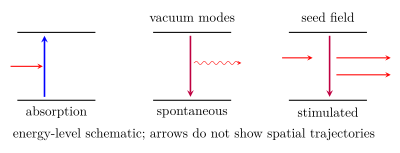
图 1 用同一能量账本比较三种过程。三者都须满足 energy conservation;但 spontaneous emission 的方向、偏振和起始相位呈概率分布,而 stimulated emission 对占据模有 Bose enhancement。
1.2 速率方程与净光子增益
对窄带 radiation field,在本课 convention 下
\[R_{\rm abs}=N_1B_{12}u_\nu(\nu_0),\]
\[R_{\rm stim}=N_2B_{21}u_\nu(\nu_0), \qquad R_{\rm sp}=N_2A_{21}.\]
若只看这两个能级,\(\dot N_2=R_{\rm abs}-R_{\rm stim}-R_{\rm sp}\)。净 stimulated photon production 需要 \(N_2B_{21}>N_1B_{12}\);若 \(g_1=g_2\),这就是 population inversion \(N_2>N_1\)。
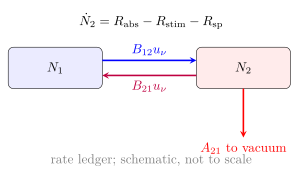
图 2 强调 spontaneous term 没有 \(u_\nu\) 因子;但量子场观点把它解释为真空涨落与 mode density 的共同结果,而非“没有相互作用”。
2. Einstein coefficients and detailed balance / 爱因斯坦系数与细致平衡
Knowledge ID: P08-U03-L01-K02
2.1 含简并度的平衡关系
热平衡时,每个 sublevel 的 Boltzmann population 相同,因此
\[\frac{N_2}{N_1}=\frac{g_2}{g_1}e^{-h\nu_0/(k_BT)}.\]
令上、下跃迁总速率相等,并与 Planck spectral energy density
\[u_\nu(\nu)=\frac{8\pi h\nu^3}{c^3}\frac{1}{e^{h\nu/(k_BT)}-1}\]
比较,得到
\[g_1B_{12}=g_2B_{21}, \qquad A_{21}=\frac{8\pi h\nu_0^3}{c^3}B_{21}.\]
这组关系依赖 \(u_\nu\) convention。若使用 angular-frequency density \(u_\omega\),应重新从 \(u_\nu d\nu=u_\omega d\omega\) 换元,不能照抄系数。
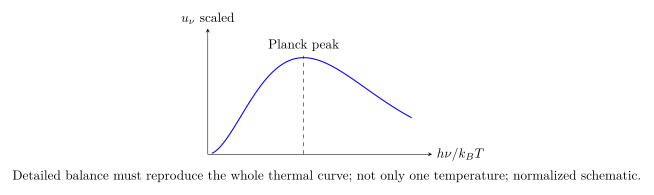
图 3 表示 detailed balance 的强约束:若无 \(A_{21}\),无法产生 Planck 分母中的 “\(-1\)”,故 spontaneous emission 不是可任意省略的附加项。
2.2 何谓 microscopic reversibility
\(g_1B_{12}=g_2B_{21}\) 不是说单个简并态的所有 polarization channel 都同强,而是说在规定的 polarization、方向平均及 sublevel 求和 convention 下,上下过程的总 line strength 服从 time-reversal symmetry。比较数据库 \(A\) 值、oscillator strength 与 line strength 时必须先核对这些平均方式。
3. Transition dipole moment / 跃迁偶极矩
Knowledge ID: P08-U03-L01-K03
3.1 从相互作用 Hamiltonian 到矩阵元
当 optical wavelength 远大于原子尺度时,electric-dipole approximation 给出
\[\hat H'(t)=-\hat{\mathbf d}\cdot\mathbf E(t), \qquad \mathbf d_{21}=\langle2\lvert\hat{\mathbf d}\rvert1\rangle.\]
驱动偏振 \(\boldsymbol\epsilon\) 选取投影 \(\boldsymbol\epsilon\cdot\mathbf d_{21}\)。即使 \(E_2-E_1=\hbar\omega\),若该矩阵元因 parity 或 angular-momentum symmetry 为零,一阶 E1 transition 仍 forbidden;它可能通过更弱的 M1、E2 或多光子通道发生。
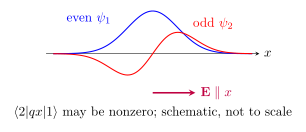
图 4 用一维 parity 示意 \(x\) 使 integrand 变成 even。它只说明 symmetry,不表示真实 orbital 振幅按比例。
3.2 自由空间 E1 spontaneous rate
对非简并、固定取向 dipole,在 SI 中
\[A_{21}=\frac{\omega_0^3\lvert\mathbf d_{21}\rvert^2}{3\pi\epsilon_0\hbar c^3}.\]
原子多重态实际使用 reduced matrix element、Clebsch–Gordan coefficient,并对初态平均、末态和 polarization 求和。\(A\propto\omega^3\lvert d\rvert^2\) 同时包含 coupling strength 与 free-space photon density of states。
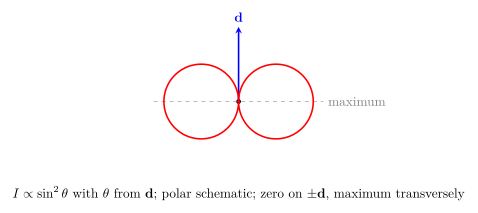
图 5 的双叶极图以偶极轴为 \(\theta=0\):轴向强度为零,横向达到最大。它表示经典 dipole pattern 与量子 E1 angular distribution 的联系;具体 Zeeman sublevel 和 polarization 会改变图样。
4. Natural lifetime and linewidth / 自然寿命与线宽
Knowledge ID: P08-U03-L01-K04
4.1 population decay 与 coherence decay
若 excitation 在 \(t=0\) 准备,只有 radiative decay,则
\[P_2(t)=e^{-\Gamma t}, \qquad \tau=\Gamma^{-1}.\]
amplitude 按 \(e^{-\Gamma t/2}\) 衰减。one-sided exponential Fourier transform 产生 Lorentzian power spectrum
\[L(\Delta)=\frac{1}{\pi}\frac{\Gamma/2}{\Delta^2+(\Gamma/2)^2}, \qquad \int_{-\infty}^{\infty}L(\Delta)d\Delta=1.\]
因此 angular-frequency FWHM 为 \(\Gamma\)。
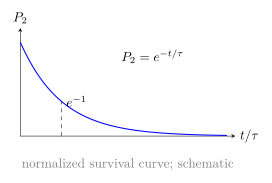
图 6 中 \(\tau\) 是 ensemble survival probability 降到 \(1/e\) 的时间,不是每个原子都恰在 \(t=\tau\) 发光。
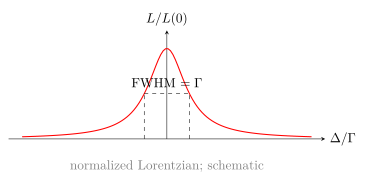
图 7 的横轴是 angular detuning;半高点在 \(\Delta=\pm\Gamma/2\)。
4.2 加性与非加性展宽
非辐射 population loss 会增大 \(\Gamma_1\);pure dephasing 则使
\[\gamma_2=\frac{\Gamma_1}{2}+\gamma_\phi.\]
homogeneous Lorentzian FWHM 是 \(2\gamma_2\)。Gaussian Doppler width 与 Lorentzian natural/collision width 卷积形成 Voigt profile,FWHM 不能简单相加。实验 linewidth 只有在其他 broadening 可忽略时才能直接反推 lifetime。
5. Saturation and power broadening / 饱和与功率展宽
Knowledge ID: P08-U03-L01-K05
5.1 closed two-level steady state
对 ideal closed two-level atom,定义
\[s(\Delta)=\frac{2\Omega^2}{\Gamma^2+4\Delta^2}.\]
steady-state excited population 与 photon scattering rate 为
\[\rho_{22}^{(\rm ss)}=\frac{s}{2(1+s)}, \qquad R_{\rm sc}=\Gamma\rho_{22}^{(\rm ss)}=\frac{\Gamma}{2}\frac{s}{1+s}.\]
\(s\ll1\) 时 rate 与 intensity 成正比;\(s\gg1\) 时 \(\rho_{22}\to1/2\)、\(R_{\rm sc}\to\Gamma/2\)。强场不能使 closed two-level steady state 长期保持 inversion。
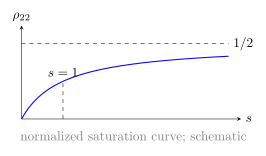
图 8 显示 saturation 是 stimulated upward/downward processes 使 populations 趋于相等,而非 transition “停止吸收”。
5.2 power-broadened resonance
令 \(s_0=2\Omega^2/\Gamma^2\) 为 on-resonance saturation parameter,则 resonant response 的 angular-frequency FWHM
\[\Delta\omega_{\rm FWHM}=\Gamma\sqrt{1+s_0}.\]
峰值趋于饱和、宽度增长,但 integrated response 的处理取决于测量 observable。开放多能级原子还会发生 optical pumping,不能只用一个 \(s_0\) 描述。
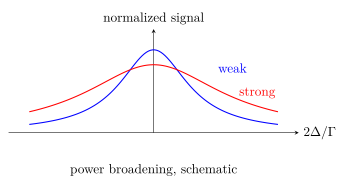
图 9 对比 weak 与 strong drive;曲线用于说明宽化,不声称峰高按某一探测器 response 精确归一。

图 10 是辐射过程建模的审计流程;在比较教材或数据库数值前,先统一 density 与 degeneracy convention。
Worked Examples / 完整例题
Worked Example 1 — 由 lifetime 求自然线宽
题目。 某孤立 excited state 只有一个 radiative channel,measured lifetime 为 \(\tau=26.0\,\mathrm{ns}\)。求 \(A_{21}\)、angular-frequency FWHM 与 ordinary-frequency FWHM。
研究对象、系统与模型。 系统为自由空间原子加量子真空;在原子静止系、无碰撞无 Doppler,population 单指数衰减。频率轴正方向取升高。
方程与计算。
\[A_{21}=\Gamma=\tau^{-1}=\frac{1}{26.0\times10^{-9}\,\mathrm{s}} =3.85\times10^7\,\mathrm{s^{-1}}.\]
\[\Delta\omega_{\rm FWHM}=\Gamma=3.85\times10^7\,\mathrm{rad\,s^{-1}},\]
\[\Delta\nu_{\rm FWHM}=\frac{\Gamma}{2\pi}=6.12\times10^6\,\mathrm{Hz}.\]
检查与解释。 \(\tau\Gamma=1\) 无量纲;\(2\pi\Delta\nu=\Delta\omega\)。三位有效数字与输入一致。若实测线宽更大,不能立即说 lifetime 更短,须排除 dephasing、Doppler 与 power broadening。
Worked Example 2 — Einstein coefficients 与简并度
题目。 设 \(g_1=2\)、\(g_2=4\),\(\lambda_0=600\,\mathrm{nm}\),\(A_{21}=2.0\times10^7\,\mathrm{s^{-1}}\)。按本课 \(u_\nu\) convention 求 \(B_{21}\) 与 \(B_{12}\)。
系统、参考系与模型。 原子处在各向同性 blackbody field;频率为实验室普通频率,忽略 recoil。使用 sublevel-summed Einstein coefficients。
计算。 \(\nu_0=c/\lambda_0=4.997\times10^{14}\,\mathrm{Hz}\),故
\[B_{21}=\frac{A_{21}c^3}{8\pi h\nu_0^3} =2.60\times10^{20}\,\mathrm{m^3\,J^{-1}\,s^{-2}}.\]
由 \(g_1B_{12}=g_2B_{21}\),
\[B_{12}=\frac{g_2}{g_1}B_{21} =5.20\times10^{20}\,\mathrm{m^3\,J^{-1}\,s^{-2}}.\]
检查与解释。 \(B u_\nu\) 的单位为 \(\mathrm{s^{-1}}\)。上能级简并度更大,所以按总 level population 定义的 absorption coefficient 更大;若按单个 magnetic sublevel 定义则关系会改写,必须声明 convention。
Worked Example 3 — 由 transition dipole 估算 \(A\)
题目。 对 \(\lambda=500\,\mathrm{nm}\) 的非简并 E1 transition,取 \(\lvert d\rvert=2.0\,e a_0\)。估算 \(A\) 与 lifetime。
系统与模型。 自由空间 point dipole,原子静止,固定 transition matrix element;用 SI,\(e=1.602\times10^{-19}\,\mathrm C\)、\(a_0=5.292\times10^{-11}\,\mathrm m\)。
计算。
\[d=2ea_0=1.70\times10^{-29}\,\mathrm{C\,m}, \qquad \omega=\frac{2\pi c}{\lambda}=3.77\times10^{15}\,\mathrm{rad\,s^{-1}}.\]
\[A=\frac{\omega^3d^2}{3\pi\epsilon_0\hbar c^3} =6.47\times10^7\,\mathrm{s^{-1}}, \qquad \tau=15.5\,\mathrm{ns}.\]
检查与解释。 \(A\) 在 allowed optical transition 常见 \(10^7\)–\(10^8\,\mathrm{s^{-1}}\) 数量级。若 \(d\to0\),\(A\to0\);若频率增加,\(A\propto\omega^3\)。真实多重态需 angular factors,故此为 order-of-magnitude estimate。
Worked Example 4 — 饱和散射与功率宽化
题目。 某 closed two-level transition 有 \(\Gamma=2\pi\times6.0\,\mathrm{MHz}\)。on resonance 时 \(s_0=3.0\)。求 steady-state excited fraction、scattering rate 与 power-broadened FWHM。
系统、参考系与坐标。 原子静止系,frequency detuning 轴取 \(\Delta=\omega_L-\omega_0\);忽略 recoil 与 multilevel optical pumping。
计算。
\[\rho_{22}=\frac{3}{2(1+3)}=0.375,\]
\[R_{\rm sc}=\Gamma\rho_{22} =2\pi(6.0\times10^6)\times0.375 =1.41\times10^7\,\mathrm{s^{-1}}.\]
ordinary-frequency FWHM 为
\[\Delta\nu_{\rm FWHM}=\frac{\Gamma\sqrt{1+s_0}}{2\pi} =6.0\,\mathrm{MHz}\times2=12.0\,\mathrm{MHz}.\]
检查与解释。 \(\rho_{22}<1/2\)、\(R_{\rm sc}<\Gamma/2=1.88\times10^7\,\mathrm{s^{-1}}\),符合 closed two-level saturation ceiling;宽度随 \(\sqrt{1+s_0}\) 增大。
Lesson synthesis / 全课综合
- 先用 \(E_2-E_1=\hbar\omega_0\) 定位 transition,再用 \(\mathbf d_{21}\) 判断 E1 coupling 是否存在。
- incoherent radiation 用 Einstein rate picture;coherent monochromatic drive 则用 \(\Omega\) 与 optical Bloch picture。
- detailed balance 将 microscopic absorption/emission 与 macroscopic Planck spectrum 相连,并固定 \(A/B\) ratio。
- lifetime 决定最小 homogeneous width,但 experiment line 还可能含 dephasing、Doppler、collision 与 power broadening。
- 强驱动使 population 饱和和 linewidth 增大;下一课把这一过程提升为 coherent time evolution。
Formula-and-decision table / 公式与决策表
| Need | Formula | Use when | Main limitation |
|---|---|---|---|
| Einstein rates | \(R_{12}=N_1B_{12}u_\nu\),\(R_{21}=N_2(A_{21}+B_{21}u_\nu)\) | incoherent isotropic field | 必须固定 \(u_\nu\) convention |
| Degeneracy balance | \(g_1B_{12}=g_2B_{21}\) | sublevel-summed level coefficients | polarization-resolved coefficient 需重做平均 |
| \(A/B\) relation | \(A_{21}=8\pi h\nu^3B_{21}/c^3\) | \(B\) 乘 \(u_\nu\) | 对 \(u_\omega\) 不能照抄 |
| E1 rate | \(A=\omega^3\lvert d\rvert^2/(3\pi\epsilon_0\hbar c^3)\) | free-space nondegenerate E1 | multilevel 需 angular factors |
| Lifetime | \(P_2=e^{-\Gamma t}\),\(\tau=1/\Gamma\) | Markov single-exponential decay | 非指数 early/late time 与 cavity effect 忽略 |
| Natural width | \(\Delta\nu=\Gamma/(2\pi)\) | purely radiative coherence | pure dephasing 使其增宽 |
| Saturated population | \(\rho_{22}=s/[2(1+s)]\) | closed two-level steady state | open transition 不适用 |
| Power width | \(\Delta\omega=\Gamma\sqrt{1+s_0}\) | ideal resonant two-level response | inhomogeneous profile 需卷积 |
Model boundaries / 模型边界
- Einstein coefficients 是 rate model,不包含 coherent phase evolution;短 pulse 与 Rabi oscillation 需 Schrödinger/Bloch treatment。
- electric-dipole approximation 要求 \(ka\ll1\);forbidden transition 可由更高 multipole 主导。
- free-space \(A\) 假设 continuum vacuum modes;cavity 或 interface 会改变 density of states 与 decay rate。
- natural linewidth 只在无 Doppler、collision、transit-time、laser linewidth 与 power broadening 时可直接观测。
- \(\Gamma=A_{21}\) 仅当没有其他 radiative branches 与 nonradiative loss;一般 \(\Gamma_2=\sum_f A_{2f}+\Gamma_{\rm nr}\)。
- closed two-level saturation 忽略 dark states、Zeeman pumping、branching leakage 与 repumping。
- Markov exponential decay忽略 very short-time quadratic survival 与强 coupling nonexponential dynamics。
- 激光场本身的 quantum statistics、spontaneous-emission antibunching 与 cavity QED 留待更高阶课程。
Misconception clinic / 误区诊所
- “受激辐射只是更快的自发辐射。” 受激率正比于 mode occupation,并向 seed mode 增加相干 photon;自发辐射的 mode、方向与相位呈概率分布。
- “\(B_{12}=B_{21}\) 永远成立。” 只有在逐 sublevel 或相同简并约定下;对总 level coefficients 应写 \(g_1B_{12}=g_2B_{21}\)。
- “有能级差就一定有强谱线。” transition dipole 可能因 symmetry 为零,能量匹配只是必要条件。
- “lifetime \(10\,\mathrm{ns}\) 意味 linewidth \(100\,\mathrm{MHz}\)。” \(100\,\mathrm{Mrad\,s^{-1}}\) 才对应 \(\Gamma\);Hz 线宽还要除以 \(2\pi\)。
- “饱和就是原子全在 excited state。” closed two-level steady state 的上限是 \(1/2\);强场使上下受激过程趋于平衡。
- “测得宽线就证明寿命短。” observed width 是多种 broadening 的结果,必须通过 intensity、pressure、temperature 等外推分离。
Practice and retrieval / 练习与提取
- K01|概念: 分别说明三种 radiative process 是否需要 incident photon、物质能量变化方向和 emitted mode 的相干性。
- K01|速率: \(N_1=8N_2\) 且 \(B_{12}=B_{21}\) 时,忽略 spontaneous term,净 stimulated photon 是产生还是吸收?
- K02|推导: 从含 \(g_1,g_2\) 的 Boltzmann ratio 与 Planck law 写出两条 Einstein relations。
- K02|convention: 若 \(u_\nu d\nu=u_\omega d\omega\),求 \(u_\omega\) 与 \(u_\nu\) 的关系,并解释为何 \(B\) 数值会改变。
- K03|symmetry: 一维 parity 中,\(\psi_1,\psi_2\) 都是 even,判断 \(\langle2\lvert qx\rvert1\rangle\)。
- K03|scaling: 相同 \(d\) 下频率加倍,free-space E1 \(A\) 变化多少倍?
- K04|计算: \(\tau=5.00\,\mathrm{ns}\) 时求 natural FWHM,单位用 MHz。
- K04|边界: 给出两个会使 measured linewidth 大于 lifetime limit 的机制。
- K05|计算: on resonance \(s_0=1\) 时求 \(\rho_{22}\)、\(R_{\rm sc}/\Gamma\) 与 width factor。
- 综合: 某线随 laser intensity 降低后 width 外推到 \(8.0\,\mathrm{MHz}\),且 pressure 外推后不再变化。若认为是 purely natural line,估算 lifetime;列出仍须验证的一项系统误差。
Answers / 答案
- absorption 需 incident photon、物质升能;stimulated emission 需 seed、物质降能且新增 photon 与 seed mode 相干;spontaneous emission 不需 real incident photon、物质降能,发射 mode 概率分布。
- \(N_1B>N_2B\),净 absorption;field photon 数减少。
- \(g_1B_{12}=g_2B_{21}\) 与 \(A_{21}=8\pi h\nu_0^3B_{21}/c^3\),后式使用 \(u_\nu\)。
- 因 \(\omega=2\pi\nu\)、\(d\omega=2\pi d\nu\),故 \(u_\omega=u_\nu/(2\pi)\)。同一物理 rate 要求 \(B_\omega u_\omega=B_\nu u_\nu\),所以 \(B_\omega=2\pi B_\nu\)。
- integrand parity 为 \(\mathrm{even}\times\mathrm{odd}\times\mathrm{even}=\mathrm{odd}\),对称区间积分为零,E1 forbidden。
- \(A\propto\omega^3\),增为 \(2^3=8\) 倍。
- \(\Gamma=2.00\times10^8\,\mathrm{s^{-1}}\),\(\Delta\nu=\Gamma/(2\pi)=31.8\,\mathrm{MHz}\)。
- 例如 Doppler、collision、transit-time、laser linewidth、power broadening 或 pure dephasing,任答二。
- \(\rho_{22}=1/4\);\(R_{\rm sc}/\Gamma=1/4\);width factor \(\sqrt2\)。
- \(\tau=[2\pi(8.0\times10^6)]^{-1}=19.9\,\mathrm{ns}\)。仍可检查 laser linewidth、transit-time、residual Doppler 或 unresolved structure。
Exit ticket / 离堂检验
- 用“density convention—matrix element—lifetime—drive strength”四个短语写出评估一条 optical line 的顺序。
- 某资料写 \(A/B=\hbar\omega^3/(\pi^2c^3)\),本课写 \(8\pi h\nu^3/c^3\)。说明它们可能并不矛盾,并指出首先要查什么。
References and source notes / 参考资料与来源说明
以下来源均于 2026-08-30 实际打开核验。正文统一采用 SI、\(u_\nu\) Einstein convention 与本课 \(\Omega\) convention;所有 TikZ 根据方程原创,未复制来源插图。
- MIT OpenCourseWare 8.421, Lecture 14: Atom–Light Interactions III
- MIT OpenCourseWare 6.974, Quantum Nature of Light and Matter
- MIT OpenCourseWare 6.974, Chapter 6: Two-Level Model and Saturation
- MIT OpenCourseWare 8.421, Assignment 7: Optical Bloch Equations with Spontaneous Emission
- NIST Atomic Spectra Database: Lines Form and Transition Probabilities
- NIST, Atomic Spectroscopy: An Introduction
Source-to-content map
| Source | Used for | Knowledge ID / Section | Model boundary or convention |
|---|---|---|---|
| MIT 8.421 Lecture 14 | Einstein \(A/B\), spontaneous emission, vacuum modes | K01–K02 | lecture notation converted to \(u_\nu\) SI |
| MIT 6.974 quantum-light chapter | detailed balance and stimulated/spontaneous rate equations | K01–K02 | ordinary-frequency density stated explicitly |
| MIT 6.974 Chapter 6 | two-level dipole coupling, saturation and broadening | K03, K05 | Rabi factor fixed in Scope |
| MIT 8.421 Assignment 7 | optical Bloch steady state and \(\Gamma_1,\Gamma_2\) distinction | K04–K05 | closed two-level assumptions stated |
| NIST ASD | measured \(A\) values and transition-probability convention context | K02–K04 | database values require checking degeneracy averaging |
| NIST Atomic Spectroscopy | line strength, widths, shifts and spectroscopy terminology | K03–K04 | data reference, not a substitute for present derivation |
复习与拓展
- 下一课把 \(\Omega\)、\(\Delta\) 与 \(\Gamma\) 放入 rotating-frame Hamiltonian 与 optical Bloch equations,研究 transient coherent control。
- Laser Operation 将把 \(N_2B_{21}-N_1B_{12}\) 解释为 gain,并加入 cavity feedback 与 threshold。
- Laser Cooling 将把 \(R_{\rm sc}\) 乘以 photon momentum \(\hbar k\),得到 velocity-dependent force。
- 可扩展数值项目:对不同 \(s_0\) 解 Bloch equations,比较 transient Rabi oscillation 与 steady-state rate model。