
Learning objectives / 学习目标
- 计算真空电场、磁场及平面波的 energy density,并区分瞬时量和周期平均量。
- 使用 \(\mathbf S=\mu_0^{-1}\mathbf E\times\mathbf B\) 求能流方向、功率与强度。
- 由 \(\mathbf g=\mathbf S/c^2\) 求场动量密度,比较吸收和镜面反射的 radiation pressure。
- 从 Maxwell equations 推导 differential 与 integral Poynting theorem,并解释 \(\mathbf J\cdot\mathbf E\) 的符号。
- 对能量问题明确控制体、系统边界、法向与平均时间尺度。
Prerequisites / 先修知识
- Maxwell's Equations。
- Electromagnetic Waves:\(E=cB\)。
- Capacitance and Stored Energy。
- Inductance and RL Circuits。
- 功、功率、动量通量、divergence theorem。
Scope and conventions / 范围与约定
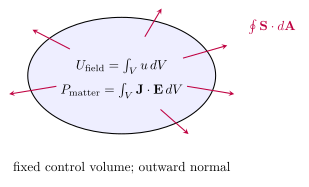
- 主体是真空经典场。定义固定控制体 \(V\),\(d\mathbf A\) 指向外。
- \(\mathbf S\cdot d\mathbf A>0\) 表示场能流出控制体;\(\mathbf J\cdot\mathbf E>0\) 表示场对物质做正功。
- 强度 \(I\equiv\langle S\rangle\) 默认是对许多周期的时间平均;\(E_0,B_0\) 是 peak amplitude,\(E_{\rm rms}=E_0/\sqrt2\)。
- radiation pressure 公式 \(I/c\) 与 \(2I/c\) 假定正入射、完全吸收或完全镜面反射;一般界面需作动量通量账本。
- 本课给出真空 momentum density;完整动量守恒还涉及 Maxwell stress tensor,留作扩展。
Notation and modeling contract / 符号与建模契约
| Symbol | Meaning | SI unit |
|---|---|---|
| \(u_E=\epsilon_0E^2/2\) | electric energy density | \(\mathrm{J\,m^{-3}}\) |
| \(u_B=B^2/(2\mu_0)\) | magnetic energy density | \(\mathrm{J\,m^{-3}}\) |
| \(u=u_E+u_B\) | total field energy density | \(\mathrm{J\,m^{-3}}\) |
| \(\mathbf S=\mu_0^{-1}\mathbf E\times\mathbf B\) | Poynting vector | \(\mathrm{W\,m^{-2}}\) |
| \(I=\langle S\rangle\) | cycle-averaged intensity | \(\mathrm{W\,m^{-2}}\) |
| \(\mathbf g=\mathbf S/c^2\) | field momentum density | \(\mathrm{kg\,m^{-2}\,s^{-1}}\) |
| \(p_{\rm rad}\) | radiation pressure | Pa |
Knowledge 1 — Electric and magnetic energy density / 电场与磁场能量密度
Knowledge ID: P04-U10-L03-K01
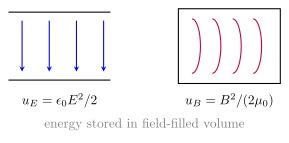
真空场的局域能量密度为
\[u_E=\frac12\epsilon_0E^2, \qquad u_B=\frac{B^2}{2\mu_0}, \qquad u=u_E+u_B.\]
这与集中参数结果一致:平行板电容器的 \(U_C=\tfrac12CV^2\) 等于 \(\int u_EdV\);长螺线管的 \(U_L=\tfrac12LI^2\) 等于 \(\int u_BdV\)(理想场近似)。
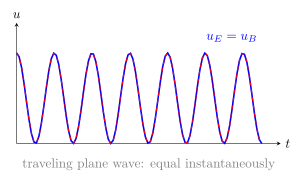
对真空行波,\(E=cB\) 且 \(c^2=1/(\mu_0\epsilon_0)\),所以
\[u_E=u_B=\frac12\epsilon_0E^2, \qquad u=\epsilon_0E^2=\frac{B^2}{\mu_0}.\]
这等分只对真空 traveling plane wave 成立;驻波的某些位置/时刻可几乎全为电能或磁能。
Knowledge 2 — Poynting vector and energy flux / 坡印廷矢量与能流
Knowledge ID: P04-U10-L03-K02
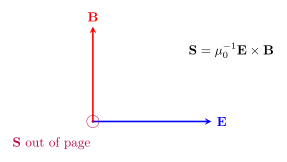
Poynting vector 定义为
\[\boxed{\mathbf S=\frac{1}{\mu_0}\mathbf E\times\mathbf B}.\]
它是单位面积、单位时间的电磁能流;跨曲面的净向外场功率为
\[P_{\rm out}=\oint_{\partial V}\mathbf S\cdot d\mathbf A.\]
对真空平面波,
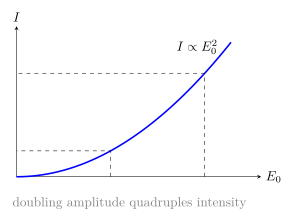
\[S=cu, \qquad I=\langle S\rangle=\frac12c\epsilon_0E_0^2 =\frac{cB_0^2}{2\mu_0} =c\epsilon_0E_{\rm rms}^2.\]
幅值加倍使 \(u\) 和 \(I\) 变为四倍;频率本身不直接进入经典平面波强度公式。对各向同性点源的远场,功率跨球面守恒给 \(I=P/(4\pi r^2)\)。
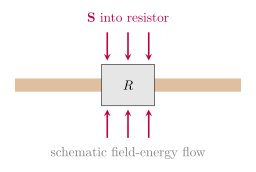
在直流电路中,能量也可主要沿导线周围的场流入电阻,而非“随漂移电子高速穿过导线”。\(\mathbf S\) 提供电源、导体表面与负载之间的局域功率流图景。
Knowledge 3 — Momentum density and radiation pressure / 动量密度与辐射压
Knowledge ID: P04-U10-L03-K03
真空中的 electromagnetic momentum density 为
\[\boxed{\mathbf g=\frac{\mathbf S}{c^2}=\epsilon_0\mathbf E\times\mathbf B}.\]
平面波有 \(g=u/c\)。正入射到面积 \(A\) 的理想表面,时间平均压力由法向动量通量得到:
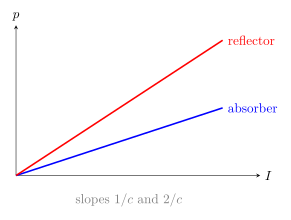
\[p_{\rm abs}=\frac{I}{c}, \qquad p_{\rm refl}=\frac{2I}{c}.\]
反射时动量从 \(+p\) 变为 \(-p\),表面获得两倍变化;这就是因子 2 的来源。
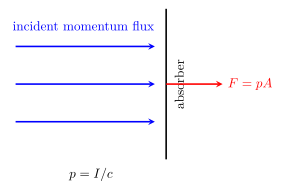
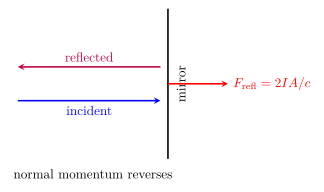
正入射且反射部分为镜面反射时,一般反射率 \(R\)、吸收率 \(A_a\) 且无透射可写 \(p=(A_a+2R)I/c\);若有透射或漫反射,必须把两侧介质中的完整角向动量通量和界面力一起列账,不能套用真空理想镜面公式。
Knowledge 4 — Energy conservation and Poynting theorem / 能量守恒与坡印廷定理
Knowledge ID: P04-U10-L03-K04
由 Ampère–Maxwell law 点乘 \(\mathbf E\)、Faraday law 点乘 \(\mathbf B/\mu_0\),并使用
\[\nabla\cdot(\mathbf E\times\mathbf B) =\mathbf B\cdot(\nabla\times\mathbf E)-\mathbf E\cdot(\nabla\times\mathbf B),\]
可得 differential Poynting theorem:
\[\boxed{\frac{\partial u}{\partial t}+\nabla\cdot\mathbf S+\mathbf J\cdot\mathbf E=0.}\]
对固定体积积分:
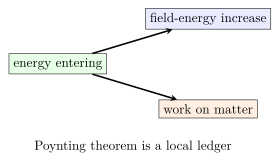
\[\boxed{\frac{d}{dt}\int_Vu\,dV =-\oint_{\partial V}\mathbf S\cdot d\mathbf A -\int_V\mathbf J\cdot\mathbf E\,dV.}\]
左侧是体内场能变化;右侧第一项是“负的净流出”,第二项是场对物质做功后的场能损失。若 \(\mathbf J\cdot\mathbf E<0\),物质反而向场供能,例如电源区域。
Poynting vector 的局部路径在某些静态/近场配置并非唯一直觉图像,但穿过完整边界的积分与能量收支是可检验的。不要把某一根“能流线”误当成粒子轨迹。
Worked Examples / 完整例题
Worked Example 1 — Field energy in a capacitor
真空平行板面积 \(A=0.0200\,\mathrm{m^2}\)、间距 \(d=1.00\,\mathrm{mm}\)、电压 \(V=500\,\mathrm V\)。求 \(u_E\) 与总能量。
系统与模型: 取板间场为系统,忽略 fringing;\(E=V/d\)。
\[E=5.00\times10^5\,\mathrm{V\,m^{-1}},\]
\[u_E=\frac12\epsilon_0E^2=1.11\,\mathrm{J\,m^{-3}}.\]
体积 \(Ad=2.00\times10^{-5}\,\mathrm{m^3}\),
\[U=u_EAd=2.21\times10^{-5}\,\mathrm J.\]
检查: \(\tfrac12CV^2\),其中 \(C=\epsilon_0A/d=1.77\times10^{-10}\,\mathrm F\),给相同结果。三位有效数字。
Worked Example 2 — Intensity from field amplitude
真空正弦波 \(E_0=120\,\mathrm{V\,m^{-1}}\)。求 \(B_0\)、平均强度和峰值 Poynting magnitude。
坐标与模型: 取任一右手平面波三元组;\(E_0\) 为峰值。
\[B_0=\frac{E_0}{c}=4.00\times10^{-7}\,\mathrm T,\]
\[I=\frac12c\epsilon_0E_0^2=19.1\,\mathrm{W\,m^{-2}}, \qquad S_{\max}=2I=38.2\,\mathrm{W\,m^{-2}}.\]
检查: 强度随 \(E_0^2\);峰值是周期平均的两倍,仅因 \(\langle\cos^2\rangle=1/2\)。
Worked Example 3 — Force on an absorbing sail
面积 \(A=12.0\,\mathrm{m^2}\) 的黑色平板正对 \(I=1.36\times10^3\,\mathrm{W\,m^{-2}}\) 的光,求力;若为理想镜面又是多少?
系统与方向: 表面为研究对象,\(+x\) 沿入射波传播;正入射,先全吸收。
\[F_{\rm abs}=\frac{IA}{c} =\frac{(1.36\times10^3)(12.0)}{2.998\times10^8} =5.44\times10^{-5}\,\mathrm N.\]
\[F_{\rm refl}=2F_{\rm abs}=1.09\times10^{-4}\,\mathrm N.\]
检查: 力沿 \(+x\);数值虽小但持续。反射使法向动量反转,因而加倍。
Worked Example 4 — Poynting-theorem ledger
某固定体积内场能以 \(0.80\,\mathrm W\) 增加,且场对其中物质做功 \(1.50\,\mathrm W\)。求净向外 Poynting flux。
系统边界: \(d\mathbf A\) 向外;把 \(P_{\rm out}=\oint\mathbf S\cdot d\mathbf A\) 定义为正向外。
\[\frac{dU}{dt}=-P_{\rm out}-P_{\rm matter},\]
\[P_{\rm out}=-(0.80)-(1.50)=-2.30\,\mathrm W.\]
解释: 负的“向外”表示净有 \(2.30\,\mathrm W\) 场能流入;其中 \(0.80\,\mathrm W\) 储存在场中,\(1.50\,\mathrm W\) 交给物质。功率账本闭合。
Lesson synthesis / 本课综合
从 \(u\)、\(\mathbf S\)、\(\mathbf g\) 到 \(p_{\rm rad}\),分别回答“哪里储能”“向哪流、流多快”“场带多少动量”“界面每面积每时间收到多少动量”。Poynting theorem 把场能变化、边界能流与物质功率放进同一控制体账本。
Formula-and-decision table / 公式与决策表
| Quantity | Formula | Use condition | Main caution |
|---|---|---|---|
| vacuum energy density | \(u=\epsilon_0E^2/2+B^2/(2\mu_0)\) | classical vacuum field | use instantaneous fields |
| energy flux | \(\mathbf S=\mathbf E\times\mathbf B/\mu_0\) | vacuum microscopic fields | direction is cross product |
| sinusoidal intensity | \(I=c\epsilon_0E_0^2/2\) | vacuum plane wave, peak amplitude | RMS removes factor \(1/2\) |
| momentum density | \(\mathbf g=\mathbf S/c^2\) | vacuum | momentum conservation also needs stress |
| radiation pressure | \(I/c\) or \(2I/c\) | normal full absorption/reflection | partial transmission needs full ledger |
| energy conservation | \(\partial_tu+\nabla\cdot\mathbf S+\mathbf J\cdot\mathbf E=0\) | fixed coordinates | sign of \(\mathbf J\cdot\mathbf E\) matters |
Model boundaries / 模型边界
- 真空 \(u_E,u_B\) 不可直接用来替代强色散/有损介质中的完整能量表达。
- \(I=P/(4\pi r^2)\) 只适用于各向同性远场且无吸收;天线辐射有角分布。
- 完美吸收体、完美反射体是边界模型;真实表面同时吸收、反射、透射、散射。
- \(\mathbf g=\mathbf S/c^2\) 是真空形式;介质中的 Abraham–Minkowski momentum 问题需要更精细的场—物质系统定义。
- 电磁场的经典连续能量密度不描述单光子探测统计。
Misconception clinic / 误区诊所
- “只有带电粒子才储存电磁能。” 能量密度存在于场所在空间,真空波离开源后仍携能。
- “\(\mathbf S\) 就等于力。” 它是能流密度;除以 \(c\) 并结合界面动量变化才得到压力。
- “反射面不吸收能量,所以没有力。” 能量可不变而动量方向反转,故仍有压力且理想情况下为 \(2I/c\)。
- “\(\mathbf J\cdot\mathbf E>0\) 表示物质给场供能。” 正好相反:场对物质做正功,场能减少。
- “平面波的电能与磁能总是空间平均才相等。” 真空单向平面波中二者在每一点每一时刻相等;驻波不然。
Practice and retrieval / 练习与提取
- K01 量纲: 证明 \(\epsilon_0E^2\) 的单位是 \(\mathrm{J\,m^{-3}}\)。
Answer
\((\mathrm{C/(V\,m)})(\mathrm{V^2/m^2})=\mathrm{CV/m^3}=\mathrm{J/m^3}\)。
- K01 比例: 场幅均加倍时总能量密度如何变?
Answer
\(u\) 对 \(E^2,B^2\) 成正比,故变为四倍。
- K02 方向: \(\mathbf E\parallel-x\)、\(\mathbf B\parallel+z\),\(\mathbf S\) 指向何方?
Answer
\((-\hat x)\times\hat z=+\hat y\),故 \(\mathbf S\parallel+y\)。
- K02 定量: \(I=800\,\mathrm{W\,m^{-2}}\),求真空波 \(E_{\rm rms}\)。
Answer
\[E_{\rm rms}=\sqrt{\frac{I}{c\epsilon_0}}=5.49\times10^2\,\mathrm{V\,m^{-1}}.\]
- K02 概念: 为什么点源远场振幅按 \(1/r\) 而强度按 \(1/r^2\)?
Answer
总功率跨球面守恒,面积按 \(r^2\);强度按 \(1/r^2\)。又因 \(I\propto E_0^2\),振幅按 \(1/r\)。
- K03 定量: 完全吸收表面受 \(I=300\,\mathrm{W\,m^{-2}}\),求压力。
Answer
\[p=I/c=1.00\times10^{-6}\,\mathrm{Pa}.\]
- K03 比较: 相同强度、正入射时镜面与黑面受力之比是多少?
Answer
理想镜面动量反转,压力 \(2I/c\);黑面为 \(I/c\),比值 2。
- K04 符号: 若 \(P_{\rm out}=3\,\mathrm W\)、\(\int\mathbf J\cdot\mathbf E\,dV=-5\,\mathrm W\),场能变化率是多少?
Answer
\[dU/dt=-3-(-5)=+2\,\mathrm W.\] 物质向场供能 5 W,净流出 3 W,余 2 W 储存。
- K04 推导: 写出推导 Poynting theorem 所需的向量恒等式。
Answer
\(\nabla\cdot(\mathbf E\times\mathbf B)=\mathbf B\cdot(\nabla\times\mathbf E)-\mathbf E\cdot(\nabla\times\mathbf B)\)。
- 综合: 为什么只算 \(u\) 不能知道能量流向?
Answer
\(u\) 是标量,只给局域储量;方向与跨界功率由矢量 \(\mathbf S\) 给出。驻波还可有非零 \(u\) 而平均净能流为零。
Exit ticket / 离堂检核
- 画一个控制体并用一句话解释 Poynting theorem 三项的符号。
- 从给定 \(E_0\) 出发,依次求 \(u(t)\)、\(I\)、\(g\)、吸收压与反射压,并指出哪些是瞬时、哪些是平均。
References and source notes / 参考资料与来源说明
Source-to-content map
| Source | Used for | Knowledge ID / section | Model boundary or convention |
|---|---|---|---|
| OpenStax University Physics Vol. 2, §16.3 Energy Carried by Electromagnetic Waves | energy density, Poynting vector, intensity | K01–K02 | sinusoidal vacuum plane waves |
| OpenStax University Physics Vol. 2, §16.4 Momentum and Radiation Pressure | momentum transfer, absorbing/reflecting pressure | K03 | normal incidence ideal surfaces |
| MIT OCW 6.641, Energy, Power Flow, and Forces | integral/differential Poynting theorem | K01–K04 | continuum macroscopic energy ledger |
| MIT OCW 2.71, Lecture 14: Maxwell's equations; polarization; Poynting's vector | irradiance and optical field conventions | K01–K02 | harmonic fields |
| The Feynman Lectures on Physics, Vol. II, Ch. 27: Field Energy and Field Momentum | energy conservation and \(\mathbf g=\mathbf S/c^2\) interpretation | K01–K04 | classical vacuum field |
资料和链接实际核对日期:2026-08-28。图示依据方程原创绘制;例题与练习独立复算。
复习与拓展
- Boundary-Value and Multipole Methods:用边界条件确定场,再积分能量与力。
- Radiation from Accelerated Charges:远区 \(\mathbf S\) 的角分布与总辐射功率。
- Waves in Media and Waveguides:介质能量速度、损耗和模式功率。