
Learning objectives / 学习目标
完成本课后,你应能:
- 从 \(\hat H_0-\hat{\mathbf d}\cdot\mathbf E(t)\) 建立二能级 matrix Hamiltonian,并说明 basis、global energy shift 与 phase convention。
- 推导 on/off-resonant Rabi probability,计算 \(\pi\)、\(\pi/2\) pulse duration 与 pulse area。
- 解释 detuning、generalized Rabi frequency、rotating frame 与 RWA,并给出 RWA 的 small parameters。
- 由 density matrix 写出含 \(T_1,T_2\) 的 optical Bloch equations,区分 population relaxation 与 coherence decay。
- 设计 resonant pulse 或 STIRAP-like coherent transfer,判断 fidelity 对 area、detuning、dephasing 与 adiabaticity 的敏感性。
Prerequisites / 先修知识
- Radiative Processes:\(\mathbf d_{eg}\)、\(\Omega\)、\(\Gamma\)、saturation。
- Quantum Time Evolution:unitary evolution 与 time-dependent Hamiltonian。
- Mixed States and Decoherence:density operator 与 open systems。
- Pauli matrices、complex exponential、rotating vectors 与 first-order ODE。
Scope and conventions / 范围与约定
- basis 顺序固定为 \((\lvert e\rangle,\lvert g\rangle)\),\(\sigma_z=\lvert e\rangle\langle e\rvert-\lvert g\rangle\langle g\rvert\)。
- bare Hamiltonian 去除 global constant 后为 \(\hat H_0=\hbar\omega_0\sigma_z/2\)。
- driving field 为 \(\mathbf E(t)=\mathbf E_0(t)\cos(\omega_Lt+\phi)\);real positive Rabi magnitude 定义 \(\Omega(t)=\lvert\mathbf d_{eg}\cdot\mathbf E_0(t)\rvert/\hbar\)。
- detuning 固定为 \(\Delta=\omega_L-\omega_0\)。在合适 phase choice 和 RWA 下,rotating-frame Hamiltonian 取
\[\hat H_R=\frac{\hbar}{2}\left(\Omega\sigma_x-\Delta\sigma_z\right).\]
- \(\Gamma_1=1/T_1\) 是 population relaxation;\(\gamma_2=1/T_2=\Gamma_1/2+\gamma_\phi\) 是 coherence decay。无 pure dephasing 时 \(T_2=2T_1\)。
- 本课 semiclassical field 不量子化;vacuum Rabi oscillation、Jaynes–Cummings collapse/revival 与 ultrastrong coupling 作为边界。
Notation and modeling contract / 符号与建模契约
| Symbol | Meaning | SI unit |
|---|---|---|
| \(\omega_0\) | bare transition angular frequency | \(\mathrm{rad\,s^{-1}}\) |
| \(\omega_L\) | drive carrier angular frequency | \(\mathrm{rad\,s^{-1}}\) |
| \(\Delta=\omega_L-\omega_0\) | detuning | \(\mathrm{rad\,s^{-1}}\) |
| \(\Omega\) | on-resonance Rabi angular frequency | \(\mathrm{rad\,s^{-1}}\) |
| \(\Omega_R=\sqrt{\Omega^2+\Delta^2}\) | generalized Rabi frequency | \(\mathrm{rad\,s^{-1}}\) |
| \(A_p=\int\Omega(t)dt\) | pulse area | rad(dimensionless) |
| \(u,v,w\) | Bloch coordinates \(2\Re\rho_{eg},2\Im\rho_{eg},\rho_{ee}-\rho_{gg}\) | 1 |
| \(T_1,T_2\) | population / coherence relaxation times | s |
| \(F\) | target-state fidelity | 1 |
1. Two-level Hamiltonian / 二能级哈密顿量
Knowledge ID: P08-U03-L02-K01
1.1 投影到近共振子空间
完整原子含很多 levels,但当 drive bandwidth 与 coupling 远小于邻近 transition separations,且只有一条 transition 近共振时,可投影到 \(\{\lvert e\rangle,\lvert g\rangle\}\)。在 dipole approximation 下
\[\hat H(t)=\frac{\hbar\omega_0}{2}\sigma_z-\hat{\mathbf d}\cdot\mathbf E_0\cos(\omega_Lt+\phi).\]
若 diagonal permanent-dipole terms 可忽略,并把 \(\mathbf d_{eg}\) 的 phase 吸收到 basis state,中间矩阵为
\[H(t)=\frac{\hbar}{2} \begin{pmatrix} \omega_0 & -2\Omega\cos(\omega_Lt+\phi)\\ -2\Omega\cos(\omega_Lt+\phi) & -\omega_0 \end{pmatrix}.\]
这里的“截断”不是说其余能级从原子中消失,而是说在所研究的时间尺度内,它们只通过很小的虚跃迁修正有效参数。判断是否能够截断,至少要比较三种量:驱动频谱宽度、目标跃迁的耦合强度、目标线与邻近谱线的间隔。如果脉冲很短,频谱会变宽;即使中心频率只对准一条谱线,也可能同时激发邻近态。若偏振不纯或选择定则允许多条磁子能级跃迁,所谓二能级模型同样会失效。因此,写下二乘二矩阵之前,必须先说明“保留谁、舍去谁、为什么舍去”。
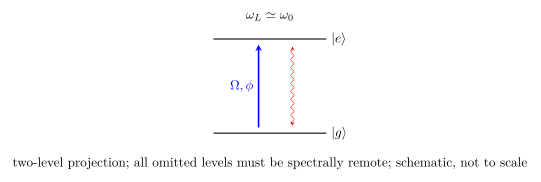
图 1 的两条线是 Hilbert-space basis,不是原子内的空间轨迹。two-level approximation 同时要求 spectral isolation 与 selection-rule isolation。
1.2 rotating frame 是一种 basis transformation
取 \(U(t)=\exp(i\omega_Lt\sigma_z/2)\),transformed Hamiltonian 为
\[H_R=UHU^\dagger+i\hbar\dot U U^\dagger.\]
它把快速 carrier rotation 从 state coefficients 移到 basis 中。保留慢项、舍去 \(e^{\pm2i\omega_Lt}\) counter-rotating terms 后得到前述 \(H_R\)。rotating frame 不改变任何 measurement probability。
物理上,旋转坐标系的价值在于把“接近共振的缓慢拍频”从极快的载波振荡中分离出来。实验室系里,状态振幅和驱动相位都高速转动,图像难以直接判断;换到随激光相位转动的基底后,失谐表现为纵向有效场,耦合表现为横向有效场。这个变换只重新分配了相位写在哪一部分,并没有给原子施加新的力,也没有改变最后测得的布居。若变换后忘记同步变换算符或初态,就会制造出并不存在的观测差异。
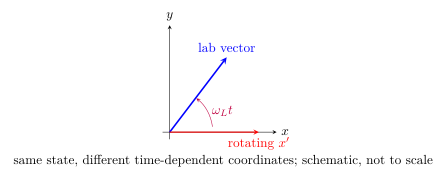
图 2 表示坐标系跟随 drive phase 旋转;在该 frame 中 resonant drive 变成近似静态 effective field。
2. Rabi oscillations / 拉比振荡
Knowledge ID: P08-U03-L02-K02
2.1 exact RWA solution
对 constant \(\Omega,\Delta\),从 \(\lvert g\rangle\) 出发,RWA 给出
\[P_e(t)=\frac{\Omega^2}{\Omega_R^2} \sin^2\left(\frac{\Omega_Rt}{2}\right), \qquad \Omega_R=\sqrt{\Omega^2+\Delta^2}.\]
on resonance \(\Delta=0\) 时完全交换 population;off resonance 时 oscillation 更快但 amplitude 小于 1。
拉比振荡的关键是概率振幅之间反复建立和消除相干叠加,而不是原子以固定速率随机跳跃。共振时,转轴恰好横穿布洛赫球赤道,初态所在的南极轨道能够经过北极,所以可以实现完全转移;失谐后,转轴向纵轴倾斜,轨道虽然绕得更快,却与北极保持有限距离。于是“振荡频率变大”和“转移效率变高”是两件相反方向变化的事情。实验上若只看短时间的一小段信号,容易把快速但低振幅的失谐振荡误判成更强耦合。
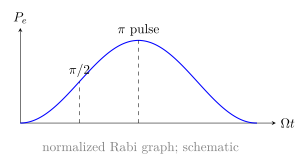
图 3 显示 coherent population oscillation;它不是随机上、下跃迁的 rate equation,而是 amplitudes 的 unitary interference。
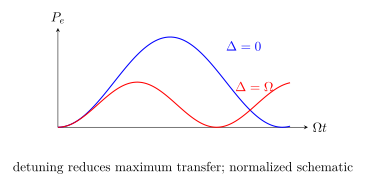
图 4 的 red curve 具有 \(P_{e,\max}=1/2\) 与 \(\Omega_R=\sqrt2\Omega\);“oscillates faster”并不等于“transfers better”。
2.2 pulse area theorem
对 on-resonance、fixed phase、忽略 decay 的 envelope \(\Omega(t)\),不同时间的 Hamiltonians commute,因此
\[P_e=\sin^2\left(\frac{A_p}{2}\right), \qquad A_p=\int_{-\infty}^{\infty}\Omega(t)dt.\]
\(A_p=\pi/2\) 制备 equal superposition,\(A_p=\pi\) 完全 inversion,\(A_p=2\pi\) 返回初态并可能积累 phase。detuning 或 phase chirp 会破坏简单 area-only result。
3. Resonance, detuning, and rotating-wave approximation / 共振、失谐与旋波近似
Knowledge ID: P08-U03-L02-K03
3.1 effective-field geometry
\(H_R=(\hbar/2)\boldsymbol\Omega_{\rm eff}\cdot\boldsymbol\sigma\),其中
\[\boldsymbol\Omega_{\rm eff}=(\Omega,0,-\Delta).\]
Bloch vector 围绕此轴以 \(\Omega_R\) precess。resonance 时轴在 equator,可把 south pole \(\lvert g\rangle\) 旋到 north pole \(\lvert e\rangle\);detuning 使轴倾向 \(z\),轨道不再经过 north pole。
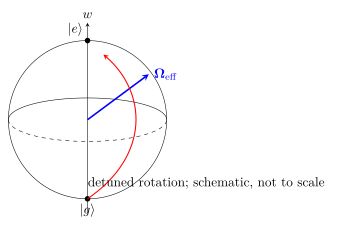
图 5 是 pure-state Bloch sphere schematic;有 relaxation 时向量长度可缩短并趋向 equilibrium。
3.2 RWA 的适用条件与 Bloch–Siegert boundary
把 cosine 拆成两项后,一项与 atomic phase 同向慢转,另一项以约 \(2\omega_L\) 快转。RWA 要求
\[\frac{\Omega}{\omega_0}\ll1, \qquad \frac{\lvert\Delta\rvert}{\omega_0}\ll1, \qquad \frac{1}{\omega_0T_{\rm env}}\ll1.\]
其中 \(T_{\rm env}\) 是 envelope variation time。counter-rotating term 的 leading resonance correction 为 Bloch–Siegert shift,数量级 \(\delta_{\rm BS}\sim\Omega^2/(4\omega_0)\);具体 factor 依 Hamiltonian convention。
旋波近似真正依赖的是累计效应小,而不是被舍去的项在每个时刻都小。反旋项的瞬时振幅可以和共旋项相当,只因其相位在一个慢动力学周期内转过许多圈,正负贡献才大体抵消。少周期强脉冲、超强耦合或载频不够高时,这种抵消不充分;此时不仅共振位置发生修正,脉冲面积和旋转轴也会偏移。判断近似时应把无量纲比值写出来,而不能仅凭“光学频率很高”作口头保证。
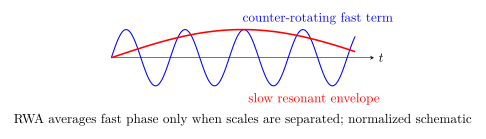
图 6 显示 time-scale separation;“fast oscillation”并非数学上等于零,只是其 cumulative contribution 在许多 cycles 上很小。
4. Optical Bloch equations / 光学布洛赫方程
Knowledge ID: P08-U03-L02-K04
4.1 density matrix dynamics
令 \(u=2\Re\rho_{eg}\)、\(v=2\Im\rho_{eg}\)、\(w=\rho_{ee}-\rho_{gg}\)。与本课 \(H_R\)、\(\Delta\) convention 一致的 equations 是
\[\dot u=\Delta v-\gamma_2u,\]
\[\dot v=-\Delta u-\Omega w-\gamma_2v,\]
\[\dot w=\Omega v-\Gamma_1(w-w_{\rm eq}), \qquad w_{\rm eq}=-1.\]
无 damping 时等价于 \(\dot{\mathbf r}=\boldsymbol\Omega_{\rm eff}\times\mathbf r\)。damping 不是简单把三分量乘同一 exponential:longitudinal 与 transverse 分量通常有不同 time constants。
布洛赫方程把三类过程放在同一本账上:哈密顿量产生可逆转动,纵向弛豫改变能级布居,横向退相干抹去相对相位。若只测激发布居,横向相干仍会通过驱动项影响后续动力学;若只测相干信号,也不能把布居恢复忽略。特别是纯退相干只缩短相干寿命而不直接搬运能量,因此它会压低振荡对比度,却不等同于自发辐射。把三个分量统一乘同一个衰减因子,会同时破坏稳态、能量流向和线宽解释。
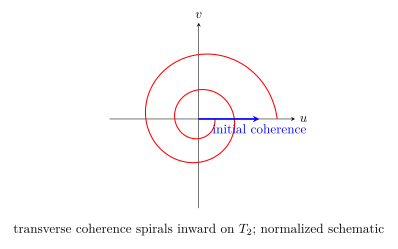
图 7 投影了 dephasing spiral;真实 three-dimensional Bloch vector 同时因 \(T_1\) 向 south pole 恢复。
4.2 steady state and saturation
在 purely radiative case \(\gamma_2=\Gamma_1/2\),解 steady state 得
\[\rho_{ee}^{(\rm ss)}= \frac{\Omega^2/4}{\Delta^2+\Gamma_1^2/4+\Omega^2/2} =\frac{s}{2(1+s)},\]
\[s=\frac{2\Omega^2}{\Gamma_1^2+4\Delta^2}.\]
若存在 pure dephasing,不能继续使用同一简化 \(s\) 而不修改 denominator。
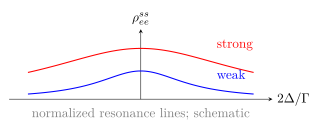
图 8 展示 saturation 与 power broadening 的同源性:它们都是 driven steady-state Bloch solution 的不同切面。
5. Coherent population transfer / 相干布居转移
Knowledge ID: P08-U03-L02-K05
5.1 resonant pulse control
对 resonant drive,rotation angle 就是 pulse area。若目标是 \(\lvert g\rangle\to\lvert e\rangle\),理想 \(\pi\) pulse 的 area error \(\epsilon=A_p-\pi\) 产生
\[F=\sin^2\left(\frac{\pi+\epsilon}{2}\right) =\cos^2\left(\frac{\epsilon}{2}\right) \approx1-\frac{\epsilon^2}{4}.\]
detuning error 则同时改变 rotation axis 与 angle;phase error 对单个 inversion 可能不显著,但会改变 superposition phase 和后续 interferometer output。
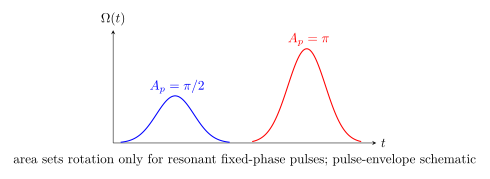
图 9 的两条 Gaussian 具有相同宽度,且使用 \(\int e^{-2(t-t_0)^2}dt=\sqrt{\pi/2}\):峰值分别取 \(\sqrt{\pi/2}\) 与 \(2\sqrt{\pi/2}\),所以面积严格为 \(\pi/2\) 与 \(\pi\)。它也提醒 pulse peak 不等于 pulse area;Gaussian 与 square pulse 可有同 area 而不同 bandwidth。
5.2 STIRAP:三能级的稳健扩展
“coherent population transfer”不只指单个 \(\pi\) pulse。对 \(\Lambda\) system \(\lvert1\rangle\leftrightarrow\lvert2\rangle\leftrightarrow\lvert3\rangle\),STIRAP 用 Stokes pulse 先于 pump pulse 的 counter-intuitive order,使 dark state
\[\lvert D(t)\rangle=\cos\theta(t)\lvert1\rangle-\sin\theta(t)\lvert3\rangle, \qquad \tan\theta=\frac{\Omega_P}{\Omega_S}\]
从 \(\lvert1\rangle\) adiabatically 转为 \(-\lvert3\rangle\)。关键条件包括 two-photon resonance、phase coherence 与 adiabaticity \(\Omega_{\rm gap}T\gg1\);有限时间仍会有小的 intermediate-state amplitude,不能把“dark”绝对化。
反直觉脉冲次序的作用,是在初态仍占据时先建立一条通往目标态的无损相干通道;随后缓慢改变两个耦合的比例,使暗态的组成连续旋转。原子并不是先被送到中间态再落到目标态,而是尽量沿瞬时本征态绕开中间态。稳健性也有明确代价:脉冲必须足够缓慢且相干,双光子失谐必须小,两个场的相对相位要稳定。若追求过短操作时间,绝热条件首先失效,中间态布居与自发损耗便重新出现。
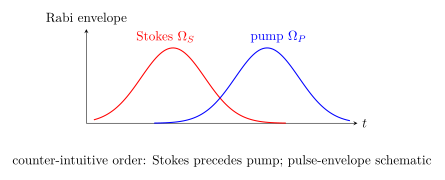
图 10 表示 STIRAP pulse ordering;它已超出严格 two-level system,但展示 coherent control 如何用 adiabatic dark-state path 提高 transfer robustness。
Worked Examples / 完整例题
Worked Example 1 — \(\pi\) pulse 所需电场与强度
题目。 transition dipole \(d=2.0\times10^{-29}\,\mathrm{C\,m}\),要求用 \(t_\pi=50.0\,\mathrm{ns}\) resonant square pulse 完成 inversion。求 \(\Omega\)、\(E_0\) 与 plane-wave intensity。
系统、参考系、坐标与模型。 原子静止系;polarization 与 \(\mathbf d\) 平行;closed two-level、RWA、pulse 内 \(\Omega\) constant,忽略 decay。
计算。
\[\Omega=\frac{\pi}{t_\pi}=6.28\times10^7\,\mathrm{rad\,s^{-1}}.\]
\[E_0=\frac{\hbar\Omega}{d}=331\,\mathrm{V\,m^{-1}}.\]
\[I=\frac12c\epsilon_0E_0^2=1.46\times10^2\,\mathrm{W\,m^{-2}}.\]
检查与解释。 \(dE_0\) 的单位为 J,除以 \(\hbar\) 得 \(\mathrm{s^{-1}}\)。若 polarization 与 dipole 成角 \(\alpha\),有效 \(d\) 乘 \(\lvert\cos\alpha\rvert\),所需 intensity 增大。
Worked Example 2 — detuned pulse 的最大 transfer
题目。 \(\Delta=0.60\Omega\),初态为 \(\lvert g\rangle\)。求 generalized Rabi frequency、最大 excited population 与首次达到最大值的时间。
模型与参考系。 rotating frame、constant drive、RWA、无 decay;detuning 使用 \(\omega_L-\omega_0\)。
计算。
\[\Omega_R=\Omega\sqrt{1+0.60^2}=1.166\Omega,\]
\[P_{e,\max}=\frac{\Omega^2}{\Omega_R^2}=\frac{1}{1.36}=0.735.\]
首次 maximum 满足 \(\Omega_Rt/2=\pi/2\):
\[t_{\max}=\frac{\pi}{\Omega_R}=\frac{2.694}{\Omega}.\]
检查与解释。 \(P_{e,\max}<1\) 且 \(t_{\max}<\pi/\Omega\);detuning 增加 precession rate,却倾斜 rotation axis,故 transfer 不完全。
Worked Example 3 — RWA 与 Bloch–Siegert 数量级
题目。 optical transition \(\omega_0=2\pi\times4.0\times10^{14}\,\mathrm{Hz}\),drive \(\Omega=2\pi\times20\,\mathrm{MHz}\)。估算 \(\Omega/\omega_0\) 与 \(\delta_{\rm BS}/(2\pi)\),取 \(\delta_{\rm BS}\approx\Omega^2/(4\omega_0)\)。
系统与模型。 resonant monochromatic drive;只估计 leading counter-rotating correction。
计算。
\[\frac{\Omega}{\omega_0}=\frac{2.0\times10^7}{4.0\times10^{14}}=5.0\times10^{-8}.\]
\[\frac{\delta_{\rm BS}}{2\pi} =\frac{(20\times10^6)^2}{4(4.0\times10^{14})} =0.25\,\mathrm{Hz}.\]
检查与解释。 correction 远小于 \(20\,\mathrm{MHz}\) coupling,故 RWA 极好。这里把 numerator/denominator 均用 ordinary-frequency ratios 后 \(2\pi\) 正确抵消;ultrastrong microwave systems 可能不再如此。
Worked Example 4 — 含纯退相干的 coherence time
题目。 population lifetime \(T_1=30.0\,\mathrm{ns}\),pure-dephasing time \(T_\phi=100\,\mathrm{ns}\),求 \(T_2\) 与 weak-drive homogeneous FWHM(MHz)。
系统与模型。 Markov population decay 与 independent exponential pure dephasing;无 Doppler、无 power broadening。
计算。
\[\frac{1}{T_2}=\frac{1}{2T_1}+\frac{1}{T_\phi} =\frac{1}{60.0\,\mathrm{ns}}+\frac{1}{100\,\mathrm{ns}} =2.667\times10^7\,\mathrm{s^{-1}},\]
\[T_2=37.5\,\mathrm{ns}.\]
Lorentzian angular FWHM 是 \(2/T_2\),故
\[\Delta\nu_{\rm FWHM}=\frac{1}{\pi T_2}=8.49\,\mathrm{MHz}.\]
检查与解释。 无 pure dephasing 时 \(T_2=2T_1=60\,\mathrm{ns}\);加入 \(\gamma_\phi\) 后缩短至 \(37.5\,\mathrm{ns}\)。linewidth 变宽但 population lifetime 不变。
Lesson synthesis / 全课综合
- 选 basis、写 \(H_0\) 与 dipole coupling,并从 matrix 元素定义 \(\Omega\);先消除 factor-of-two ambiguity。
- 变到 rotating frame,用 \(\Omega/\omega_0\)、\(\lvert\Delta\rvert/\omega_0\) 与 envelope timescale 审查 RWA。
- 无耗散时把 dynamics 看成 Bloch vector 围绕 \((\Omega,0,-\Delta)\) 旋转。
- 有耗散时使用 density matrix 与 \(T_1,T_2\);不要把 amplitude damping 当作单一 scalar exponential。
- control design 由 pulse area、axis、phase、adiabaticity 与 decoherence 共同决定,而不只由 peak intensity 决定。
Formula-and-decision table / 公式与决策表
| Need | Formula | Use when | Main limitation |
|---|---|---|---|
| Lab Hamiltonian | \(H=\hbar\omega_0\sigma_z/2-dE_0\cos\omega_Lt\) | isolated dipole-coupled pair | omitted levels and diagonal Stark terms |
| RWA Hamiltonian | \(H_R=\hbar(\Omega\sigma_x-\Delta\sigma_z)/2\) | near resonance, weak coupling | \(\Omega,\lvert\Delta\rvert\ll\omega_0\) |
| Rabi probability | \(P_e=(\Omega^2/\Omega_R^2)\sin^2(\Omega_Rt/2)\) | constant coherent drive | no relaxation |
| Pulse area | \(A_p=\int\Omega dt\) | resonant fixed-phase envelope | detuning/chirp breaks area-only result |
| Effective axis | \(\boldsymbol\Omega_{eff}=(\Omega,0,-\Delta)\) | Bloch-sphere reasoning | sign follows stated convention |
| Coherence rate | \(1/T_2=1/(2T_1)+1/T_\phi\) | Markov damping | nonexponential noise not captured |
| Bloch dynamics | equations for \((u,v,w)\) above | driven open two-level atom | multilevel leakage ignored |
| STIRAP dark state | \(\lvert D\rangle=\cos\theta\lvert1\rangle-\sin\theta\lvert3\rangle\) | coherent three-level transfer | two-photon resonance and adiabaticity required |
Model boundaries / 模型边界
- two-level truncation requires all neglected detunings large relative to coupling and bandwidth;strong broadband pulses excite more levels。
- RWA fails for ultrastrong coupling, few-cycle pulses or large detuning;then counter-rotating effects and Bloch–Siegert shift matter。
- semiclassical drive omits photon-number fluctuation and atom–field entanglement。
- Markov \(T_1,T_2\) assumes memoryless baths;\(1/f\) noise and spectral diffusion can produce nonexponential envelopes。
- Bloch sphere surface represents pure states;mixed states lie inside sphere。
- pulse-area theorem requires on-resonance, fixed phase and commuting Hamiltonians。
- STIRAP is a three-level extension;finite-time transfer has small but nonzero intermediate amplitude and is not magically loss-free。
- selection rules and multilevel Zeeman structure can make polarization coupling state dependent。
这些边界可以用一个统一问题检查:被忽略的自由度是否会在操作时间内积累可分辨的相位、布居或噪声。若答案为会,就必须扩大哈密顿量、加入相应耗散通道,或把结论降格为局部近似。数值上“曲线看起来差不多”不能替代量纲比值、极限检验和对照实验。
Misconception clinic / 误区诊所
- “Rabi frequency 等于 off-diagonal Hamiltonian 除以 \(\hbar\)。” 在本课 convention 中 off-diagonal 是 \(\hbar\Omega/2\);必须看定义而非只看名称。
- “detuning 只让 oscillation 变慢。” \(\Omega_R\) 反而增大,但 amplitude 降低,因为 rotation axis 倾斜。
- “rotating frame 是原子真的旋转。” 它是 time-dependent basis transformation,observable 不变。
- “RWA 把一个真实作用项设为零。” 它利用 scale separation 做 averaging;correction 如 Bloch–Siegert shift 并非严格为零。
- “\(T_2=T_1\)。” purely radiative limit 是 \(T_2=2T_1\);pure dephasing 使 \(T_2\) 更短。
- “\(\pi\) pulse 对所有误差都稳健。” area、detuning、phase、inhomogeneous coupling 与 decoherence 都会降低 fidelity。
Practice and retrieval / 练习与提取
- K01|matrix: 按本课 basis 写出 \(H_R\) 的 \(2\times2\) matrix。
- K01|boundary: 给出 two-level truncation 的两个独立条件。
- K02|计算: \(\Omega=2\pi\times5.0\,\mathrm{MHz}\) 时求 \(t_\pi,t_{\pi/2}\)。
- K02|area: square pulse amplitude 加倍、duration 减半,ideal resonant transfer 是否改变?
- K03|detuning: \(\Delta=2\Omega\) 时求 \(P_{e,\max}\)。
- K03|RWA: 为什么 few-cycle pulse 可能违反 RWA,即使 peak \(\Omega\) 不大?
- K04|Bloch: \(\Omega=0\) 时写出 \(u,v,w\) 的长期极限。
- K04|dephasing: \(T_1=20\,\mu\mathrm s\)、\(T_2=15\,\mu\mathrm s\),求 \(T_\phi\)。
- K05|fidelity: \(\pi\) pulse area error 为 \(0.10\,\mathrm{rad}\),用小误差式估计 infidelity。
- 综合: 设计一个把 \(\lvert g\rangle\) 变为 \((\lvert g\rangle+\lvert e\rangle)/\sqrt2\) 的 pulse,并说明如何改变 optical phase 以制备相对相位 \(i\) 的 superposition。
Answers / 答案
- \(H_R=(\hbar/2)\begin{pmatrix}-\Delta&\Omega\\\Omega&\Delta\end{pmatrix}\)。
- 目标 transition 近共振且其 coupling 显著;所有其他 transitions 的 detuning 相对 \(\Omega\) 与 pulse bandwidth 足够大。selection-rule leakage 也须小。
- \(t_\pi=\pi/\Omega=100\,\mathrm{ns}\),\(t_{\pi/2}=50.0\,\mathrm{ns}\)。
- area \(\Omega t\) 不变,故在 stated ideal conditions 下 transfer 不变;带宽和 RWA error 实际会变化。
- \(P_{e,\max}=\Omega^2/(\Omega^2+4\Omega^2)=0.20\)。
- envelope variation time 接近 \(1/\omega_0\),光谱带宽接近 carrier,无法平均 counter-rotating component。
- \(u,v\to0\),\(w\to w_{eq}=-1\),即 ground state thermal limit。
- \(1/T_\phi=1/T_2-1/(2T_1)=1/15-1/40=1/24\,\mu\mathrm{s}^{-1}\),故 \(T_\phi=24\,\mu\mathrm s\)。
- \(1-F\approx\epsilon^2/4=2.5\times10^{-3}\)。
- resonant \(\pi/2\) pulse。rotation axis 由 drive phase 决定;把 phase 相对 \(x\) quadrature 移 \(\pi/2\),可把 real coherence 转成相差 \(i\) 的 superposition(整体相位无物理意义)。
Exit ticket / 离堂检验
- 对同一实验分别用 Hamiltonian、effective-field 与 Bloch equations 三种语言说明 detuning 的作用。
- 一次 transfer 的 population 看似 100%,为什么仍可能不是 high-fidelity quantum control?至少指出一个 phase 或 coherence 检验。
References and source notes / 参考资料与来源说明
以下来源均于 2026-08-30 实际打开核验。正文的 detuning、basis 与 Rabi factor 已统一声明;不同来源的 sign/factor convention 未机械拼接。
- MIT OpenCourseWare 6.974, Chapter 6: Two-Level Model, Rabi Oscillations and Density Matrix
- MIT OpenCourseWare 8.422, Lecture 13: Derivation of Optical Bloch Equations
- MIT OpenCourseWare 8.421, Assignment 1: Rotating Frame and Rabi Dynamics
- MIT OpenCourseWare 8.421, Assignment 7: Optical Bloch Equations
- MIT OpenCourseWare 6.977, Ultrafast Optics: Maxwell–Bloch Equations
- Vitanov et al., Stimulated Raman Adiabatic Passage in Physics, Chemistry, and Beyond — author preprint
Source-to-content map
| Source | Used for | Knowledge ID / Section | Model boundary or convention |
|---|---|---|---|
| MIT 6.974 Chapter 6 | two-level Hamiltonian, Rabi solution, density matrix | K01–K04 | \(\Omega\) converted to stated off-diagonal convention |
| MIT 8.422 Lecture 13 | optical Bloch derivation | K04 | signs tied to this note's \(\Delta\) and basis |
| MIT 8.421 Assignment 1 | rotating frame, Bloch-vector precession | K01–K03 | magnetic analogue re-expressed as optical drive |
| MIT 8.421 Assignment 7 | damping, steady state, saturation | K04 | distinguishes \(\Gamma_1\) and \(\gamma_2\) |
| MIT 6.977 textbook | coherent two-level dynamics and Maxwell–Bloch context | K02–K04 | propagation effects excluded here |
| Vitanov et al. author preprint | STIRAP and coherent population transfer | K05 | explicitly marked three-level extension and finite-time boundary |
复习与拓展
- Laser Operation 把 single-atom Bloch response coarse-grain 成 gain-medium rate equations,并加入 cavity feedback。
- Magnetic Resonance 使用同一 rotating-frame/Bloch geometry,但 interaction 从 electric dipole 换成 magnetic dipole。
- Precision Measurement 使用 \(\pi/2\)–free evolution–\(\pi/2\) Ramsey sequence,把 detuning phase 变为 population signal。
- 数值扩展:同时积分 full lab Hamiltonian 与 RWA Hamiltonian,测量 Bloch–Siegert shift 和 RWA error。