
Learning objectives / 学习目标
完成本课后,你应能:
- 解释为何封闭二能级系统的稳态光学泵浦不能产生严格 population inversion,并比较 three-level 与 four-level laser。
- 从一次 round-trip intensity balance 推导 laser threshold,清楚区分 distributed loss、mirror loss、field gain 与 intensity gain。
- 计算 Fabry–Pérot longitudinal-mode spacing、cold-cavity linewidth 与允许振荡的模数,并说明 mode-selection 元件的作用。
- 建立 inversion–photon rate equations,解释 gain clamping、slope efficiency、relaxation oscillation 与 spontaneous-emission seed。
- 区分 gain switching、Q switching 与 mode locking,并由等间隔、等相位的频率梳推导 pulse spacing 与 transform-limited pulse width 的数量级。
Prerequisites / 先修知识
- Radiative Processes:Einstein coefficients、stimulated emission、saturation 与 linewidth。
- Two-Level Atoms and Coherent Control:Rabi coupling、coherence 与 dephasing。
- Fabry–Pérot interference、指数传播、复振幅与 first-order rate equations。
- 能量守恒、photon energy \(h\nu\) 与功率单位 \(\mathrm{W}\)。
Scope and conventions / 范围与约定
- 采用单一 traveling-wave intensity gain coefficient \(g\),定义 \(I(z)=I(0)e^{(g-\alpha_i)z}\);\(g\) 与 internal distributed loss \(\alpha_i\) 的单位均为 \(\mathrm{m^{-1}}\)。若教材对 field amplitude 定义 gain,数值会差一因子 2,本课不混用。
- linear cavity 的 active length 取 \(L\),两端镜 intensity reflectivity 为 \(R_1,R_2\);一次 round trip 穿过增益介质两次。
- cavity longitudinal resonance 采用 group index \(n_g\):\(\nu_q\simeq qc/(2n_gL)\),free spectral range \(\Delta\nu_{\rm FSR}=c/(2n_gL)\)。
- \(N\) 表示有效 inversion density,\(S\) 表示 cavity photon density;mode-overlap/confinement factor 写作 \(\Gamma_c\),不可与原子 population decay rate 混淆。
- 速率方程是 semiclassical、spatially averaged 模型;精细的 spatial hole burning、multimode beating、quantum noise 与 linewidth enhancement 只在边界中讨论。
Notation and modeling contract / 符号与建模契约
| Symbol | Meaning | SI unit |
|---|---|---|
| \(N_1,N_2\) | lower / upper laser-level population density | \(\mathrm{m^{-3}}\) |
| \(N=N_2-(g_2/g_1)N_1\) | degeneracy-corrected inversion density | \(\mathrm{m^{-3}}\) |
| \(\sigma(\nu)\) | stimulated-emission cross section | \(\mathrm{m^2}\) |
| \(g=\sigma N\) | traveling-wave intensity gain coefficient | \(\mathrm{m^{-1}}\) |
| \(\alpha_i\) | distributed internal intensity loss | \(\mathrm{m^{-1}}\) |
| \(R_1,R_2\) | mirror intensity reflectivities | 1 |
| \(\tau_p\) | photon lifetime in the cold cavity | s |
| \(S\) | photon density in the selected cavity mode | \(\mathrm{m^{-3}}\) |
| \(R_p\) | effective pump excitation rate density | \(\mathrm{m^{-3}\,s^{-1}}\) |
| \(T_R\) | cavity round-trip time | s |
| \(Q\) | cold-cavity quality factor \(2\pi\times\) stored energy / energy lost per cycle | 1 |
1. Population inversion and pumping schemes / 粒子数反转与泵浦方案
Knowledge ID: P08-U03-L03-K01
1.1 为什么需要反转
在同一 mode 上,absorption 与 stimulated emission 的净作用由 degeneracy-corrected population difference 决定:
\[g(\nu)=\sigma(\nu)\left[N_2-\frac{g_2}{g_1}N_1\right].\]
只有括号内为正,弱 probe 才被放大。对一个封闭二能级系统,resonant coherent drive 使稳态最多趋向 \(N_1/g_1=N_2/g_2\),即 transparency;它不能靠同一条跃迁同时泵浦并建立严格 inversion。实际激光利用额外能级和不同时间尺度打破这一限制。
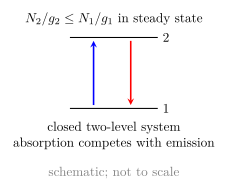
图 1 把同一 resonant field 的上、下跃迁画在一起;增加强度只会 saturation,不会产生净小信号增益。
1.2 three-level 与 four-level schemes
Three-level laser 将原子从 ground state \(1\) 泵到短寿命 pump level \(3\),快速无辐射落到 metastable upper laser level \(2\),再由 \(2\to1\) 激光跃迁。由于 lower laser level 是基态,要抽走超过约一半的相关 population,threshold pump 较高。Four-level laser 的激光跃迁为 \(3\to2\),而 lower level \(2\) 快速落回 \(1\),使 \(N_2\approx0\);于是很小的 upper-level population 便可反转。
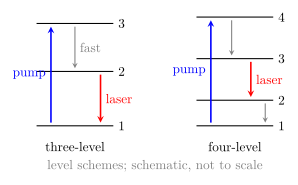
图 2 的关键不是能级数量本身,而是 upper laser level 长寿命、lower laser level 快速清空这一 lifetime hierarchy。
2. Gain, loss, and threshold / 增益、损耗与阈值
Knowledge ID: P08-U03-L03-K02
2.1 从 round-trip ledger 推导 threshold
从镜 1 内侧的一束 intensity 出发,一次 round trip 后
\[\frac{I_{\rm after}}{I_{\rm before}} =R_1R_2\exp\left[2(g-\alpha_i)L\right].\]
小信号振荡 threshold 是 round-trip multiplier 等于 1:
\[g_{\rm th}=\alpha_i+\frac{1}{2L}\ln\frac{1}{R_1R_2}.\]
低于 threshold,spontaneous photons 在多次往返后平均衰减;超过 threshold,小信号会增长,直到 saturation 降低 \(g\) 并把稳态净 round-trip gain 钳位到 1。
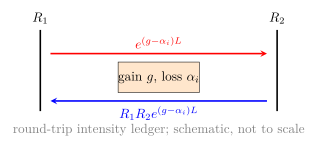
图 3 强制保留两个 mirror factors 和两次介质传播,可避免 threshold 公式最常见的因子 2 错误。
2.2 photon lifetime 与 threshold 的等价写法
若把所有 cold-cavity loss 合并为 photon lifetime \(\tau_p\),small-signal photon density obeys
\[\dot S=\left(\Gamma_c v_g\sigma N-\frac{1}{\tau_p}\right)S+\text{seed}.\]
因此 \(N_{\rm th}=1/(\Gamma_cv_g\sigma\tau_p)\)。这与 round-trip 写法等价,前提是 \(\tau_p\) 使用同一组 mirror、distributed loss 与 group velocity 定义。不要把 amplitude ring-down time 当成 intensity/photon lifetime。
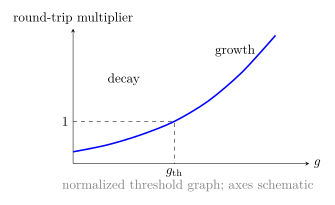
图 4 显示 threshold 是 stability change,而不是“有无 spontaneous emission”的分界;阈值以下仍有 fluorescence 与 amplified spontaneous emission。
3. Resonator modes and mode selection / 谐振腔模与选模
Knowledge ID: P08-U03-L03-K03
3.1 longitudinal modes、FSR 与 linewidth
linear cavity 的 round-trip phase 必须是 \(2\pi q\):
\[2k(\nu_q)L=2\pi q,\]
\[\Delta\nu_{\rm FSR}\simeq\frac{c}{2n_gL}.\]
Cold-cavity resonance 的 FWHM 可写为 \(\delta\nu_c=\Delta\nu_{\rm FSR}/\mathcal F=\nu_q/Q\),其中 \(\mathcal F\) 是 finesse。只有同时落在 gain bandwidth 内且 round-trip gain 超过 loss 的 mode 能振荡。
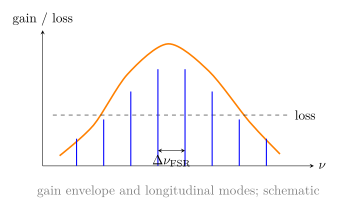
图 5 把 continuous gain envelope 与 discrete cavity spectrum 分开;“原子发什么频率”和“腔允许什么频率”是两个筛选条件。
3.2 transverse modes 与 mode selection
Transverse modes 由 cavity geometry 决定,通常以 TEM\(_{mn}\) 标记。Aperture、curved-mirror stability、spatial overlap 与 intracavity etalon 可提高某一空间模或纵模的相对损耗差。选模不是免费过程:它往往增加总 loss,从而提高 threshold。
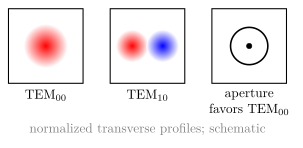
图 6 展示空间选模的物理机制:高阶模在 aperture 处有更大 diffraction/clipping loss。
4. Rate equations and steady-state output / 速率方程与稳态输出
Knowledge ID: P08-U03-L03-K04
4.1 最小 inversion–photon 模型
对 four-level、single-mode、uniform model,可写
\[\dot N=R_p-\frac{N}{\tau}-v_g\sigma NS,\]
\[\dot S=\Gamma_cv_g\sigma NS-\frac{S}{\tau_p}+\beta\frac{N}{\tau}.\]
\(\beta\) 是 spontaneous emission 落入所研究 cavity mode 的 fraction。宏观激光通常 \(\beta\ll1\),但它提供启动 seed;微腔中 \(\beta\) 可不小,L–L curve 的“拐点”会变得平滑。
忽略 above-threshold steady state 中的 seed term,第二式给出
\[N=N_{\rm th}=\frac{1}{\Gamma_cv_g\sigma\tau_p}.\]
这称为 gain clamping。继续增大 \(R_p\),主要增加 \(S\) 而不是 \(N\):
\[S\simeq\Gamma_c\tau_p\left(R_p-\frac{N_{\rm th}}{\tau}\right).\]
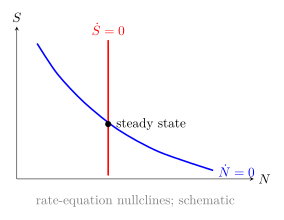
图 7 的交点是稳态;瞬态可围绕它出现 damped relaxation oscillation,但其频率和阻尼取决于 pump level 与两个 lifetimes。
4.2 input–output curve 与效率
输出功率不是“pump power 减 threshold”本身,而还受 pump absorption、quantum defect、mode overlap 与 output-coupler fraction 限制。常用局部关系为
\[P_{\rm out}\simeq\eta_s(P_{\rm pump}-P_{\rm th}),\]
其中 \(\eta_s\) 是 measured slope efficiency;它不是普适常数,也不能超过相应 energy-conversion bound。
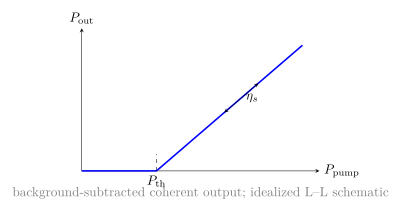
图 8 对应上式的 background-subtracted coherent output,所以在 \(P_{\rm th}\) 从零起;threshold 附近的 sharp kink 只是 \(\beta\ll1\) 的理想化。实际 detector signal 还可含 background fluorescence,且高泵浦会出现 thermal roll-over,二者不属于这条理想直线。
5. Pulsed lasers and mode locking / 脉冲激光与锁模
Knowledge ID: P08-U03-L03-K05
5.1 Q switching 与 gain switching
Q switching 先在低 \(Q\)(高 loss)状态储存 inversion,再快速提高 \(Q\),使储能在短时间内以 high-energy pulse 释放。Gain switching 则直接用快速 pump 改变 gain;两者操纵的物理变量不同。
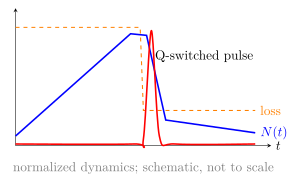
图 9 显示 pulse energy 来自预先积累的 inversion;峰值功率升高并不意味着能量守恒被突破。
5.2 mode locking:频率梳与时间脉冲是同一 Fourier 结构
若 \(M\) 个等间隔 longitudinal modes 具有固定相对相位,field 可写为
\[E(t)=\operatorname{Re}\left\{e^{-i\omega_0t}\sum_{m}A_m e^{-im\Omega_Rt+i\phi_m}\right\},\]
其中 \(\Omega_R=2\pi/T_R\)。若 \(\phi_m\) 无关联,强度近似噪声;若 \(\phi_m\) 锁定,所有 modes 每个 round trip 同相叠加一次,pulse separation 为 \(T_R=1/\Delta\nu_{\rm FSR}\)。可用 optical bandwidth \(\Delta\nu\) 越宽,transform-limited pulse 越短;例如 Gaussian intensity pulse 满足 \(\Delta\nu\,\Delta t\ge0.441\)。
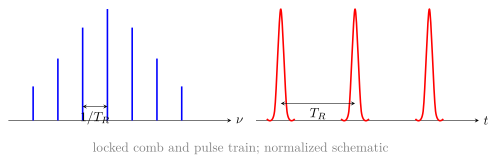
图 10 是同一 signal 的 frequency-domain 与 time-domain 表示。Mode locking 不等于只有一个 longitudinal mode,恰恰需要许多 modes 保持 phase relation。
5.3 laser linewidth 的模型边界
Cold-cavity linewidth \(\nu/Q\) 衡量被动腔的 energy decay;实际 lasing field 在 gain narrowing 后可远窄于它。理想 Schawlow–Townes phase-diffusion linewidth 的 scaling 可写成
\[\Delta\nu_{\rm ST}\propto\frac{h\nu}{P_{\rm out}\tau_p^2}n_{\rm sp},\]
但精确 prefactor 取决于 one-sided/two-sided linewidth、output coupling、spontaneous-emission factor、standing/traveling-wave 与 semiconductor linewidth-enhancement convention。技术噪声、thermal drift 与 vibration 往往主导 measured linewidth;没有说明模型与 convention 时,不应套用单一 prefactor。
Worked Examples / 完整例题
Worked Example 1 — 由 round-trip balance 求 threshold gain
已知: \(L=0.300\ \mathrm{m}\),\(R_1=0.995\),\(R_2=0.950\),\(\alpha_i=0.0200\ \mathrm{m^{-1}}\)。
研究对象与系统边界: 两镜之间一次完整 round trip;只计指定 distributed loss 与 mirrors。
参考系与坐标: cavity 固定实验室系,\(z\) 沿单程传播;gain 是 intensity gain。
模型及理由: small-signal、uniform gain,正适合 threshold onset。
\[g_{\rm th}=\alpha_i+\frac{1}{2L}\ln\frac{1}{R_1R_2}.\]
代入 \(R_1R_2=0.94525\):
\[g_{\rm th}=0.0200+\frac{\ln(1/0.94525)}{0.600} =0.1138\ \mathrm{m^{-1}}.\]
取三位有效数字,\(g_{\rm th}=0.114\ \mathrm{m^{-1}}\)。检查: \(g\) 与 \(\alpha_i\) 都是 inverse length;令 \(R_1,R_2\to1\) 时镜损耗项趋零。回代 \(R_1R_2e^{2(g-\alpha_i)L}=1.000\)。解释: output coupler 的 5% transmission 是本例主要 threshold loss。
Worked Example 2 — cavity FSR、cold linewidth 与模数
已知: linear cavity \(L=0.500\ \mathrm{m}\),\(n_g=1.00\),finesse \(\mathcal F=300\),gain FWHM \(\Delta\nu_g=1.20\ \mathrm{GHz}\)。
系统与参考系: 静止 cavity;只计 longitudinal modes,忽略 dispersion across bandwidth。
坐标/模型: propagation axis 为 \(z\);Fabry–Pérot resonance。
\[\Delta\nu_{\rm FSR}=\frac{c}{2n_gL}=2.998\times10^8\ \mathrm{Hz}.\]
\[\delta\nu_c=\frac{\Delta\nu_{\rm FSR}}{\mathcal F} =9.99\times10^5\ \mathrm{Hz}\approx0.999\ \mathrm{MHz}.\]
Gain FWHM 内的 mode intervals 数约 \(\Delta\nu_g/\Delta\nu_{\rm FSR}=4.00\);实际可有约 4–5 个 resonance,取决于 gain center 相对 mode grid 的位置,不能仅凭带宽宣称精确整数。检查: \(\delta\nu_c<\Delta\nu_{\rm FSR}\),与 high finesse 一致。解释: 若要可靠 single-longitudinal-mode operation,还需 mode competition 或附加 etalon。
Worked Example 3 — gain clamping 与 steady photon density
已知: \(\Gamma_c=0.80\),\(v_g=2.00\times10^8\ \mathrm{m\,s^{-1}}\),\(\sigma=3.00\times10^{-20}\ \mathrm{m^2}\),\(\tau_p=5.00\ \mathrm{ns}\),\(\tau=200\ \mathrm{\mu s}\),\(R_p=3.00\times10^{22}\ \mathrm{m^{-3}\,s^{-1}}\)。
系统边界: uniform four-level active volume;single mode。
参考系/坐标: cavity frame;spatial average removes explicit coordinate.
模型: above threshold、\(\beta\) seed negligible in steady balance。
\[N_{\rm th}=\frac{1}{\Gamma_cv_g\sigma\tau_p} =4.17\times10^{19}\ \mathrm{m^{-3}}.\]
Threshold pump rate density is
\[R_{p,\rm th}=\frac{N_{\rm th}}{\tau} =2.08\times10^{23}\ \mathrm{m^{-3}\,s^{-1}}.\]
给定 \(R_p\) 反而低于 threshold,因此不能使用 above-threshold \(S\) 公式;稳态 \(S\) 只来自 spontaneous seed,题设不足以算出宏观输出。量纲与合理性检查: \(N/\tau\) 的单位正确;此反例显示先判断 operating regime 是计算的一部分。若把 \(R_p\) 改为 \(3.00\times10^{24}\ \mathrm{m^{-3}\,s^{-1}}\),则
\[S=\Gamma_c\tau_p(R_p-R_{p,\rm th}) =1.12\times10^{16}\ \mathrm{m^{-3}}.\]
解释: above threshold 后 inversion 被钳在 \(N_{\rm th}\),额外 pump 流向 coherent photons。
Worked Example 4 — mode-locked pulse spacing 与 transform limit
已知: ring laser round-trip optical path 对应 \(T_R=10.0\ \mathrm{ns}\);Gaussian optical intensity spectrum FWHM \(\Delta\nu=4.00\ \mathrm{THz}\)。
研究对象: 一列 fully phase-locked pulses。
参考系/坐标: laboratory time \(t\);忽略 dispersion 与 chirp。
模型: transform-limited Gaussian pulse。
\[f_{\rm rep}=\frac{1}{T_R}=100\ \mathrm{MHz},\]
\[\Delta t_{\rm min}=\frac{0.441}{\Delta\nu} =1.10\times10^{-13}\ \mathrm{s}=110\ \mathrm{fs}.\]
检查: Hz 与 s 互为倒数;\(4\ \mathrm{THz}\) bandwidth 支持 sub-picosecond duration,数量级合理。解释: 110 fs 是零 chirp、Gaussian shape 的下界;实际 intracavity dispersion 会使 pulse 更长。
Lesson synthesis / 全课综合
激光器是一条闭合 feedback chain:pump 建立 lifetime hierarchy 所允许的 inversion;inversion 给出 small-signal gain;cavity 把一次放大转成 round-trip feedback 并量化 threshold;gain saturation 将 runaway growth 变成 steady output;最后,mode amplitude 和 phase 决定输出是 single-frequency CW、Q-switched pulse 还是 mode-locked pulse train。
可执行建模流程:
- 画出 pump 与 laser levels,先判断 lower level 是否能快速清空。
- 声明 gain 是 field 还是 intensity convention;建立完整 round-trip ledger。
- 由 gain spectrum 与 cavity mode grid 找 candidate modes。
- 用 rate equations 先判 below/above threshold,再求 \(N,S\) 与 output。
- 对 pulse 问题同时检查 energy storage、bandwidth、phase locking 与 time–bandwidth product。
Formula-and-decision table / 公式与决策表
| Question | Relation | Use only when | Common limit |
|---|---|---|---|
| 是否反转 | \(N=N_2-(g_2/g_1)N_1>0\) | 同一 transition、简并度已知 | closed two-level steady pump 只能至 transparency |
| threshold gain | \(g_{\rm th}=\alpha_i+(2L)^{-1}\ln[1/(R_1R_2)]\) | linear cavity、intensity gain、uniform medium | gain saturation 尚可忽略 |
| mode spacing | \(\Delta\nu_{\rm FSR}=c/(2n_gL)\) | linear cavity、局部 group index | strong dispersion 时 \(n_g\) 不可省 |
| cold linewidth | \(\delta\nu_c=\Delta\nu_{\rm FSR}/\mathcal F=\nu/Q\) | passive resonance | 不是 laser phase-diffusion linewidth |
| inversion threshold | \(N_{\rm th}=1/(\Gamma_cv_g\sigma\tau_p)\) | single-mode rate model | parameters must share same loss convention |
| gain clamping | \(N=N_{\rm th}\) | above threshold、seed negligible | multimode/spatial hole burning 可破坏简单钳位 |
| repetition rate | \(f_{\rm rep}=1/T_R\) | one pulse per round trip | harmonic mode locking 可为整数倍 |
| Gaussian limit | \(\Delta\nu\Delta t\ge0.441\) | intensity FWHM、Gaussian pulse | chirp/shape changes product |
Model boundaries / 模型边界
- Rate equations 丢弃 optical phase,不能描述 Rabi oscillation、coherent transients 或 mode-locking phase dynamics。
- Uniform inversion 忽略 standing-wave spatial hole burning;它会允许多个 longitudinal modes 共存。
- Threshold 是 linear stability criterion。High-\(\beta\) nanolaser 中 L–L kink 变弱,“thresholdless”也不表示 loss 消失。
- \(Q\) switching 需要 pump storage time 长于 switching/pulse time;若 upper-state lifetime 太短,无法积累能量。
- Transform limit 是给定 spectral amplitude 与 phase 的下界;positive/negative chirp 都会增加 pulse duration。
- Schawlow–Townes scaling 不包含 technical frequency noise、cavity pulling、Henry factor、Petermann factor 与 non-orthogonal modes;精密 linewidth 必须声明完整模型。
Misconception clinic / 误区诊所
- “受激辐射存在就会产生激光。” 错。还需 net round-trip gain、feedback 和一个能稳定饱和的 operating point。
- “二能级原子用强光就能反转。” 封闭二能级 resonant steady state 最多 equalize population per sublevel。
- “threshold 时 gain 为零。” threshold 时 gain 恰好补偿 total loss;净 round-trip exponent 为零。
- “FSR 就是 cavity linewidth。” FSR 是相邻 resonance 间距;linewidth 是单个 resonance 宽度,二者之比是 finesse。
- “Mode locking 是只留一个 mode。” 它要求许多 modes 保持 fixed relative phase;single-mode CW 不会形成短 pulse train。
- “更短 pulse 只需更强 pump。” pulse duration 的硬约束来自 bandwidth、dispersion 与 phase,不只来自 energy。
Practice and retrieval / 练习与提取
- [K01 概念] 为什么 four-level laser 的 threshold 通常低于 three-level laser?
- [K01 判断] 一个简并度相同的封闭二能级 ensemble 被 resonant CW field 长时间驱动至 \(N_1=N_2\)。它有 gain、loss 还是 transparency?
- [K02 推导] 从 \(R_1R_2e^{2(g-\alpha_i)L}=1\) 推导 \(g_{\rm th}\)。
- [K02 定量] \(L=0.20\ \mathrm{m}\)、\(R_1=1.00\)、\(R_2=0.90\)、\(\alpha_i=0\),求 intensity threshold gain。
- [K03 定量] \(L=0.75\ \mathrm{m}\)、\(n_g=1\) 的 linear cavity 的 FSR 是多少?
- [K03 图像] Gain bandwidth 内有 6 个 cavity resonances,为什么仍可能只振荡一个?
- [K04 边界] 何时可在 steady photon equation 中忽略 \(\beta N/\tau\)?
- [K04 定量] 若 \(\Gamma_c=1\)、\(v_g=2.0\times10^8\ \mathrm{m\,s^{-1}}\)、\(\sigma=2.0\times10^{-20}\ \mathrm{m^2}\)、\(\tau_p=10\ \mathrm{ns}\),求 \(N_{\rm th}\)。
- [K05 比较] Q switching 与 mode locking 分别操纵什么,典型目标有何不同?
- [K05 定量] Gaussian pulse spectrum FWHM 为 \(10\ \mathrm{THz}\),求 transform-limited intensity FWHM 下界。
Answers / 答案
- Four-level lower laser level 被快速清空,近似 \(N_1\approx0\);three-level lower laser level 是高度占据的 ground state,必须先抽走大比例 population。
- Transparency:stimulated emission 与 absorption 相抵,\(g=0\);仍可能有 spontaneous emission。
- 取自然对数得 \(\ln R_1R_2+2(g-\alpha_i)L=0\),故 \(g_{\rm th}=\alpha_i+(2L)^{-1}\ln[1/(R_1R_2)]\)。
- \(g_{\rm th}=\ln(1/0.90)/(0.40)=0.263\ \mathrm{m^{-1}}\)。
- \(\Delta\nu_{\rm FSR}=c/(2L)=2.00\times10^8\ \mathrm{Hz}=200\ \mathrm{MHz}\)。
- 各 mode 的 gain、spatial overlap、loss 与 saturation competition 不同;最先起振者可耗尽共享 inversion 并抑制其余 modes。
- Above threshold 且 stimulated photon production 远大于 spontaneous coupling into that mode 时;启动瞬态和 high-\(\beta\) microcavity 中不能忽略。
- \(N_{\rm th}=1/(v_g\sigma\tau_p)=2.50\times10^{19}\ \mathrm{m^{-3}}\)。
- Q switching 快速改变 cavity loss/Q,目标通常是高能量、高峰值单脉冲;mode locking 固定许多 longitudinal modes 的相对相位,目标是周期性超短脉冲。
- \(\Delta t_{\min}=0.441/(10^{13}\ \mathrm{Hz})=4.41\times10^{-14}\ \mathrm{s}=44.1\ \mathrm{fs}\)。
Exit ticket / 离堂检验
- 给定一张真实 laser datasheet 的 cavity length、mirror reflectivity、gain bandwidth 与 pulse bandwidth,写出你必须先确认的四种 convention,才可计算 threshold、mode spacing 与 transform limit。
- 用不超过六行方程说明“pump 增强为何 above threshold 后主要提高 output 而非无限提高 inversion”。
References and source notes / 参考资料与来源说明
以下页面均于 2026-08-30 实际打开核验;正文据其物理框架重新组织,全部图示为依据方程原创绘制。
- MIT OpenCourseWare, 6.974 Fundamentals of Photonics: Quantum Electronics — Chapter 7, Lasers:laser rate equations、threshold、steady-state operation。https://www.ocw.mit.edu/courses/6-974-fundamentals-of-photonics-quantum-electronics-spring-2006/18f30fad63a62ef4dd894d3752b55a60_chapter7.pdf
- MIT OpenCourseWare, 6.974 Fundamentals of Photonics: Quantum Electronics — Class Notes:gain media、resonators、laser dynamics 与 linewidth conventions。https://ocw.mit.edu/courses/6-974-fundamentals-of-photonics-quantum-electronics-spring-2006/bf3bdeb971819ddc9c68719d28bb2745_classnotes.pdf
- MIT OpenCourseWare, 6.977 Ultrafast Optics — Chapter 5:active mode locking、pulse formation 与 ultrafast laser dynamics。https://ocw.mit.edu/courses/6-977-ultrafast-optics-spring-2005/resources/chapter5/
- MIT OpenCourseWare, 6.977 Ultrafast Optics — Complete Textbook:frequency comb、mode locking、time–bandwidth relations、Q switching background。https://ocw.mit.edu/courses/6-977-ultrafast-optics-spring-2005/f806ff596f9bffb74003360e2c05c086_MIT6_977S05_textbook.pdf
- MIT OpenCourseWare, 6.974 Lecture Notes index:Chapter 6–7 的课程结构与符号语境交叉核验。https://ocw.mit.edu/courses/6-974-fundamentals-of-photonics-quantum-electronics-spring-2006/pages/lecture-notes/
Source-to-content map
| Source | Used for | Knowledge ID / Section | Model boundary or convention |
|---|---|---|---|
| MIT 6.974 Chapter 7 | threshold、rate equations、steady state | K01, K02, K04 | intensity gain 与 cavity loss 均明确 |
| MIT 6.974 Class Notes | resonator、gain、laser dynamics | K02–K04 | cold cavity 与 active oscillator 分开 |
| MIT 6.977 Chapter 5 | active mode locking、pulse train | K05 | phase locking 和 dispersion 条件 |
| MIT 6.977 Textbook | transform limit、Q switching、frequency comb | K03, K05 | pulse-shape convention 明确为 Gaussian intensity FWHM |
| MIT 6.974 Notes index | 章节交叉定位与 terminology | all | 未把 index 本身当作数值来源 |
复习与拓展
- 与 Laser Cooling and Trapping 相连:cooling laser 需要 narrow linewidth、detuning control 与 stable intensity。
- 与 Precision Measurement 相连:atomic clock local oscillator 的 phase noise 和 cavity stabilization 直接限制 interrogation。
- 可扩展:semiconductor laser Henry factor、frequency pulling、injection locking、frequency-comb carrier-envelope offset。