
Learning objectives / 学习目标
完成本课后,你应能:
- 从 photon momentum 与 scattering rate 建立 radiation-pressure force,并判断 absorption 与 spontaneous-emission recoil 对平均力和动量扩散的不同贡献。
- 推导一维低饱和 optical molasses 的 \(F\simeq-\alpha v\),解释 red detuning 与 Doppler temperature \(T_D=\hbar\Gamma/(2k_B)\) 的模型条件。
- 说明 MOT 中 polarization、Zeeman shift、quadrupole gradient 缺一不可,并使用 \(F\simeq-\kappa x-\alpha v\) 估算 trap dynamics。
- 从 dynamic polarizability 写出 optical dipole potential,比较 red/blue detuned traps、lattice spacing、recoil energy 与 photon scattering。
- 用 phase-space density \(n\lambda_{\rm dB}^3\) 判断 quantum degeneracy,并区分 Bose condensation 与 Fermi degeneracy 的统计含义。
Prerequisites / 先修知识
- Radiative Processes:linewidth、saturation、scattering rate、spontaneous recoil。
- Laser Operation:laser detuning、linewidth、intensity stability。
- Impulse and Momentum:\(\Delta\mathbf p\)、force 与 momentum diffusion。
- Doppler effect、harmonic motion、Boltzmann distribution、de Broglie wavelength 与 Bose/Fermi statistics。
Scope and conventions / 范围与约定
- 先用 closed two-level atom,transition angular linewidth \(\Gamma\) 是 excited-state population decay rate,laser detuning \(\Delta=\omega_L-\omega_0\);red detuning 即 \(\Delta<0\)。
- 一维两束 molasses 中,\(+x\) beam wavevector \(+k\hat{\mathbf x}\),\(-x\) beam wavevector \(-k\hat{\mathbf x}\),原子 velocity 为 \(v\hat{\mathbf x}\)。
- 单束 on-resonance saturation parameter 记 \(s_0=I/I_{\rm sat}\);多束强场需考虑 cross-saturation,本课只在明确低饱和推导中令 denominator 近似独立。
- Temperature 指 velocity distribution 的 effective kinetic temperature。Nonthermal clouds、anisotropic distributions 与 condensed fraction 不能只由一个 \(T\) 完全描述。
- MOT 与 optical dipole trap 的 diagrams 都是 schematic;真实 force 依赖 multilevel structure、polarization、magnetic sublevels 与 beam geometry。
Notation and modeling contract / 符号与建模契约
| Symbol | Meaning | SI unit |
|---|---|---|
| \(\mathbf k\) | laser wavevector, \(\lvert\mathbf k\rvert=2\pi/\lambda\) | \(\mathrm{m^{-1}}\) |
| \(\hbar\mathbf k\) | momentum per absorbed photon | \(\mathrm{kg\,m\,s^{-1}}\) |
| \(\Gamma\) | excited-state population decay rate | \(\mathrm{s^{-1}}\) |
| \(s_0\) | single-beam saturation parameter | 1 |
| \(\Delta=\omega_L-\omega_0\) | laser detuning | \(\mathrm{rad\,s^{-1}}\) |
| \(\alpha\) | viscous damping coefficient in \(F=-\alpha v\) | \(\mathrm{kg\,s^{-1}}\) |
| \(\kappa\) | MOT spring constant in \(F=-\kappa x\) | \(\mathrm{N\,m^{-1}}\) |
| \(U(\mathbf r)\) | optical dipole potential energy | J |
| \(E_r=(\hbar k)^2/(2m)\) | single-photon recoil energy | J |
| \(\lambda_{\rm dB}=h/\sqrt{2\pi mk_BT}\) | thermal de Broglie wavelength | m |
1. Radiation-pressure force / 辐射压力
Knowledge ID: P08-U04-L02-K01
1.1 Momentum ledger of one scattering cycle
Absorption from a traveling laser mode gives directed momentum \(+\hbar\mathbf k\) to the atom。Spontaneous photon emission has direction-dependent recoil \(-\hbar\mathbf k_s\);for isotropic or symmetric many-cycle emission its mean can vanish, but its variance does not。Thus mean force follows the directed absorption rate, while random emission is a principal source of momentum diffusion。
For a stationary two-level atom driven by one beam,steady scattering rate is
\[R_{\rm sc}=\frac{\Gamma}{2}\frac{s_0}{1+s_0+4\Delta^2/\Gamma^2}.\]
The average force along the beam is
\[\mathbf F_{\rm sc}=\hbar\mathbf k R_{\rm sc}.\]
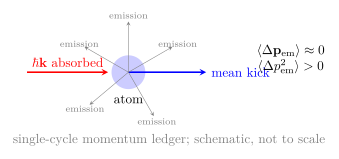
图 1 区分 mean recoil 和 diffusion。每次 spontaneous emission 并非“没有动量”,只是多次平均方向可能为零。
要正确理解散射力,应同时记两本账。第一本是平均动量账:原子优先从方向确定的激光束吸收光子,所以每次吸收都给出同向冲量;自发发射方向在许多次循环后相互抵消,于是平均力沿光束传播方向。第二本是涨落账:每次发射的方向不可预测,动量平方却始终为正,故速度分布不断扩散。冷却方案必须让速度相关的阻尼从第一本账中取走的动能,多于第二本账加入的随机反冲能;只计算平均力而不计算涨落,就无法得到最低温度。
“稳态散射率”还隐含内部态比机械运动更快达到平衡。若原子在一个寿命内速度变化很小,才可把瞬时速度代入洛伦兹响应;若用极短强脉冲、快速扫频或窄束使耦合迅速改变,内部相干来不及稳态化,必须回到随时间变化的布洛赫方程。这样区分可防止把连续光公式误用于相干脉冲力。
1.2 Force saturation
At exact resonance and strong saturation,\(R_{\rm sc}\to\Gamma/2\),so
\[F_{\max}=\frac{\hbar k\Gamma}{2}.\]
This upper bound belongs to an ideal closed cycling transition and one traveling direction。Optical pumping into dark states、branching loss、finite laser linewidth 和 multibeam saturation 会降低 usable force。
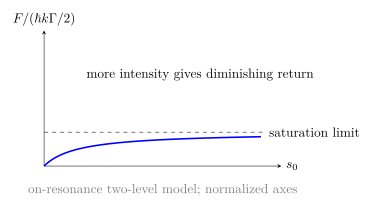
图 2 表明 radiation pressure 不随 intensity 无限线性增长;high power 还会 power broaden velocity selectivity。
饱和上限的物理原因是激发态必须等待衰变后才能再次完成同样的吸收循环。强度很低时,提高光强几乎按比例提高散射率;强度很高时,基态与激发态布居趋于接近,再增加光子并不能让一个二能级原子每个寿命完成任意多次循环。对于开放跃迁,还会有原子漏到不受驱动的暗态,因此实际平均力往往比理想上限更小,并需要再泵浦光把布居送回循环跃迁。
2. Doppler cooling and Doppler limit / 多普勒冷却与极限
Knowledge ID: P08-U04-L02-K02
2.1 Counterpropagating red-detuned beams
Moving atom sees Doppler-shifted detunings \(\Delta-kv\) and \(\Delta+kv\)。Including a shared saturation denominator schematically,one-dimensional net force is
\[F(v)=\frac{\hbar k\Gamma}{2} \left[ \frac{s_+}{1+s_{\rm tot}+4(\Delta-kv)^2/\Gamma^2} -\frac{s_-}{1+s_{\rm tot}+4(\Delta+kv)^2/\Gamma^2} \right].\]
For equal weak beams \(s_+=s_-=s_0\ll1\) and \(\lvert kv\rvert\ll\Gamma\),Taylor expansion yields
\[F(v)\simeq-\alpha v,\]
\[\alpha=-\frac{8\hbar k^2s_0(\Delta/\Gamma)}{\left(1+4\Delta^2/\Gamma^2\right)^2}.\]
Thus \(\Delta<0\) gives \(\alpha>0\) and damping;blue detuning reverses the sign and heats small velocities。
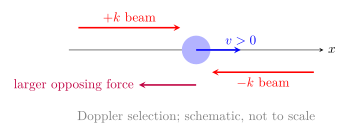
图 3 中向右运动的原子更接近吸收从右侧迎面而来的 red-detuned photons,因此平均 kick 向左。
低速展开中的负号可以逐层核对。红失谐表示静止原子看到的光频率略低于共振;当原子向右运动时,迎面而来的右侧光在原子系中被蓝移,更接近共振,所以从右向左的光子吸收概率更大;所得冲量指向左,与速度相反。原子若改向左运动,两个光束的角色交换,阻力也反向。正因这种对称性,零速度处净平均力为零,而一阶斜率为负。若改为蓝失谐,迎面光反而离共振更远,同向光更容易被吸收,一阶斜率变正,成为反阻尼。
泰勒展开只能描述捕获范围中心的一小段。速度太大时,两束光对原子都远离共振,力趋近于零;速度处于某一范围时,只有迎面光接近共振,减速最强;继续增大光强虽然扩大功率展宽,却也降低速度选择性并增强反冲扩散。因此“更强的冷却光”不等于“更低的温度”,捕获速度、阻尼率和稳态温度必须分别优化。
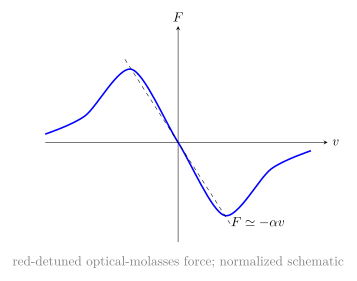
图 4 显示 friction approximation 只在 line center 附近的小 velocity 区有效;far outside capture range,force tends to zero。
2.2 Diffusion–friction balance and Doppler limit
Friction removes kinetic energy, but random absorption/emission recoils add momentum diffusion。In the ideal three-dimensional two-level、low-intensity model,optimizing at approximately \(\Delta=-\Gamma/2\) gives
\[T_D=\frac{\hbar\Gamma}{2k_B}.\]
This is not a universal floor。Multilevel polarization-gradient cooling can go below \(T_D\);recoil energy, dark states, sub-recoil schemes and trap geometry introduce other scales。
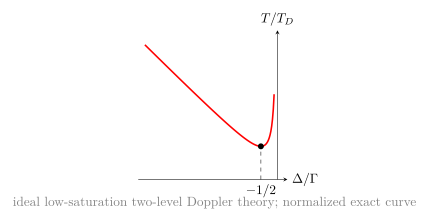
图 5 直接绘制 \(T/T_D=[1+4(\Delta/\Gamma)^2]/[4\lvert\Delta\rvert/\Gamma]\)(\(\Delta<0\)),将最优 detuning 与 limit 绑定在同一模型中;例如 \(\Delta/\Gamma=-1,-1.5,-2.5\) 时分别得到 \(1.25,1.667,2.60\)。真实 alkali experiments 达到 sub-Doppler temperature 并不“违反”此公式,而是超出其二能级假设。
多普勒极限来自阻尼与扩散的平衡,而不是原子停止运动。温度下降时,阻尼移除的能量随速度减小;但每次散射仍带来有限反冲,扩散不会同时消失,最终两者相等。最优失谐约为半个自然线宽,是因为太接近共振会散射过多并削弱速度选择,太远离共振又使阻尼太弱。真实碱金属有多个磁子能级和空间变化的偏振,原子可在不同光移势之间被光抽运,形成西西弗斯冷却;这改变了耗散机制,所以温度低于二能级极限并不矛盾。
报告温度时还要说明测量方法。释放膨胀、飞行时间、回捕获和谱线展宽分别对速度分布作不同假设;若云团非高斯、各方向温度不同或存在微运动,用单一温度拟合可能掩盖重要结构。温度是分布参数,而不是直接从荧光亮度读出的量。
3. Magneto-optical traps / 磁光阱
Knowledge ID: P08-U04-L02-K03
3.1 从 velocity damping 到 position restoring
Optical molasses damps velocity but does not provide static position restoration。MOT adds a magnetic quadrupole field with zero near the center and oppositely circularly polarized counterpropagating beams。Zeeman shift makes an atom displaced to \(+x\) preferentially scatter the beam pushing toward \(-x\);reversing displacement reverses the imbalance。
Near center and low velocity,
\[F_x\simeq-\kappa x-\alpha v_x.\]
If \(\mu' b'x/\hbar\) acts like a local detuning and polarizations are chosen for restoring sign,a useful scaling is
\[\kappa\sim\alpha\frac{\lvert\mu'b'\rvert}{\hbar k},\]
but multilevel Clebsch–Gordan coefficients and optical pumping determine the precise prefactor/sign。
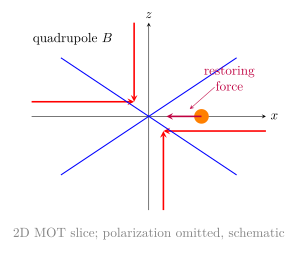
图 6 是 three-dimensional six-beam MOT 的二维截面。图中省略 polarization helicity,因此不能仅凭箭头判定 restoring sign;正文的 atomic transition/polarization 才完成物理 specification。
磁场梯度本身只改变不同位置的能级间隔,并不会对静止中性原子自动产生足够的中心恢复力;两束光本身也只提供速度阻尼,不能选择空间方向。二者结合后,位移造成塞曼失谐,圆偏振又通过选择定则决定哪一束光更容易驱动恢复方向的跃迁。若把两束光的偏振手性对调,或选错有效磁矩符号,原本的恢复力会变成排斥力。因此磁光阱的箭头图必须同时声明场梯度、量子化轴、跃迁和偏振,而不能只画六束光就声称一定俘获。
在中心附近,恢复项决定平衡位置和振荡频率,阻尼项决定振荡是否快速衰减;在远处,光斑有限、塞曼位移过大和跃迁饱和会使线性模型失效。重力会令云团相对磁场零点下沉,光束不平衡会推移中心,线圈不对称会耦合不同方向。测得的云尺寸则同时包含温度和弹簧常数,不能只凭尺寸判断“更冷”。
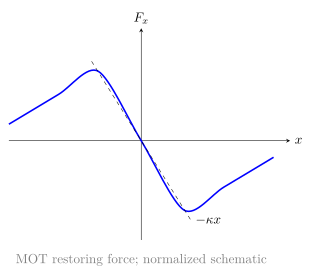
图 7 显示 harmonic approximation 只在 trap center 附近成立;capture volume 外 Zeeman shift/beam size 会使 force decline。
3.2 Equilibrium、loading and loss
MOT atom number obeys a loading-loss model such as \(\dot N=R-N/\tau-\beta_2\int n^2dV\)。Low density 时 \(N(t)=R\tau(1-e^{-t/\tau})\);high density 时 light-assisted collisions、radiation trapping 与 reabsorption become important。Temperature、atom number、density and phase-space density are distinct performance metrics。
装载曲线提供的是流入与损失的动力学信息。初始斜率主要反映原子源和捕获率,长时间平台同时受背景气体碰撞和光致双体损失影响。提高光强可能增加捕获数,却也可能提高温度、降低密度或增强碰撞损失;因此优化“最多原子”“最高密度”和“最大相空间密度”往往给出不同参数。
4. Optical dipole traps and optical lattices / 光偶极阱与光晶格
Knowledge ID: P08-U04-L02-K04
4.1 Conservative dipole potential
Far from resonance,induced dipole follows the field with dynamic polarizability \(\alpha_{\rm pol}(\omega)\)。For \(\mathbf E(t)=\operatorname{Re}[\mathbf E_0e^{-i\omega t}]\),cycle-averaged potential is
\[U(\mathbf r)=-\frac{1}{4}\operatorname{Re}[\alpha_{\rm pol}(\omega)]\lvert\mathbf E_0(\mathbf r)\rvert^2 =-\frac{\operatorname{Re}\alpha_{\rm pol}}{2\epsilon_0c}I(\mathbf r).\]
The conservative force is \(\mathbf F_{\rm dip}=-\nabla U\)。In a simple near-resonant two-level scaling,red detuning gives attraction to intensity maxima,blue detuning attraction to minima;potential scales roughly \(I/\Delta\) while off-resonant scattering scales roughly \(I/\Delta^2\),so large detuning at increased power can reduce heating for fixed trap depth。
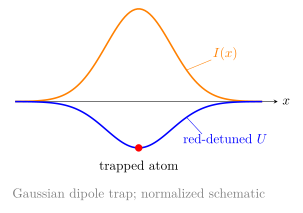
图 8 对照 intensity maximum 与 red-detuned potential minimum;\(U\) 是 potential energy,不应与 intensity 同号照抄。
偶极阱与近共振散射力的差别在于能量是否主要以可逆方式储存在原子—光场耦合中。远失谐时,原子内部态只被虚激发,光强空间变化形成交流斯塔克位移,梯度因此给出近似保守力。红失谐使低能位置落在强光处,蓝失谐使低能位置落在弱光处。后一种方案可把原子放在暗区以减少散射,但需要用光场几何围出稳定的强度最小。任何有限失谐仍有少量实激发和自发散射,所以“保守”只是受控近似。
在给定阱深下增大失谐通常需要同步提高光功率;势深大致随强度除以失谐变化,而散射大致随强度除以失谐平方变化,所以较大失谐有利于降低加热。但真实原子的多条跃迁会共同贡献极化率,简单符号规则在调谐到两条共振之间时可能改变,必须用完整动态极化率核对。
4.2 Standing-wave optical lattice and recoil scale
Two counterpropagating coherent beams form \(I(x)\propto\cos^2(kx)\),hence
\[U(x)=U_0\cos^2(kx),\]
with site spacing
\[d=\frac{\lambda}{2}.\]
Natural energy scale is recoil energy
\[E_r=\frac{(\hbar k)^2}{2m}.\]
Lattice depth is often quoted in units of \(E_r\)。Shallow lattices support broad tunneling bands;deep lattices localize atoms and approach harmonic wells,but spontaneous scattering、intensity noise and interactions remain。
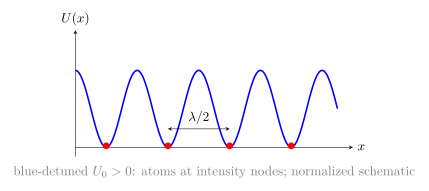
图 9 明确选择 \(U_0>0\) 的 blue-detuned convention,所以 atom positions 位于 \(\cos^2(kx)=0\) 的 intensity nodes。若改为 red detuning,\(U_0<0\),最低点移到 intensity antinodes,与图中 sites 相差 \(\lambda/4\);不能只改变 detuning 标签而保留同一原子位置。
光晶格把连续平移对称性变为离散平移对称性。阱很浅时,原子波函数跨越许多格点,能谱形成能带;阱加深时,单格点附近可近似谐振子,但相邻格点间仍可能隧穿。反冲能把光子动量与原子质量合成统一标尺:同样波长下,轻原子的反冲能更大,能带和隧穿的相对尺度也不同。格深用反冲能作单位,是为了比较不同原子和不同波长,而不是宣称系统温度等于某个反冲倍数。
5. Ultracold gases and quantum degeneracy / 超冷气体与量子简并
Knowledge ID: P08-U04-L02-K05
5.1 Phase-space density, not temperature alone
Thermal de Broglie wavelength is
\[\lambda_{\rm dB}=\frac{h}{\sqrt{2\pi mk_BT}}.\]
Dimensionless phase-space density is
\[\mathcal D=n\lambda_{\rm dB}^3.\]
Cooling increases \(\lambda_{\rm dB}\),compression increases \(n\);quantum statistics becomes unavoidable when \(\mathcal D\) is order unity。For a uniform ideal Bose gas,BEC onset occurs at \(\mathcal D_c=\zeta(3/2)\approx2.612\)。For fermions,Pauli filling defines a Fermi temperature,and \(T/T_F\ll1\) marks degeneracy;identical fermions do not all condense into one single-particle ground state。
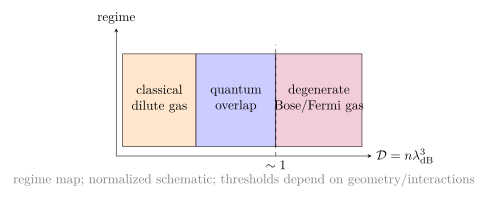
图 10 强调 temperature 不是唯一横轴;一个很冷但极稀薄的 cloud 仍可能 nondegenerate。
量子简并出现时,热德布罗意波长已与平均粒子间距相当,交换对称性不再是微小修正。玻色子可大量占据同一单粒子态,费米子则逐层填满至费米能;两者都会偏离经典麦克斯韦—玻尔兹曼分布,但物理结果不同。相空间密度同时含密度和温度:压缩云团能提高密度,却可能因碰撞和绝热加热升温;蒸发能降温,却也损失原子。实验优化必须跟踪二者的联合变化,而不能只追求最低温度。
均匀理想玻色气体的临界数值不能原封不动套到谐振阱或强相互作用气体。外势改变态密度,有限粒子数使转变变圆滑,相互作用移动临界点并影响凝聚份额。判定简并通常结合飞行时间动量分布、凝聚峰、热云拟合和相干性质,而不是只把一个估算的相空间密度与常数比较。
5.2 Cooling sequence and entropy
Typical neutral-atom route is beam slowing/loading → MOT → sub-Doppler/molasses → conservative transfer → evaporative or sympathetic cooling。MOT photon scattering is excellent for capture but perturbs fragile quantum coherence;dipole/magnetic trap supplies conservative confinement,evaporation selectively removes high-energy atoms while rethermalizing the remainder。Atom loss is not automatically cooling:只有剩余 ensemble 的 energy per particle 和 entropy are reduced in the desired way 才算 effective evaporation。
这条实验链的每一步都改变不同资源。磁光阱提供大的捕获范围,却持续散射光子;偏振梯度冷却降低速度展宽,却未必提供长时间约束;保守阱减少散射,阱深却限制可保留的原子;蒸发冷却依赖足够快的弹性碰撞来重新热化,同时又要避免三体复合等非弹性损失。只有把时间尺度和能量尺度逐一比较,才能判断下一步是否真正提高相空间密度。
Worked Examples / 完整例题
Worked Example 1 — \(^{87}\)Rb Doppler limit
已知: \(\Gamma/(2\pi)=6.07\ \mathrm{MHz}\),\(k_B=1.380649\times10^{-23}\ \mathrm{J\,K^{-1}}\)。
研究对象: ideal closed two-level \(^{87}\)Rb-like transition。
系统边界与参考系: free atoms in 3D optical molasses,laboratory frame。
坐标: isotropic temperature,no preferred axis。
模型: low-intensity Doppler theory at optimum detuning;ignore sub-Doppler structure。
\[\Gamma=2\pi(6.07\times10^6)=3.814\times10^7\ \mathrm{s^{-1}}.\]
\[T_D=\frac{\hbar\Gamma}{2k_B} =1.46\times10^{-4}\ \mathrm K=146\ \mathrm{\mu K}.\]
检查: \(\hbar\Gamma\) has joules;division by \(k_B\) gives kelvin。解释: real alkali multilevel polarization-gradient cooling can fall below 146 µK without violating the two-level result。
Worked Example 2 — Maximum radiation-pressure acceleration
已知: \(\lambda=780\ \mathrm{nm}\),\(\Gamma=3.814\times10^7\ \mathrm{s^{-1}}\),\(m=1.443\times10^{-25}\ \mathrm{kg}\)。
研究对象: one atom on a perfectly closed cycling transition。
系统/参考系: one resonant traveling beam in laboratory frame。
坐标: \(+x\) along beam。
模型: strong saturation、no branching、velocity held resonant。
\[k=\frac{2\pi}{\lambda}=8.06\times10^6\ \mathrm{m^{-1}},\]
\[F_{\max}=\frac{\hbar k\Gamma}{2}=1.62\times10^{-20}\ \mathrm N,\]
\[a_{\max}=\frac{F_{\max}}{m}=1.12\times10^5\ \mathrm{m\,s^{-2}}.\]
检查: force/mass gives acceleration;value is about \(1.14\times10^4g\)。解释: high acceleration acts only while Doppler/Zeeman shifts remain within capture linewidth;a Zeeman slower or chirp is needed for a large speed change。
Worked Example 3 — MOT gravitational sag
已知: \(^{87}\)Rb mass \(m=1.443\times10^{-25}\ \mathrm{kg}\),vertical spring constant \(\kappa_z=2.00\times10^{-18}\ \mathrm{N\,m^{-1}}\)。
研究对象: cloud center in vertical MOT axis。
system boundary/reference: atom plus effective optical spring in lab/gravity frame。
坐标: \(+z\) upward,trap magnetic zero at \(z=0\)。
模型: linear restoring force and static equilibrium;ignore density effects。
\[-\kappa_zz-mg=0,\]
\[z_{\rm eq}=-\frac{mg}{\kappa_z} =-7.08\times10^{-7}\ \mathrm m=-0.708\ \mathrm{\mu m}.\]
检查: \(\mathrm N/(\mathrm{N\,m^{-1}})=\mathrm m\);negative means below magnetic zero。解释: if the displacement approaches the non-harmonic capture scale,the linear MOT model must be replaced by full scattering forces。
Worked Example 4 — 1064 nm optical lattice scales
已知: counterpropagating beams \(\lambda=1064\ \mathrm{nm}\),\(^{87}\)Rb mass \(m=1.443\times10^{-25}\ \mathrm{kg}\)。
研究对象: 1D standing-wave lattice。
system/reference: stationary optical phase in lab frame;ignore lattice motion。
坐标: \(x\) along beams。
模型: sinusoidal lattice,single-photon recoil scale。
\[d=\frac{\lambda}{2}=532\ \mathrm{nm}.\]
\[\frac{E_r}{h}=\frac{h}{2m\lambda^2}=2.03\times10^3\ \mathrm{Hz}.\]
\[\frac{E_r}{k_B}=9.73\times10^{-8}\ \mathrm K=97.3\ \mathrm{nK}.\]
检查: \(h/(m\lambda^2)\) has inverse seconds;\(E_r/k_B\) gives kelvin。解释: lattice depth quoted as \(20E_r\) means a potential scale about \(h\times40.6\ \mathrm{kHz}\),not a temperature measurement by itself。
Lesson synthesis / 全课综合
Laser cooling and trapping uses three distinct force ideas。Near-resonant scattering force is dissipative and velocity selective;MOT adds Zeeman-dependent position selectivity;far-detuned dipole force is approximately conservative and organizes atoms in smooth traps or periodic lattices。Cooling sequence must therefore trade capture rate against recoil heating、coherence and density。Quantum degeneracy finally occurs when matter-wave overlap, not merely a low thermometer reading, becomes order unity。
建模流程:
- 声明 transition、\(\Gamma\)、laser detuning、beam direction and saturation convention。
- Write one-beam scattering rates first,then sum directed photon momenta。
- Expand only after checking \(s_0\ll1\) and \(\lvert kv\rvert\ll\Gamma\)。
- For MOT add Zeeman shift and polarization selection;for dipole trap use \(-\nabla U\)。
- Compare \(T_D\)、\(E_r/k_B\)、trap depth、density and \(n\lambda_{\rm dB}^3\),each answering a different question。
Formula-and-decision table / 公式与决策表
| Question | Relation | Use only when | Boundary |
|---|---|---|---|
| scattering rate | \(R_{\rm sc}=(\Gamma/2)s/[1+s+4\Delta^2/\Gamma^2]\) | closed steady two-level transition | multilevel branching/dark states alter it |
| mean beam force | \(\mathbf F=\hbar\mathbf kR_{\rm sc}\) | directed absorption, symmetric mean emission | diffusion remains even if mean emission recoil is zero |
| molasses damping | \(F\simeq-\alpha v\) | equal weak beams, small \(v\), red detuning | finite capture range |
| Doppler limit | \(T_D=\hbar\Gamma/(2k_B)\) | ideal two-level, optimized low-intensity molasses | not a universal lower bound |
| MOT near center | \(F\simeq-\kappa x-\alpha v\) | correct polarization and linear Zeeman gradient | full multilevel force outside center |
| dipole potential | \(U=-\operatorname{Re}\alpha_{\rm pol}I/(2\epsilon_0c)\) | far-detuned induced-dipole regime | scattering/other levels must be checked |
| lattice spacing | \(d=\lambda/2\) | two counterpropagating coherent beams | crossing angle changes spacing |
| recoil scale | \(E_r=(\hbar k)^2/(2m)\) | single-photon momentum transfer | many-body/trap energy adds other scales |
| degeneracy | \(\mathcal D=n\lambda_{\rm dB}^3\) | thermal dilute gas estimate | trap geometry changes critical coefficient |
Model boundaries / 模型边界
- Doppler force formula assumes a stationary internal steady state relative to mechanical motion;ultrafast/pulsed or coherent force regimes require optical Bloch dynamics。
- The Doppler limit assumes a simple two-level transition。Polarization gradients、dark states、sideband cooling and Raman cooling have different limits。
- MOT needs a cycling transition and repumping in real alkali atoms;without repump atoms accumulate in dark hyperfine states。
- Optical dipole potential is state/polarization dependent;vector/tensor polarizabilities and differential Stark shifts matter in precision work。
- Deep lattice does not automatically imply low temperature;atoms can occupy excited bands or be heated by intensity/phase noise。
- \(n\lambda_{\rm dB}^3\) uses local density in an inhomogeneous trap;uniform-gas \(2.612\) should not be copied unchanged as a global trapped-gas atom-number criterion。
Misconception clinic / 误区诊所
- “Spontaneous emission 平均 recoil 为零,所以不加热。” Mean 可为零,variance 不为零;momentum diffusion sets cooling limits。
- “Red-detuned beam 总会把 atom 拉向 source。” Direction and magnitude depend on velocity、detuning and geometry;single traveling beam exerts push along propagation。
- “Optical molasses is a trap.” It damps motion but lacks restoring force;gravity causes free cloud to leave。
- “MOT 只需 magnetic quadrupole field.” Gradient、circular polarization、red-detuned beams and suitable Zeeman levels jointly produce restoring force。
- “Doppler limit is absolute zero attainable limit.” It is a two-level diffusion–friction limit;sub-Doppler methods go below it。
- “Red-detuned dipole trap and red-detuned cooling are same force.” One is far-detuned conservative gradient force;the other is near-resonant dissipative scattering force。
- “Any nK gas is a BEC.” Quantum degeneracy depends on density and statistics through phase-space density。
Practice and retrieval / 练习与提取
- [K01 定量] 一个 atom 以 \(R_{\rm sc}=2.0\times10^6\ \mathrm{s^{-1}}\) 吸收 \(780\ \mathrm{nm}\) photons,求 average one-beam force。
- [K01 概念] 为什么 isotropic spontaneous emission 对 mean force 可为零,却对 temperature 不为零?
- [K02 符号] 在本课 detuning convention 下,哪一 detuning sign gives damping near \(v=0\)?
- [K02 定量] transition \(\Gamma/(2\pi)=10.0\ \mathrm{MHz}\) 的 Doppler limit 是多少?
- [K03 比较] Optical molasses 与 MOT 的 force expansion 分别含哪些 terms?
- [K03 定量] \(\kappa=1.0\times10^{-18}\ \mathrm{N\,m^{-1}}\)、\(m=1.0\times10^{-25}\ \mathrm{kg}\),求 small-oscillation angular frequency。
- [K04 判断] Red-detuned far-off-resonant Gaussian beam 把 positive-polarizability atom trapping at intensity maximum or minimum?
- [K04 定量] \(\lambda=800\ \mathrm{nm}\) standing-wave lattice 的 site spacing 是多少?
- [K05 定量] \(n=1.0\times10^{19}\ \mathrm{m^{-3}}\)、\(\lambda_{\rm dB}=0.50\ \mathrm{\mu m}\),求 phase-space density 并判断是否 order unity。
- [K05 边界] 为什么从 MOT 移除 hot atoms 不一定是有效 evaporative cooling?
Answers / 答案
- \(F=\hbar(2\pi/\lambda)R_{\rm sc}=1.70\times10^{-21}\ \mathrm N\),方向沿 beam propagation。
- 随机 recoil vectors cancel in first moment but add in second moment,causing momentum diffusion and kinetic-energy growth。
- \(\Delta<0\);red detuning gives \(\alpha>0\) in \(F=-\alpha v\)。
- \(\Gamma=2\pi\times10^7\ \mathrm{s^{-1}}\),\(T_D=\hbar\Gamma/(2k_B)=2.40\times10^{-4}\ \mathrm K=240\ \mathrm{\mu K}\)。
- Molasses near origin has \(F\simeq-\alpha v\) but no \(-\kappa x\);MOT adds position restoring \(-\kappa x\)。
- \(\omega=\sqrt{\kappa/m}=3.16\times10^3\ \mathrm{rad\,s^{-1}}\)。
- Intensity maximum;\(U\propto-I\) for positive real polarizability in this red-detuned convention。
- \(d=\lambda/2=400\ \mathrm{nm}\)。
- \(\mathcal D=n\lambda_{\rm dB}^3=(10^{19})(0.5\times10^{-6})^3=1.25\),已是 order unity,但 exact transition depends on statistics/geometry/interactions。
- 若 loss 不具 energy selectivity、rethermalization 不充分或 density collapses too fast,remaining energy per particle/phase-space density may not improve。
Exit ticket / 离堂检验
- 从 two-beam force 写出 red detuning 的 low-\(v\) expansion,并用一句物理语言解释每个负号。
- 为一项 optical-lattice clock experiment 列出四个必须同时比较的 energy/frequency scales:至少包含 recoil、trap depth、scattering/decoherence 与 thermal scale。
References and source notes / 参考资料与来源说明
以下权威直接来源均于 2026-08-30 实际打开核验;正文按统一 \(\Gamma\)、detuning 与 polarizability convention 重写,所有图原创。
- NIST, Laser Cooling of Atoms:radiation pressure、cooling mechanisms and recoil limits 的技术综述。https://tf.nist.gov/general/pdf/144.pdf
- NIST, Observation of Atoms Laser-Cooled Below the Doppler Limit:optical molasses、Doppler model boundary、sub-Doppler discovery、BEC/clock connections。https://nvlpubs.nist.gov/nistpubs/sp958-lide/html/331-333.html
- NIST, NIST’s Quantum Research Highlights:laser cooling milestones、Doppler limit 与 ultracold applications。https://www.nist.gov/physics/nists-quantum-research-highlights
- NIST, Magneto-Optical Trapping Using Planar Optics:MOT geometry、beam/polarization implementation 与 compact trapping。https://www.nist.gov/publications/magneto-optical-trapping-using-planar-optics
- NIST technical PDF, Magneto-Optical Trapping Using Planar Optics:planar MOT 的直接技术文献。https://tf.nist.gov/general/pdf/3122.pdf
- NIST, The Nobel Moment: Eric Cornell:laser cooling、magnetic/optical confinement 与 Bose–Einstein condensation context。https://www.nist.gov/nist-and-nobel/eric-cornell/nobel-moment-eric-cornell
- NIST, Calcium Magneto-Optical Trap:具体 neutral-atom MOT apparatus 与 spectroscopy context。https://tf.nist.gov/ofm/calcium/backup files/camot.htm
Source-to-content map
| Source | Used for | Knowledge ID / Section | Model boundary or convention |
|---|---|---|---|
| NIST Laser Cooling of Atoms | scattering/recoil/cooling limits | K01, K02, K04 | simplified formulas labeled two-level and regime-limited |
| NIST Below-Doppler history | optical molasses、sub-Doppler、clock/BEC links | K02, K05 | historical experiments show Doppler limit is not universal |
| NIST Quantum Highlights | milestones and temperature scales | K02, K05 | context, not a replacement for force derivation |
| NIST Planar MOT page/PDF | MOT restoring geometry and implementation | K03 | real multilevel/polarization system beyond 1D toy model |
| NIST Cornell/BEC | quantum-degenerate gas route and significance | K05 | ideal-gas threshold separated from experimental interactions |
| NIST Calcium MOT | specific MOT and cooling application | K03 | species-specific transition details not generalized |
复习与拓展
- 与 Precision Measurement 相连:long interrogation time requires cold atoms、controlled trap Stark shifts and low motional dephasing。
- 与 Radiative Processes 相连:same \(\Gamma\) and saturation physics now enters mechanical force and diffusion。
- 可扩展:polarization-gradient/Sisyphus cooling、Raman sideband cooling、evaporative cooling kinetics、Bloch bands、Hubbard model、Feshbach resonances。