
Learning objectives / 学习目标
完成本课后,你应能:
- 从 \(\hat H=-\boldsymbol{\mu}\cdot\mathbf B\) 推导 Zeeman splitting 与 Larmor-frequency magnitude,并用 gyromagnetic-ratio sign 判断旋向。
- 比较 NMR 与 ESR/EPR 的载流磁矩、频率尺度、selection rule、探测对象及典型应用。
- 在 rotating frame 中计算 detuning、effective field、\(\pi/2\) 与 \(\pi\) pulse 的 flip angle,并解释 phase control。
- 使用 Bloch equations 区分 \(T_1\)、\(T_2\)、\(T_2^*\),从 FID 推导 Lorentzian FWHM,并说明 spin echo 能与不能消除什么。
- 解释 chemical shift、field gradient、slice selection、frequency/phase encoding 如何把 resonance frequency 变成光谱或空间信息。
Prerequisites / 先修知识
- Orbital Angular Momentum 与 Spin:angular-momentum/spin operators、magnetic moment 与 Zeeman effect。
- Two-Level Atoms and Coherent Control:rotating frame、Rabi oscillation、Bloch vector 与 relaxation。
- Fourier transform、complex transverse signal、exponential decay 与 Lorentzian line。
- 磁场、torque 与 vector cross product。
Scope and conventions / 范围与约定
- 磁矩与角动量关系定义为 \(\boldsymbol{\mu}=\gamma\mathbf J\);\(\gamma\) 是有符号 gyromagnetic ratio。动力学写成 \(d\mathbf M/dt=\gamma\mathbf M\times\mathbf B\)。
- 共振频率只报正的 magnitude:\(\omega_0=\lvert\gamma\rvert B_0\)、\(\nu_0=\omega_0/(2\pi)\);旋向另由 \(\operatorname{sgn}\gamma\) 与 RF circular polarization 决定。
- 静磁场 \(\mathbf B_0=B_0\hat{\mathbf z}\)。对正 \(\gamma\) 的 rotating-frame 图,detuning 定义 \(\Delta=\omega_{\rm rf}-\omega_0\),并写 \(\mathbf B_{\rm eff}=B_1\hat{\mathbf x}'-(\Delta/\gamma)\hat{\mathbf z}'\)。
- \(B_1\) 指与 spin 共旋的 circular component;若 laboratory coil 给出 linearly polarized amplitude,不先分解 circular components 会产生因子 2 歧义。
- Classical Bloch equations 描述 ensemble expectation values。Single-spin unitary、radiation damping、strong coupling、quadrupolar nuclei 与 detailed MRI reconstruction 均需额外模型。
Notation and modeling contract / 符号与建模契约
| Symbol | Meaning | SI unit |
|---|---|---|
| \(\gamma\) | signed gyromagnetic ratio | \(\mathrm{rad\,s^{-1}\,T^{-1}}\) |
| \(\omega_0=\lvert\gamma\rvert B_0\) | positive Larmor angular-frequency magnitude | \(\mathrm{rad\,s^{-1}}\) |
| \(\mathbf M\) | ensemble magnetization density | \(\mathrm{A\,m^{-1}}\) |
| \(B_0\) | static polarizing field | T |
| \(B_1\) | co-rotating transverse RF field amplitude | T |
| \(\Omega_1=\lvert\gamma\rvert B_1\) | on-resonance nutation angular frequency | \(\mathrm{rad\,s^{-1}}\) |
| \(\Delta=\omega_{\rm rf}-\omega_0\) | RF detuning | \(\mathrm{rad\,s^{-1}}\) |
| \(T_1\) | longitudinal or spin–lattice recovery time | s |
| \(T_2\) | homogeneous transverse coherence time | s |
| \(T_2^*\) | observed dephasing time including static inhomogeneity | s |
| \(\mathbf G=\nabla B_z\) | magnetic-field gradient | \(\mathrm{T\,m^{-1}}\) |
1. Magnetic moments and Larmor precession / 磁矩与拉莫尔进动
Knowledge ID: P08-U04-L01-K01
1.1 Zeeman energy 与 torque
磁矩在均匀场中的 Hamiltonian 是
\[\hat H_Z=-\hat{\boldsymbol\mu}\cdot\mathbf B=-\gamma\hat{\mathbf J}\cdot\mathbf B.\]
对 spin-\(1/2\) 且 \(\mathbf B=B_0\hat{\mathbf z}\),两能级间隔大小为
\[\Delta E=\hbar\lvert\gamma\rvert B_0=\hbar\omega_0.\]
Ensemble magnetization obeys
\[\frac{d\mathbf M}{dt}=\gamma\mathbf M\times\mathbf B_0.\]
叉乘使 \(\mathbf M\) 的大小不变、只改变方向;因此静场本身产生 precession 而非把横向分量自动“拉回” \(z\)。后者来自 relaxation。
有符号旋磁比的必要性可以从力矩方向直接看出。若两个粒子的角动量方向相同,但磁矩与角动量的比例符号相反,它们在同一静磁场中的进动方向就相反。频谱仪通常只报告正的共振频率,所以取绝对值没有问题;然而设计圆偏振射频场、判断旋转坐标系方向或比较电子与核自旋时,符号必须保留。最稳妥的做法是把“频率大小”和“几何旋向”写成两条独立陈述,而不是让一个带符号的数同时承担两种含义。
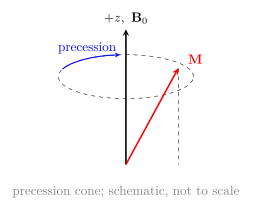
图 1 表示 fixed polar angle 的 coherent precession;真实 ensemble 的 cone envelope 会因 \(T_2\) 衰减。
1.2 微观相位与宏观信号
每个 spin magnetic moment 可有相同 \(M_z\) 而横向相位不同。Equilibrium ensemble 的 transverse phases 随机,故 \(M_x=M_y=0\);RF pulse 把相位组织起来后,宏观 \(M_+=M_x+iM_y\) 才能在线圈中感应 voltage。
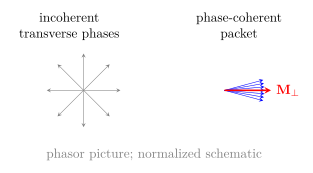
图 2 说明 NMR detector 测的是 coherent sum,不是单个核磁矩的直接轨迹。
2. Nuclear magnetic resonance and electron spin resonance / 核磁共振与电子自旋共振
Knowledge ID: P08-U04-L01-K02
2.1 同一共振条件,不同磁矩尺度
NMR 驱动 nuclear-spin Zeeman levels;ESR/EPR 驱动 electron-spin levels。两者都满足
\[\hbar\omega_{\rm rf}=\Delta E,\]
且磁偶极 selection rule 在简单轴量子数表象下为 \(\Delta m=\pm1\)。Electron magnetic moment 远大于 nuclear moment,所以相同 \(B_0\) 下 ESR 通常在 GHz microwave,proton NMR 通常在 MHz RF。
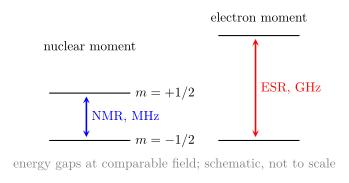
图 3 只比较数量级;实际 splitting 还受 \(g\) factor、hyperfine、chemical shielding、crystal field 与 anisotropy 影响。
2.2 spectroscopy 信息来自 local environment
NMR effective field 可写成 \(B_{\rm loc}=B_0(1-\sigma_{\rm shield})\),chemical shift 习惯用 dimensionless ratio 的 ppm 表示;ESR 的 effective \(g\) tensor 与 hyperfine coupling 则报告电子态和邻近 nuclear spins。Resonance frequency 因而既是“时钟”,也是 local environment probe。
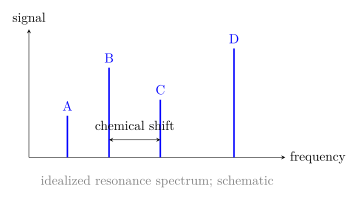
图 4 中峰位、splitting、area 与 linewidth 分别携带不同信息;不可把“峰更高”直接解释为“population 一定更多”,因为 pulse、relaxation 和 receiver response 也会改变峰高。
3. Resonant pulses and spin manipulation / 共振脉冲与自旋操控
Knowledge ID: P08-U04-L01-K03
3.1 rotating frame 与 effective field
在 laboratory frame,\(B_1\) 快速旋转;在与 RF 同转的 frame,它近似静止。对正 \(\gamma\) 与本课 detuning convention,
\[\mathbf B_{\rm eff}=B_1(\cos\phi\,\hat{\mathbf x}'+\sin\phi\,\hat{\mathbf y}')-\frac{\Delta}{\gamma}\hat{\mathbf z}'.\]
Magnetization 绕 \(\mathbf B_{\rm eff}\) nutates,generalized angular-frequency magnitude 为
\[\Omega_{\rm eff}=\sqrt{\Omega_1^2+\Delta^2}, \qquad \Omega_1=\lvert\gamma\rvert B_1.\]
旋转坐标系并不是让样品或磁场真的转起来,而是把观察坐标跟随射频相位旋转。共振时,静场引起的快速进动恰好被坐标转动抵消,只剩横向驱动,所以磁化矢量能围绕横轴做清楚的翻转。失谐时,抵消不完全,残余量表现为纵向有效场;翻转轴因此倾斜。这个图像还能解释脉冲相位为何重要:改变射频初相位,等价于在横向平面内旋转有效场方向,会改变随后自由演化和第二个脉冲的干涉结果。
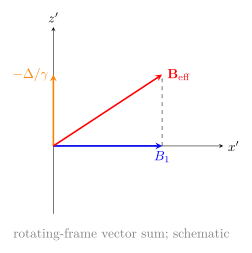
图 5 把 detuning 画成 effective longitudinal field;off resonance 时 rotation axis 倾斜,固定 pulse duration 不再产生理想 \(\pi/2\) rotation。
3.2 pulse area、phase 与 composite control
On resonance 且 square pulse 中 \(B_1\) 恒定,flip-angle magnitude 为
\[\theta=\Omega_1t_p=\lvert\gamma\rvert B_1t_p.\]
\(\theta=\pi/2\) 建立最大 transverse coherence,\(\theta=\pi\) 反转 \(M_z\)。RF phase \(\phi\) 选择 rotating-frame rotation axis;它不是装饰参数,而决定 subsequent interference。量子写法为
\[\hat R_{\hat{\mathbf n}}(\theta)=\exp\left(-\frac{i\theta}{2}\hat{\mathbf n}\cdot\boldsymbol\sigma\right),\]
其中 exact handedness 与 basis / \(\gamma\) convention 一致。
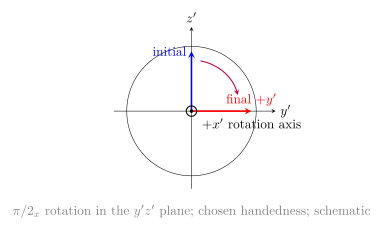
图 6 显示 \(x'\)-axis pulse 把初始 \(+z'\) 磁化旋到横向 \(\pm y'\),绝不会旋到 \(x'\) rotation axis 本身。图中选择 \(+y'\) 作为本课示意手性;改变 \(\gamma\) 符号或 RF phase 会反转终态符号。实验中 amplitude error、detuning 与 \(B_1\) inhomogeneity 可用 composite pulses 或 adiabatic passages 提高 robustness。
3.3 spin echo
Hahn echo sequence \(\pi/2-\tau-\pi-\tau-\)echo 将 static frequency offsets 导致的 phase fan-out 翻转并在 \(2\tau\) refocus。它能恢复 \(T_2^*\) 中的可逆 inhomogeneous dephasing,却不能倒转 microscopic stochastic decoherence,因此 echo envelope 仍按 \(T_2\) 衰减。
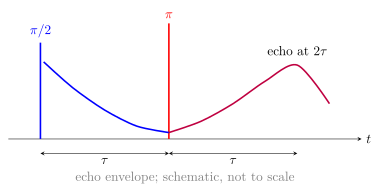
图 7 将 dephasing 与 irreversible loss 区分开;echo peak 低于初始 signal 正是 finite \(T_2\) 的表现。
4. Relaxation times and line shapes / 弛豫时间与线型
Knowledge ID: P08-U04-L01-K04
4.1 Bloch equations
Phenomenological Bloch equations 为
\[\frac{d\mathbf M}{dt} =\gamma\mathbf M\times\mathbf B -\frac{M_x\hat{\mathbf x}+M_y\hat{\mathbf y}}{T_2} -\frac{(M_z-M_0)\hat{\mathbf z}}{T_1}.\]
\(T_1\) 描述 energy exchange 后的 longitudinal recovery,\(T_2\) 描述 homogeneous phase coherence;常见 spin-\(1/2\) Markov model 满足 \(1/T_2=1/(2T_1)+1/T_\phi\)。Observed free-induction decay 常被 static field distribution 加速为 \(T_2^*\le T_2\),但 complex、多指数或 non-Markov systems 不必由单一时间常数描述。
三种时间常数回答不同问题。纵向弛豫考察系统怎样把多余能量交给环境并恢复热平衡;横向弛豫考察不同自旋之间不可逆的相位记忆怎样丢失;表观退相干还把样品各处静态频率不同造成的可逆散相算了进去。自旋回波能把“走得快的先走、翻转后再赶回来”这类静态差异重新聚焦,却无法让环境已经带走的相位信息返回。因此,直接由自由感应衰减拟合出的时间不能未经回波验证就称为内禀横向弛豫时间。
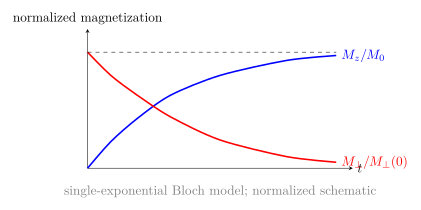
图 8 并列显示 longitudinal recovery 与 transverse decay;二者的 time origin 和 normalization 必须说明。
4.2 FID 与 Lorentzian width
在 homogeneous、single-frequency limit,
\[M_+(t)=M_+(0)e^{-t/T_2}e^{-i\omega_0t},\qquad t\ge0.\]
其 absorptive Lorentzian 可写
\[L(\omega)\propto\frac{T_2}{1+(\omega-\omega_0)^2T_2^2}.\]
因此 angular-frequency FWHM 与 ordinary-frequency FWHM 分别为
\[\Delta\omega_{\rm FWHM}=\frac{2}{T_2}, \qquad \Delta\nu_{\rm FWHM}=\frac{1}{\pi T_2}.\]
若 FID envelope 是 \(e^{-t/T_2^*}\),observed inhomogeneous width 对应 \(T_2^*\);若 frequency distribution 是 Gaussian,line shape 也不是 Lorentzian。
线宽公式中的圆周率来自角频率与普通频率的换算以及洛伦兹线的半高定义,而不是可以凭经验省略的常数。先在角频率轴上找出两个半高点,其间距为 \(2/T_2\);再除以 \(2\pi\) 才得到赫兹单位的 \(1/(\pi T_2)\)。如果仪器显示的是功率谱幅值、绝对值谱或高斯拟合宽度,半高定义可能对应另一条曲线,必须回到实际拟合模型核对。
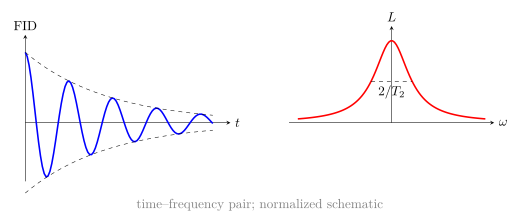
图 9 把 decay time 与 spectral width 连成 Fourier pair,并标明这里画的是 absorptive Lorentzian,不是 magnitude spectrum 的任意定义。
5. MRI and spectroscopy connections / MRI 与光谱学联系
Knowledge ID: P08-U04-L01-K05
5.1 从 chemical shift 到 spatial encoding
Spectroscopy 让 local shielding/coupling 改变 frequency;MRI 则有意施加 field gradient:
\[B_z(\mathbf r,t)=B_0+\mathbf G(t)\cdot\mathbf r,\]
\[\omega(\mathbf r,t)=\lvert\gamma\rvert B_z(\mathbf r,t).\]
在一个 convention 下,累积 spatial phase 可写为 \(\phi(\mathbf r)=\mathbf k\cdot\mathbf r\),其中
\[\mathbf k(t)=\gamma\int_0^t\mathbf G(t')\,dt'.\]
\(\mathbf k\) 的单位是 \(\mathrm{rad\,m^{-1}}\);sign 取决于 signal/Fourier convention。Slice-selection gradient 配合 finite-bandwidth RF pulse 选择位置区间;frequency encoding 和 phase encoding 采样 reciprocal-space data,随后 Fourier reconstruction 得到 spin-density/contrast image。
空间编码的核心不是“磁场越强图像越亮”,而是给不同位置写入可预测的频率或相位标签。层面选择把射频带宽映射为一段位置范围;相位编码在短时间内积累位置相关相位;读出梯度则让不同位置在采样期间以不同瞬时频率进动。重建所需的是这些标签在倒空间中的系统采样。磁场不均匀、梯度非线性、化学位移和运动都会篡改标签,所以伪影分析本质上是检查实际相位是否仍满足所假定的空间模型。
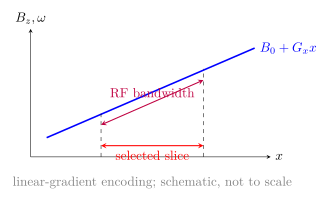
图 10 显示 frequency becomes position only if gradient calibration and field homogeneity are known。MRI contrast 还依赖 proton density、\(T_1\)、\(T_2/T_2^*\)、diffusion、flow 与 pulse-sequence timing,不是单纯的“水含量照片”。
5.2 安全与解释边界
MRI 不使用 ionizing X rays,但不等于“没有风险”:strong static field 对 ferromagnetic objects/implants 产生 force and torque;switched gradients 可诱导 stimulation 和 acoustic noise;RF deposition 产生 heating。临床安全判断属于专业 protocol,本课只讨论信号物理。
此外,图像灰度不是某个单一物质常数的直接照片。同一组织在不同重复时间、回波时间、翻转角和序列下可以呈现完全不同的对比;接收线圈灵敏度和重建滤波也会改变亮度。物理解释必须同时给出脉冲序列和采集参数,不能只凭“亮”或“暗”反推一种组织性质。
Worked Examples / 完整例题
Worked Example 1 — 3 T 中 proton Larmor frequency
已知: proton \(\gamma_p/(2\pi)=42.5774789\ \mathrm{MHz\,T^{-1}}\),\(B_0=3.000\ \mathrm{T}\)。
研究对象: 水中 proton magnetic moment 的 Zeeman resonance。
系统边界与参考系: 均匀静场中的 spin ensemble,laboratory frame。
坐标: \(+z\) 沿 \(\mathbf B_0\)。
模型: 忽略 shielding 和 field inhomogeneity,只求 positive frequency magnitude。
\[\nu_0=\frac{\lvert\gamma_p\rvert}{2\pi}B_0 =127.7324367\ \mathrm{MHz}.\]
取 field precision 相称的结果,\(\nu_0=127.7\ \mathrm{MHz}\)。检查: \(\mathrm{MHz\,T^{-1}}\times\mathrm T=\mathrm{MHz}\);3 T 是 1 T frequency 的三倍。解释: clinical scanner 仍须围绕此 carrier 处理 kHz 级 gradient/chemical-shift offsets。
Worked Example 2 — \(\pi/2\) pulse duration
已知: proton co-rotating field \(B_1=10.0\ \mathrm{\mu T}\),on resonance。
研究对象: initially \(+z\) magnetization。
系统/参考系: uniform spin packet,RF rotating frame。
坐标: RF phase 选择 \(+x'\) rotation axis。
模型: square pulse,neglect relaxation during pulse。
\[\Omega_1=2\pi(42.5774789\times10^6)(10.0\times10^{-6}) =2.675\times10^3\ \mathrm{rad\,s^{-1}}.\]
\[t_{\pi/2}=\frac{\pi/2}{\Omega_1}=5.87\times10^{-4}\ \mathrm{s}=0.587\ \mathrm{ms}.\]
检查: \(\Omega_1t\) dimensionless;若 \(B_1\) doubled,duration halves。解释: 这里的 \(B_1\) 是 co-rotating component;若仪器报 linear field peak,必须先确认 calibration convention。
Worked Example 3 — 由 homogeneous linewidth 求 \(T_2\)
已知: absorptive NMR line 是 Lorentzian,ordinary-frequency FWHM \(\Delta\nu=4.00\ \mathrm{Hz}\)。
研究对象: homogeneous spin ensemble transverse coherence。
系统/参考系: rotating frame;carrier 已移除。
坐标: transverse plane \(x'y'\)。
模型: single exponential FID,no static inhomogeneity。
\[T_2=\frac{1}{\pi\Delta\nu} =7.96\times10^{-2}\ \mathrm{s}=79.6\ \mathrm{ms}.\]
检查: Hz 的倒数给 s;\(T_2\) 越长 line 越窄。解释: 若 4 Hz 是未 echo-refocused observed width,则结果应称 \(T_2^*\),不能自动解释为 intrinsic \(T_2\)。
Worked Example 4 — readout gradient 的 frequency span
已知: proton sample width \(L_x=0.200\ \mathrm{m}\),linear gradient \(G_x=20.0\ \mathrm{mT\,m^{-1}}\)。
研究对象: sample 两端的 Larmor-frequency difference。
系统/参考系: stationary sample in laboratory scanner。
坐标: \(x\in[-L_x/2,L_x/2]\),\(B_z=B_0+G_xx\)。
模型: neglect chemical shift and nonlinear gradient terms。
\[\Delta B=G_xL_x=(20.0\times10^{-3})(0.200)=4.00\times10^{-3}\ \mathrm T,\]
\[\Delta\nu=\frac{\lvert\gamma_p\rvert}{2\pi}\Delta B =170.3\ \mathrm{kHz}.\]
检查: gradient times length gives tesla;frequency span is symmetric around carrier if sample centered。解释: receiver bandwidth must cover at least this encoded span plus margins; otherwise edge positions alias or disappear。
Lesson synthesis / 全课综合
Magnetic resonance 的主线是“frequency labels a quantum energy gap”。Static field creates splitting;phase-matched RF creates controllable rotations;environment writes itself into frequency offsets and relaxation;gradients deliberately add known position-dependent offsets。Time-domain coil voltage 经 Fourier transform 后成为 spectrum,而经过多维 gradient sampling 后成为 image。
建模流程:
- 声明 magnetic species、signed \(\gamma\) 与 \(B_0\) direction。
- 用 \(\lvert\gamma\rvert B_0\) 求 positive carrier,另行判断 precession/RF handedness。
- 进入 rotating frame,画 \(\mathbf B_{\rm eff}\),再算 pulse area。
- 把 reversible dephasing、\(T_2\) decay 与 \(T_1\) recovery 分开。
- 对 spectroscopy/MRI 说明 frequency offset 来自 shielding、coupling、inhomogeneity 还是 intentionally applied gradient。
Formula-and-decision table / 公式与决策表
| Decision | Relation | Use only when | Boundary |
|---|---|---|---|
| Larmor magnitude | \(\omega_0=\lvert\gamma\rvert B_0\) | Zeeman-dominated transition | signed \(\gamma\) separately sets handedness |
| Zeeman gap | \(\Delta E=\hbar\lvert\gamma\rvert B_0\) | isolated spin-\(1/2\) | hyperfine/quadrupole terms may add structure |
| effective field | \(\mathbf B_{\rm eff}=B_1\hat{\mathbf x}'-(\Delta/\gamma)\hat{\mathbf z}'\) | positive \(\gamma\), stated rotating convention | for electron/sign changes rederive orientation |
| flip angle | \(\theta=\lvert\gamma\rvert B_1t_p\) | resonant square pulse, co-rotating \(B_1\) | relaxation and inhomogeneity negligible during pulse |
| Bloch relaxation | \(\dot{\mathbf M}=\gamma\mathbf M\times\mathbf B-\mathbf M_\perp/T_2-(M_z-M_0)\hat{\mathbf z}/T_1\) | ensemble phenomenology | non-exponential dynamics need richer model |
| Lorentzian width | \(\Delta\nu=1/(\pi T_2)\) | exponential homogeneous FID | use \(T_2^*\) for observed inhomogeneous FID |
| spatial phase | \(\mathbf k=\gamma\int\mathbf Gdt\) | linear calibrated gradients | sign follows Fourier/signal convention |
Model boundaries / 模型边界
- Bloch equation assumes a macroscopic magnetization with phenomenological relaxation; it does not predict \(T_1,T_2\) from microscopic bath physics。
- \(T_2\le2T_1\) is tied to common completely positive Markov spin-\(1/2\) models; multi-level exchange or fit artifacts require care。
- A single \(T_2^*\) cannot describe arbitrary field maps; Gaussian/static distributions can yield non-exponential FID。
- Rotating-wave description needs \(\Omega_1,\lvert\Delta\rvert\ll\omega_0\) and the correct co-rotating field component。
- Spin echo refocuses quasi-static reversible offsets, not rapidly fluctuating noise, diffusion through gradients, or true \(T_2\) processes。
- MRI intensity is sequence-dependent and not an absolute map of one material property without calibration/modeling。
Misconception clinic / 误区诊所
- “Larmor precession means \(\mathbf M\) spirals toward \(z\).” 静态 torque 只转向;spiral envelope 来自 \(T_2\) 与 \(T_1\) relaxation。
- “电子和质子的 \(\gamma\) 都可直接当正数。” 频率大小可取绝对值,但旋向和 resonant circular polarization 依赖 sign。
- “\(\pi\) pulse 是把所有 spin 空间翻转 180°。” 它是 Bloch vector 在 rotating frame 的 unitary rotation,并受 detuning/\(B_1\) inhomogeneity 限制。
- “\(T_2^*=T_2\)。” \(T_2^*\) 通常还含 static inhomogeneous dephasing,spin echo 可部分 refocus。
- “Linewidth 永远是 \(1/T_2\) Hz。” 对 exponential FID 的 absorptive Lorentzian,ordinary-frequency FWHM 是 \(1/(\pi T_2)\)。
- “MRI 没有 ionizing radiation,所以没有安全问题。” Static field、gradients、RF heating、implants 与 projectiles 均有专门 safety constraints。
Practice and retrieval / 练习与提取
- [K01 符号] 为什么本课将 \(\omega_0\) 定义为 \(\lvert\gamma\rvert B_0\) 而不直接写 \(\gamma B_0\)?
- [K01 定量] \(\gamma/(2\pi)=10.0\ \mathrm{MHz\,T^{-1}}\) 的核在 \(2.50\ \mathrm T\) 中共振频率是多少?
- [K02 比较] 同一磁场中 ESR 通常比 proton NMR 的频率高很多,根本原因是什么?
- [K02 解释] NMR chemical shift 与 ESR \(g\)-factor anisotropy 分别主要探测什么 local information?
- [K03 定量] \(\lvert\gamma\rvert=2.00\times10^8\ \mathrm{rad\,s^{-1}\,T^{-1}}\)、\(B_1=5.00\ \mathrm{\mu T}\),求 resonant \(\pi\) pulse duration。
- [K03 边界] 为什么 off-resonance square \(\pi\) pulse 未必完全 inversion?
- [K04 定量] homogeneous \(T_2=50.0\ \mathrm{ms}\),求 Lorentzian ordinary-frequency FWHM。
- [K04 判断] Hahn echo 完全恢复了 static inhomogeneity,却只剩初始幅度的 70%;这 30% 可否都归因于 calibration error?
- [K05 定量] proton gradient \(G_x=10.0\ \mathrm{mT\,m^{-1}}\) 跨 \(0.300\ \mathrm m\) 的 frequency span 是多少?
- [K05 综合] 简述 slice selection、phase encoding 和 frequency encoding 各自把什么信息写入 signal。
Answers / 答案
- \(\gamma\) 可为负;\(\lvert\gamma\rvert B_0\) 明确是正频率大小,而 sign 保留给 precession handedness 与 RF polarization。
- \(\nu_0=(10.0\ \mathrm{MHz\,T^{-1}})(2.50\ \mathrm T)=25.0\ \mathrm{MHz}\)。
- Electron magnetic moment/gyromagnetic-ratio magnitude 远大于 nuclear value,因此相同 \(B_0\) 的 Zeeman gap 更大。
- Chemical shift 主要反映电子 shielding 和化学环境;ESR \(g\) anisotropy 反映 unpaired-electron orbital/crystal environment 与 spin–orbit coupling。
- \(\Omega_1=1000\ \mathrm{rad\,s^{-1}}\),\(t_\pi=\pi/\Omega_1=3.14\ \mathrm{ms}\)。
- Detuning makes effective field tilt and \(\Omega_{\rm eff}=\sqrt{\Omega_1^2+\Delta^2}\);rotation axis/angle 都偏离 ideal。
- \(\Delta\nu=1/(\pi T_2)=6.37\ \mathrm{Hz}\)。
- 不可。即使 static offsets 被 refocus,true \(T_2\) decoherence、diffusion、pulse errors 等仍可降低 echo;需独立 control 才能归因。
- \(\Delta B=3.00\ \mathrm{mT}\),\(\Delta\nu=(42.577\ \mathrm{MHz\,T^{-1}})(0.00300\ \mathrm T)=127.7\ \mathrm{kHz}\)。
- Slice gradient + RF bandwidth 选定位置带;phase-encoding gradient 写入位置相关相位;readout gradient 写入位置相关 instantaneous frequency。
Exit ticket / 离堂检验
- 设计一个最小实验区分 \(T_2\) 与 \(T_2^*\):给出 pulse sequence、扫描变量和预期 envelope。
- 一位同学把 electron 的负 \(\gamma\) 代入 \(\nu=\gamma B/(2\pi)\) 得“负频率”。用 frequency magnitude、rotation handedness 与 RF polarization 三句话纠正。
References and source notes / 参考资料与来源说明
以下直接来源均于 2026-08-30 实际打开核验;正文重新推导并统一 sign/FWHM convention,图示均原创。
- MIT OpenCourseWare, 22.920 A Hands-On Introduction to Nuclear Magnetic Resonance — Lecture 2: The Rotating Frame, RF Pulses and the Bloch Equations。https://ocw.mit.edu/courses/22-920-a-hands-on-introduction-to-nuclear-magnetic-resonance-january-iap-1997/resources/lecture_2/
- MIT OpenCourseWare, 22.920 Lecture 2 PDF:\(T_1/T_2\)、free precession、rotating frame、RF pulses 与 Bloch equations。https://ocw.mit.edu/courses/22-920-a-hands-on-introduction-to-nuclear-magnetic-resonance-january-iap-1997/2c3c010568e1561a18c5b472db1d84ec_lecture_2.pdf
- MIT OpenCourseWare, 22.058 Principles of Medical Imaging — Lecture 1:Bloch equations、gradient phase 与 spin-magnetization gratings。https://ocw.mit.edu/courses/22-058-principles-of-medical-imaging-fall-2002/f11b6a71410d09c30d42b0b260b21d7d_lecture1.pdf
- NIH/NIBIB, Magnetic Resonance Imaging (MRI):MRI signal/contrast、medical imaging mechanism 与 safety context。https://www.nibib.nih.gov/science-education/science-topics/magnetic-resonance-imaging-mri
- NIST, Magnetic Resonance Spectroscopy:ESR/EPR/EDMR 对 atomic-scale defects 的 spectroscopic role。https://www.nist.gov/programs-projects/magnetic-resonance-spectroscopy
- NIST, Electron Spin Resonance at the Single Atom Level:oscillating-field resonance、state manipulation、\(T_1/T_2\) 与 decoherence context。https://www.nist.gov/programs-projects/electron-spin-resonance-single-atom-level
Source-to-content map
| Source | Used for | Knowledge ID / Section | Model boundary or convention |
|---|---|---|---|
| MIT 22.920 Lecture 2 page/PDF | rotating frame、RF pulse、Bloch equations、\(T_1/T_2\) | K01, K03, K04 | course sign conventions converted to explicit signed-\(\gamma\) contract |
| MIT 22.058 Lecture 1 | Bloch dynamics、gradient encoding | K04, K05 | linear gradient and ensemble magnetization |
| NIH/NIBIB MRI | MRI mechanism、contrast and safety context | K05 | no clinical advice; non-ionizing does not mean risk-free |
| NIST Magnetic Resonance Spectroscopy | ESR/EPR applications and atomic defects | K02, K05 | application evidence, not a source of pulse equations |
| NIST Single-Atom ESR | resonance matching、coherent manipulation、decoherence | K02–K04 | single-atom platform distinguished from bulk Bloch ensemble |
复习与拓展
- 与 Two-Level Atoms and Coherent Control 对照:optical 与 magnetic Bloch equations 共享数学结构,但 decay channels、drive polarization 与 carrier scales 不同。
- 与 Precision Measurement 相连:Ramsey interrogation、spin squeezing 与 atomic clocks 都继承 pulse phase 和 decoherence bookkeeping。
- 可扩展:chemical shift tensor、J coupling、quadrupolar NMR、EPR hyperfine、k-space reconstruction、diffusion MRI。