
Learning objectives / 学习目标
- 由磁场中的曲率、sagitta 与电荷符号重建 charged-particle transverse momentum;
- 比较 electromagnetic 与 hadronic showers,并使用 stochastic/constant/noise terms 解释 calorimeter resolution;
- 联合 time of flight、momentum、ionization 或 Cherenkov information 做 particle identification;
- 为 trigger/DAQ 建立 rate–latency–bandwidth–efficiency 账本,识别 selection bias;
- 正确定义 missing transverse momentum,列出 fake missing-energy 的 detector 与 event sources。
Prerequisites / 先修知识
- Particle Accelerators:magnetic rigidity、beam axis、luminosity 与 bunch crossings。
- Radiation Interaction with Matter:ionization、bremsstrahlung、pair production 与 interaction length。
- Energy, Momentum, and Reactions:relativistic \(E^2=p^2c^2+m^2c^4\)。
- Weighted least squares、Gaussian uncertainty、vector components 与 SI prefixes。
Scope and conventions / 范围与约定
- Collider beam defines \(z\);transverse plane is \(x\)–\(y\),\(p_T\) and missing transverse momentum live only in this plane。
- Tracker measures spatial hits and time; momentum is inferred from a calibrated magnetic field and material model, not directly “read off”。
- Calorimeter energy is reconstructed from calibrated signals; response can be nonlinear and particle dependent。Resolution parameters are detector-specific。
- Time-of-flight formulas assume known path length and synchronized clocks;real PID combines likelihoods and calibration samples。
- “Invisible” means no direct detector signal in the relevant apparatus。Only total transverse imbalance is robust at a hadron collider;unknown incoming parton momenta prevent full longitudinal missing momentum reconstruction。
- We discuss general-purpose collider detectors,not detailed electronics, radiation damage, alignment algorithms, unfolding or full Monte Carlo simulation。
Notation and modeling contract / 符号与建模契约
| Symbol | Meaning | Unit |
|---|---|---|
| \(R\) | transverse curvature radius | m |
| \(L,s_g\) | chord length and sagitta | m |
| \(p_T\) | momentum perpendicular to beam | \(\mathrm{GeV}/c\) |
| \(X_0,\lambda_I\) | radiation and nuclear interaction length | m or mass thickness |
| \(E_{\mathrm{cal}}\) | calibrated calorimeter energy | J or GeV |
| \(a,b,c_n\) | stochastic, constant, noise resolution coefficients | stated with convention |
| \(\beta\) | \(v/c\) | 1 |
| \(t,L_{\mathrm{TOF}}\) | flight time and path length | s, m |
| \(\epsilon_{\mathrm{trig}}\) | trigger efficiency for a defined population | 1 |
| \(\mathbf p_T^{\mathrm{miss}}\) | negative vector sum of reconstructed transverse momenta | \(\mathrm{GeV}/c\) |
Sagitta 记作 \(s_g\),避免与 Mandelstam \(s\) 混淆;calorimeter noise coefficient 记作 \(c_n\),避免与光速 \(c\) 混淆。
1. Tracking and momentum reconstruction / 径迹与动量重建
Knowledge ID: P11-U04-L02-K01
Charged particle 穿过 silicon pixels、strips 或 gaseous layers 时产生离散 hits。Pattern recognition 先把可能来自同一粒子的 hits 组合,fit 再在 known magnetic field、energy loss 与 multiple scattering 模型下估计 track parameters。均匀轴向磁场中 transverse projection 是圆,
\[p_T[\mathrm{GeV}/c]=0.2998\,|q/e|B[\mathrm T]R[\mathrm m].\]
若量得弦长 \(L\) 与小 sagitta \(s_g\),几何给 \(s_g\simeq L^2/(8R)\),所以 \(p_T\propto1/s_g\)。高 momentum 轨迹近直,固定 position error 导致 relative momentum uncertainty 随 \(p_T\) 增长;低 momentum 又受 multiple Coulomb scattering 支配。常见 schematic 参数化是
\[\left(\frac{\sigma_{p_T}}{p_T}\right)^2 \simeq (A p_T)^2+B^2,\]
其中 \(A,B\) 依 field、lever arm、hit resolution、material 与 angle。Track fit 还给 covariance matrix;下游 invariant mass 或 vertex uncertainty 必须传播它,而不是只保留最佳值。Charge sign 来自弯转方向,若 sagitta 与 uncertainty 同量级就可能 misidentify。
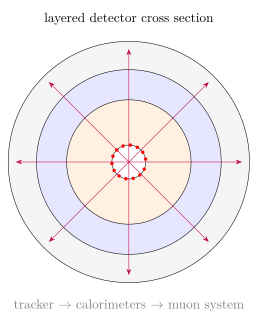
图 1 — 通用 collider detector 的同心层次示意;不同粒子在不同层留下互补信息,图不按比例。
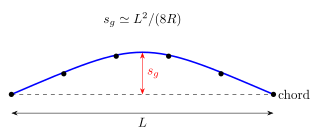
图 2 — Sagitta 由多个 hit 的弧线 fit 得到;高 \(p_T\) 时 \(s_g\) 小,alignment 与 hit resolution 更关键。
2. Electromagnetic and hadronic calorimetry / 电磁与强子量能
Knowledge ID: P11-U04-L02-K02
Calorimeter 让粒子产生 shower 并把 deposited energy 转换为光或电荷。Electromagnetic shower 由 electron bremsstrahlung 与 photon pair production 级联,纵向尺度由 radiation length \(X_0\) 描述。Hadronic shower 还包含核破裂、次级 hadrons、neutrons、不可见 binding energy 与 electromagnetic subshowers,尺度由 nuclear interaction length \(\lambda_I\) 描述,波动更大。
Homogeneous calorimeter 的整个 volume 可为 active medium;sampling calorimeter 交替 absorber 与 active layers,以 compactness、cost 和 resolution 交换。常见 energy resolution 写成独立项的 quadrature:
\[\frac{\sigma_E}{E} =\frac{a}{\sqrt{E/\mathrm{GeV}}}\oplus b\oplus\frac{c_n}{E/\mathrm{GeV}},\]
其中 stochastic term 来自 shower/采样统计,constant term 来自 calibration、uniformity 与 leakage,noise term 在低能量重要;\(\oplus\) 表示平方和开根。公式不是一套 universal constants。
Hadronic response 对 electromagnetic 与 non-electromagnetic fractions 可能不同(non-compensation),故需要 test-beam、in-situ resonances、isolated particles 与 simulation 做 calibration。Calorimeter “测到的能量”是 estimator;dead material、leakage、pileup 与 saturation 都可偏置它。
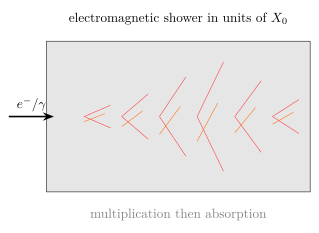
图 3 — 电磁 shower 先倍增后因临界能以下的 ionization 而衰减;线条只是粒子数密度示意。
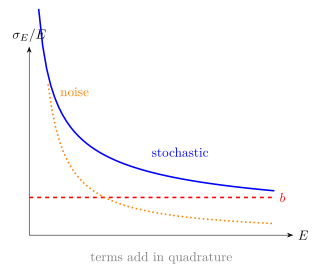
图 4 — Resolution terms 的能量依赖:低能 noise、中过渡区 stochastic、高能 constant term 可能主导。
3. Time-of-flight and particle identification / 飞行时间与粒子鉴别
Knowledge ID: P11-U04-L02-K03
若 path length \(L_{\mathrm{TOF}}\) 与 flight time \(t\) 已校准,
\[\beta=\frac{L_{\mathrm{TOF}}}{ct}.\]
再与 tracker momentum 联合,
\[m^2c^4=p^2c^2\left(\frac{1}{\beta^2}-1\right).\]
同一 \(p\) 下较重粒子速度更慢,但 \(p\gg mc\) 时 \(\beta\to1\),time difference 快速缩小;timing resolution 和 path uncertainty 决定 separation power。不能只靠到达时间识别粒子,因为 production time、路径与 momentum 都需知道。
Particle identification(PID)通常组合多个响应:\(\mathrm dE/\mathrm dx\) 依 \(\beta\gamma\),Cherenkov angle 满足 \(\cos\theta_C=1/(n\beta)\) 且有 threshold,transition radiation 对高-\(\gamma\) electron 敏感,calorimeter/track energy–momentum matching 又区分 electrons、muons 与 hadrons。每个 subsystem 输出 probability density 或 likelihood;最终 working point 在 efficiency 与 misidentification rate 间折衷,必须用 control samples 校准 data–simulation differences。
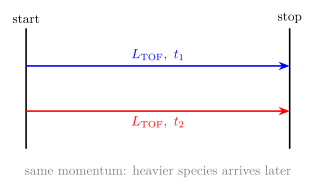
图 5 — TOF 需要共同起点、已知路径和同步 stop;时间差只有与 momentum 联合才给 mass hypothesis。
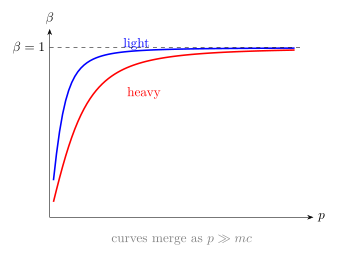
图 6 — 不同质量的 \(\beta(p)\) 曲线在低中动量可分,高动量趋近 \(c\),TOF separation 变差。
4. Trigger and data-acquisition systems / 触发与数据采集系统
Knowledge ID: P11-U04-L02-K04
Collider crossing rate 可达 MHz–tens of MHz,而 raw detector bandwidth、offline storage 与 computing 有限。Trigger 是实时 selection:低 latency hardware/firmware 先用 coarse information,software stages 再运行更完整 reconstruction。DAQ 把 synchronized fragments 组装成 event、检查 integrity、buffer 并写入 storage。
Rate budget 可写为
\[R_{\mathrm{out}}=R_{\mathrm{in}}f_{\mathrm{live}}\epsilon_{\mathrm{sel}}, \qquad \dot D=R_{\mathrm{out}}S_{\mathrm{event}},\]
其中 \(f_{\mathrm{live}}\) 反映 dead time/live fraction,\(S_{\mathrm{event}}\) 是平均 event size。Trigger efficiency 必须针对明确定义的 truth/reconstructed population 测量;threshold 附近有 turn-on,而 prescale 只接受每 \(n\) 个满足条件的 event 中一部分。
Trigger 不是透明漏斗:它决定 recorded dataset。若 search variable 直接参与 trigger,可能 sculpt background distribution;若 rare topology 没有合适 trigger path,它即使发生也不会进入 analysis。设计需要 redundancy、unbiased/zero-bias samples、monitoring、calibration streams 与 stable configuration metadata。高 rate 还带 pileup、buffer overflow 和 synchronization failure,不能把未记录 events 当成随机缺失。
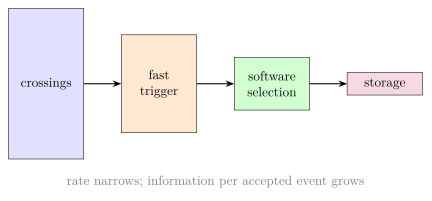
图 7 — Trigger funnel 的每级有 latency、buffer 与 efficiency;缩窄宽度表示 rate,不表示物理价值。
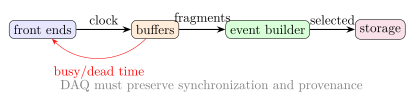
图 8 — DAQ 数据路径与 back-pressure;dead time 会与 beam conditions 相关,必须被记录和校正。
5. Missing energy and invisible particles / 丢失能量与不可见粒子
Knowledge ID: P11-U04-L02-K05
Hadron collider 中 incoming protons 沿 beam direction 的 partons 带未知 longitudinal momentum fractions,但初态总 transverse momentum 近似为零。因此定义
\[\mathbf p_T^{\mathrm{miss}}=-\sum_{i\in\mathrm{reconstructed}}\mathbf p_{T,i}, \qquad p_T^{\mathrm{miss}}=\lvert\mathbf p_T^{\mathrm{miss}}\rvert, \qquad E_T^{\mathrm{miss}}=c\,p_T^{\mathrm{miss}}.\]
它是 event-level inference,不是探测器里一个独立 hit。这里 \(p_T^{\mathrm{miss}}\) 的单位为 \(\mathrm{GeV}/c\);高能物理常用 \(c=1\) 时,数值相同的 \(E_T^{\mathrm{miss}}\) 以 \(\mathrm{GeV}\) 报告,但两者维度不可静默混用。Neutrinos 或 long-lived weakly interacting particles 可造成 genuine imbalance;但 jet energy mismeasurement、dead regions、unclustered soft activity、pileup、cosmic rays、beam background、noise 与 reconstruction failure 都能造成 fake tails。
Hermetic coverage 减少普通粒子从 cracks 逃走;calibration、quality filters 与 momentum balance control samples 约束 response。严格说 collider 分析常报告 missing transverse momentum,而非完整 “missing energy”:longitudinal component 不可由 event conservation 唯一恢复。只有在 initial four-momentum 完全已知的环境(例如理想 \(e^+e^-\) collider)才可构造更完整 missing four-momentum。一个大 \(E_T^{\mathrm{miss}}\) event 不是新粒子证据;需要分布、background model 与统计检验。
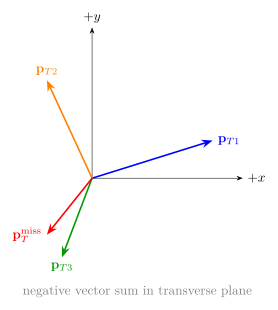
图 9 — Missing transverse momentum 是所有 reconstructed objects 的负矢量和;不能把标量 \(p_T\) 直接相减。
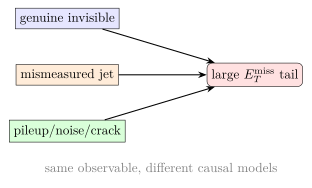
图 10 — 大 missing-momentum tail 可能来自真实不可见粒子或 detector/reconstruction 本底,必须用控制样本区分。
Worked Examples / 完整例题
Worked Example 1 — 由曲率重建 \(p_T\)
已知: 单电荷 track 在 \(B=3.80\,\mathrm T\) 轴向磁场中的 transverse radius 为 \(R=1.20\,\mathrm m\),弯转方向已确定电荷为正。
研究对象/坐标: beam 为 \(z\),在 \(x\)–\(y\) plane fit 圆;忽略 energy loss 与 nonuniform field。
模型理由: 使用 calibrated magnetic rigidity。
\[p_T=0.2998(1)(3.80)(1.20)=1.37\,\mathrm{GeV}/c.\]
检查: 半径增大代表 momentum 增大;\(p_T\) 不是 total \(p\),还需 track dip angle。三位有效数字。电荷正负来自曲率方向而非公式绝对值。
Worked Example 2 — Calorimeter resolution budget
已知: \(E=100\,\mathrm{GeV}\),\(a=10.0\%\),\(b=0.700\%\),\(c_n=0.200\,\mathrm{GeV}\),采用 \(\sigma_E/E=a/\sqrt{E/\mathrm{GeV}}\oplus b\oplus c_n/E\)。
系统: calibrated electromagnetic cluster;三项按独立 Gaussian contributions。
\[\frac{\sigma_E}{E} =\sqrt{(0.100/10)^2+(0.00700)^2+(0.200/100)^2} =0.0124.\]
所以 \(\sigma_E=1.24\,\mathrm{GeV}\)。检查: relative resolution 无量纲,absolute uncertainty 与 \(E\) 相乘。若 calibration terms correlated,简单 quadrature 不成立。
Worked Example 3 — TOF 的 \(\pi/K\) separation
已知: \(p=1.00\,\mathrm{GeV}/c\),path \(L=2.00\,\mathrm m\);\(m_\pi c^2=0.140\,\mathrm{GeV}\),\(m_Kc^2=0.494\,\mathrm{GeV}\)。
参考系: detector laboratory;共同 production time,路径差忽略。
\[\beta_\pi=\frac{1.00}{\sqrt{1.00^2+0.140^2}}=0.990, \quad \beta_K=\frac{1.00}{\sqrt{1.00^2+0.494^2}}=0.897.\]
\[t_\pi=\frac{2.00}{0.990c}=6.73\,\mathrm{ns}, \quad t_K=7.44\,\mathrm{ns}, \quad \Delta t=0.71\,\mathrm{ns}.\]
合理性: 较重 kaon 同 momentum 下更慢;若 timing resolution 为 \(100\,\mathrm{ps}\),理想 separation 约 7 个单测量标准差,但 path/start-time uncertainty 需合入。
Worked Example 4 — Trigger 与 bandwidth 账本
已知: input crossings \(40.0\,\mathrm{MHz}\);first stage 接受 \(100\,\mathrm{kHz}\),software output \(1.00\,\mathrm{kHz}\),平均 event \(2.00\,\mathrm{MB}\);live fraction \(0.980\)。
系统边界: 从 crossing 到 permanent storage;MB 按 \(10^6\) bytes。
最终有效写入率
\[R_{\mathrm{store}}=(1.00\times10^3)(0.980)=980\,\mathrm{s^{-1}},\]
\[\dot D=(980)(2.00\,\mathrm{MB})=1.96\,\mathrm{GB\,s^{-1}}.\]
一天约 \(1.69\times10^5\,\mathrm{GB}=169\,\mathrm{TB}\)。检查: 这不含 compression、metadata 与 downtime;trigger efficiency 不能由 rate reduction alone 推出,因为 rejected populations 不同。
Worked Example 5 — Missing transverse momentum 的矢量和
已知: 三个 reconstructed objects 有 \((p_x,p_y)\):\((40,0)\)、\((-10,30)\)、\((-20,-10)\,\mathrm{GeV}/c\)。
坐标与系统: beam 沿 \(z\);只对 selected event 的 reconstructed transverse objects 求和。
\[\sum\mathbf p_T=(10,20)\,\mathrm{GeV}/c, \qquad \mathbf p_T^{\mathrm{miss}}=(-10,-20)\,\mathrm{GeV}/c.\]
\[p_T^{\mathrm{miss}}=\sqrt{10^2+20^2}=22.4\,\mathrm{GeV}/c, \qquad E_T^{\mathrm{miss}}=c\,p_T^{\mathrm{miss}}=22.4\,\mathrm{GeV}.\]
方向在第三象限,\(\tan^{-1}(20/10)=63.4^\circ\) below \(-x\) axis。检查: momentum magnitude 是 \(22.4\,\mathrm{GeV}/c\);只有写出 \(E_T^{\mathrm{miss}}=c p_T^{\mathrm{miss}}\) 或声明 \(c=1\) 后,才能报告 \(22.4\,\mathrm{GeV}\)。不能把三个 magnitudes 相减;结果既可由 invisible momentum 也可由 unmeasured soft activity 产生。
Lesson synthesis / 全课综合
Detector reconstruction 是一条带 covariance 的 inverse chain:hits \(\to\) tracks/vertices,signals \(\to\) calibrated clusters/showers,times 与 response patterns \(\to\) PID,trigger/DAQ \(\to\) recorded sample,objects 的 transverse vector balance \(\to\mathbf p_T^{\mathrm{miss}}\)。每一步都含 calibration、efficiency、resolution 和 failure modes;因而最终 particle four-vectors 不是“事实清单”,而是由明确 detector model 支撑的 estimators。下一课的 statistics 正是把这些 estimators 与 uncertainties 转成证据强度。
Formula-and-decision table / 公式与决策表
| Task | Relation | Use only when | Main failure mode |
|---|---|---|---|
| track momentum | \(p_T=0.2998\lvert q/e\rvert BR\) | calibrated \(B\), fitted transverse circle | alignment/material/multiple scattering |
| sagitta | \(s_g\simeq L^2/(8R)\) | small curvature over chord | finite hit resolution |
| calorimeter resolution | \(\sigma_E/E=a/\sqrt{E}\oplus b\oplus c_n/E\) | stated energy convention and calibration | correlations/nonlinearity/leakage |
| TOF speed | \(\beta=L/(ct)\) | start time and path known | clock/path uncertainty |
| mass from \(p,\beta\) | \(m^2c^4=p^2c^2(\beta^{-2}-1)\) | same track and calibrated systems | high-\(p\) loss of separation |
| data throughput | \(\dot D=R_{\mathrm{out}}S_{\mathrm{event}}\) | live fraction and units stated | burst/buffer/compression effects |
| missing transverse quantities | \(\mathbf p_T^{\mathrm{miss}}=-\sum_i\mathbf p_{T,i}\);\(p_T^{\mathrm{miss}}=\lvert\mathbf p_T^{\mathrm{miss}}\rvert\);\(E_T^{\mathrm{miss}}=c p_T^{\mathrm{miss}}\) | object definition and calibrations fixed | fake tails, acceptance gaps, or silent \(c=1\) mixing |
Model boundaries / 模型边界
- Track curvature measures \(p_T\) in an axial field;total momentum also needs polar angle。Neutral particles do not leave ordinary charged tracks。
- A detector resolution is a probability distribution conditioned on particle, energy, angle and environment;one headline number is not universal。
- Electromagnetic and hadronic shower scales differ;\(X_0\) and \(\lambda_I\) cannot be interchanged。
- TOF mass inference requires independently measured momentum, production time and path;at high \(p\) species converge in \(\beta\)。
- Trigger creates a selected dataset and can sculpt observables;efficiency and prescale metadata are part of physics interpretation。
- Hadron-collider “missing energy” normally means transverse imbalance;longitudinal missing component is not constrained event by event。
- Large missing momentum alone does not identify an invisible particle;detector backgrounds and Standard Model neutrinos require statistical control。
Misconception clinic / 误区诊所
- “Tracker 直接量 momentum。” 它量 positions;momentum 是 field/material model 下由 curvature fit 的结果。
- “Calorimeter 把所有粒子能量完全收集。” Muons、neutrinos、leakage、dead material 与 noncompensation 破坏这一说法。
- “到得晚的就是重粒子。” 还需相同 momentum、路径与 production time,并计 timing uncertainty。
- “Trigger 只删掉无趣 events,不影响分析。” Threshold、prescale 与 topology selection 会改变 sample distribution。
- “\(E_T^{\mathrm{miss}}\) 是不可见粒子的能量。” 它是可见 transverse momenta 的负矢量和,可能混合多个不可见粒子与 fake contributions。
Practice and retrieval / 练习与提取
- [K01·定量] \(B=2.00\,\mathrm T\) 中单电荷 track 的 \(R=0.500\,\mathrm m\),求 \(p_T\)。
- [K01·误差] 为什么相同 hit resolution 下 high-\(p_T\) track 的 relative momentum resolution 通常更差?
- [K02·概念] 区分 \(X_0\) 与 \(\lambda_I\) 的物理用途。
- [K02·定量] 若纯 stochastic term \(a=50\%\),\(E=25\,\mathrm{GeV}\) 时 \(\sigma_E/E\) 与 \(\sigma_E\) 是多少?
- [K03·推导] 从 \(p=\gamma mv\) 与 \(E=\gamma mc^2\) 推得 \(m^2c^4=p^2c^2(\beta^{-2}-1)\)。
- [K03·边界] 为什么 TOF 在 very high momentum 的 \(\pi/K\) identification 变差?
- [K04·定量] \(50\,\mathrm{kHz}\) output、\(1.50\,\mathrm{MB}\) event 对应 raw throughput 多少?
- [K04·概念] 什么是 trigger turn-on,为什么 analysis threshold 常高于 nominal trigger threshold?
- [K05·矢量] 可见 transverse vector sum 为 \((6,-8)\,\mathrm{GeV}/c\),求 \(\mathbf p_T^{\mathrm{miss}}\) 与 magnitude。
- [K01–K05·综合] 列出一个 large \(E_T^{\mathrm{miss}}\) event 从 detector 到 physics claim 的四个验证关口。
第 1 题答案
\(p_T=0.2998(2.00)(0.500)=0.300\,\mathrm{GeV}/c\)。方向需由 curvature sign 单独判断。
第 2 题答案
High \(p_T\) 使 \(R\) 大、sagitta 小;固定的 sagitta/position uncertainty 占测量值的比例更大,所以 \(p_T\propto1/s_g\) 的相对误差增大。
第 3 题答案
\(X_0\) 控制高能 electron bremsstrahlung/photon conversion 等 electromagnetic shower 尺度;\(\lambda_I\) 控制 hadron nuclear interaction/shower 尺度。
第 4 题答案
\(\sigma_E/E=0.50/\sqrt{25}=0.100\),\(\sigma_E=2.50\,\mathrm{GeV}\)。
第 5 题答案
\(p=\gamma m\beta c\),故 \(p^2c^2(\beta^{-2}-1)=\gamma^2m^2c^4(1-\beta^2)=m^2c^4\)。
第 6 题答案
当 \(p\gg mc\),两者 \(\beta\to1\),flight-time difference 小于 timing/path/start-time resolution;需 Cherenkov、\(dE/dx\) 等互补信息。
第 7 题答案
\(\dot D=5.00\times10^4\times1.50\,\mathrm{MB}=75.0\,\mathrm{GB\,s^{-1}}\),未计 compression 与 overhead。
第 8 题答案
Resolution 使 efficiency 在 threshold 附近从 0 平滑升到 plateau。Analysis 放在 plateau 可减少急剧的效率建模与 spectrum sculpting。
第 9 题答案
\(\mathbf p_T^{\mathrm{miss}}=(-6,8)\,\mathrm{GeV}/c\),magnitude \(10\,\mathrm{GeV}/c\)。
第 10 题答案
示例:track/cluster quality 与 event cleaning;jet/lepton calibrations 和 cracks;pileup/control samples 对 fake tails;trigger efficiency/provenance;最后用 background likelihood 与 population-level significance 检验,不能以单 event 下结论。
Exit ticket / 离堂检验
- 给定一条弯曲 track 和一个 calorimeter cluster,写出你需要哪些额外信息才能把它识别为 electron,并列出一个可能的假信号。
- 用一句式子和两句边界说明为什么 hadron collider 只可靠地使用 missing transverse momentum。
References and source notes / 参考资料与来源说明
以下链接均于 2026-08-30 实际打开并核对;正文重新组织,所有图均依据方程原创绘制。
- Particle Data Group 2024 — Particle Detectors at Accelerators — tracking, timing, calorimeters, PID, resolution and detector-response limits
- CERN — How a detector works — layered detector logic and momentum from magnetic curvature
- CMS — Detector Overview — tracker, ECAL/HCAL, muon system, trigger rates and missing transverse energy
- CMS — Tracking — silicon hit positions, curvature, momentum and displaced-track reconstruction
- CMS — Energy of Hadrons (HCAL) — sampling calorimetry, hadronic showers, hermeticity and missing transverse imbalance
Source-to-content map
| Source | Used for | Knowledge ID / Section | Model boundary or convention |
|---|---|---|---|
| PDG detector review | detector technologies, resolution and response models | K01–K03 | quoted performance is technology- and geometry-dependent |
| CERN detector overview | curvature and layered evidence | K01, K02 | conceptual overview; reconstruction is model-dependent |
| CMS detector overview | subdetector roles, trigger funnel and invisible signatures | K02, K04, K05 | CMS architecture is an example, not a universal detector layout |
| CMS tracking | hit-based path and momentum reconstruction | K01 | track momentum requires calibrated field and alignment |
| CMS HCAL | sampling showers, hermeticity and imbalance | K02, K05 | missing momentum also has instrumental sources |
复习与拓展
- 下一课 Statistical Evidence in Particle Physics 把 detector estimators、efficiencies 和 nuisance parameters 放入 likelihood。
- 回链 Radiation Detection:calibration、efficiency、dead time 与 counting statistics 在 collider detector 中仍是核心。
- 未来扩展:Kalman filter、vertexing、particle-flow reconstruction、unfolding、jet algorithms、pileup mitigation 与 detector simulation。