
Learning objectives / 学习目标
- 推导 transit depth 与 circular radial-velocity semi-amplitude 的主要依赖;
- 比较 direct imaging、microlensing、astrometry 的信号、选择效应和可重复性;
- 联合 \(M_p,R_p\) 计算 bulk density,并说明 composition degeneracy;
- 区分 transmission、emission/eclipse、phase-curve spectra 与 stellar contamination;
- 把 habitable zone 作为辐射—气候筛选器,而非生命或液态水的充分条件。
Prerequisites / 先修知识
- Light, Spectra, and Distance 的 Doppler shift、flux 与 spectrum;
- Formation and Orbital Architecture 的 orbital elements 和 selection effects;
- Planetary Interiors, Surfaces, and Atmospheres 的 density、equilibrium temperature 与 atmospheric scale height。
Scope and conventions / 范围与约定
- \(i=90^\circ\) 表示 edge-on;radial velocity 主要给 \(M_p\sin i\)。
- 下列 transit depth 忽略 limb darkening、spots、dilution 与 grazing geometry;实际拟合必须包含它们。
- “检测”与“确认/统计验证”分开;stellar variability 和 eclipsing binaries 可制造假阳性。
- 大气 retrieval 必须联合 instrumental systematics、stellar spectrum、clouds 和 molecular opacity。
- Habitable zone 讨论以 surface liquid water 的气候条件为动机,不等价于 inhabited zone。
Notation and modeling contract
| Symbol | Meaning | SI / convention |
|---|---|---|
| \(R_p,R_*,M_p,M_*\) | planet/star radius and mass | m, kg |
| \(P,a,e,i\) | period, semimajor axis, eccentricity, inclination | s, m, 1, rad |
| \(\delta\) | fractional transit depth | 1 |
| \(K\) | stellar RV semi-amplitude | m s\(^{-1}\) |
| \(\alpha_*\) | astrometric angular semimajor axis | rad |
| \(A_B,T_{\rm eq}\) | Bond albedo, equilibrium temperature | 1, K |
| \(H\) | atmospheric scale height | m |
1. Transit and radial-velocity detection / 凌星与径向速度探测
Knowledge ID: P12-U02-L03-K01
小行星、非掠凌星和均匀恒星面的几何极限给
\[\delta\simeq\left(\frac{R_p}{R_*}\right)^2.\]
周期来自重复间隔,duration 和 ingress/egress 约束 \(a/R_*\)、impact parameter 与 eccentricity combinations。凌星概率数量级 \(p_{\rm tr}\sim(R_*+R_p)/a\),故短周期样本被几何偏置。
行星与恒星绕 barycenter 运动,恒星谱线呈周期 Doppler shift。忽略 \(M_p\) 相对 \(M_*\),semi-amplitude 为
\[K\simeq\left(\frac{2\pi G}{P}\right)^{1/3} \frac{M_p\sin i}{M_*^{2/3}\sqrt{1-e^2}}.\]
Transit 提供 \(R_p/R_*\),RV 提供 \(M_p\sin i\);二者都依赖 host-star parameters,因此“know the star, know the planet”。
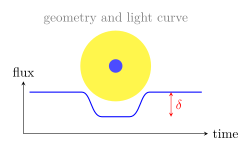
图 1 关联遮挡面积与 light-curve depth;真实底部因 limb darkening 通常不完全平。
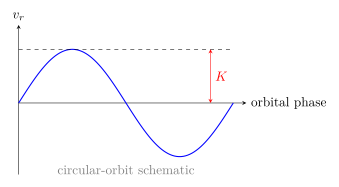
图 2 的正负表示远离/接近约定;偏心轨道曲线一般不再正弦。
2. Direct imaging, microlensing, and astrometry / 直接成像、微引力透镜与天体测量
Knowledge ID: P12-U02-L03-K02
Direct imaging 同时受 angular separation 与 contrast 限制;coronagraph/PSF subtraction 偏爱年轻、自发光、宽轨巨行星,并需 common proper motion 排除背景星。Microlensing 利用前景系统的引力放大背景星,行星产生短暂 anomaly;它可探测较冷、较远行星,但单次事件通常不可重复,物理质量需额外 parallax/finite-source constraints。Astrometry 测恒星在天空平面上的反射运动:
\[\alpha_*\simeq\frac{M_p}{M_*}\frac{a}{d},\]
其中 \(a/d\) 以弧度表示。它对长周期和较大质量更敏感,并可破除 RV 的 \(\sin i\) 退化。
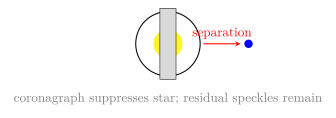
图 3 展示 direct-imaging 的 inner working angle 与 contrast 双限制。
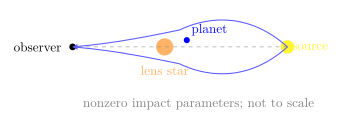
图 4 是 microlensing 对齐示意;光线弯曲与尺寸均不按比例。
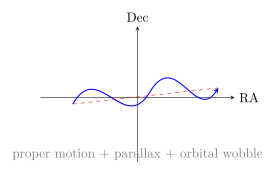
图 5 强调 astrometric orbit 必须与 proper motion、annual parallax 同时拟合。
3. Mass–radius relations and bulk composition / 质量—半径关系与总体组成
Knowledge ID: P12-U02-L03-K03
有 \(M_p,R_p\) 后可得 \(\bar\rho=3M_p/(4\pi R_p^3)\) 与表面重力 \(g=GM_p/R_p^2\)。但 equation of state 使关系非线性:rock/iron 行星被自压缩,H/He 包层即使质量分数小也可显著增大半径;年龄与 irradiation 影响 giant radius。组成反演应给 posterior over core, mantle, water, envelope parameters,而非把一条 mass–radius curve 当分类边界。
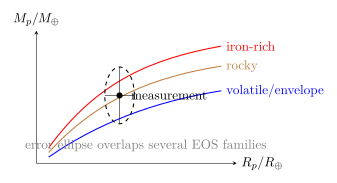
图 6 显示一个测量点可与多种有误差的结构家族重叠。
4. Atmospheric spectra and climate / 大气光谱与气候
Knowledge ID: P12-U02-L03-K04
Transmission spectroscopy 比较凌星内外光谱;大气在分子吸收波段使有效半径增加,信号尺度近似数个 scale heights:
\[\Delta\delta\sim\frac{2R_pNH}{R_*^2},\]
\(N\) 为数个有效尺度高度。Secondary eclipse 给 dayside planet/star spectrum;phase curve 给 longitudinal energy redistribution;direct-emission/reflection spectroscopy 可避开 transit geometry。Cloud/haze 可抹平特征,stellar spots/faculae 可伪造波长依赖,molecular bands 还会重叠。
Climate 由 stellar spectrum、bolometric flux、rotation、atmospheric mass/composition、clouds、surface/ocean 与 internal heat 共同控制。\(T_{\rm eq}\) 是 top-of-atmosphere baseline,不是地表温度预测。
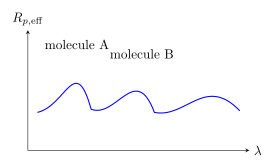
图 7 是 transmission features;峰高也依赖 \(H\), clouds 和 abundance。
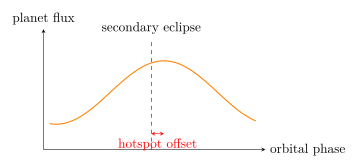
图 8 用 phase-curve 最大值偏移探测大气热输运;示意未画 eclipse 缺口。
5. Habitable-zone concept and its limitations / 宜居带概念及其局限
Knowledge ID: P12-U02-L03-K05
经典 circumstellar habitable zone(HZ)是给定 host spectrum 和一类 climate model 下,岩石行星可能维持 surface liquid water 的 orbital-flux 区域。它是目标筛选器:不保证 atmosphere 存在、水存在、长期稳定或生命出现。HZ 外也可能由 thick H\(_2\)、tidal/internal heating 或 subsurface ocean 形成宜居环境;HZ 内也可能因 atmospheric loss、runaway greenhouse、tidal locking climate、flares 或 water inventory 而不宜居。
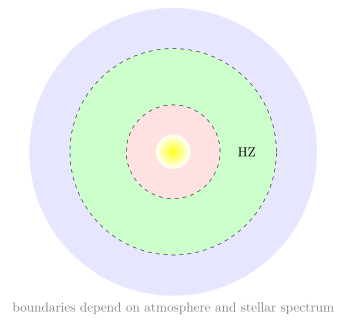
图 9 不是一条普适绿色圆环;边界随模型、恒星和行星性质移动。
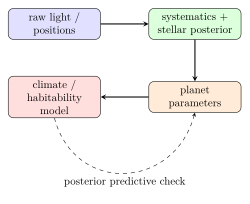
图 10 把 habitability inference 放在链条末端,避免把一个光变 dip 直接解释为“第二地球”。
Worked examples / 完整例题
Worked Example 1 — Transit depth 到半径
已知: 太阳半径恒星的 transit depth \(\delta=1.00\%\)。系统/坐标: 无 dilution、非掠凌星,视线为观测方向。模型理由: 小行星均匀盘近似。
\[\frac{R_p}{R_*}=\sqrt{0.0100}=0.100, \qquad R_p=6.96\times10^7\,\mathrm m.\]
即约 \(0.974R_J\)(取 \(R_J=7.15\times10^7\,\mathrm m\))。深度无量纲,半径方向正确。若有未解析伴星 dilution,真实 \(R_p/R_*\) 会更大;limb darkening 需联合拟合。
Worked Example 2 — Hot Jupiter 的 RV 信号
已知: \(M_p=M_J\)、\(M_*=M_\odot\)、\(P=3.00\,\mathrm d\)、\(e=0\)、\(i=90^\circ\)。参考系: system barycenter;远离为正。代入圆轨道公式:
\[K=\left(\frac{2\pi G}{P}\right)^{1/3}\frac{M_J}{M_\odot^{2/3}} =1.41\times10^2\,\mathrm{m\,s^{-1}}.\]
三位有效数字 \(K=141\,\mathrm{m\,s^{-1}}\)。周期更短或质量更大均增大 \(K\),极限合理。未凌星时只得到 \(M_p\sin i\),且 stellar activity 可产生相似周期信号。
Worked Example 3 — Mass–radius density
已知: \(M_p=5.00M_\oplus\),\(R_p=2.00R_\oplus\)。系统边界: 行星整体;采用球形 bulk density。
\[\frac{\bar\rho_p}{\bar\rho_\oplus}=\frac{5.00}{2.00^3}=0.625,\]
取 \(\rho_\oplus=5.51\,\mathrm{g\,cm^{-3}}\),得 \(3.44\,\mathrm{g\,cm^{-3}}=3.44\times10^3\,\mathrm{kg\,m^{-3}}\)。密度低于地球提示 volatile/H-He envelope,但不唯一规定比例;误差应由 \(M,R\) covariance 传播。
Worked Example 4 — Equilibrium temperature 筛选
已知: Sun-like star、\(a=0.250\,\mathrm{AU}\)、\(A_B=0.30\)、均匀再分配;地球同一假设 \(T_{\rm eq,\oplus}=255\,\mathrm K\)。模型: grey radiative equilibrium,无 greenhouse/internal heat。
\[T_{\rm eq}=255\left(\frac{1\,\mathrm{AU}}{0.250\,\mathrm{AU}}\right)^{1/2}=510\,\mathrm K.\]
两位有效数字 \(5.1\times10^2\,\mathrm K\)。更近应更热,方向正确。该温度不能直接判定地表状态;clouds、redistribution 与 atmospheric optical depth 均未给定。
Lesson synthesis / 本课综合
可靠推断遵循:raw time series/spectrum/positions → instrument 与 stellar model → detection likelihood 和 false-positive test → orbital/radius/mass posterior → interior/atmosphere forward model → climate/habitability hypothesis。不同方法覆盖不同 selection function;合并方法比单一“最精确数值”更能打破退化。
Formula-and-decision table
| Observable | Baseline relation | Gives | Does not directly give |
|---|---|---|---|
| transit depth | \(\delta\simeq(R_p/R_*)^2\) | radius ratio | absolute radius without \(R_*\) |
| RV curve | \(K\propto M_p\sin i P^{-1/3}\) | minimum mass | true mass without inclination |
| astrometry | \(\alpha_*\simeq(M_p/M_*)a/d\) | sky-plane orbit | easy short-period sensitivity |
| \(M,R\) | \(\bar\rho=3M/(4\pi R^3)\) | bulk density | unique composition |
| irradiation | \(T_{\rm eq}\) | radiative baseline | surface climate |
| transmission | \(\Delta\delta\sim2R_pNH/R_*^2\) | wavelength-dependent opacity | unique abundance without retrieval |
Model boundaries / 模型边界
- Transit/RV equations above are leading-order; finite integration, eccentricity, limb darkening and correlated noise matter.
- Direct imaging detections require background-object rejection and calibrated throughput.
- Microlensing is powerful statistically but often yields broad individual physical-parameter posteriors.
- Mass–radius curves depend on EOS, thermal state and atmosphere age.
- Biosignature interpretation requires disequilibrium context, false-positive pathways and stellar UV—not one molecule alone.
Misconception clinic / 误区诊所
- “1% 凌星就是半径 1%。” 面积比使半径比为平方根,即 10%。
- “RV 给精确质量。” 通常给 \(M_p\sin i\)。
- “直接成像看见表面。” 多数只是不可分辨光点和光谱。
- “相同密度就是相同组成。” 分层、EOS 和 envelope 产生退化。
- “在 HZ 内就宜居。” HZ 既非必要也非充分条件。
Practice and retrieval / 练习与检索
- [K01] \(\delta=400\,\mathrm{ppm}\),求 \(R_p/R_*\)。
- [K01] RV 未知 inclination 时报告何种质量量?
- [K02] 为什么 direct imaging 偏爱年轻宽轨巨行星?
- [K02] 令 \(M_p/M_*=10^{-3}\)、\(a=5\,\mathrm{AU}\)、\(d=10\,\mathrm{pc}\),求 \(\alpha_*\)(mas)。
- [K03] \(M=8M_\oplus,R=2R_\oplus\),密度相对地球多少?
- [K03] 列出 mass–radius 反演的两个退化参数。
- [K04] 为什么高分子量大气的 transmission feature 较小?
- [K04] stellar spots 如何污染 transmission spectrum?
- [K05] 写出 HZ 内仍不宜居的两个原因。
- [综合] 设计 transit+RV+secondary-eclipse 的三步联合推断链。
Answer 1
\(R_p/R_*=\sqrt{4.00\times10^{-4}}=0.0200\)。
Answer 2
\(M_p\sin i\)(更精确地说是与其他轨道参数联合的 minimum-mass posterior)。
Answer 3
年轻巨行星仍有强热辐射,宽轨角分离大于 coronagraph inner working angle;这也是选择偏差。
Answer 4
\(a/d=0.5''\),乘 \(10^{-3}\) 得 \(0.0005''=0.50\,\mathrm{mas}\)。
Answer 5
\(\rho/\rho_\oplus=8/2^3=1.00\)。
Answer 6
例如 iron-core fraction 与 silicate mantle,或 water layer 与 H/He envelope;年龄/temperature 也退化。
Answer 7
\(H=kT/(\mu m_ug)\) 随 \(\mu\) 增大而减小,跨越数个 \(H\) 的有效半径变化更小。
Answer 8
未被行星遮挡的冷 spots 改变 out-of-transit stellar spectrum,使相对 transit depth 呈伪波长结构。
Answer 9
无/过薄大气导致失水;runaway greenhouse;强 flares;无水 inventory;极端 tidal heating,任两项均可。
Answer 10
Transit 给 \(R_p/R_*\) 与周期;RV 给 \(M_p\sin i\) 并与 transit inclination 得质量;eclipse 给 dayside spectrum/temperature。三者联合 stellar posterior 得密度和能量收支。
Exit ticket / 离堂检验
收到“发现一颗 HZ 内、\(1.1R_\oplus\) 的地球 2.0”新闻标题:写出你在接受该结论前必须索取的五项数据或模型假设。
References and source notes / 参考资料与来源说明
本课所有 TikZ 均依据正文方程原创绘制,未复制来源插图;来源文字经重组表述。
- NASA Science, How We Find and Characterize — transit、RV、microlensing、direct imaging 与光谱;核对 2026-08-30。
- OpenStax Astronomy, 21.4 Planets beyond the Solar System — 检测公式、选择效应和方法比较;核对 2026-08-30。
- NASA Exoplanet Science Strategy — 组成退化、atmosphere 与 habitability 边界;核对 2026-08-30。
- NASA Exoplanet Archive, Data Resources — 观测参数、归档与方法数据产品;核对 2026-08-30。
- OpenStax Astronomy 2e, 30.3 Searching for Life beyond Earth — HZ 与 biosignature 的教学边界;核对 2026-08-30。
Source-to-content map
| Source | Used for | Knowledge ID / Section | Model boundary or convention |
|---|---|---|---|
| NASA find/characterize | method signals | K01–K02, K04 | method-dependent selection |
| OpenStax 21.4 | transit/RV and discovery bias | K01–K02 | simplified leading-order equations |
| NASA Strategy | mass–radius, spectra, HZ limits | K03–K05 | retrieval and habitability degeneracies |
| NASA Archive | parameter/data provenance | all | literature values need uncertainty/provenance |
| OpenStax 30.3 | life-search framing | K05 | HZ is a first filter |
复习与拓展
- 用 injection–recovery curve 校正 period–radius occurrence rate。
- 以后可扩展 hierarchical Bayesian population inference 与 retrieval。
- 下一课 Stellar Observables and Classification 说明为什么 host-star \(R_*,M_*,T_{\rm eff},[\mathrm{Fe/H}]\) 是行星推断的底座。