
Learning objectives / 学习目标
- 从 disk temperature、surface density 与 Kepler motion 解释凝结线和吸积区域;
- 用 mass、radius、density、period、eccentricity 与 inclination 描述体系结构,并识别 selection bias;
- 计算 mean-motion resonance、mutual Hill spacing,区分短期规则与长期稳定;
- 解释 disk migration、planet–planet scattering、tidal synchronization 与 tidal heating 的能量和角动量账本;
- 对任何形成情景明确可观测约束、时间尺度和模型边界。
Prerequisites / 先修知识
- Orbits and Kepler's Laws:\(P^2\propto a^3\)、轨道能量与角动量;
- Angular Momentum 与 Energy, Heat, and Work;
- Telescopes and Detectors 的 selection function。
Scope and conventions / 范围与约定
- 采用以恒星为中心的 osculating elements;\(a,e,i\) 分别为半长轴、偏心率、倾角。
- 原行星盘先作轴对称、薄盘、近 Keplerian 模型;真实盘含湍流、磁场、螺旋结构和 photoevaporation。
- “rocky / giant / sub-Neptune”是观测与组成类别,不是无歧义的形成标签。
- 稳定性必须给出时间跨度;在有限积分时间内不相撞并不等价于永远稳定。
- 潮汐采用 equilibrium-tide 的定性框架;耗散参数 \(Q\) 和 Love number \(k_2\) 有模型依赖。
Notation and modeling contract / 符号与建模契约
| Symbol | Meaning | SI / convention |
|---|---|---|
| \(M_*,m_p\) | stellar and planet mass | kg |
| \(a,e,i,P,n\) | semimajor axis, eccentricity, inclination, period, mean motion | m, 1, rad, s, rad s\(^{-1}\) |
| \(\Sigma,T\) | disk surface density and temperature | kg m\(^{-2}\), K |
| \(R_{\rm H,m}\) | mutual Hill radius | m |
| \(p:q\) | period commensurability | integers |
| \(\Omega_s\) | spin angular speed | rad s\(^{-1}\) |
| \(k_2,Q\) | Love number and tidal quality factor | 1 |
1. Protoplanetary disks and accretion / 原行星盘与吸积
Knowledge ID: P12-U02-L01-K01
分子云核坍缩时,微小的初始角动量使物质不能全部径直落入恒星,而形成旋转的 protoplanetary disk。薄盘中圆轨道角速度近似
\[\Omega_K(r)=\sqrt{\frac{GM_*}{r^3}}.\]
温度随半径降低,只有当局部温度低于某物质凝结温度时,它才贡献固体表面密度。水雪线外的冰增加可用固体量,有利于快速形成能吸积 H/He 的大质量核心。尘粒经历 sticking、fragmentation、radial drift;跨过“米级障碍”后形成 planetesimals,再由 gravitational focusing 加速增长。焦聚后的有效碰撞截面近似
\[\sigma_{\rm coll}=\pi(R_1+R_2)^2\left(1+\frac{v_{\rm esc}^2}{v_\infty^2}\right).\]
这不是单调“越撞越大”:高速碰撞会碎裂,气体阻力会令固体漂移,巨行星还必须在盘气体消散前取得包层。
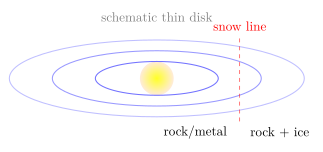
图 1 把 snow line 画成温度阈值的位置;它会随恒星光度与盘演化移动,并非固定边界。
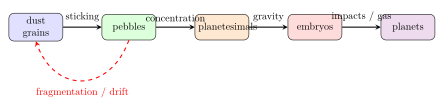
图 2 显示形成链条和逆过程;“尘埃直接变行星”的省略会隐藏最困难的尺度跨越。
2. Planet classes and orbital distributions / 行星类别与轨道分布
Knowledge ID: P12-U02-L01-K02
可观测的 bulk density 是
\[\bar\rho=\frac{3M_p}{4\pi R_p^3},\]
但相同 \(M_p,R_p\) 可由不同 core/mantle/volatile/envelope 组合产生,存在 composition degeneracy。轨道体系结构至少需联合报告 multiplicity、period ratios、\(e\)、mutual inclination 与 host properties。观测样本不是母总体:transit 偏爱短周期且近 edge-on 的轨道,radial velocity 偏爱大 \(M_p\sin i\) 与短周期。因此“热木星常见”必须经 detection efficiency 校正。
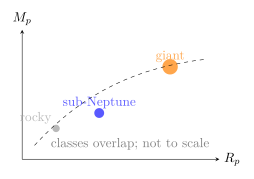
图 3 强调类别是连续参数空间上的描述,虚线不代表唯一 mass–radius law。
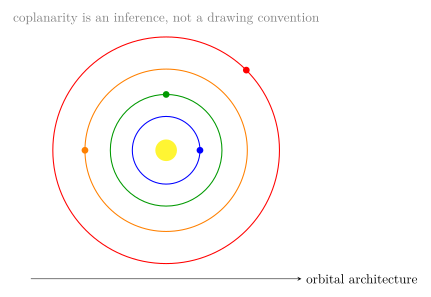
图 4 表示一个低互倾多行星系统;实际系统的轨道可能偏心、倾斜并存在未探测成员。
3. Resonances, migration, and long-term stability / 共振、迁移与长期稳定
Knowledge ID: P12-U02-L01-K03
若 \(P_2/P_1\approx p/q\)(\(p,q\) 为小整数),系统接近 mean-motion resonance。真正的共振要看 resonant angle 是否 librate,而不只是 period ratio 接近整数。盘的内外密度波对行星施加不等 torque,净角动量交换可使 \(a\) inward 或 outward migration;当多行星迁移会聚时可捕获入共振,后续盘消散又可能打破链条。
两颗近圆、近共面行星常用 mutual Hill radius
\[R_{\rm H,m}=\left(\frac{m_1+m_2}{3M_*}\right)^{1/3}\frac{a_1+a_2}{2},\qquad \Delta=\frac{a_2-a_1}{R_{\rm H,m}}\]
衡量间隔。对两行星的特定理想条件,Hill criterion 可给出避免 close encounter 的充分条件;对多行星、偏心或共振系统,\(\Delta\) 只是 heuristic,必须 N-body integration 并检查能量、角动量误差。
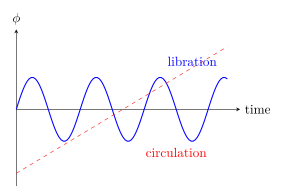
图 5 比较 resonant angle 的 libration 与 circulation;period commensurability 本身不足以判定共振。
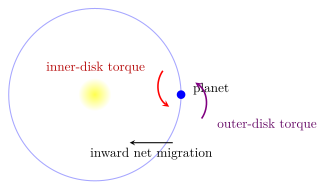
图 6 是 torque ledger;箭头方向只是一个 inward-migration 情形,真实净 torque 可反号。
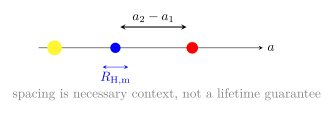
图 7 把轨道间隔与 Hill 尺度分开,避免把星际距离直接当稳定指标。
4. Tides, spin–orbit coupling, and tidal heating / 潮汐、自转—轨道耦合与潮汐加热
Knowledge ID: P12-U02-L01-K04
潮汐来自外部引力场在天体尺度上的梯度。若潮汐隆起相对两体连线有 phase lag,torque 会在 spin 与 orbit 间交换 angular momentum,同时机械能因内部摩擦转为热。孤立两体总角动量近守恒,但 mechanical energy 下降;常见终态是 synchronous rotation、较低 eccentricity,或在偏心轨道上形成其他 spin–orbit resonance。
耗散强度常以 \(k_2/Q\) 参数化。它依赖内部结构、频率与温度,不能当作普适常数。潮汐加热需非零 time-varying deformation(例如 eccentricity、obliquity 或非同步自转);完全圆、共面且同步的理想两体极限中稳态潮汐热趋近零。
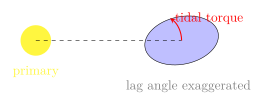
图 8 的 bulge lag 产生 torque;箭头方向取决于 spin 与 orbital mean motion 的相对大小。
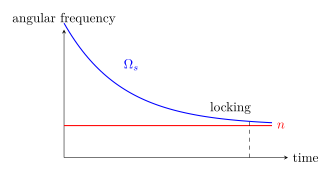
图 9 显示一种超同步自转被耗散拉向 \(\Omega_s=n\) 的情形;并非所有体系都到达这一终态。
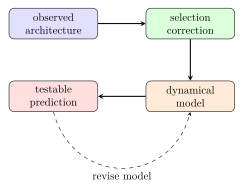
图 10 是形成推断流程:先校正探测过程,再用动力学模型产生可检验预测。
Worked examples / 完整例题
Worked Example 1 — 由温度律估算 snow line
已知: \(T(r)=280\,\mathrm{K}(r/\mathrm{AU})^{-1/2}\),水凝结温度 \(170\,\mathrm{K}\)。系统/参考系: 一颗太阳型星周围的轴对称被动盘;\(r\) 从恒星向外。模型理由: 只求数量级,忽略黏性加热和阴影。
\[170=280\left(\frac{r}{\mathrm{AU}}\right)^{-1/2} \quad\Rightarrow\quad r=\left(\frac{280}{170}\right)^2\mathrm{AU}=2.71\,\mathrm{AU}.\]
两位有效数字为 \(2.7\,\mathrm{AU}=4.0\times10^{11}\,\mathrm m\)。量纲检查:比值平方无量纲,结果保留长度。\(T\) 随 \(r\) 降低,所以水冰在更外侧稳定,方向合理。若恒星更亮或盘有显著 viscous heating,snow line 应外移。
Worked Example 2 — Mutual Hill spacing
已知: \(M_*=M_\odot\),\(m_1=m_2=5M_\oplus\),\(a_1=0.100\,\mathrm{AU}\),\(a_2=0.130\,\mathrm{AU}\),取 \(M_\oplus/M_\odot=3.00\times10^{-6}\)。系统: 近圆、近共面两行星;半径向外为正。
\[R_{\rm H,m}=\left(\frac{10(3.00\times10^{-6})}{3}\right)^{1/3}(0.115\,\mathrm{AU}) =2.48\times10^{-3}\,\mathrm{AU},\]
\[\Delta=\frac{0.030}{0.00248}=12.1.\]
\(R_{\rm H,m}=3.71\times10^8\,\mathrm m\)。比值无量纲,数量级合理。较大的 \(\Delta\) 通常意味着更少近遇,但不能在未知 \(e\)、resonance、其他行星和所需寿命时宣称“永久稳定”。
Worked Example 3 — 2:1 commensurability 的半长轴比
已知: 同一恒星周围 \(P_2/P_1=2\)。模型: 行星质量远小于恒星,Keplerian two-body approximation。由 \(P^2\propto a^3\):
\[\frac{a_2}{a_1}=\left(\frac{P_2}{P_1}\right)^{2/3}=2^{2/3}=1.587.\]
若 \(a_1=0.100\,\mathrm{AU}\),则 \(a_2=0.159\,\mathrm{AU}\)(三位有效数字)。外行星周期更长且半径更大,方向正确。该计算只证明 period commensurability;必须检验 resonant angle 才能称为 resonance。
Worked Example 4 — 同步自转频率
已知: 卫星圆轨道周期 \(P=10.0\,\mathrm d\)。系统/参考系: 惯性系中的自转角速度,轨道法线定正方向;采用理想同步终态。\(P=8.64\times10^5\,\mathrm s\),故
\[n=\Omega_s=\frac{2\pi}{P}=7.27\times10^{-6}\,\mathrm{rad\,s^{-1}}.\]
同步自转周期仍为 \(10.0\,\mathrm d\)。若初始自转周期 \(1.00\,\mathrm d\),则 \(\Omega_{s,0}=7.27\times10^{-5}\,\mathrm{rad\,s^{-1}}>n\),常见 torque 会降低 spin 并把角动量送入轨道。频率量纲为 s\(^{-1}\);具体锁定时间不能仅由 \(P\) 推出,还需 \(k_2/Q\)、半径、质量与初始轨道。
Lesson synthesis / 本课综合
形成问题的可执行链条是:盘的 \(T,\Sigma,\Omega\) 决定材料与时间尺度 → 固体增长和气体捕获产生行星 → disk torque 与多体散射重排 \(a,e,i\) → 潮汐在近距离体系继续演化 spin、orbit 与 heat → 观测选择函数把真实母总体变成样本。任何“形成故事”都必须同时通过组成、年龄、轨道分布和观测偏差四重检验。
Formula-and-decision table / 公式与决策表
| Question | Relation | Use only when | Main limitation |
|---|---|---|---|
| local orbital rate? | \(\Omega_K=\sqrt{GM_*/r^3}\) | star dominates gravity | pressure/self-gravity corrections |
| collision enhanced? | \(\sigma=\pi R^2(1+v_{\rm esc}^2/v_\infty^2)\) | two-body focusing | fragmentation, gas drag |
| period resonance nearby? | \(P_2/P_1\approx p/q\) | identify candidate | must test angle libration |
| spacing scale? | \(R_{\rm H,m}\) and \(\Delta\) | near-circular, low inclination | not universal lifetime rule |
| synchronous state? | \(\Omega_s=n=2\pi/P\) | circular equilibrium endpoint | eccentric resonances possible |
Model boundaries / 模型边界
- Thin axisymmetric disk 不含磁流体 wind、self-gravity spiral 和局部 pressure traps。
- Core accretion 不是唯一 giant-planet 机制;massive cold disks 可能 gravitationally fragment。
- 轨道分布是 formation、evolution 与 detection 的卷积,不能只反演一种过程。
- Hill spacing 不能替代长期 symplectic N-body integration;积分也要报告 timestep 与守恒误差。
- Constant-\(Q\) equilibrium tide 对频率依赖复杂的岩石、海洋或流体内部只是参数化。
Misconception clinic / 误区诊所
- “所有行星都在今天的位置形成。” 盘 torque 与散射可显著迁移半长轴。
- “接近 2:1 就必定共振。” 必须看共振角是否 librate。
- “大密度唯一决定岩石组成。” mass–radius inversion 有核心、包层和温度退化。
- “潮汐会消灭角动量。” 孤立系统总角动量近守恒;耗散主要降低机械能。
- “观测到的周期分布就是本征分布。” detection efficiency 随周期、半径、质量和几何变化。
Practice and retrieval / 练习与检索
- [K01] 若 \(T=240(r/\mathrm{AU})^{-1/2}\,\mathrm K\),\(T_{\rm cond}=120\,\mathrm K\),求凝结半径。
- [K01] 写出 gravitational focusing 显著的速度条件并解释。
- [K02] 同质量下半径增大 20%,平均密度变为原来的多少?
- [K02] 为什么 transit survey 偏爱短周期体系?给出两个因素。
- [K03] \(P_2/P_1=3/2\) 时求 \(a_2/a_1\)。
- [K03] 两行星间隔 \(0.040\,\mathrm{AU}\)、\(R_{\rm H,m}=0.0040\,\mathrm{AU}\),求 \(\Delta\),并说明结论边界。
- [K03] period ratio 固定在 2.000 是否足以证明 resonance?
- [K04] 圆轨道周期 4.00 d 的同步角速度是多少?
- [K04] 为什么理想圆、共面、同步两体的稳态 tidal heating 趋近零?
- [综合] 为“热木星原位形成”与“外侧形成后迁移”提出各一个可检验观测预测。
Answer 1
\(r=(240/120)^2\,\mathrm{AU}=4.00\,\mathrm{AU}\)。
Answer 2
\(v_{\rm esc}\gtrsim v_\infty\);此时 \(1+v_{\rm esc}^2/v_\infty^2\) 明显大于 1,轨迹被引力弯折。
Answer 3
\(\rho'/\rho=(1/1.2^3)=0.579\)。
Answer 4
短周期有更高几何凌星概率 \(\sim R_*/a\),且固定观测时间内凌星次数更多。
Answer 5
\(a_2/a_1=(3/2)^{2/3}=1.31\)。
Answer 6
\(\Delta=10\);只能作给定质量、偏心率与成员条件下的间隔指标,不能保证永久稳定。
Answer 7
不足;需构造并检验 resonant angle 的 libration。
Answer 8
\(P=345600\,\mathrm s\),\(\Omega=2\pi/P=1.82\times10^{-5}\,\mathrm{rad\,s^{-1}}\)。
Answer 9
潮汐形变在共转系不再周期变化,理想模型没有持续 phase lag 做功;实际 libration 等可保留耗散。
Answer 10
原位形成可预测内盘需异常高固体面密度;迁移可预测共振链、spin–orbit misalignment 或外侧伴星等动力学痕迹。预测必须与 selection function 联合比较。
Exit ticket / 离堂检验
选一个多行星系统,只用四行写出:一个形成假说、一个可观测量、一个选择效应、一个足以推翻该假说的结果。
References and source notes / 参考资料与来源说明
本课所有 TikZ 均依据正文方程原创绘制,未复制来源插图;来源文字经重组表述。
- OpenStax Astronomy 2e, 14.3 Formation of the Solar System — 凝结、吸积、分异与后期散射;核对 2026-08-30。
- OpenStax Astronomy 2e, 21.3 Evidence That Planets Form around Other Stars — 原行星盘观测与时间尺度;核对 2026-08-30。
- OpenStax Astronomy 2e, 21.6 New Perspectives on Planet Formation — migration、hot Jupiters 与散射;核对 2026-08-30。
- NASA Astrobiology Strategy, Formation of Habitable Planetary Systems — architecture、volatile transport 与 habitability context;核对 2026-08-30。
- Fabrycky et al., Identifying non-resonant Kepler planetary systems — resonant-angle libration/circulation 与 Hill-stability 判据的直接动力学来源;核对 2026-08-30。
- Gladman, Dynamics of Systems of Two Close Planets — mutual-Hill separation 与近圆、近共面两行星 Hill-stability 充分条件;核对 2026-08-30。
- Barnes, Tidal locking of habitable exoplanets — equilibrium-tide 模型中的 \(k_2\)、\(Q\)、角动量交换及同步/非同步边界;核对 2026-08-30。
Source-to-content map
| Source | Used for | Knowledge ID / Section | Model boundary or convention |
|---|---|---|---|
| OpenStax 14.3 | condensation, accretion, differentiation | K01 | qualitative nebular sequence |
| OpenStax 21.3 | observed disks and formation timescale | K01 | observations do not uniquely identify mechanism |
| OpenStax 21.6 | migration and scattering | K03 | simplified pathways, not exhaustive |
| NASA Astrobiology Strategy | architectures and habitability context | K02, synthesis | habitability is multivariate |
| Fabrycky et al. | resonant-angle diagnostic and Hill stability | K03 | commensurability alone is not resonance |
| Gladman 1993 | mutual-Hill spacing criterion | K03, Worked Example 2 | sufficient only for the stated two-planet idealization |
| Barnes 2017 | \(k_2/Q\), tidal torque and locking states | K04 | equilibrium-tide prescriptions are model-dependent |
复习与拓展
- 后续可用 symplectic integrator 比较 resonance capture 与 scattering。
- Planetary Interiors, Surfaces, and Atmospheres 将把 formation history 连接到内部、挥发分与磁层。
- Exoplanets 将把 selection function 与 mass–radius inference 定量化。