
Learning objectives / 学习目标
- 从 flux 与 distance 得 luminosity,并用 Stefan–Boltzmann law 联结 \(L,R,T_{\rm eff}\);
- 解释 OBAFGKM spectral sequence 主要是 temperature/ionization sequence,而非简单 abundance sequence;
- 在 H–R diagram 上识别 main sequence、giants、supergiants、white dwarfs,并读 constant-radius direction;
- 用 visual/eclipsing/spectroscopic binary 的轨道数据测质量,说明 inclination 退化;
- 定义 \([\mathrm{Fe/H}]\) 与 stellar population,区分 metallicity、age、kinematics 的相关和退化。
Prerequisites / 先修知识
- Light, Spectra, and Distance:parallax、flux、magnitude、spectral lines;
- Orbits and Kepler's Laws;
- blackbody spectrum、Doppler shift 与 uncertainty propagation。
Scope and conventions / 范围与约定
- \(T_{\rm eff}\) 定义为使 \(L=4\pi R^2\sigma T_{\rm eff}^4\) 成立的有效温度;真实 atmosphere 非黑体。
- H–R 横轴按传统向右变冷;必须读轴而非凭直觉。
- Spectral type 包含 temperature class 与 luminosity class;metallicity 另行报告。
- \(Z\) 是所有比 He 重元素的总质量分数;天文学中的 “metals” 不等同化学金属。
- 样本须说明 volume-limited 或 flux-limited;明亮星样本严重偏向 luminous stars。
Notation and modeling contract
| Symbol | Meaning | SI / convention |
|---|---|---|
| \(F,L,d\) | bolometric flux, luminosity, distance | W m\(^{-2}\), W, m |
| \(R,T_{\rm eff}\) | stellar radius and effective temperature | m, K |
| \(M_1,M_2,a,P\) | binary masses, relative semimajor axis, period | kg, m, s |
| \([\mathrm{Fe/H}]\) | logarithmic iron abundance relative to Sun | dex |
| \(X,Y,Z\) | H, He, metal mass fractions | 1 |
1. Luminosity, radius, temperature, and mass / 光度、半径、温度与质量
Knowledge ID: P12-U03-L01-K01
Bolometric luminosity 是恒星每秒向外辐射的总能量;各向同性近似下
\[F_{\rm bol}=\frac{L}{4\pi d^2}.\]
结合 parallax distance 与 extinction/bolometric correction 才能从 measured band flux 得 \(L\)。有效温度和 photospheric radius 满足
\[L=4\pi R^2\sigma T_{\rm eff}^4.\]
这三量中两量可决定第三,但 \(R\) 还可由 angular diameter、eclipsing binary 或 interferometry 约束。质量不是由亮度直接“称出”;可靠标尺主要来自 binary dynamics。Main-sequence mass–luminosity relation 是经验/模型分段近似,不能用于 giants 或 white dwarfs。
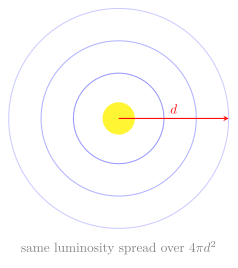
图 1 展示 inverse-square dilution;球壳不代表光被介质吸收。
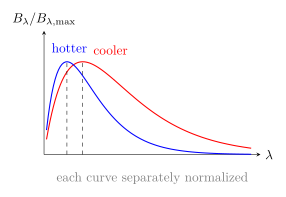
图 2 的每条 Planck curve 分别归一到自身峰值,只显示 hotter spectrum 的峰位向短波移动;总通量增大由 \(F=\sigma T^4\) 给出,本图不能用于比较曲线面积。
2. Spectral classification / 光谱分类
Knowledge ID: P12-U03-L01-K02
现代 sequence 从热到冷为 O–B–A–F–G–K–M,并细分 0–9;luminosity classes I–V 主要反映 surface gravity 与 line morphology。吸收线强弱不只由元素丰度决定,还由 Boltzmann excitation、Saha ionization、opacity 与 pressure broadening 决定。例如 H Balmer lines 在约 \(10^4\,\mathrm K\) 附近最强:更热时 H 多被电离,更冷时 \(n=2\) 布居不足。
因此谱型分类是 atmosphere state 的经验坐标。要测 abundance,必须用 atmosphere model 同时拟合 \(T_{\rm eff},\log g\), microturbulence 与 line blending。
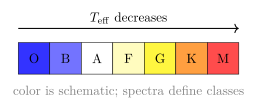
图 3 给出 temperature order;真实感知颜色受响应函数和 extinction 影响。
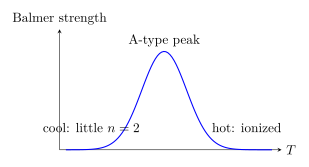
图 4 说明同样富含氢的恒星也可有很弱 Balmer lines。
3. Hertzsprung–Russell diagram / 赫罗图
Knowledge ID: P12-U03-L01-K03
H–R diagram 以 luminosity(或 absolute magnitude)对 \(T_{\rm eff}\)/spectral type 作图。Main sequence 从左上到右下,是核心氢燃烧恒星的质量序列;右上 giants/supergiants 低温却高 luminosity,必须半径巨大;左下 white dwarfs 高温却低 luminosity,半径很小。
由 Stefan–Boltzmann law,constant-radius lines 满足 \(L\propto T^4\)。H–R diagram 是状态空间,不是单颗恒星必沿 main sequence 从右下走到左上;演化 track 依初始质量、composition、mass loss 与 binarity。
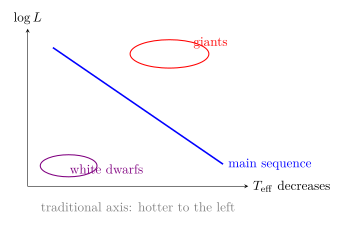
图 5 是 H–R topology,不表示人口比例或精确边界。
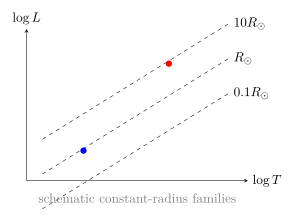
图 6 用 \(L\propto R^2T^4\) 读半径;实际 H–R 横轴常向右变冷,作图前需检查定义。
4. Binary stars and stellar-mass measurement / 双星与恒星质量测量
Knowledge ID: P12-U03-L01-K04
Visual binary 给 angular orbit,加 distance 得 physical relative semimajor axis;用 Newton–Kepler relation
\[M_1+M_2=\frac{4\pi^2a^3}{GP^2}.\]
Spectroscopic double-lined binary 给 velocity amplitudes \(K_1,K_2\),动量关系给 \(M_1K_1=M_2K_2\)(同一 \(i,e\));eclipses 可约束 \(i\) 与相对半径。只有联合 light curve、RV 与 atmosphere model,才能同时得到 individual masses/radii。Unresolved optical double 不一定 gravitationally bound。
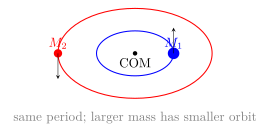
图 7 显示两星围共同质心,第三定律使用相对轨道 \(a=a_1+a_2\)。
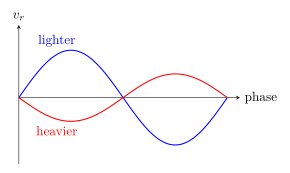
图 8 的反相 RV curves 给 mass ratio;较大 velocity amplitude 对应较小质量。
5. Metallicity and stellar populations / 金属丰度与恒星族
Knowledge ID: P12-U03-L01-K05
常用 logarithmic abundance 定义
\[[\mathrm{Fe/H}]=\log_{10}\left(\frac{N_{\rm Fe}}{N_{\rm H}}\right)_* -\log_{10}\left(\frac{N_{\rm Fe}}{N_{\rm H}}\right)_\odot.\]
\([\mathrm{Fe/H}]=-1\) 表示 Fe/H 为太阳的 \(0.1\),不是“少 1%”。总 metallicity \(Z\)、alpha enhancement \([\alpha/\mathrm{Fe}]\) 与 Fe/H 不等价。Population I/II 是历史性 shorthand:disk 中较年轻、metal-rich 与 halo/globular-cluster 中较老、metal-poor 是统计趋势,不能只凭一个指标给单星绝对年龄。Age–metallicity–kinematics–selection 存在重叠。
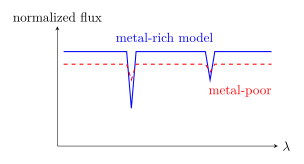
图 9 示意相同 \(T,\log g\) 下 line strength 对 abundance 的响应;真实分析需 line-by-line radiative transfer。
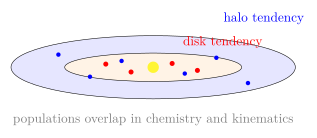
图 10 是统计族群而非两类互斥盒子。
Worked examples / 完整例题
Worked Example 1 — 由半径和温度求 luminosity
已知: \(R=2.00R_\odot\),\(T_{\rm eff}=6000\,\mathrm K\),\(T_\odot=5772\,\mathrm K\)。系统边界: photosphere,总 bolometric output;假设 spherical effective radiator。
\[\frac{L}{L_\odot}=\left(\frac{R}{R_\odot}\right)^2 \left(\frac{T}{T_\odot}\right)^4 =4(6000/5772)^4=4.66.\]
三位有效数字。无量纲比值正确;半径加倍即使温度接近太阳也应约四倍亮,结果合理。若只有单一 band flux,需 bolometric correction 和 extinction。
Worked Example 2 — 由 H–R 位置求半径
已知: \(L=100L_\odot\),\(T=5000\,\mathrm K\)。模型: effective-temperature definition;与太阳比较。
\[\frac{R}{R_\odot}=\left(\frac{L}{L_\odot}\right)^{1/2} \left(\frac{T_\odot}{T}\right)^2 =10(5772/5000)^2=13.3.\]
所以 \(R=13.3R_\odot\),符合“cool but luminous → giant radius”。温度和 luminosity 不确定度都应传播,尤其 \(R\propto T^{-2}\)。
Worked Example 3 — Visual binary 总质量
已知: relative semimajor axis \(a=4.00\,\mathrm{AU}\),period \(P=5.00\,\mathrm{yr}\)。系统/参考系: bound two-body barycentric orbit,\(a\) 已由 angular orbit 和 distance 去投影。采用 solar units 的 Kepler relation:
\[\frac{M_1+M_2}{M_\odot}=\frac{(a/\mathrm{AU})^3}{(P/\mathrm{yr})^2} =\frac{4.00^3}{5.00^2}=2.56.\]
总质量 \(2.56M_\odot\)。半长轴增大使所需质量增大,周期增长使质量减小,趋势正确。若把单星绕质心的 \(a_1\) 误作 relative \(a\),会系统低估质量。
Worked Example 4 — 读 logarithmic metallicity
已知: \([\mathrm{Fe/H}]=-0.50\)。约定: number ratio 相对太阳,不将其等同总 \(Z\)。
\[\frac{(N_{\rm Fe}/N_{\rm H})_*}{(N_{\rm Fe}/N_{\rm H})_\odot}=10^{-0.50}=0.316.\]
即 Fe/H 是太阳的 \(31.6\%\),不是“少 \(0.5\%\)”。logarithm argument 无量纲。该值不能单独给年龄;还需 alpha abundance、kinematics、isochrone/asteroseismology 等。
Lesson synthesis / 本课综合
观测链是:calibrated flux + distance → \(L\);spectrum/colors → \(T_{\rm eff}\)、\(\log g\)、abundances;\(L+T\) → \(R\);binary dynamics → \(M\);把这些量放入 H–R/abundance/kinematic space,再与 evolution models 比较。分类的价值是压缩数据,不是把自然界切成无重叠标签。
Formula-and-decision table
| Goal | Relation | Conditions | Key systematic |
|---|---|---|---|
| luminosity | \(L=4\pi d^2F_{\rm bol}\) | isotropic, extinction corrected | parallax, bolometric correction |
| effective radius | \(L=4\pi R^2\sigma T^4\) | definition of \(T_{\rm eff}\) | atmosphere model |
| binary total mass | \(M_{\rm tot}=4\pi^2a^3/(GP^2)\) | bound Kepler orbit | inclination/distance |
| mass ratio | \(M_1K_1=M_2K_2\) | double-lined same orbit | line blending |
| iron abundance | \([\mathrm{Fe/H}]\) | logarithmic number ratio | NLTE/3D atmosphere |
Model boundaries / 模型边界
- Stars are not perfect blackbodies; \(T_{\rm eff}\) is a flux-equivalent definition.
- Spectral class alone does not uniquely give composition, mass or age.
- H–R positions overlap across different mass/metallicity/evolutionary states.
- Binary mass inference needs the physical orbit; angular separation alone is insufficient.
- Flux-limited samples overrepresent luminous stars; population fractions require selection correction.
Misconception clinic / 误区诊所
- “最亮的星离我们最近。” Apparent flux mixes luminosity and distance。
- “氢线弱说明氢少。” excitation/ionization 可使富氢 atmosphere 的 Balmer lines 弱。
- “H–R 横轴向右更热。” 传统画法恰好相反。
- “双星两颗都绕较大那颗。” 二者均绕共同质心。
- “metal-poor 就能精确断龄。” age–chemistry–kinematics 有散布和退化。
Practice and retrieval / 练习与检索
- [K01] 同 \(T\) 而 \(R=3R_\odot\),求 \(L/L_\odot\)。
- [K01] 同 \(L\) 而 \(T\) 加倍,\(R\) 变多少?
- [K02] 为什么 Balmer lines 在极热 O stars 中可变弱?
- [K02] Luminosity class V 通常表示什么?
- [K03] cool yet luminous 的星在 H–R 哪一区、半径怎样?
- [K03] hot yet faint 的星常是哪一类?
- [K04] \(a=2\,\mathrm{AU},P=2\,\mathrm{yr}\),求总质量。
- [K04] 若 \(K_1=30,K_2=60\,\mathrm{km\,s^{-1}}\),求 \(M_1/M_2\)。
- [K05] \([\mathrm{Fe/H}]=-2\) 是太阳 Fe/H 的多少?
- [综合] 写出从 apparent flux 到 stellar mass 的最少观测链,并指出不能单星直接完成的环节。
Answer 1
\(L/L_\odot=(3)^2=9\)。
Answer 2
\(R\propto T^{-2}\),变为 \(1/4\)。
Answer 3
高温使大量 H ionized,没有 bound electron 产生 Balmer absorption。
Answer 4
主序/矮星(dwarf),但仍需 temperature subclass。
Answer 5
右上 giant/supergiant 区;由 \(L\propto R^2T^4\) 知半径大。
Answer 6
White dwarf,位于左下。
Answer 7
\((M_1+M_2)/M_\odot=2^3/2^2=2.0\)。
Answer 8
\(M_1/M_2=K_2/K_1=2.0\);速度幅较小者质量较大。
Answer 9
\(10^{-2}=0.01\),即太阳的 \(1\%\)。
Answer 10
Flux+parallax+extinction 得 \(L\);spectrum 得 \(T\);\(L,T\) 得 \(R\);质量需要 binary orbit(或依赖模型的 asteroseismology/isochrone),单独孤星不能纯动力学称量。
Exit ticket / 离堂检验
给定一颗“G2 V、\([\mathrm{Fe/H}]=-0.3\)、apparent magnitude 6”的星,列出能立即判断、必须测 parallax、必须要 binary/evolution model 才能判断的量各两项。
References and source notes / 参考资料与来源说明
本课所有 TikZ 均依据正文方程原创绘制,未复制来源插图;来源文字经重组表述。
- OpenStax Astronomy 2e, 17.3 The Spectra of Stars — spectral sequence、Balmer line temperature dependence;核对 2026-08-30。
- OpenStax Astronomy 2e, 17.4 Using Spectra — abundance、motion 与 atmosphere inference;核对 2026-08-30。
- OpenStax Astronomy, 18.2 Measuring Stellar Masses — binary mass measurement;核对 2026-08-30。
- OpenStax Astronomy, 18.4 The H–R Diagram — diagram topology、radius 与 selection;核对 2026-08-30。
- NASA Science, Types of Stars — main sequence 与 evolutionary categories;核对 2026-08-30。
Source-to-content map
| Source | Used for | Knowledge ID / Section | Model boundary or convention |
|---|---|---|---|
| OpenStax 17.3 | spectral classification | K02 | temperature controls line strengths |
| OpenStax 17.4 | \(T,R\), abundance, velocity | K01, K05 | atmosphere-model dependence |
| OpenStax 18.2 | binary dynamics | K04 | physical relative orbit required |
| OpenStax 18.4 | H–R diagram | K03 | sample selection noted |
| NASA Types | broad stellar categories | K03 | teaching overview, not exact mass boundaries |
复习与拓展
- 用 Gaia-like parallax covariance 比较 flux-limited 与 volume-limited H–R diagrams。
- 下一课 Stellar Structure 将用 \(M,R,L\) 作为边界数据建立内部方程。
- Stellar Formation and Evolution 将把 H–R 位置变成 time-dependent tracks。