
Learning objectives / 学习目标
- 写出并解释球对称行星的 hydrostatic 与 mass-continuity equations;
- 建立 accretion、differentiation、radioactivity、secular cooling 与 tidal heating 的能量账本;
- 计算 scale height、escape parameter 与 equilibrium temperature,区分 greenhouse 与 albedo;
- 用 pressure balance 估算 magnetopause,解释磁层既能重定向粒子也可能开启逃逸通道;
- 把 reflectance、thermal emission、radar、gravity、topography 视为带退化和空间分辨率限制的反演数据。
Prerequisites / 先修知识
Scope and conventions / 范围与约定
- \(r\) 从中心向外;\(m(r)\) 是半径 \(r\) 内质量,\(P(R)\) 取近似表面压力。
- 固体行星也能在地质时间尺度呈现黏弹/流变响应;“hydrostatic”不等于“气体”。
- 单层 grey greenhouse、isothermal atmosphere、dipole field 均为基准模型,不替代辐射传输、化学和 MHD。
- 遥感颜色代表特定 band 与处理流程,不自动等于人眼颜色或唯一矿物组成。
Notation and modeling contract / 符号与建模契约
| Symbol | Meaning | SI |
|---|---|---|
| \(r,R,m(r),M\) | radius, planetary radius, enclosed and total mass | m, kg |
| \(P,\rho,g\) | pressure, density, gravity | Pa, kg m\(^{-3}\), m s\(^{-2}\) |
| \(F_{\rm int},L_{\rm int}\) | internal heat flux and luminosity | W m\(^{-2}\), W |
| \(A_B,T_{\rm eq}\) | Bond albedo, equilibrium temperature | 1, K |
| \(H,\mu\) | scale height, molecular weight in atomic mass units | m, 1 |
| \(v_{\rm esc},\lambda_J\) | escape speed, Jeans parameter | m s\(^{-1}\), 1 |
| \(P_{\rm sw},B\) | solar-wind dynamic pressure, magnetic field | Pa, T |
1. Hydrostatic structure and differentiation / 流体静力结构与分异
Knowledge ID: P12-U02-L02-K01
球对称、缓慢演化的基准结构由
\[\frac{dP}{dr}=-\rho(r)\frac{Gm(r)}{r^2}, \qquad \frac{dm}{dr}=4\pi r^2\rho(r)\]
与 equation of state \(P=P(\rho,T,X_i)\) 闭合。边界条件通常是 \(m(0)=0\) 与给定表面压力。观测的 \(M,R\) 只给平均密度;gravity harmonics、moment of inertia、seismology 与 tidal Love numbers 才逐步约束径向结构。
早期 accretion、短寿命放射性核素和 giant impacts 可使天体部分熔融。密度大的金属下沉、低密度硅酸盐/冰上浮,释放 gravitational potential energy,形成 differentiation。它需要足够温度与可流动性,不是所有小天体都完全分异。
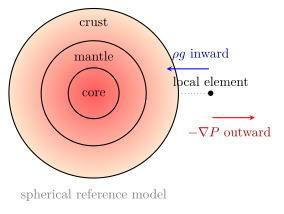
图 1 把 hydrostatic balance 画为每个壳层上的局部平衡,而不是表面两支力。
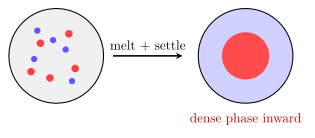
图 2 显示分异需要 material mobility;颜色只表示相对密度,不指定成分。
2. Heat sources and geologic activity / 热源与地质活动
Knowledge ID: P12-U02-L02-K02
内部能量账本可写成
\[L_{\rm int}=L_{\rm sec}+L_{\rm rad}+L_{\rm diff}+L_{\rm tide}+L_{\rm latent},\]
分别代表 secular cooling、radioactive decay、ongoing differentiation/contraction、tidal dissipation 和 phase-change latent heat。体积产热随 \(R^3\),表面积散热随 \(R^2\),因此大天体通常热惯性更强,但 composition、water、lid rheology 与 tides 可打破单纯尺寸排序。
传导通量 \(\mathbf q=-k\nabla T\);当温度梯度足够陡且材料可流动时 convection 更有效。火山、tectonics、cryovolcanism 是热和物质输运的表面表现,不必等同于地球式 plate tectonics。
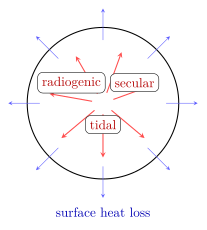
图 3 是热账本:内部多源产热最终必须通过表面散失或改变储能。
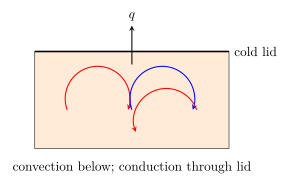
图 4 区分内部 convection 与边界层 conduction;两者可串联限制总热流。
3. Atmosphere retention, greenhouse effect, and escape / 大气保留、温室效应与逃逸
Knowledge ID: P12-U02-L02-K03
等温、薄层、常 \(g\) 大气的 pressure scale height 是
\[H=\frac{k_BT}{\mu m_u g}.\]
无温室、均匀再分配的 equilibrium temperature 基准为
\[T_{\rm eq}=\left[\frac{(1-A_B)L_*}{16\pi\sigma a^2}\right]^{1/4}.\]
Greenhouse effect 是大气对 outgoing infrared 的 optical depth 改变 surface–space temperature relation;它不是简单“把热关住”,也不能从 CO\(_2\) 存在单独确定强度。Retention 由 gravity、temperature、composition、stellar EUV、impact erosion、outgassing 与 chemistry 共同决定。Jeans parameter
\[\lambda_J=\frac{GM_pm}{k_BT r}=\frac{mv_{\rm esc}^2}{2k_BT}\]
衡量热速度尾部与束缚能;小 \(\lambda_J\) 有利于热逃逸,但 hydrodynamic 与 non-thermal escape 需要更完整模型。
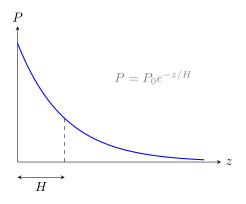
图 5 的指数律只适用于等温、常重力近似;高层大气 \(T\) 与组成会变。
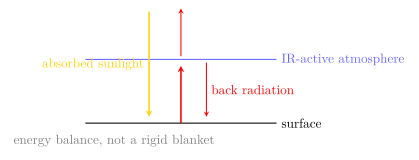
图 6 用通量而非“困住热量”表述 greenhouse:顶层入射与出射最终仍平衡。
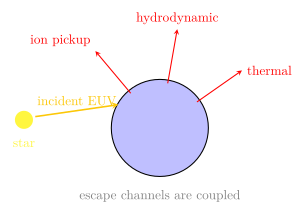
图 7 区分 thermal、energy-limited/hydrodynamic 与 ion pickup 等通道。
4. Magnetospheres and solar-wind interaction / 磁层与太阳风相互作用
Knowledge ID: P12-U02-L02-K04
行星内部 dynamo 通常需要 electrically conducting fluid、可用能量与合适流动/rotation。Solar wind 遇到 intrinsic field 时形成 bow shock、magnetopause、tail 与可能的 radiation belts。次恒星点的数量级可由磁压与动态压平衡:
\[\frac{B^2(R_s)}{2\mu_0}\sim P_{\rm sw}, \qquad B(R_s)\sim B_0\left(\frac{R_p}{R_s}\right)^3.\]
于是 \(R_s/R_p\) 只按压力的 \(-1/6\) 次方变化。磁层会偏转部分带电流,却也通过 reconnection、cusp 与 polar outflow 耦合能量;“有磁场必然完全保护大气”不是普适结论。
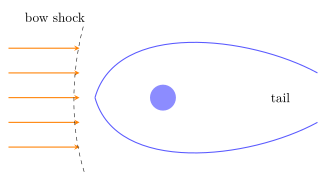
图 8 是日侧压缩、夜侧拉长的 magnetosphere;不按比例。
5. Surface processes and remote sensing / 表面过程与遥感
Knowledge ID: P12-U02-L02-K05
表面记录 impact cratering、volcanism、tectonism、erosion/deposition、space weathering 与 volatile transport。Crater density 可给 relative age,但 absolute chronology 依赖 impactor flux calibration 与 resurfacing history。
遥感把 radiance 映射为 composition、grain size、temperature、roughness 或 elevation。反射谱常用相对带深和连续谱;热红外由 Planck emission 与 emissivity 共同决定;radar 同时受 dielectric constant、roughness 与 incidence angle 影响。反演应写为 \(\mathbf d=\mathbf F(\boldsymbol\theta)+\mathbf n\) 并报告 posterior/degeneracy,而不是逐像素贴唯一物质标签。
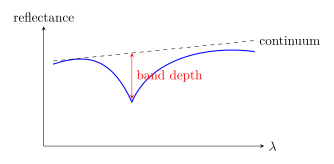
图 9 的 absorption band 可约束矿物/冰,但 grain size 与混合方式会改变深度。
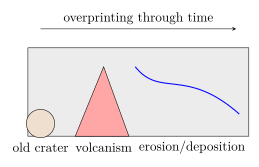
图 10 表示 surface chronology 的叠加:年轻过程可擦除更老记录。
Worked examples / 完整例题
Worked Example 1 — 均匀密度行星的中心压力
已知: \(M=6.00\times10^{24}\,\mathrm{kg}\),\(R=6.40\times10^6\,\mathrm m\)。系统/坐标: 球对称、不可压缩行星,\(r\) 向外;\(P(R)=0\)。模型理由: 估算自引力压力尺度。积分 hydrostatic equation 得
\[P_c=\frac{3GM^2}{8\pi R^4}=1.71\times10^{11}\,\mathrm{Pa}.\]
量纲为 \(GM^2/R^4=\mathrm{kg\,m^{-1}s^{-2}}=\mathrm{Pa}\)。压力为正且向中心增加。真实可压缩且分层的类地行星中心压力不同,因此此值是基准而非精密地球模型。
Worked Example 2 — 内部储能冷却时间
已知: 可释放热储量 \(E=1.0\times10^{30}\,\mathrm J\),内部 luminosity \(L=5.0\times10^{13}\,\mathrm W\)。系统边界: 整颗行星;假设 \(L\) 恒定且无新热源。
\[t=\frac{E}{L}=2.0\times10^{16}\,\mathrm s=6.3\times10^8\,\mathrm{yr}.\]
两位有效数字。能量/功率给时间,量纲正确。真实 \(L\) 会随温度和 rheology 变化,radioactivity/tides 也补充能量,故不是年龄预测。
Worked Example 3 — 大气 scale height
已知: \(T=250\,\mathrm K\),\(\mu=29.0\),\(g=9.80\,\mathrm{m\,s^{-2}}\)。模型: 等温、理想气体、常 \(g\),\(z\) 向上。
\[H=\frac{(1.380649\times10^{-23})(250)}{(29.0)(1.66054\times10^{-27})(9.80)} =7.32\times10^3\,\mathrm m.\]
\(H=7.32\,\mathrm{km}\)。分子越重或重力越强,\(H\) 越小;温度升高使 \(H\) 增大,极限趋势合理。高层非等温和 dissociation 会破坏该单一尺度。
Worked Example 4 — 磁层顶 stand-off distance
已知: 表面赤道场 \(B_0=3.0\times10^{-5}\,\mathrm T\),\(P_{\rm sw}=2.0\,\mathrm{nPa}\);忽略几何修正。系统: 行星偶极场与稳态太阳风,恒星方向为日侧。
\[\frac{R_s}{R_p}=\left(\frac{B_0^2}{2\mu_0P_{\rm sw}}\right)^{1/6} =\left(1.79\times10^5\right)^{1/6}=7.5.\]
因此 \(R_s\approx7.5R_p\)(两位有效数字)。括号内无量纲;压力增大应压缩磁层,公式的 \(P_{\rm sw}^{-1/6}\) 符合方向。真实值受 dipole orientation、currents 与 reconnection 影响。
Lesson synthesis / 本课综合
建模顺序是:用 \(M,R,J_n,k_2\) 约束 bulk/interior → 建热源与散热账本预测地质活动 → 用 irradiation、composition、gravity 计算大气结构与逃逸 → 用 dynamo 与 solar wind 判断 plasma interaction → 把表面与光谱数据通过带噪 forward model 反演。每一层都向下一层提供边界条件,也会被上一层观测退化限制。
Formula-and-decision table
| Task | Relation | Conditions | Warning |
|---|---|---|---|
| radial structure | \(dP/dr=-\rho Gm/r^2\) | spherical, quasi-static | needs EOS |
| heat transport | \(\mathbf q=-k\nabla T\) | conduction | \(k\) may vary |
| atmosphere thickness | \(H=kT/(\mu m_ug)\) | isothermal ideal gas | not exosphere |
| irradiation baseline | \(T_{\rm eq}\) | specified albedo/redistribution | not surface \(T\) with greenhouse |
| thermal retention | \(\lambda_J=mv_{\rm esc}^2/(2kT)\) | Jeans framework | nonthermal escape omitted |
| magnetopause scale | magnetic pressure \(\sim P_{\rm sw}\) | dipole, steady wind | geometry factors omitted |
Model boundaries / 模型边界
- Hydrostatic equations do not determine composition without EOS and extra observables.
- Surface-age crater chronology is model-calibrated, especially uncertain away from the Moon.
- Grey equilibrium temperature omits wavelength-dependent albedo, clouds, circulation and internal heat.
- A magnetic field changes escape pathways; it is neither a perfect shield nor necessarily irrelevant.
- Spectral band matching is not unique mineral identification without laboratory and photometric context.
Misconception clinic / 误区诊所
- “平均密度直接给核心大小。” 不同 EOS 与 envelope 可产生同一 \(M,R\)。
- “小天体必然死寂。” tidal heating 可维持 Io、Enceladus 类活动。
- “温室效应违反能量守恒。” 顶层长期入射与出射仍平衡,改变的是温度剖面。
- “磁场一定阻止大气逃逸。” reconnection/cusp/polar flow 可输运能量和粒子。
- “假彩色图就是肉眼颜色。” 它是 band mapping 与处理选择。
Practice and retrieval / 练习与检索
- [K01] 写出球对称结构的两条基本微分方程及中心边界条件。
- [K01] 同质量而半径减半,均匀模型 \(P_c\) 变几倍?
- [K02] \(E=3.0\times10^{29}\,\mathrm J\)、\(L=1.0\times10^{13}\,\mathrm W\),求冷却时间。
- [K02] 为什么体积/面积 scaling 只是一阶趋势?
- [K03] \(T\) 加倍、其余不变时 \(H\) 如何变?
- [K03] \(A_B\) 增大时 \(T_{\rm eq}\) 怎样变化?
- [K03] 列出一种 thermal 与一种 non-thermal escape。
- [K04] 太阳风动态压增大 64 倍,dipole stand-off ratio 变为多少倍?
- [K05] 为什么单个 absorption band 不能唯一指定矿物?
- [综合] 为一颗无全球磁场但有厚大气的行星写出两种相容解释。
Answer 1
\(dP/dr=-\rho Gm/r^2\)、\(dm/dr=4\pi r^2\rho\);\(m(0)=0\),并给表面压力或半径边界。
Answer 2
\(P_c\propto R^{-4}\),变为 \(16\) 倍。
Answer 3
\(t=3.0\times10^{16}\,\mathrm s=9.5\times10^8\,\mathrm{yr}\)。
Answer 4
Composition、radioactivity、water、lid rheology、tides 与 atmosphere 均改变输运。
Answer 5
\(H\propto T\),加倍。
Answer 6
\(T_{\rm eq}\propto(1-A_B)^{1/4}\),随 \(A_B\) 增大而下降。
Answer 7
Thermal:Jeans 或 hydrodynamic;non-thermal:ion pickup、sputtering 等。
Answer 8
\(R_s\propto P^{-1/6}\),变为 \(64^{-1/6}=1/2\)。
Answer 9
Grain size、temperature、mixture、viewing geometry 和 continuum 都可改变 band。
Answer 10
高重力/低 EUV 可保留大气;持续 outgassing 可补偿逃逸。磁场不是保留的唯一控制量。
Exit ticket / 离堂检验
观测者只给一颗行星的 \(M,R\) 和一条红外光谱。列出三个可推断量、三个不能唯一推断量,并为每个不能唯一推断量指出所需新增观测。
References and source notes / 参考资料与来源说明
本课所有 TikZ 均依据正文方程原创绘制,未复制来源插图;来源文字经重组表述。
- OpenStax Astronomy 2e, 7.2 Composition and Structure of Planets — 组成、尺寸、温室与地质活动;核对 2026-08-30。
- OpenStax Astronomy 2e, 14.5 Planetary Evolution — 热源、演化与表面活动;核对 2026-08-30。
- NASA Science, Magnetospheres — solar-wind coupling 与磁层定义;核对 2026-08-30。
- NASA NTRS, Role of a Planetary Magnetic Field — 磁场和 atmospheric escape 的模型边界;核对 2026-08-30。
- OpenStax Astronomy 2e, 8.3 Earth’s Atmosphere — hydrostatic atmosphere、来源与逃逸背景;核对 2026-08-30。
- MNRAS, A validated planetary interior structure model — mass continuity、hydrostatic equilibrium、thermal transport 与 EOS closure;核对 2026-08-30。
- Gronoff et al., Atmospheric Escape Processes and Planetary Atmospheric Evolution — scale height、Jeans parameter、EUV-driven hydrodynamic 与 non-thermal escape;核对 2026-08-30。
- NASA Exoplanet Archive, Calculated Composite Parameters — equilibrium-temperature 的 blackbody/redistribution convention;核对 2026-08-30。
- Bagenal, Planetary Magnetospheres — dipole magnetic-pressure balance 与 \(R_s\propto P_{\rm sw}^{-1/6}\);核对 2026-08-30。
- Rengel et al., Radiative transfer and inversion codes for characterizing planetary atmospheres — forward model、ill-conditioned retrieval 与 validation;核对 2026-08-30。
Source-to-content map
| Source | Used for | Knowledge ID / Section | Model boundary or convention |
|---|---|---|---|
| OpenStax 7.2 | planetary classes, greenhouse, geology | K01–K03 | comparative overview |
| OpenStax 14.5 | heat and divergent evolution | K02, K05 | qualitative scaling |
| NASA Magnetospheres | field–wind system | K04 | dynamic coupled system |
| NASA NTRS report | escape and magnetization | K03–K04 | rejects perfect-shield simplification |
| OpenStax 8.3 | atmosphere pressure and loss | K03 | Earth used as one case |
| MNRAS interior model | structure ODEs and EOS closure | K01 | spherical hydrostatic layered model |
| Gronoff et al. 2020 | scale height, Jeans parameter and escape regimes | K03 | evaluate Jeans escape near the exobase; regimes couple |
| NASA Exoplanet Archive | equilibrium-temperature baseline | K03 | blackbody and stated heat redistribution, not surface climate |
| Bagenal 2013 | magnetopause pressure balance | K04, Worked Example 4 | dipole/low-plasma-pressure scaling; order-unity factor omitted here |
| Rengel et al. 2023 | forward modelling and inverse retrieval | K05 | ill-posed inference requires priors and validation |
复习与拓展
- 用多层 EOS 对同一 \(M,R\) 构造 composition-degenerate models。
- Exoplanets 将把这些反演方法用于不可空间分辨的世界。
- 与 Single-Particle Motion 的磁化粒子运动接口。