
Learning objectives / 学习目标
- 从各质点动能之和推导 \(K_{\rm rot}=\tfrac12I\omega^2\),说明 \(I\) 与轴的选择。
- 推导 \(dW=\tau_zd\theta\)、\(P=\boldsymbol\tau\cdot\boldsymbol\omega\) 并识别其适用条件。
- 使用 König 分解 \(K=\tfrac12Mv_{\rm CM}^2+K_{\rm rel}\),处理平动与转动组合。
- 同时用受力—力矩方程和能量方程求解斜面纯滚,并检查静摩擦限制。
- 区分静止地面纯滚、移动表面、滑滚与滚动阻力中的功和耗散。
Prerequisites / 先修知识
0. Energy ledger and notation / 能量账本与记号
| Symbol | Meaning | SI unit |
|---|---|---|
| \(K_{\rm rot}\) | rotational kinetic energy about chosen axis | J |
| \(K_{\rm CM}\) | translational kinetic energy of center of mass | J |
| \(W_\tau\) | work of torque in fixed-axis rotation | J |
| \(P\) | instantaneous power | W |
| \(I_{\rm CM}=\beta MR^2\) | shape factor representation | \(\mathrm{kg\,m^2}\) |
| \(f_s\) | static friction, signed along surface | N |
Knowledge 1 — Rotational kinetic energy / 转动动能
Knowledge ID: P01-U05-L03-K01
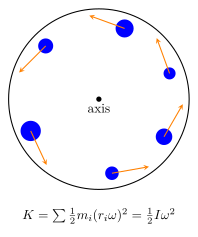
刚体绕固定轴以角速度 \(\omega\) 转动,第 \(i\) 个质点速度为 \(v_i=r_{\perp i}\omega\),所以
\[K=\sum_i\frac12m_iv_i^2 =\frac12\left(\sum_i m_ir_{\perp i}^2\right)\omega^2.\]
因此
\[\boxed{K_{\rm rot}=\frac12I\omega^2}.\]
这是动能的重写,不是额外的一种能量。\(I\) 与 \(\omega\) 必须关于同一轴;三维一般式是 \(K=\tfrac12\boldsymbol\omega\cdot\mathbf I\boldsymbol\omega\)。
Worked Example 1 — 飞轮可用动能
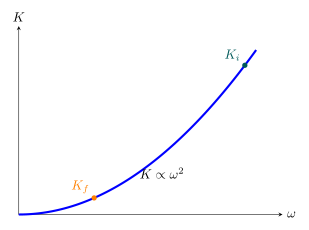
均匀实心飞轮质量 \(M=80.0\ \mathrm{kg}\)、半径 \(R=0.400\ \mathrm m\),转速从 \(600\ \mathrm{rpm}\) 降至 \(200\ \mathrm{rpm}\)。忽略轴平动,求释放的动能。
\[I=\frac12MR^2=6.40\ \mathrm{kg\,m^2},\]
\[\omega_i=600\frac{2\pi}{60}=20\pi\ \mathrm{rad\,s^{-1}}, \qquad \omega_f=\frac{20\pi}{3}\ \mathrm{rad\,s^{-1}}.\]
\[E_{\rm out}=K_i-K_f =\frac12I(\omega_i^2-\omega_f^2) =\boxed{1.12\times10^4\ \mathrm J}.\]
结果为正,表示系统对外最多释放约 \(11.2\ \mathrm{kJ}\)(若无其他损失)。由于能量随 \(\omega^2\) 而非 \(\omega\) 变化,转速降为三分之一时仍剩初动能的九分之一。
Knowledge 2 — Work and power in rotation / 转动中的功与功率
Knowledge ID: P01-U05-L03-K02
固定轴转动中,作用点的微位移为 \(d\mathbf r=d\boldsymbol\theta\times\mathbf r\),因而
\[dW=\mathbf F\cdot d\mathbf r =(\mathbf r\times\mathbf F)\cdot d\boldsymbol\theta =\boldsymbol\tau\cdot d\boldsymbol\theta.\]
固定轴标量形式为
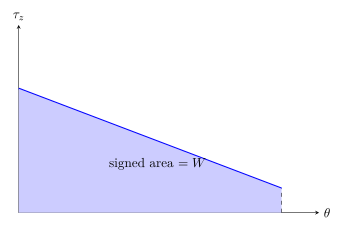
\[\boxed{W=\int_{\theta_i}^{\theta_f}\tau_z(\theta)\,d\theta}, \qquad \boxed{P=\frac{dW}{dt}=\boldsymbol\tau\cdot\boldsymbol\omega}.\]
净力矩功满足
\[W_{\rm net}=\Delta K_{\rm rot}\]
但只有在同一个系统和轴下才可直接使用。
Worked Example 2 — 角度依赖的力矩
某转轴上作用 \(\tau(\theta)=12.0-2.00\theta\)(\(\mathrm{N\,m}\),\(\theta\) 以 rad 计),物体由 \(\theta=0\) 转到 \(4.00\ \mathrm{rad}\)。初始静止,\(I=4.00\ \mathrm{kg\,m^2}\)。求功与末角速度。
\[W=\int_0^4(12-2\theta)d\theta =\left[12\theta-\theta^2\right]_0^4 =32.0\ \mathrm J.\]
\[W=\Delta K=\frac12I\omega_f^2 \quad\Rightarrow\quad \omega_f=\sqrt{\frac{2W}{I}} =\boxed{4.00\ \mathrm{rad\,s^{-1}}}.\]
在区间内 \(\tau\ge4\ \mathrm{N\,m}>0\),故动能应增加;符号检查一致。
2.1 Motor power and units
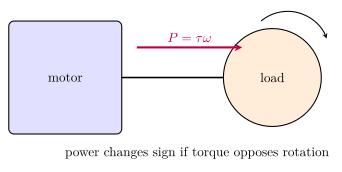
若电机在角速度 \(\omega\) 下提供同向轴力矩 \(\tau\),机械输出功率为 \(P=\tau\omega\)。例如 \(\tau=150\ \mathrm{N\,m}\)、\(1200\ \mathrm{rpm}\):
\[P=150\left(1200\frac{2\pi}{60}\right) =18.8\ \mathrm{kW}.\]
不能直接把 rpm 代入 SI 公式。
Knowledge 3 — Combined translation and rotation / 平动与转动的组合
Knowledge ID: P01-U05-L03-K03
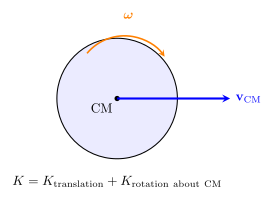
对任意质点系,写 \(\mathbf v_i=\mathbf v_{\rm CM}+\mathbf v_i'\)。由于 \(\sum m_i\mathbf v_i'=0\),总动能分解为
\[\boxed{K=\frac12Mv_{\rm CM}^2+\sum_i\frac12m_i\lvert\mathbf v_i'\rvert^2}.\]
对刚体,质心系内是绕 CM 的转动,因此
\[\boxed{K=\frac12Mv_{\rm CM}^2+\frac12I_{\rm CM}\omega^2}.\]
这称为 König 分解。第二项必须用过质心的轴;若直接用瞬时接触点轴,需要确保该点在惯性系中瞬时静止,并正确使用平行轴定理。
Worked Example 3 — 同速滚动的环与盘
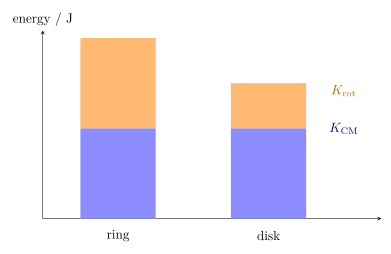
质量均为 \(M=3.00\ \mathrm{kg}\)、半径均为 \(R=0.200\ \mathrm m\) 的薄环与实心盘,都以 \(v_{\rm CM}=4.00\ \mathrm{m\,s^{-1}}\) 纯滚。求各自动能。
纯滚给出 \(\omega=v/R\)。令 \(I=\beta MR^2\),则
\[K=\frac12Mv^2+\frac12\beta MR^2\frac{v^2}{R^2} =\frac12Mv^2(1+\beta).\]
薄环 \(\beta=1\):
\[K_{\rm ring}=Mv^2=\boxed{48.0\ \mathrm J}.\]
实心盘 \(\beta=1/2\):
\[K_{\rm disk}=\frac34Mv^2=\boxed{36.0\ \mathrm J}.\]
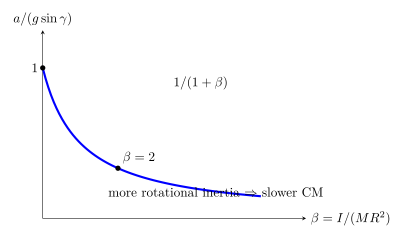
同样的质心速度并不意味着同样的总动能;环的质量更远离轴,转动能份额更大。
Knowledge 4 — Energy and force analysis of rolling / 滚动物体的能量与受力分析
Knowledge ID: P01-U05-L03-K04
4.1 Rolling down an incline
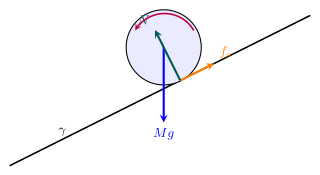
刚体在倾角 \(\gamma\) 的斜面上无滑下滚。取沿斜面向下为正:
\[Mg\sin\gamma-f_s=Ma,\]
\[f_sR=I_{\rm CM}\alpha, \qquad a=R\alpha.\]
令 \(I_{\rm CM}=\beta MR^2\),解得
\[\boxed{a=\frac{g\sin\gamma}{1+\beta}}, \qquad \boxed{f_s=\frac{\beta}{1+\beta}Mg\sin\gamma}.\]
此情形中静摩擦沿斜面向上,提供绕 CM 的转矩;但方向必须由方程或潜在滑动趋势判断,不能泛化。
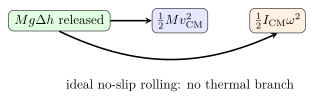
从能量也可得到速度。若自静止下降高度 \(h\),且接触点对静止斜面的速度为零,则理想静摩擦的瞬时功率为
\[P_f=\mathbf f_s\cdot\mathbf v_C=0.\]
于是
\[Mgh=\frac12Mv^2+\frac12I_{\rm CM}\frac{v^2}{R^2},\]
\[\boxed{v=\sqrt{\frac{2gh}{1+\beta}}}.\]
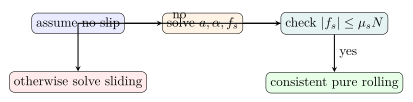
能量法不给出 \(f_s\);必须再用动力学检查 \(\lvert f_s\rvert\le\mu_sN\)。若不满足,纯滚假设自相矛盾,需改用动摩擦和滑滚方程。
Worked Example 4 — 实心球下滚与摩擦检查
均匀实心球从 \(30.0^\circ\) 斜面由静止纯滚下行,\(I_{\rm CM}=\tfrac25MR^2\)。求加速度、所需静摩擦与最低 \(\mu_s\)。
\(\beta=2/5\):
\[a=\frac{g\sin30^\circ}{1+2/5} =\frac57g\left(\frac12\right) =\boxed{3.50\ \mathrm{m\,s^{-2}}}.\]
\[f_s=\frac{2/5}{1+2/5}Mg\sin30^\circ =\frac27Mg\sin30^\circ =\frac17Mg,\]
方向沿斜面向上。由于 \(N=Mg\cos30^\circ\),
\[\mu_{s,\min}=\frac{f_s}{N} =\frac{2\tan30^\circ}{7} =\boxed{0.165}.\]
若实际 \(\mu_s\) 小于此值,球将滑动,\(a=5g\sin\gamma/7\) 不再成立。
4.2 When can static friction do work?
“静摩擦不做功”只对特定对象、参考系和理想接触成立:
- 刚体在静止表面纯滚:轮上瞬时接触点 \(\mathbf v_C=0\),故对整个刚体的接触功率为零。
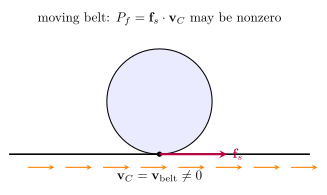
- 运动传送带上无相对滑动:接触点对地速度通常不为零,静摩擦可向物体传递能量。
- 可变形轮胎:有限接触斑内存在形变与滞后,可产生滚动阻力和热。
- 若滑动,动摩擦通常把有序机械能转为内能;其耗散率与相对滑动速度有关。
Lesson synthesis / 全课综合
滚动问题的可靠流程:
- 选系统与惯性参考系,画质心受力图。
- 分别写 \(\sum F_\parallel=Ma_{\rm CM}\) 与 \(\sum\tau_{\rm CM}=I_{\rm CM}\alpha\)。
- 若假设无滑,加入接触速度或加速度约束。
- 解出静摩擦并检查 \(|f_s|\le\mu_sN\)。
- 能量法用于求速率,但不能单独确定摩擦大小;明确接触功率是否为零。
Formula-and-decision table
| Need | Relation | Conditions |
|---|---|---|
| fixed-axis rotational energy | \(K_{\rm rot}=\tfrac12I\omega^2\) | same fixed axis for \(I,\omega\) |
| torque work | \(W=\int\tau_zd\theta\) | fixed axis and signed component |
| rotational power | \(P=\boldsymbol\tau\cdot\boldsymbol\omega\) | instantaneous inertial-frame power |
| rigid-body kinetic energy | \(K=\tfrac12Mv_{\rm CM}^2+\tfrac12I_{\rm CM}\omega^2\) | rigid body; second axis through CM |
| no-slip constraint | \(v_{\rm CM}=R\omega\) | stationary surface and declared signs |
| incline acceleration | \(a=g\sin\gamma/(1+\beta)\) | pure rolling, \(I=\beta MR^2\) |
| incline speed after drop \(h\) | \(v=\sqrt{2gh/(1+\beta)}\) | conservative ideal pure rolling |
Model boundaries / 模型边界
- \(K_{\rm rot}=\tfrac12I\omega^2\) uses a scalar \(I\) only for fixed-axis or principal-axis rotation.
- \(W=\int\tau d\theta\) requires conjugate signed torque and angle about the same fixed axis.
- Pure rolling is a kinematic constraint that must pass the static-friction inequality; it is not guaranteed by the words “rough surface”.
- Ideal static contact on a stationary surface transfers no instantaneous work to a rigid rolling body, but may supply a torque and redistribute how gravitational energy becomes translation versus rotation.
- Real rolling resistance comes from deformation, hysteresis and contact geometry; it is absent from the ideal point-contact model.
Misconception clinic
Practice and retrieval
- \(I=2.0\ \mathrm{kg\,m^2}\)、\(\omega=5.0\ \mathrm{rad\,s^{-1}}\),求转动动能。
- 恒力矩 \(8.0\ \mathrm{N\,m}\) 使物体转过 \(3.0\ \mathrm{rad}\),求功。
- 力矩 \(12\ \mathrm{N\,m}\) 与角速度 \(4.0\ \mathrm{rad\,s^{-1}}\) 同向,求功率;若反向呢?
- 证明刚体动能分解中的交叉项为零。
- 薄环以 \(v\) 纯滚,总动能用 \(Mv^2\) 表示。
- 实心圆柱从高度 \(h\) 纯滚下落,求末速度。
- 同斜面上薄环与实心球谁先到达底部?
- 一轮在静止水平面匀速纯滚,理想模型中静摩擦必须非零吗?
- 若解得所需静摩擦满足 \(\lvert f_s\rvert/N=0.30\),但 \(\mu_s=0.20\),能否维持纯滚?下一步如何建模?
- 判断:轮与向右运动传送带无相对滑动,因此静摩擦对轮一定不做功。
Answers / 答案
- \(K=\tfrac12(2.0)(5.0)^2=25\ \mathrm J\)。
- \(W=\tau\Delta\theta=24\ \mathrm J\)。
- 同向 \(P=48\ \mathrm W\);反向 \(P=-48\ \mathrm W\)。
- 写 \(\mathbf v_i=\mathbf V+\mathbf v_i'\);交叉项为 \(\mathbf V\cdot\sum m_i\mathbf v_i'=\mathbf V\cdot0\)。
- \(I=MR^2\)、\(\omega=v/R\),故 \(K=\tfrac12Mv^2+\tfrac12Mv^2=Mv^2\)。
- \(\beta=1/2\),\(v=\sqrt{2gh/(3/2)}=\sqrt{4gh/3}\)。
- 实心球 \(\beta=2/5\) 小于薄环的 \(1\),故加速度更大、先到。
- 不必须;理想无阻力匀速纯滚可有 \(f_s=0\)。
- 不能;静摩擦上限不足。改用动摩擦,并分别解平动、转动和相对滑动。
- 错。接触点对地可随传送带运动,\(P_f=\mathbf f_s\cdot\mathbf v_C\) 可非零。
Exit ticket
- 为什么能量法能求纯滚物体末速度,却通常不能告诉你静摩擦是否足够?
- 写出一个静摩擦对刚体做正功的具体场景,并明确参考系与系统边界。
References and source notes
以下直接来源于 2026-08-20 核对。
- OpenStax, 10.4 Moment of Inertia and Rotational Kinetic Energy.
- OpenStax, 10.8 Work and Power for Rotational Motion.
- OpenStax, 11.1 Rolling Motion.
- MIT OpenCourseWare 8.01SC, Online Textbook: Chapters 20 and 21.
- MIT OpenCourseWare 8.01SC, Readings: Lessons 35–37.
- MIT OpenCourseWare 16.07, Lecture L22 — 2D Rigid Body Dynamics: Work and Energy.
Source-to-content map
| Source | Used for | Knowledge ID / section | Boundary or convention |
|---|---|---|---|
| OpenStax 10.4 | derivation of \(K_{\rm rot}\) | K01 | fixed-axis scalar inertia |
| OpenStax 10.8 | torque work and power | K02 | torque and angle about same fixed axis |
| OpenStax 11.1 | rolling energy and incline dynamics | K03, K04 | ideal rolling without slipping |
| MIT 8.01SC Chapters 20–21 | CM decomposition and rolling dynamics | K03, K04 | inertial ground frame |
| MIT 8.01SC readings | course-sequence cross-check | K01–K04 | undergraduate scope |
| MIT 16.07 L22 | rigid-body work-energy framework | K01–K03 | two-dimensional rigid body |
复习与拓展
- Lesson 1.5.4 将用角动量解释滚动物体与碰撞后的转动状态。
- Lesson 1.5.5 将把 \(K=\tfrac12I\omega^2\) 推广为 \(\tfrac12\boldsymbol\omega\cdot\mathbf I\boldsymbol\omega\)。
- Unit 1.6 的弹性与材料响应将解释真实轮胎的形变损耗和滚动阻力来源。
- 可扩展实验:让不同形状物体从同一斜面滚下,以到达时间反推 \(\beta\) 并估计不确定度。