
Learning objectives / 学习目标
- 由总 entropy maximum 或 Gibbs-energy minimum 推出 thermal、mechanical 与 chemical equilibrium 条件。
- 推导非反应多组分系统的 Gibbs phase rule,并对 phase diagram 正确计数自由度。
- 从两相 chemical potentials 相等推导 Clapeyron equation,并说明 Clausius approximation 的额外假设。
- 根据 Gibbs free-energy derivatives 区分 first-order 与 continuous transitions,识别 latent heat、volume jump 与 response anomaly。
- 建立 classical nucleation free-energy model,计算 critical radius 与 barrier,并解释 supercooling、metastability 和 hysteresis。
- 区分 equilibrium coexistence line、spinodal limit 与 rate-dependent observed transition。
Prerequisites / 先修知识
- Gibbs energy、chemical potential 与 Maxwell relations。
- 局部稳定性、势函数曲率与 spinodal。
- latent heat 与 heating curve。
- phase diagram、偏导数、molar quantities、简单约束计数与 surface area/volume geometry。
Scope and conventions / 范围与约定
- 相 \(\alpha,\beta,\gamma\) 指宏观均匀区域;默认界面为平面且忽略重力、电场、表面曲率与膜选择性,因此平衡写成相同 \(T,p,\mu_i\)。弯曲界面可有 Laplace pressure jump。
- Gibbs phase rule 采用非反应平衡、\(C\) 个独立 components、\(P\) 个 phases:\(F=C-P+2\)。若另有独立化学反应或外加约束,必须修改计数。
- \(\Delta X\equiv X_\beta-X_\alpha\);Clapeyron slope 沿 \(\alpha\leftrightarrow\beta\) coexistence line 定义,\(\Delta h=T\Delta s\) 只在可逆相平衡转变处使用。
- Clausius–Clapeyron vapor-pressure form 额外假设 vapor ideal、\(v_g\gg v_l\)、\(\Delta h_{vap}\) 在积分温区近似常量。
- Classical nucleation theory 假设球形 nucleus、sharp interface、bulk \(\Delta g_v\) 与常数 surface tension \(\gamma\);纳米尺度、heterogeneous surface 与 diffuse interface 可显著修正。
Notation and modeling contract / 符号与建模契约
| Symbol | Meaning | SI unit |
|---|---|---|
| \(C,P,F\) | components, phases, thermodynamic degrees of freedom | 1 |
| \(\mu_i^\phi\) | chemical potential of component \(i\) in phase \(\phi\) | \(\mathrm{J\,mol^{-1}}\) |
| \(g,h,s,v\) | molar Gibbs energy, enthalpy, entropy, volume | \(\mathrm{J\,mol^{-1}}\), \(\mathrm{J\,mol^{-1}}\), \(\mathrm{J\,mol^{-1}K^{-1}}\), \(\mathrm{m^3\,mol^{-1}}\) |
| \(\gamma\) | interfacial free energy per area | \(\mathrm{J\,m^{-2}}\) |
| \(\Delta g_v\) | bulk Gibbs-energy change per volume, product minus parent | \(\mathrm{J\,m^{-3}}\) |
| \(r^*,\Delta G^*\) | critical radius and nucleation barrier | m, J |
Knowledge 1 — Equality of temperature, pressure, and chemical potential / 温度、压强与化学势平衡
Knowledge ID: P03-U05-L03-K01
1.1 平衡是所有允许交换都不再降低总势
把两个子系统 \(A,B\) 组成孤立复合系统。允许微量能量交换且 \(dU_B=-dU_A\) 时,
\[dS_{tot}=\left(\frac{1}{T_A}-\frac{1}{T_B}\right)dU_A.\]
熵极大要求任意正负 \(dU_A\) 的一阶项为零,故 \(T_A=T_B\)。相同地,允许体积和组分交换得到平面界面的
\[\boxed{T^\alpha=T^\beta,\qquad p^\alpha=p^\beta,\qquad \mu_i^\alpha=\mu_i^\beta\ \text{for every transferable }i.}\]
这三类分别是 thermal、mechanical、chemical equilibrium。若某隔板不允许组分 \(i\) 通过,\(\mu_i\) 不相等也可形成受约束平衡;必须先写允许的 virtual changes。
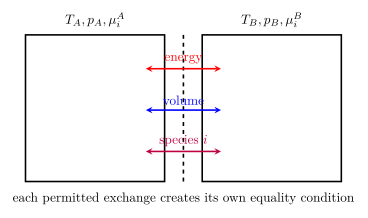
图 1:平衡条件取决于隔板允许交换什么;双箭头表示允许的虚变化,不是持续净流。
在恒定外界 \(T,p\) 下,若组分 \(i\) 从 \(\beta\) 相转移 \(dn_i>0\) 到 \(\alpha\) 相,则
\[dG=(\mu_i^\alpha-\mu_i^\beta)dn_i.\]
较低 \(\mu_i\) 的相会增长,直到相等。对纯物质 \(g^\phi=\mu^\phi\),两相共存即 molar Gibbs-energy curves 相交。若忽略界面且恰在共存的 \(T,p\),总 \(G\) 对两相比例呈平坦方向;相分数由总量约束决定,而不是由一个唯一的抛物线最低点决定。
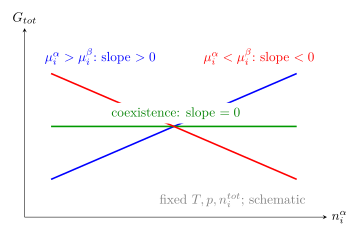
图 2:\(dG/dn_i^\alpha=\mu_i^\alpha-\mu_i^\beta\) 决定转移方向;宏观纯相在精确共存时中间绿线为平坦方向,不选定唯一相分数。
Worked Example 1 — 由 chemical potentials 判断相转移方向
已知: 同一纯物质在固定 \(T,p\) 下有 \(\mu^\alpha=-10.000\ \mathrm{kJ\,mol^{-1}}\)、\(\mu^\beta=-9.800\ \mathrm{kJ\,mol^{-1}}\)。考察 \(0.0500\ \mathrm{mol}\) 从 \(\beta\) 转入 \(\alpha\) 的初始变化。
系统与方向: 两相合起来为封闭系统;\(dn^\alpha=+0.0500\ \mathrm{mol}\)、\(dn^\beta=-dn^\alpha\)。
模型理由: 外界固定 \(T,p\),忽略有限界面与组成变化造成的 \(\mu\) 变化,只求初始一阶趋势。
\[\Delta G\approx(\mu^\alpha-\mu^\beta)dn^\alpha =(-0.200\ \mathrm{kJ\,mol^{-1}})(0.0500\ \mathrm{mol}) =-0.0100\ \mathrm{kJ}.\]
\[\boxed{\Delta G=-10.0\ \mathrm J;\quad \alpha\ \text{phase initially grows}.}\]
检查: 乘积单位为 J;\(\alpha\) 的 chemical potential 更低,向 \(\alpha\) 转移使 \(G\) 降低。最终平衡不能用固定初值外推,必须在相态/组成调整后满足 \(\mu^\alpha=\mu^\beta\)。
Knowledge 2 — Gibbs phase rule / 吉布斯相律
Knowledge ID: P03-U05-L03-K02
2.1 自由度来自“变量数减约束数”
对非反应系统,每个相有 \(C-1\) 个独立 composition variables,加上全系统共同 \(T,p\):变量数为 \(P(C-1)+2\)。每个 component 在 \(P\) 个 phases 中 chemical potential 相等,产生 \(C(P-1)\) 个独立约束。因此
\[\boxed{F=P(C-1)+2-C(P-1)=C-P+2.}\]
\(F\) 是在不改变相数的前提下可独立改变的 intensive variables 数量,不是“可以任选的相数”。若固定 pressure,condensed phase rule 常写 \(F'=C-P+1\);这是额外施加一个约束后的结果。
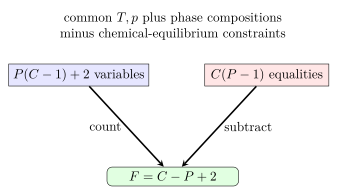
图 3:Gibbs phase rule 是明确的 constraint count,而不是背诵出的经验公式。
2.2 纯物质 \(p\)–\(T\) 图把自由度画出来
对 \(C=1\):单相区 \(P=1\Rightarrow F=2\),可独立改变 \(T,p\);两相线 \(P=2\Rightarrow F=1\),指定 \(T\) 后 \(p\) 已由 coexistence condition 决定;triple point \(P=3\Rightarrow F=0\),\(T,p\) 都被固定。临界点不是“三相点”;它是两相差异连续消失的端点。
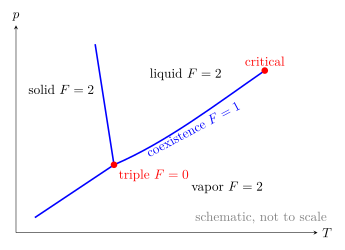
图 4:纯物质单相区、共存线和 triple point 的维数正好对应 \(F=2,1,0\)。
Worked Example 2 — Binary two-phase equilibrium 的自由度
已知: 不发生反应的二元体系含 liquid 与 vapor 两相,\(C=2,P=2\)。
系统与变量: 宏观相平衡,忽略重力和毛细压力。
计数:
\[F=C-P+2=2-2+2=2.\]
所以可选择两项独立 intensive variables,例如 \((T,p)\);给定二者后,各相平衡组成由 \(\mu_1^l=\mu_1^v\) 与 \(\mu_2^l=\mu_2^v\) 决定。若再固定 \(p\),则
\[F'=1,\]
只有一个自由 intensive variable,可用 \(T\) 表示;相组成随之确定。检查: overall composition 改变通常改变两相相分数,但在两相区内、固定 \(T,p\) 时不增加 intensive degree of freedom(lever rule 接口)。
Knowledge 3 — Clausius–Clapeyron equation / 克劳修斯—克拉佩龙方程
Knowledge ID: P03-U05-L03-K03
3.1 Clapeyron equation 是共存条件的切线
沿两相共存线,纯物质有 \(g^\alpha(T,p)=g^\beta(T,p)\),且相邻共存点仍满足 \(dg^\alpha=dg^\beta\)。用 \(dg=-s\,dT+v\,dp\):
\[-s_\alpha dT+v_\alpha dp=-s_\beta dT+v_\beta dp.\]
因此
\[\boxed{\frac{dp}{dT}=\frac{\Delta s}{\Delta v} =\frac{\Delta h}{T\Delta v}.}\]
斜率符号由 entropy jump 与 volume jump 共同决定。融化通常 \(\Delta h_{fus}>0\);普通物质 \(\Delta v_{fus}>0\),故熔点随压力升高。水的冰融化时 \(\Delta v_{fus}<0\),斜率为负。
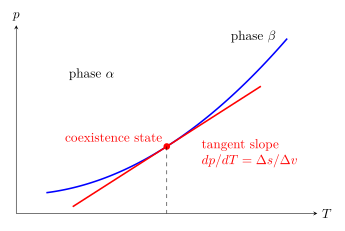
图 5:Clapeyron equation 给出 coexistence curve 在每个平衡点的局部切线斜率。
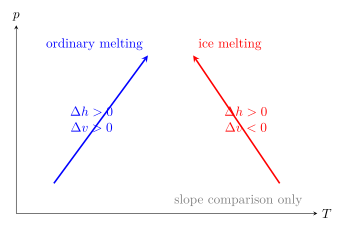
图 6:相同正 latent heat 下,volume change 的符号决定 melting curve 的斜率。
3.2 Clausius–Clapeyron 是 vaporization 的近似积分式
若 \(v_g\gg v_l\) 且 vapor ideal,\(\Delta v\approx RT/p\),于是
\[\frac{d\ln p}{dT}=\frac{\Delta h_{vap}}{RT^2}.\]
若 \(\Delta h_{vap}\) 近似常量,积分给
\[\boxed{\ln\left(\frac{p_2}{p_1}\right) =-\frac{\Delta h_{vap}}{R}\left(\frac{1}{T_2}-\frac{1}{T_1}\right).}\]
接近 critical point 时 \(\Delta v\) 与 \(\Delta h\) 都趋零,ideal-vapor/constant-latent-heat assumptions 失效,应回到完整 equation of state 或 Clapeyron form。
Worked Example 3 — 估算较低温度的 vapor pressure
已知: 液体在 \(T_1=373.15\ \mathrm K\) 的 vapor pressure 为 \(p_1=101.325\ \mathrm{kPa}\);在 \(353.15\)–\(373.15\ \mathrm K\) 内取 \(\Delta h_{vap}=40.7\ \mathrm{kJ\,mol^{-1}}\) 常量。求 \(T_2=353.15\ \mathrm K\) 的 \(p_2\)。
系统与模型: 纯物质 liquid–vapor equilibrium;vapor ideal、\(v_g\gg v_l\)。
方程:
\[\ln\left(\frac{p_2}{p_1}\right) =-\frac{40700}{8.314} \left(\frac{1}{353.15}-\frac{1}{373.15}\right) =-0.743.\]
\[\boxed{p_2=(101.325)e^{-0.743}=48.2\ \mathrm{kPa}.}\]
检查: 对数比值无量纲;降低温度应降低 vapor pressure,结果方向正确。三位有效数字合理;该值是给定 constant-\(\Delta h\) 模型的估算,不冒充精密 steam-table data。
Knowledge 4 — First-order and continuous phase transitions / 一级与连续相变
Knowledge ID: P03-U05-L03-K04
4.1 First-order transition:势连续,一阶导数跳跃
固定 \(p\) 扫温时,两相 molar Gibbs energies 在 \(T_{tr}\) 相等,但斜率 \(dg/dT=-s\) 不同。因此 \(s\) 跳跃,latent heat 为
\[L=T_{tr}\Delta s.\]
若固定 \(T\) 扫压,\(dg/dp=v\) 的跳跃对应 volume discontinuity。first-order coexistence 允许两相比例改变而 \(T,p\) 保持在共存条件。
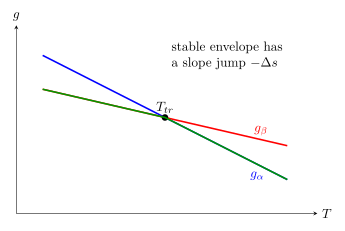
图 7:一级相变中 \(g\) 连续但 stable lower envelope 出现折角;图线为局部线性示意。
4.2 Continuous transition:无 latent heat,但 response 可奇异
连续相变中 \(g\) 与一阶导数通常连续,所以没有 finite latent heat 或 volume jump;二阶导数如 \(C_p=-T(\partial^2g/\partial T^2)_p\)、susceptibility 或 compressibility 可跳跃或发散。现代描述用 order parameter、symmetry、correlation length 与 critical exponents;“二级相变”是 Ehrenfest classification 的历史术语,不涵盖所有临界现象。
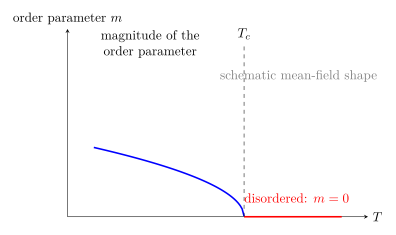
图 8:连续相变的 order parameter 可在 \(T_c\) 连续趋于零;真实临界指数未必是图示 mean-field 值。
Knowledge 5 — Metastability, nucleation, and hysteresis / 亚稳态、成核与滞后
Knowledge ID: P03-U05-L03-K05
5.1 亚稳态是局部最低点,不是全局平衡
低于 equilibrium freezing temperature 的液体可仍保持均匀,因为形成 solid–liquid interface 需要 surface free energy。对半径 \(r\) 的球形 product nucleus,classical homogeneous nucleation 给
\[\Delta G(r)=4\pi r^2\gamma+\frac{4\pi}{3}r^3\Delta g_v,\]
其中有利相变时 \(\Delta g_v<0\)。极大值位置与 barrier 为
\[\boxed{r^*=\frac{2\gamma}{\lvert\Delta g_v\rvert},\qquad \Delta G^*=\frac{16\pi\gamma^3}{3\Delta g_v^2}.}\]
\(r<r^*\) 的胚胎缩小可降势,\(r>r^*\) 则增长可降势。容器壁、杂质和缺陷提供 heterogeneous nucleation sites,通常降低 barrier。
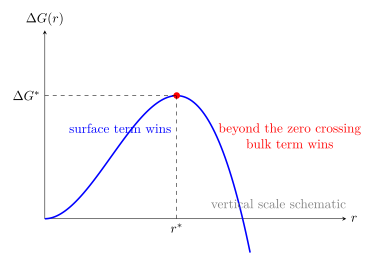
图 9:nucleation barrier 把 thermodynamically favored phase 与立即转变区分开;曲线不按数值比例。
5.2 Hysteresis 记录 barrier 与时间尺度
冷却时系统可能在 equilibrium line 之后才成核(supercooling);加热时反向过程也可能延迟(superheating)。因此观测转变温度依赖扫描速率、缺陷、样品尺寸与等待时间,形成 hysteresis loop。平衡 coexistence temperature 本身不因扫描方向改变;hysteresis 是动力学历史,不应直接代入 Gibbs phase rule 当作两条平衡线。
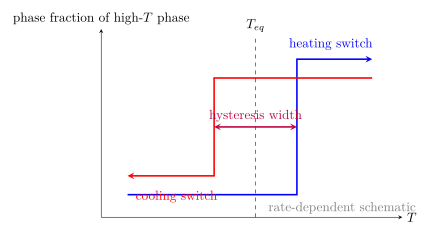
图 10:升温与降温路径因 barrier 分离;虚线是理想 equilibrium transition,台阶位置随实验时间尺度变化。
Worked Example 4 — Classical homogeneous nucleation barrier
已知: 球形新相 nucleus 的 interfacial energy \(\gamma=0.100\ \mathrm{J\,m^{-2}}\),bulk driving force \(\Delta g_v=-2.00\times10^7\ \mathrm{J\,m^{-3}}\),温度 \(T=250\ \mathrm K\)。
系统与模型: 均匀 parent phase 内 spherical sharp-interface nucleus;忽略弹性、各向异性和容器壁。
坐标: 半径 \(r\ge0\);product-minus-parent bulk term 为负。
\[r^*=\frac{2(0.100)}{2.00\times10^7} =1.00\times10^{-8}\ \mathrm m=10.0\ \mathrm{nm}.\]
\[\Delta G^*=\frac{16\pi(0.100)^3}{3(2.00\times10^7)^2} =4.19\times10^{-17}\ \mathrm J.\]
以 \(k_B=1.380649\times10^{-23}\ \mathrm{J\,K^{-1}}\):
\[\frac{\Delta G^*}{k_BT} =\frac{4.19\times10^{-17}}{(1.380649\times10^{-23})(250)} =1.21\times10^4.\]
结论: \(\boxed{r^*=10.0\ \mathrm{nm},\ \Delta G^*=4.19\times10^{-17}\ \mathrm J}\)。检查: \(\gamma/\lvert\Delta g_v\rvert\) 给 m;barrier 远大于 \(k_BT\),理想 homogeneous nucleation 极慢,真实转变很可能由 heterogeneous sites 主导。连续介质半径为 \(10\ \mathrm{nm}\) 尚可作数量级模型,但材料微观结构仍需核验。
Lesson synthesis / 全课整合
Phase equilibrium 的核心是允许交换对应的 intensive variables 相等;对多组分多相系统,这些等式数目产生 Gibbs phase rule。沿两相相等条件移动,微分给 Clapeyron slope。first-order transition 在势的一阶导数上跳跃,continuous transition 则把异常推到更高导数或涨落尺度。然而,global minimum 只说明终态,界面能造成的 nucleation barrier 决定从 metastable state 到稳定相的等待时间和 hysteresis。
建模流程: 定义 components 与 phases → 列出允许交换和外场 → 写 \(T,p,\mu_i\) equilibrium conditions → 用 phase rule 计自由度 → 对纯物质共存线用 Clapeyron → 检查 transition derivative order → 比较 global stability 与 local metastability → 若问“何时发生”,加入 nucleation kinetics 与时间尺度。
Formula-and-decision table / 公式—决策表
| Task | Relation | Use only when | Key caution |
|---|---|---|---|
| phase equilibrium | \(T^\alpha=T^\beta\), \(p^\alpha=p^\beta\), \(\mu_i^\alpha=\mu_i^\beta\) | planar interface, transferable species, no extra fields | constraints can remove equalities |
| phase-rule count | \(F=C-P+2\) | nonreacting equilibrium system | reactions and fixed variables reduce \(F\) |
| coexistence slope | \(dp/dT=\Delta h/(T\Delta v)\) | two equilibrium phases | signs depend on chosen \(\Delta\) convention |
| vapor-pressure estimate | \(\ln(p_2/p_1)=-(\Delta h_{vap}/R)(1/T_2-1/T_1)\) | ideal vapor, negligible liquid volume, constant \(\Delta h\) | fails near critical point |
| first-order transition | \(L=T_{tr}\Delta s\) | finite entropy jump at coexistence | observed switching may be delayed |
| critical nucleus | \(r^*=2\gamma/\lvert\Delta g_v\rvert\) | spherical homogeneous sharp interface | heterogeneous geometry lowers barrier |
| nucleation barrier | \(\Delta G^*=16\pi\gamma^3/(3\Delta g_v^2)\) | same classical model | kinetics needs prefactor as well |
Model boundaries / 模型边界
- Equal pressures assume a planar interface;curvature creates a Laplace pressure difference, and gravity permits hydrostatic gradients。
- Gibbs phase rule counts equilibrium intensive degrees of freedom;overall amounts control phase fractions but not the same freedom count。
- Components are independent conserved chemical building blocks, not automatically the number of named species;independent reactions reduce the count。
- Clausius–Clapeyron is not the exact Clapeyron equation;ideal vapor、negligible condensed volume and nearly constant latent heat are extra assumptions。
- Ehrenfest derivative classification is useful but incomplete near modern critical phenomena;fluctuations can invalidate mean-field smoothness assumptions。
- Classical nucleation theory ignores diffuse interfaces、anisotropy、elastic strain and molecular discreteness;hysteresis widths are kinetic and apparatus-dependent。
Misconception clinic / 易错概念诊所
- “两相存在就一定处于相平衡。” 共存样品可能仍有净热、体积或物质传递;必须满足允许交换对应的 intensive equalities。
- “Gibbs phase rule 中 \(P\) 是 pressure。” 此处 \(P\) 表示 phase number;压强写 \(p\),必须区分字体和语境。
- “两相区有两相,所以自由度更多。” 相平衡等式增加约束;纯物质两相线反而只有一个 intensive degree of freedom。
- “Clausius–Clapeyron 对所有相界都精确。” 精确的是 Clapeyron form;Clausius form 专为满足额外近似的 vapor equilibrium。
- “连续相变就是什么量都连续。” 势与一阶导数可连续,但 heat capacity、susceptibility 或 correlation length 可奇异。
- “过冷液体比晶体自由能高,所以必立即冻结。” bulk driving force 还要克服 interface-created nucleation barrier;有限时间内可亚稳。
- “hysteresis 的两条支路都是平衡 phase boundary。” hysteresis 是路径和速率依赖;equilibrium coexistence line 唯一。
Practice and retrieval / 练习与检索
1. 三种平衡(K01)
两个相可交换热、体积和组分 \(i\)。写出平衡条件。
Answer
在平面界面、无额外外场时,\(T^\alpha=T^\beta\)、\(p^\alpha=p^\beta\)、\(\mu_i^\alpha=\mu_i^\beta\)。若有多个可交换组分,每个组分都要满足 chemical-potential equality。
2. 受限平衡(K01)
若膜只允许溶剂通过、不允许溶质通过,溶质的 \(\mu\) 是否必须两侧相等?
Answer
不必须;被禁止的虚变化不产生相应平衡条件。溶剂的 generalized chemical potential 必须相等,且可能出现 osmotic pressure difference。
3. 纯物质 phase rule(K02)
纯物质两相共存时 \(F\) 是多少?固定温度后还能独立选择压力吗?
Answer
\(F=1-2+2=1\)。固定 \(T\) 已用尽自由度,\(p\) 由 coexistence curve 决定,不能再独立选择。
4. Triple point(K02)
为什么纯物质三相共存是一个点而不是一个面积?
Answer
\(C=1,P=3\) 给 \(F=0\),没有可连续独立改变的 intensive variable;在普通 \(p\)–\(T\) 平面中因此是孤立点。
5. Clapeyron sign(K03)
某熔化过程 \(\Delta h>0\)、\(\Delta v<0\)。熔化线 \(dp/dT\) 的符号是什么?加压使熔点怎样?
Answer
\(dp/dT=\Delta h/(T\Delta v)<0\);等价地 \(dT/dp<0\),加压降低熔点,水冰是典型情形。
6. Vapor-pressure ratio(K03)
若 \(\Delta h_{vap}=30.0\ \mathrm{kJ\,mol^{-1}}\),从 \(T_1=300\ \mathrm K\) 升到 \(T_2=330\ \mathrm K\),\(p_2/p_1\) 的 Clausius estimate 是多少?
Answer
\(\ln(p_2/p_1)=-(30000/8.314)(1/330-1/300)=1.094\),所以 \(p_2/p_1=e^{1.094}=2.99\)。这是 constant-latent-heat ideal-vapor approximation。
7. First-order signature(K04)
固定压力扫温时,一级相变的 \(g(T)\)、\(s(T)\) 与 latent heat 分别怎样?
Answer
\(g\) 在共存温度连续且两相相等;\(s=-dg/dT\) 有有限跳跃;latent heat \(L=T_{tr}\Delta s\) 非零。
8. Continuous transition(K04)
没有 latent heat 是否说明 heat capacity 必定平滑?
Answer
不说明。连续相变的一阶导数可连续,但 \(C_p=-Tg_{TT}\) 可跳跃或发散;还需考察 order parameter、susceptibility 与 correlation length。
9. Critical nucleus(K05)
若 supercooling 增强使 \(\lvert\Delta g_v\rvert\) 加倍而 \(\gamma\) 不变,\(r^*\) 与 \(\Delta G^*\) 怎样变化?
Answer
\(r^*=2\gamma/\lvert\Delta g_v\rvert\) 减半;\(\Delta G^*\propto1/\Delta g_v^2\) 降为四分之一,因此 nucleation 快得多。
10. 三条“边界”辨析(K03–K05)
分别说明 coexistence line、spinodal 与 hysteretic switching line 的物理含义。
Answer
coexistence line 是两相全局 Gibbs energies 相等的平衡条件;spinodal 是亚稳均匀相局部曲率降到零、response 发散的极限;switching line 是有限扫描速率下实际成核/消失的位置,依赖缺陷和时间,不是唯一平衡线。
Exit ticket / 课末检验
- 对一个二元两相系统,先用 phase rule 计数,再列出完整 chemical-potential equalities,并说明 overall composition 改变什么。
- 一条实验相界有负斜率且出现显著 supercooling:分别用 Clapeyron thermodynamics 与 nucleation kinetics 解释这两个观察,不能混用层次。
References and source notes / 参考资料与来源说明
- MIT OCW 3.020, Lecture 11 — Phase Coexistence in Unary Systems — chemical-potential coexistence、Gibbs phase rule、Clapeyron equation and vapor pressure。
- MIT OCW 3.012, Lecture 16 — Single-component phase diagrams — triple point、phase-rule interpretation 与 coexistence-slope derivation。
- MIT OCW 3.00, Lecture 27 — Gibbs Free Energy and Phase Diagrams — Gibbs phase rule、single-component diagrams 与 Clausius–Clapeyron。
- OpenStax Chemistry: Atoms First 2e, 10.3 Phase Transitions — vapor pressure、integrated Clausius–Clapeyron assumptions and calculations。
- OpenStax Chemistry 2e, 10.4 Phase Diagrams — stable regions、triple point、critical point and supercritical boundary。
- University of Cambridge, Statistical Physics Lecture Notes — chemical-potential equality、Clapeyron derivation、first-order/continuous transitions and criticality。
- MIT OCW 3.46, Phase Transformations II — metastability、interfacial barrier、nucleation and phase-transformation kinetics。
- NIST teqp documentation — Phase equilibria — computational pure-fluid and mixture equilibrium by equal pressure/Gibbs energy/chemical potentials。
- NIST TRC — Pure Compound Properties — triple-point、boiling-point、vapor-pressure and condensed-phase boundary metadata。
以上链接均于 2026-08-25 实际打开并核对到具体页面、lecture resource 或 PDF。正文统一采用 product-minus-parent 的 \(\Delta\) 约定;数值例题独立复算,TikZ 图按本文公式原创。
Source-to-content map
| Source | Used for | Knowledge ID / Section | Model boundary or convention |
|---|---|---|---|
| MIT 3.020 Lecture 11 | equilibrium, phase rule, Clapeyron | K01–K03 | unary planar-interface equilibrium |
| MIT 3.012 Lecture 16 | triple point and coexistence slope | K02, K03 | single-component diagrams |
| MIT 3.00 Lecture 27 | Gibbs-energy phase diagrams | K02, K03 | equilibrium rather than kinetics |
| OpenStax 10.3 | integrated vapor-pressure relation | K03 | ideal vapor and constant latent heat |
| OpenStax 10.4 | phase-diagram interpretation | K02, K04 | stable macroscopic regions |
| Cambridge Statistical Physics notes | transition order and critical interface | K03, K04 | modern caveat beyond Ehrenfest labels |
| MIT 3.46 Phase Transformations II | metastability and nucleation | K05 | sharp-interface classical model |
| NIST teqp | numerical phase-equilibrium conditions | K01, K03 | equation-of-state and initial-guess dependence |
| NIST TRC pure properties | transition-property metadata | K02, K03 | phase, range and evaluated-data conventions |
复习与拓展
- 下一课从 multiplicity 与 probability 解释为什么 equilibrium macrostate overwhelmingly typical。
- 配分函数将从 microscopic states 计算 \(F,G,\mu\),连接本单元的势函数。
- 临界性深入 order parameter、correlation length、critical exponents 与 renormalization。
- 不可逆热力学将把有限 chemical-potential difference 解释为通量的驱动力;materials kinetics 会扩展 nucleation-and-growth rate。