
Learning objectives / 学习目标
完成本课后,你应能:
- 用充电电容器的两个跨界曲面定位原安培定律的逻辑矛盾。
- 定义位移电流并证明理想平行板电容器中 \(I_d=I\)。
- 陈述真空中 Maxwell equations 的积分形式,解释每个边界、方向和源项。
- 用 divergence theorem 与 Stokes theorem 得到微分形式,并说明其光滑性要求。
- 从 Ampère–Maxwell law 推导 continuity equation,检查电荷守恒、量纲与极限。
Prerequisites / 先修知识
- Gauss's Law and Symmetry:闭曲面通量。
- Ampère's Law:稳恒电流与环路积分。
- Faraday's and Lenz's Laws:变化磁通与环流电场。
- Capacitance and Stored Energy:\(C=\epsilon_0A/d\)。
- 向量散度、旋度、Stokes theorem 与 divergence theorem。
Scope and conventions / 范围与约定
- 采用 SI;场写作 \(\mathbf E(\mathbf r,t)\)、\(\mathbf B(\mathbf r,t)\)。
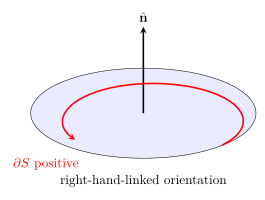
- 闭曲面面积元 \(d\mathbf A\) 指向外;环路方向与所选开曲面的法向遵循右手规则。
- 除特别说明,介质是真空,源为自由电荷密度 \(\rho\) 和电流密度 \(\mathbf J\)。
- “位移电流”不是电荷穿过真空隙的输运;它是 \(\epsilon_0\,d\Phi_E/dt\) 在 Ampère–Maxwell law 中的等效源项。
- 积分形式对分片光滑场适用;写微分形式时假定观察点附近场和源足够光滑。奇异点应回到积分形式或用分布处理。
- 本课不讨论磁单极、极化介质中的 \(\mathbf D,\mathbf H\) 或规范势。
Notation and modeling contract / 符号与建模契约
| Symbol | Meaning | SI unit |
|---|---|---|
| \(C\) | oriented closed loop | — |
| \(S\) | oriented surface with boundary \(\partial S=C\) | \(\mathrm{m^2}\) |
| \(\Phi_E=\int_S\mathbf E\cdot d\mathbf A\) | electric flux | \(\mathrm{V\,m}\) |
| \(\Phi_B=\int_S\mathbf B\cdot d\mathbf A\) | magnetic flux | Wb |
| \(I_c=\int_S\mathbf J\cdot d\mathbf A\) | conduction current through \(S\) | A |
| \(I_d=\epsilon_0\,d\Phi_E/dt\) | displacement current for \(S\) | A |
| \(\rho\) | volume charge density | \(\mathrm{C\,m^{-3}}\) |
| \(\mathbf J\) | charge-current density | \(\mathrm{A\,m^{-2}}\) |
| \(\epsilon_0,\mu_0\) | vacuum permittivity, permeability | \(\mathrm{F\,m^{-1}},\mathrm{H\,m^{-1}}\) |
Knowledge 1 — Inconsistency of Ampère's law for charging capacitors / 充电电容器揭示的安培定律问题
Knowledge ID: P04-U10-L01-K01
1.1 Surface independence is not optional
稳恒磁学中的 Ampère law 为
\[\oint_C\mathbf B\cdot d\boldsymbol\ell=\mu_0 I_{\mathrm{enc}}.\]
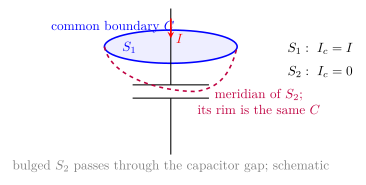
同一几何回路 \(C\) 可张成不同曲面。若右侧是物理定律,它不能因我们画哪一张数学曲面而改变。对正在充电的电容器,穿过导线的 \(S_1\) 截获传导电流 \(I\);鼓起并穿过板间隙的 \(S_2\) 却没有任何电荷越过。旧式定律于是同时预言 \(\mu_0I\) 与 \(0\)。
1.2 Local diagnosis
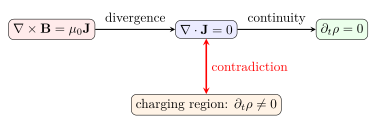
对旧式微分定律 \(\nabla\times\mathbf B=\mu_0\mathbf J\) 取散度:
\[0=\nabla\cdot(\nabla\times\mathbf B)=\mu_0\nabla\cdot\mathbf J.\]
它强迫 \(\nabla\cdot\mathbf J=0\),只容许稳恒电流;而充电区域有 \(\partial\rho/\partial t\ne0\)。矛盾不是电容器的怪现象,而是旧式 Ampère law 缺少时间依赖项。
Knowledge 2 — Displacement current / 位移电流
Knowledge ID: P04-U10-L01-K02
Maxwell 增加
\[I_d\equiv\epsilon_0\frac{d\Phi_E}{dt},\]
使安培环路定律成为
\[\oint_C\mathbf B\cdot d\boldsymbol\ell =\mu_0\left(I_c+I_d\right).\]
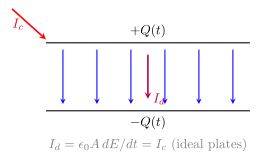
对边缘效应可忽略的平行板电容器,\(E=Q/(\epsilon_0A)\),因此
\[I_d=\epsilon_0\frac{d(EA)}{dt} =\frac{dQ}{dt}=I_c.\]
两张曲面于是给出同一个磁场环流。量纲检查:\(\epsilon_0(d\Phi_E/dt)\) 的单位为 \((\mathrm{C/(V\,m)})(\mathrm{V\,m/s})=\mathrm A\)。
位移电流密度在真空中写作
\[\mathbf J_d=\epsilon_0\frac{\partial\mathbf E}{\partial t}.\]
它会产生磁场,但不能据此声称有真实带电粒子跨越间隙。介质中常写 \(\partial\mathbf D/\partial t\);那是把极化响应纳入宏观场的另一种记账,本课暂不展开。
Knowledge 3 — Maxwell's equations in integral form / 麦克斯韦方程积分形式
Knowledge ID: P04-U10-L01-K03
真空中的完整积分形式为
\[\oint_{\partial V}\mathbf E\cdot d\mathbf A=\frac{Q_{\rm enc}}{\epsilon_0},\]
\[\oint_{\partial V}\mathbf B\cdot d\mathbf A=0,\]
\[\oint_{\partial S}\mathbf E\cdot d\boldsymbol\ell=-\frac{d}{dt}\int_S\mathbf B\cdot d\mathbf A,\]
\[\oint_{\partial S}\mathbf B\cdot d\boldsymbol\ell =\mu_0\int_S\mathbf J\cdot d\mathbf A +\mu_0\epsilon_0\frac{d}{dt}\int_S\mathbf E\cdot d\mathbf A.\]
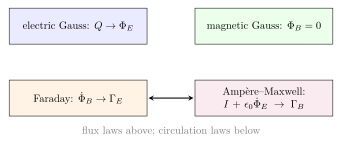
前两式是“闭曲面账本”:电荷是 \(\mathbf E\) 的源,已知实验范围内没有磁荷源。后两式是“边界—跨界”关系:变化磁通造成电场环流;传导电流与变化电通量共同造成磁场环流。
方向约定不可省略:改变 \(S\) 的法向,\(\partial S\) 的正向也必须一起反转。Faraday law 的负号编码 Lenz law;它不是可以按题意随意添加的符号。
Knowledge 4 — Maxwell's equations in differential form / 麦克斯韦方程微分形式
Knowledge ID: P04-U10-L01-K04
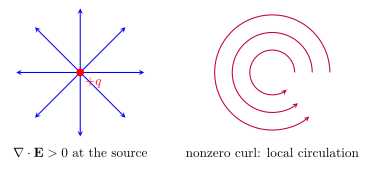
对任意小体积使用 divergence theorem、对任意小曲面使用 Stokes theorem,得到局域方程:
\[\nabla\cdot\mathbf E=\frac{\rho}{\epsilon_0}, \qquad \nabla\cdot\mathbf B=0,\]
\[\nabla\times\mathbf E=-\frac{\partial\mathbf B}{\partial t}, \qquad \nabla\times\mathbf B=\mu_0\mathbf J+\mu_0\epsilon_0\frac{\partial\mathbf E}{\partial t}.\]
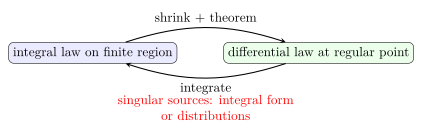
积分形式说区域及边界的总账;微分形式说每一个普通点的局域源和旋涡。两者在足够光滑时等价,但点电荷处的 \(\mathbf E\) 发散,不能把“普通函数的点值”当成完整描述。
Knowledge 5 — Charge conservation and continuity equation / 电荷守恒与连续性方程
Knowledge ID: P04-U10-L01-K05
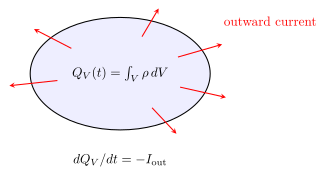
任意固定体积 \(V\) 内的电荷变化来自穿出边界的净电流:
\[\frac{d}{dt}\int_V\rho\,dV=-\oint_{\partial V}\mathbf J\cdot d\mathbf A.\]
用 divergence theorem 得局域 continuity equation:
\[\boxed{\frac{\partial\rho}{\partial t}+\nabla\cdot\mathbf J=0.}\]
也可直接从 Ampère–Maxwell law 推导:对其取散度,利用 \(\nabla\cdot(\nabla\times\mathbf B)=0\) 及 Gauss law,
\[0=\mu_0\nabla\cdot\mathbf J+\mu_0\epsilon_0\frac{\partial}{\partial t}(\nabla\cdot\mathbf E) =\mu_0\left(\nabla\cdot\mathbf J+\frac{\partial\rho}{\partial t}\right).\]
这说明 displacement-current term 不是装饰性“对称补丁”,而是电磁场方程与局域电荷守恒相容所必需。
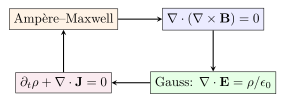
稳恒情形 \(\partial\rho/\partial t=0\) 恢复 \(\nabla\cdot\mathbf J=0\);这正是旧式 Ampère law 的有效边界,而不是普遍定律。
Worked Examples / 完整例题
Worked Example 1 — Charging capacitor: two surfaces, one field
半径 \(R=4.00\,\mathrm{cm}\) 的圆形平行板电容器以恒定 \(I=0.600\,\mathrm A\) 充电。求板间 \(r=1.50\,\mathrm{cm}\) 圆周上的 \(B\)。
对象与约定: 取板间场近似均匀、忽略边缘效应;回路圆心与极板同轴,电流指向上板,以右手定则定义 \(+\phi\)。
模型: \(r<R\) 时只有面积比 \(r^2/R^2\) 的电通量穿过回路内曲面,故 \(I_{d,\rm enc}=I r^2/R^2\)。
\[B(2\pi r)=\mu_0I\frac{r^2}{R^2},\]
\[B=\frac{\mu_0Ir}{2\pi R^2} =\frac{(4\pi\times10^{-7})(0.600)(0.0150)}{2\pi(0.0400)^2} =1.13\times10^{-6}\,\mathrm T.\]
检查: 单位为 T;\(B\propto r\) 且 \(r\to0\) 时趋零。方向为绕充电电流的 \(+\phi\)。答案保留三位有效数字。
Worked Example 2 — RC charging displacement current
\(R=2.00\,\mathrm{k\Omega}\)、\(C=5.00\,\mu\mathrm F\) 串联接到 \(12.0\,\mathrm V\) 电源,\(t=8.00\,\mathrm{ms}\) 时求导线电流与板间总位移电流。
系统与模型: 理想 lumped RC,忽略漏电和边缘场;正方向取电流流入正极板。
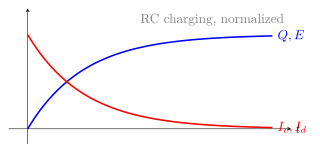
\[I_c(t)=\frac{V}{R}e^{-t/(RC)},\qquad RC=10.0\,\mathrm{ms},\]
\[I_c=(6.00\,\mathrm{mA})e^{-0.800}=2.70\,\mathrm{mA}.\]
由 \(I_d=\epsilon_0d\Phi_E/dt=dQ/dt\),
\[I_d=2.70\,\mathrm{mA}.\]
检查: \(t=0\) 时应为 \(6.00\,\mathrm{mA}\),\(t\to\infty\) 时两者都趋零;结果满足。位移电流不是电子越过介质。
Worked Example 3 — Integral-to-local Gauss law
已知球内 \(\mathbf E=ar\,\hat{\mathbf r}\),其中 \(a=2.00\times10^3\,\mathrm{V\,m^{-2}}\)。求体电荷密度并核对半径 \(0.100\,\mathrm m\) 球内总电荷。
参考系与模型: 球心为原点;场在原点光滑且球对称。
\[\nabla\cdot(ar\hat{\mathbf r})=\frac{1}{r^2}\frac{d}{dr}(ar^3)=3a, \qquad \rho=3\epsilon_0a=5.31\times10^{-8}\,\mathrm{C\,m^{-3}}.\]
\[Q=\rho\frac{4\pi R^3}{3}=2.23\times10^{-10}\,\mathrm C.\]
积分核对:\(\epsilon_0E(R)4\pi R^2=4\pi\epsilon_0aR^3\),数值相同。量纲和 \(R^3\) 缩放均正确。
Worked Example 4 — Continuity fixes a time-dependent current
一球内均匀电荷密度为 \(\rho(t)=\rho_0e^{-t/\tau}\),要求球内电流保持球对称且在 \(r=0\) 有限。求 \(\mathbf J(r,t)\)。
系统与方向: 以球心为原点,\(\hat{\mathbf r}\) 向外;球是固定控制体。设 \(\mathbf J=J_r\hat{\mathbf r}\)。
\[\frac{1}{r^2}\frac{\partial}{\partial r}(r^2J_r) =-\frac{\partial\rho}{\partial t}=\frac{\rho}{\tau}.\]
积分并用原点有限性排除 \(C/r^2\) 项:
\[r^2J_r=\frac{\rho r^3}{3\tau}, \qquad \boxed{\mathbf J=\frac{\rho_0e^{-t/\tau}}{3\tau}r\hat{\mathbf r}}.\]
检查: 电荷减少,所以电流应向外;\(J_r\propto r\) 在原点有限。单位为 \(\mathrm{C\,m^{-3}}\,\mathrm m/\mathrm s=\mathrm{A\,m^{-2}}\)。
Lesson synthesis / 本课综合
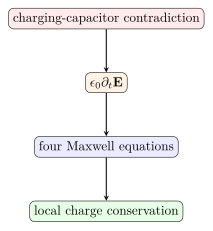
建模流程:先声明回路、曲面及相互取向;再判定问题需积分还是局域形式;列出真实传导电流和变化电通量;利用对称性计算;最后用 surface independence、continuity equation、量纲和稳恒极限交叉检查。
Formula-and-decision table / 公式与决策表
| Need | Equation | Use when | Main caution |
|---|---|---|---|
| charging-gap magnetic field | \(\oint_C\mathbf B\cdot d\boldsymbol\ell=\mu_0(I_c+\epsilon_0d\Phi_E/dt)\) | time-dependent flux through a spanning surface | \(I_d\) is not charge transport across vacuum |
| global source/flux | \(\oint\mathbf E\cdot d\mathbf A=Q/\epsilon_0\) | finite closed surface | outward normal |
| induced circulation | \(\oint\mathbf E\cdot d\boldsymbol\ell=-d\Phi_B/dt\) | oriented open surface | loop and normal linked |
| local field equations | \(\nabla\cdot\mathbf E=\rho/\epsilon_0\), etc. | fields smooth near point | singularities need distributions |
| charge bookkeeping | \(\partial_t\rho+\nabla\cdot\mathbf J=0\) | fixed spatial coordinates | minus sign means outward flux lowers charge |
Model boundaries / 模型边界
- 理想平行板结论 \(I_d=\epsilon_0A\,dE/dt\) 忽略 fringing;完整通量仍满足 surface independence。
- 真空形式使用 \(\epsilon_0,\mu_0\);线性介质中宏观 \(\mathbf D,\mathbf H\) 的源分类依约定而变,但微观 Maxwell equations 不变。
- 微分方程的经典场假设在量子尺度、点源自能与强场量子电动力学问题中不足。
- Maxwell equations 给出场的演化和源;粒子的机械响应还需要 Lorentz force law。
Misconception clinic / 误区诊所
- “\(I_d\) 是电子穿过电容器介质。” 错。它由变化电通量定义;若有漏电,漏电才属于 \(I_c\)。
- “回路任选,曲面也能独立任选方向。” 错。\(C\) 与 \(S\) 的取向由右手规则绑定。
- “\(\nabla\cdot\mathbf B=0\) 说明 \(\mathbf B=0\)。” 错。它只说明无净磁通源,闭合磁力线可非零。
- “积分形式比微分形式近似。” 错。满足数学条件时两者等价;积分形式对奇异源往往更稳健。
- “连续性方程决定电流的全部细节。” 错。它只约束散度;还需本构关系和边界条件。
Practice and retrieval / 练习与提取
- K01 概念: 为什么旧式 Ampère law 在稳恒导线中没有暴露曲面矛盾?
Answer
稳恒电流满足 \(\nabla\cdot\mathbf J=0\),任意同边界曲面截获的净传导电流相同;充电时区域电荷随时间改变,这一前提失效。
- K02 定量: 电通量以 \(3.20\times10^5\,\mathrm{V\,m\,s^{-1}}\) 增加,求 \(I_d\)。
Answer
\[I_d=\epsilon_0\frac{d\Phi_E}{dt}=(8.854\times10^{-12})(3.20\times10^5)=2.83\times10^{-6}\,\mathrm A.\]
- K02 图像: 若 \(\Phi_E(t)=\Phi_0\sin\omega t\),写出 \(I_d(t)\) 并指出相位。
Answer
\[I_d=\epsilon_0\omega\Phi_0\cos\omega t.\] \(I_d\) 比 \(\Phi_E\) 超前 \(\pi/2\)。
- K03 方向: 将 Faraday law 的曲面法向反向后,等式如何保持?
Answer
法向反向使 \(\Phi_B\) 变号;按右手规则,边界正向也反向,使环路积分同时变号,因此等式不变。
- K03 分类: 哪两条 Maxwell equation 是通量律,哪两条是环流律?
Answer
两条 Gauss laws 是通量律;Faraday law 和 Ampère–Maxwell law 是环流律。
- K04 推导: 用 Stokes theorem 从积分 Faraday law 得到局域形式。
Answer
\[\int_S(\nabla\times\mathbf E)\cdot d\mathbf A =-\int_S\frac{\partial\mathbf B}{\partial t}\cdot d\mathbf A.\] 对任意 \(S\) 成立,故在光滑点 \(\nabla\times\mathbf E=-\partial\mathbf B/\partial t\)。
- K04 边界: 为什么点电荷处不宜直接把 \(\nabla\cdot\mathbf E\) 当普通有限函数?
Answer
Coulomb field 在源点发散;其散度需用三维 delta distribution 表示。包围源点的积分 Gauss law 仍给出有限通量。
- K05 符号: 某小体积有净外流 \(5.0\,\mathrm{mA}\),体内总电荷变化率是多少?
Answer
\[\frac{dQ}{dt}=-I_{\rm out}=-5.0\,\mathrm{mC\,s^{-1}}.\]
- K05 判断: \(\mathbf J=J_0x\hat{\mathbf x}\) 且 \(\rho(x,0)=0\)。求初始 \(\partial\rho/\partial t\)。
Answer
\(\nabla\cdot\mathbf J=J_0\),故 \(\partial\rho/\partial t=-J_0\);这里 \(J_0\) 的单位为 \(\mathrm{A\,m^{-3}}\)。
- 综合: 若删去 Ampère–Maxwell law 的位移项,对其取散度会与哪条基本守恒律冲突?
Answer
会强迫 \(\nabla\cdot\mathbf J=0\),与一般连续性方程 \(\partial_t\rho+\nabla\cdot\mathbf J=0\) 冲突;只有 \(\partial_t\rho=0\) 时相容。
Exit ticket / 离堂检核
- 不看笔记,用“同边界两曲面”图解释 displacement current 为什么必需。
- 从 differential Ampère–Maxwell law 在三行内推出 continuity equation,并逐项说明单位。
References and source notes / 参考资料与来源说明
Source-to-content map
| Source | Used for | Knowledge ID / section | Model boundary or convention |
|---|---|---|---|
| OpenStax University Physics Vol. 2, §16.1 Maxwell's Equations and Electromagnetic Waves | capacitor inconsistency, displacement current, integral equations | K01–K03 | vacuum SI; ideal capacitor example |
| MIT OCW 8.02, Chapter 13: Maxwell's Equations and Electromagnetic Waves | independent equation and wave-preparation cross-check | K02–K05 | undergraduate calculus-based treatment |
| MIT OCW 2.71, Lecture 14: Maxwell's equations; polarization; Poynting's vector | differential equations and field conventions | K03–K05 | phasor material not used here |
| MIT OCW RES.6-001, Chapter 13: Electrodynamics | Ampère–Maxwell consistency and dynamic fields | K01–K05 | continuum macroscopic fields |
| The Feynman Lectures on Physics, Vol. II, Ch. 18: The Maxwell Equations | conceptual synthesis and source/circulation interpretation | K03–K05 | classical vacuum equations |
资料和链接实际核对日期:2026-08-28。所有图示依据方程原创绘制;例题与练习独立复算。
复习与拓展
- Electromagnetic Waves:在无源区对旋度方程再取旋度得到波动方程。
- Energy and Momentum:由场方程导出局域能量账本。
- Potentials and Gauge Freedom:用势自动满足两条齐次 Maxwell equations。